


How to Overcome Analysis Paralysis in Real Estate: A Practical Decision System
What if the next step on a real estate deal isn’t more research, but a clear rule for deciding when you have enough? To understand how to overcome analysis paralysis in real estate, set your investment criteria before reviewing options, separate reversible choices from high-consequence decisions, and define the evidence you need to move forward. This isn’t a reason to cut corners on due diligence. It gives due diligence a finish line.
If you’ve revisited a deal after checking the numbers, asked for another opinion without resolving the question, or held every decision for your approval, the issue may not be a lack of information. Unclear criteria and decision ownership can make careful analysis hard to distinguish from delay.
This article offers a practical system for making timely, defensible choices without abandoning rigor. You’ll learn how to set decision thresholds, time-box research, document your reasoning, and assign authority according to the stakes. The result is a repeatable process that helps you move forward with appropriate confidence and keeps the business from depending on you to resolve every open question.
Key Takeaways
- Recognize analysis paralysis when continued evaluation delays a decision without resolving material uncertainty, whether you’re reviewing a deal or managing operations.
- Separate deal-specific unknowns from business bottlenecks, especially decisions that repeatedly return to the owner.
- Learn how to overcome analysis paralysis in real estate by defining the decision, setting criteria, identifying necessary evidence, and establishing a review boundary.
- Use clear decision rights to determine what can be delegated within agreed limits and what requires owner review.
- Use a simple review routine to track open decisions, accountable owners, next steps, and unresolved evidence.
How to Recognize Analysis Paralysis in Real Estate Decisions
Analysis paralysis is continued evaluation that delays a decision without resolving material uncertainty. In real estate, it may begin as disciplined due diligence, then become repeated review that changes neither what you know nor what you plan to do. The general concept is described in Analysis paralysis: analysis continues to the point of inaction.
It isn’t limited to buying a property. You might keep revising an acquisition spreadsheet, postpone choosing a property manager, hold every vendor decision for yourself, or leave an operational change under review without naming who can approve it. Learning how to overcome analysis paralysis in real estate starts with noticing when additional evaluation has stopped reducing meaningful uncertainty.
For another perspective on how self-doubt can affect investing decisions, watch this conversation:
What does analysis paralysis look like in real estate investing?
Imagine a property meets your stated purchase criteria, and you’ve reviewed the income and expense assumptions. You update the spreadsheet with slightly different estimates, but no new source or changed assumption affects the decision. That’s different from finding an unresolved diligence item, such as a repair concern that needs a qualified inspection before you can assess the potential downside.
The key difference is whether the information could matter to the decision. A material finding might change your offer, terms, or choice to walk away. Another round of calculations that only provides reassurance may not. The same pattern can occur in operations: delaying a vendor selection despite comparable proposals, or requiring owner approval for routine choices that fall within agreed limits.
When is more analysis useful, and when is it delaying action?
Before extending a review, ask: Could the information I’m seeking materially change the decision or its downside? Name what remains uncertain, what evidence would resolve it, and what you would do if the assumption proves wrong. If there’s a specific diligence gap, assign someone to close it and identify the next step. If the main reason to continue is a desire to feel completely certain, more research may not help.
The goal isn’t perfect certainty or risk-free investing. It’s a defensible decision based on relevant evidence, explicit assumptions, and an understood downside. If self-doubt is driving repeated review rather than a genuine information gap, the guide to overcoming imposter syndrome in real estate investing may help you examine that pattern.
Why Real Estate Investors Get Stuck Between Due Diligence and a Decision
Delay can point to one of three process gaps: unclear decision criteria, unresolved ownership, or information gathering with no defined endpoint. These are possibilities to investigate, not universal explanations. A deal may have a genuine diligence gap, while a familiar operating choice may be stalled because no one knows who has authority to make it.
Unclear decision criteria can prolong evaluation without improving the evidence. If the standard for a good decision keeps shifting, more research may produce more comparisons without making the choice clearer. A checklist-based practical decision system can help make the questions and responsibilities explicit before a decision is underway.
How do unclear criteria and changing assumptions prolong deal analysis?
Suppose you start evaluating a property for long-term rental income, then change your return threshold after seeing the projections. You compare the deal against a short-term rental strategy, revise assumptions again, and evaluate it against a new target. The issue may not be insufficient analysis. The goalposts have moved, so the comparisons no longer answer the same question.
Before assessing the next opportunity, record the strategy, required criteria, and conditions that would rule a deal out. During review, separate assumptions that need verification, such as an expense estimate or property condition, from requests for extra reassurance. If your strategy genuinely changes, revise the criteria and record why. Apply the new standard consistently rather than adapting it to fit one deal.
How can owner dependency create decision paralysis across a portfolio?
Business bottlenecks occur when routine work pauses for the owner, even when the underlying question is familiar. Trace where approvals are needed across leasing, maintenance, acquisitions, and team workflows. For each delay, note the decision waiting, who is expected to make it, and whether the hold-up comes from missing information, unclear authority, or an exception that needs owner judgment.
A written process can show a team member what information to gather and which steps to follow. It doesn’t automatically authorize that person to make a judgment or approve an exception. Define decision rights separately: which choices can be made within agreed guardrails, and which must come to you. Without that distinction, familiar questions can keep circling back to the owner, even when the process is documented.
To diagnose a stalled decision, ask: Is evidence missing, are the criteria unclear, or is authority unresolved? That’s a useful first step in learning how to overcome analysis paralysis in real estate. Peer perspective can help you test assumptions while keeping the decision yours. The InvestHER Community for women real estate investors is one place to find that connection.
How to Make a Real Estate Decision Without Analyzing It Forever
A repeatable decision process keeps analysis focused on what could change the outcome. Define the decision, set criteria, identify the evidence needed, establish a review boundary, and document the result. This approach to how to overcome analysis paralysis in real estate doesn’t remove risk. It makes your reasoning and remaining uncertainty visible.
Predefined criteria make deal comparisons more consistent because each opportunity is assessed against the same priorities, not standards that shift during review.
What decision criteria should you set before reviewing a deal?
Before opening a listing or evaluating an operating choice, write down what matters. For an acquisition, that might include fit with your strategy, available capital and team capacity, key risks, and non-negotiable requirements. Use the same criteria across opportunities unless a documented change in strategy gives you a reason to revise them.
Separate information by type. For example:
- Verified facts: information supported by a reliable document or source.
- Estimates: projections that depend on assumptions and may need sensitivity testing.
- Judgments: your assessment of fit, trade-offs, or comfort with the remaining uncertainty.
Hypothetical example: You’re considering a small rental property. Assume your strategy requires a particular property type and that your available team can support its operations. These are assumptions for the example, not claims about actual returns or market conditions. Your review could verify the property’s condition and gather expense information. Then you can weigh whether the remaining workload fits your business priorities.
How can a decision deadline and stop rule reduce repeated analysis?
Set a review boundary around the evidence you actually need. Choose a decision date based on unresolved diligence, who must provide it, and any relevant transaction deadlines. There’s no universal timeline. The boundary should reflect the decision’s stakes and the time required to verify material facts.
Then define a stop rule: what specific new evidence would justify reopening the decision? A newly identified condition issue, for example, might warrant reassessing a property, while wanting one more general opinion may not. This leaves room for material information without turning every settled choice into a fresh review.
Classify the decision by reversibility. A choice that can be adjusted with limited consequences may need a narrower review than a commitment with material, difficult-to-reverse consequences. Give higher-stakes decisions the scrutiny they require without applying the same review process to every routine choice.
Close the loop in writing: record a proceed, pause, or decline outcome, the rationale, any remaining uncertainty, and the accountable owner. A pause should specify the evidence or action needed to move forward. That record makes the decision understandable later and gives you a clear reason to revisit it, instead of relying on memory or renewed unease.
How Systems, Delegation, and AI Can Reduce Decision Bottlenecks
Repeatable workflows can keep familiar decisions from becoming owner bottlenecks. The goal isn’t to route every choice through a process or remove your oversight. It’s to clarify who can decide, what guardrails apply, and which exceptions need your judgment.
Use the stakes and decision rights to choose an approval path:
- Owner-only approval: Reserve this for decisions your role requires or choices with consequences beyond the team’s agreed authority.
- Delegated within guardrails: A team member handles recurring choices, such as selecting a vendor from approved options under defined criteria.
- Escalate to the owner: Bring forward exceptions, missing information, or choices that exceed the role’s authority.
This clarity can help you overcome analysis paralysis in real estate by reducing the number of routine choices that stall while waiting for an owner response.
What should an investor document before delegating a decision?
Document the decision boundary, not just the task steps. Specify the scope, information the person should review, limits they must stay within, role accountable for the outcome, and conditions that trigger escalation. For a recurring vendor choice, for example, define how proposals are compared and when owner input is needed.
A process document doesn’t automatically transfer authority. Confirm explicitly whether the person can recommend, decide within guardrails, or approve an exception. Then check whether the arrangement reduces unnecessary approvals while keeping responsibility clear. If the owner still needs to approve every routine choice, the workflow may be documented, but decision authority hasn’t moved.
How can AI support real estate decisions without replacing human judgment?
AI can assist with bounded information tasks, such as summarizing records you provide, organizing questions for a property or operations review, or flagging details that appear inconsistent. Treat its output as a starting point for human review, not as verified evidence or a decision.
Set clear guardrails: identify what information the tool may use, require someone to check summaries against original records, and name who approves consequential choices. For example, AI might organize maintenance requests by issue type, while an accountable team member verifies the details and decides what action to take within their authority. Don’t treat AI as an autonomous underwriter or a guarantee of accuracy.
Build workflows around people who own the judgment, with systems and AI supporting their work. Explore resources from The Real Estate InvestHER for building the business behind your portfolio.
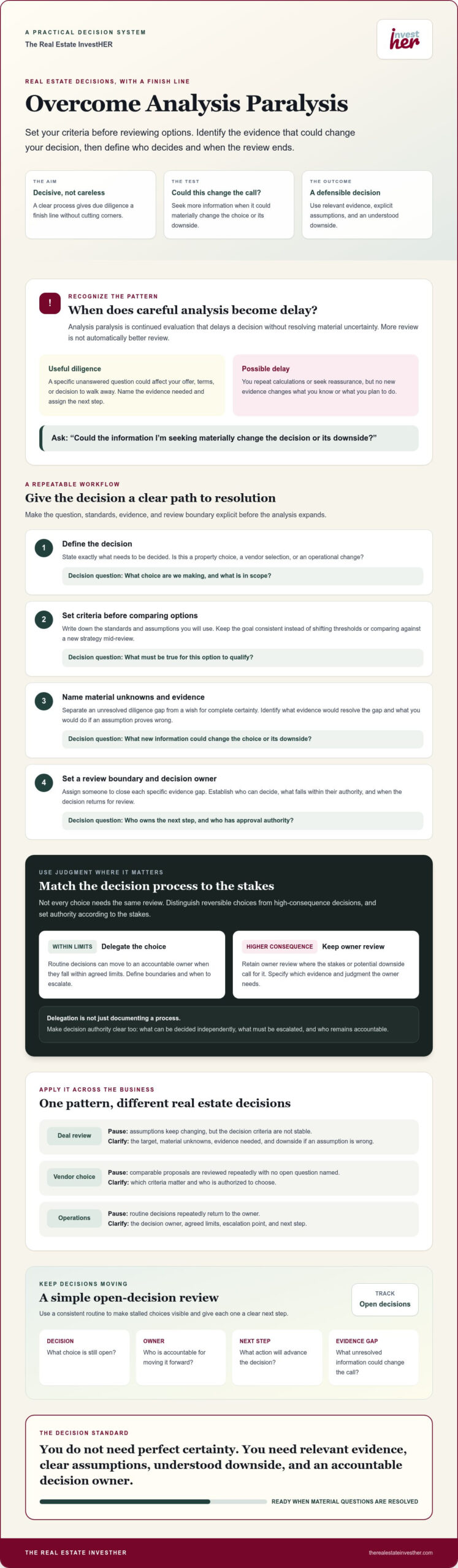
Overcoming Analysis Paralysis in Real Estate
Choose one stalled decision and apply the criteria, evidence, and stop rule you’ve defined. Don’t start by redesigning every process in your business. A live decision, such as selecting a vendor or deciding whether to advance an acquisition, gives you a practical way to see what’s unclear and move it forward.
What is a practical first step to get unstuck this week?
Write a brief decision record. Keep it visible to the people involved, and include:
- Decision: What needs to be decided?
- Owner: Who is accountable for making or approving the decision?
- Criteria: What requirements or boundaries will guide the choice?
- Missing evidence: What specific information is still needed, and who will obtain it?
- Next review point: When will the decision be revisited, based on the evidence or a relevant deadline?
At that review, choose proceed, pause, or decline. If you pause, name the information or action required and assign an owner. If you proceed or decline, record the reason and any key assumption behind the decision. This keeps a pause from becoming an indefinite holding pattern and gives you a basis for revisiting the choice if material evidence changes.
For a recurring review routine, scan open decisions at an established team check-in. Confirm the owner, next review point, and unresolved evidence for each item. Close decisions that are settled and look for patterns. If leasing, maintenance, or other familiar work repeatedly waits for your approval, examine the decision rights and operating structure behind the delay.
When can peer support or mentorship add useful perspective?
Peer input can help you test an assumption, notice a blind spot, or compare how a similar business question is framed. It should sharpen your judgment, not replace it. For broader business-building context, see this strategic guide to scaling real estate investments. If structured guidance is relevant to your goals, the Real Estate Mentorship for Women guide offers related context.
Learning how to overcome analysis paralysis in real estate doesn’t mean acting without care. It means pairing sound diligence with clear ownership and accountable next steps. For peer perspective and educational resources, you can explore the InvestHER Community. The decision remains yours, but you don’t have to test every assumption alone.
Make Your Next Decision Clear and Accountable
To understand how to overcome analysis paralysis in real estate, start with one delayed decision, not a complete business overhaul. Set criteria before comparing options, identify evidence that could change your choice, and use a stop rule to give the review a clear boundary. The aim isn’t certainty. It’s a defensible decision with an owner and a documented rationale.
Then look beyond the deal itself. Clear decision rights can keep familiar operating choices from returning to you by default, while AI can help organize information without taking responsibility for judgment. When a decision still feels difficult, peer perspective can help you test assumptions while keeping the decision yours.
The InvestHER Community Membership offers peer support and educational resources. For more structured guidance, the STRIVE Mentorship Program provides coaching and access to experienced investors. Explore the InvestHER Community to learn more. Choose one open decision, clarify what’s missing, and give it a responsible path forward.
Frequently Asked Questions
What is analysis paralysis in real estate investing?
Analysis paralysis in real estate investing is continued review that delays a decision without resolving material uncertainty. It differs from diligent underwriting, which investigates decision-relevant risks, tests assumptions, and may change the decision. For example, repeatedly revising a property evaluation when the relevant assumptions and evidence haven’t changed may add little value. The aim isn’t certainty or a risk-free deal. It’s a defensible decision based on the available evidence and understood risks.
How do I stop overanalyzing a real estate deal?
Write down the decision, your strategy criteria, unresolved evidence, and a review boundary before continuing your analysis. Ask whether new information could change the outcome or materially affect the risk. Choose a decision date that fits the diligence required and any relevant transaction deadlines, rather than using a universal timeline. Then record whether you’ll proceed, pause for specific information, or decline. This process supports sound judgment, not rushed decisions.
How can I tell the difference between due diligence and analysis paralysis?
Useful due diligence tests material assumptions, verifies relevant information, and could change your decision. Analysis paralysis often revisits settled questions without new evidence or a defined reason. Name the unanswered question, then specify what evidence would resolve it. For example, confirming a repair concern may affect your assessment, while rerunning the same evaluation without changed inputs may not. If you can’t identify decision-changing evidence, consider applying your existing criteria and recording an outcome.
Can a real estate investor make a good decision without having all the information?
Yes, investors often make decisions with some uncertainty, but material unknowns should be identified rather than ignored. Separate confirmed facts from estimates and judgments, then assess whether unresolved information could change the decision or meaningfully alter its risk. If critical evidence is missing, pause and identify how it will be obtained. Incomplete information isn’t automatically acceptable, and this approach can’t determine whether a specific property or investment is suitable for you.
Why do experienced real estate investors still experience analysis paralysis?
Experience doesn’t remove uncertainty, competing priorities, changing assumptions, or unclear decision ownership. An investor may lack consistent criteria for comparing opportunities or repeatedly reopen questions that were already settled. These are possible process or operational causes, not a diagnosis or proof that you lack knowledge. Review how the decision is being made: Are the criteria stable? Is a material question unanswered? Does every approval return to you? The answers can point to a more useful next step.
How can I delegate real estate decisions without losing control?
Delegate by clarifying the decision’s scope, who has authority, what boundaries apply, and which conditions require escalation. Start with recurring choices that fit clear guardrails, such as comparing routine vendor options using agreed criteria. Documenting a process alone doesn’t transfer judgment or approval rights, so confirm what the team member can decide. Review whether the change reduces unnecessary approvals while keeping accountability clear. Consequential decisions should remain with the designated human decision-maker.
Can AI help with real estate investment analysis paralysis?
AI may help organize information, summarize material you provide, or surface questions for human review, but its output needs verification. Define what the tool can prepare and which decisions remain with an accountable person. Check summaries against original records before relying on them. Generated analysis isn’t verified due diligence, autonomous underwriting, or a substitute for professional advice where appropriate. Use AI to support a clear decision process, not to add another layer of tools or defer judgment.

Article by
Andresa Guidelli
Real estate investor, operator, and founder of The Real Estate InvestHER, a national platform supporting women real estate investors. With 15+ years of experience in real estate investing and business operations, she focuses on helping investors build stronger businesses behind their portfolios through better systems, clearer decision-making, leadership, and responsible use of AI.
Be the first to comment