


Common First-Time Real Estate Investor Mistakes, and How to Avoid Them
A property can look like a strong investment and still expose a weak decision process. The common first-time real estate investor mistakes aren’t limited to choosing the wrong property. They include relying on optimistic numbers, overlooking due diligence, underestimating reserves, and keeping every operating decision with the owner.
It makes sense to focus on the purchase: the deal sets the direction. But a sound investment also depends on how consistently you evaluate opportunities and how prepared you are to manage what comes next. A repeatable framework helps you compare deals on the same terms. Thorough diligence and realistic reserves help reveal risks before they become expensive surprises.
This article covers mistakes that can arise during deal review, decision-making, and ownership. You’ll learn how to set clear criteria, pressure-test assumptions with appropriate expert input, and build practical processes so routine work doesn’t require your approval at every step. The goal isn’t to eliminate uncertainty. It’s to make informed decisions and build a business that can support your portfolio as it grows.
Key Takeaways
- Common first-time real estate investor mistakes include rushed diligence, optimistic deal assumptions, and unclear operating ownership. Treat them as risks to assess, not reasons to avoid investing.
- Check income, expenses, vacancy, and repair assumptions before relying on a deal’s projected returns.
- Compare opportunities against your goals and capacity, including risk, workload, liquidity needs, and operational complexity.
- Start with a few recurring workflows, then decide which steps can be delegated and which decisions still need your judgment.
- Choose one risk to review, verify its assumptions, assign an owner, and set a time to revisit it.
What are the most common first-time real estate investor mistakes?
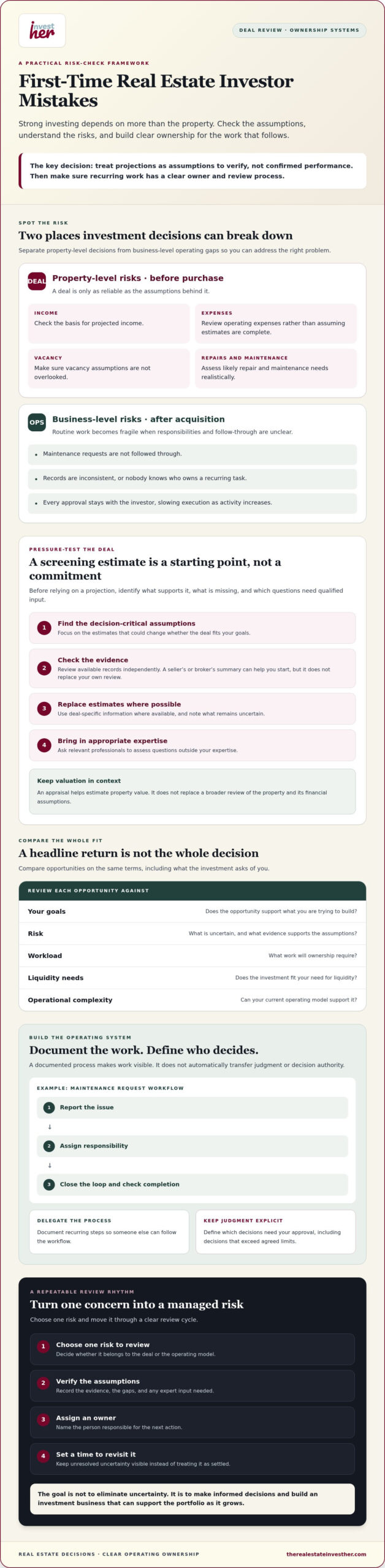
The common first-time real estate investor mistakes include using untested deal assumptions, skipping independent due diligence, overvaluing a headline return, underestimating the work of ownership, and leaving recurring tasks without a clear owner. These are risks to examine, not inevitable outcomes or reasons to avoid investing. A consistent review process can help you spot them before they shape a purchase or become part of how you operate.
It helps to separate mistakes into two categories. Property-level mistakes weaken the purchase decision, such as relying on projected income without checking its basis. Business-level mistakes make ownership harder to manage, such as unclear responsibility for maintenance follow-up or keeping every approval with the investor. Both matter, especially if you’re building an investment business that can grow without requiring your attention at every step.
Which mistakes can weaken a real estate deal before purchase?
A deal is only as reliable as the assumptions behind it. Check the basis for projected income, expenses, vacancy, and likely maintenance needs rather than treating estimates as confirmed facts. Review available records independently, and ask relevant professionals to assess questions outside your expertise. A seller’s or broker’s summary can be a useful starting point, but it shouldn’t replace your own review.
Headline returns don’t tell you whether a property fits your goals, risk tolerance, or capacity to manage it. An attractive projection may depend on income or expense assumptions that haven’t been verified. Property valuation is another part of the picture: understanding the real estate appraisal process can help clarify how an appraised value is estimated, but an appraisal doesn’t replace a broader review of the property and its financial assumptions.
Which mistakes appear after an investment is acquired?
After acquisition, gaps often show up in routine work: maintenance requests aren’t followed through, records are inconsistent, or nobody knows who should handle a recurring task. An operating mistake is a repeatable gap in ownership, process, or review. Naming the person responsible, the next action, and how completion will be checked can prevent small oversights from becoming recurring problems.
Keeping every approval with you may feel like control, but it can slow execution as activity increases. Start by documenting recurring steps, such as how a maintenance issue is reported, assigned, and closed. Then define decision rights separately: someone else may follow the process, while you retain approval over decisions that exceed agreed limits. Documentation makes work visible, but it doesn’t automatically transfer judgment or authority.
For early investors, a practical first step is to identify whether a concern belongs to the deal or the operating model. That distinction helps you direct the next conversation, whether you need to check an assumption with an appropriate expert or clarify who owns a recurring responsibility.
How do weak assumptions and rushed due diligence create avoidable risk?
A deal decision is only as useful as the assumptions you’ve checked. If projected income is optimistic, operating expenses are incomplete, vacancy is ignored, or repairs are underestimated, the numbers can make a property appear to fit your goals without evidence to confirm that it does.
A screening estimate is a first-pass tool, not a final basis for commitment. Use it to decide whether an opportunity deserves further attention. Before proceeding, replace decision-critical estimates with deal-specific information where available, and identify what remains uncertain. This helps prevent common first-time real estate investor mistakes caused by treating a preliminary projection as verified performance.
How can investors pressure-test a deal before committing?
Start with the assumptions that could change your decision. For each one, write down the evidence you have, what’s still missing, and who can help verify it. Compare expected income and operating expenses with relevant property records and other reliable documentation. If a question involves financing, a qualified lending professional can help clarify your options. The Consumer Financial Protection Bureau also offers guidance to prepare for your mortgage, including reviewing finances and gathering paperwork.
For specialist questions, such as a property condition concern or a financing detail you don’t understand, seek input from a qualified professional. Peer perspective can help surface assumptions you may have overlooked, but it shouldn’t replace expert advice when that’s needed.
Illustrative scenario, not market data: An investor screens a rental using the seller’s income summary and a rough repair estimate. The deal appears to meet her return target. Before committing, she checks available income and expense records and arranges a closer review of the property’s condition. If documented expenses or likely repairs differ from the estimates, she can update the analysis and decide whether the deal still fits her goals.
What should due diligence verify beyond the purchase price?
Due diligence means checking the facts and assumptions behind a commitment. Review relevant property, operating, and financial records, and list missing information rather than quietly filling gaps with optimistic estimates. Clarify likely repair needs, ongoing responsibilities, and questions that require further investigation. The records and expert reviews needed will depend on the property and the decision being made.
Keep a simple assumption log with the item, current estimate, supporting evidence, open question, and next step. If a key fact can’t be confirmed in time, decide how that uncertainty affects your willingness to proceed. For more perspectives on building a thoughtful investing practice, explore resources for women real estate investors.
How can first-time investors compare opportunities without chasing headline returns?
Compare opportunities against your goals and capacity, not just their projected returns. A useful decision matrix considers risk, management workload, liquidity needs, key assumptions, and operational complexity. There’s no universal best strategy: a property that fits an investor with time and hands-on experience may not suit someone prioritizing a lighter workload or greater access to cash.
To keep the comparison grounded, label each entry as a verified fact, an investor assumption, or a recommendation. For example, a documented expense is a fact, an estimate of future maintenance is an assumption, and a decision to seek a professional review is a recommendation. This distinction helps prevent a confident forecast from being mistaken for confirmed information, a pattern behind common first-time real estate investor mistakes.
What criteria belong in a first-deal comparison?
Use the same criteria for each opportunity so the comparison stays consistent. Consider both financial assumptions and the work required to own the investment:
- Risk: What could materially affect performance, and how much uncertainty can you accept?
- Management workload: What recurring attention will the property require, and who can handle it?
- Liquidity needs: How much of your available capital would be committed, and what funds need to remain accessible?
- Assumptions: Which inputs are supported by documentation, and which still need verification?
- Operational complexity: How many people, processes, or specialized skills will it take to manage the investment?
Then assess fit. Do you have the time, relevant skills, support, and capital for the responsibilities involved? Record unresolved questions beside each opportunity, along with the evidence needed to answer them. If one option depends on a responsibility you can’t realistically cover, that’s useful information, even if its projected return looks compelling.
How can investors avoid analysis paralysis without rushing?
Set decision criteria before reviewing individual deals. Decide what must be true for an opportunity to merit further diligence, which risks would make it a poor fit, and who can help assess specialist questions. A short list of unanswered questions turns analysis into practical next steps instead of an open-ended search for certainty.
Review the comparison at a set point or when material information changes. If new evidence affects an assumption, update the matrix and reconsider the fit. For broader starting-point guidance, consult How to Start Investing in Real Estate: The 2026 Strategic Guide for Women. Pairing a clear decision process with perspective from experienced peers or qualified professionals can help you move forward deliberately, without treating speed or projected returns as the measure of a sound choice.
What practical systems help prevent mistakes after the first investment?
A small set of clear, recurring workflows can reduce missed follow-up and confusion about who owns the next step. Start with work that affects property performance, investor decisions, or timely responses. A system doesn’t need to be elaborate. It needs to make responsibilities visible and help the right person act without routing every routine task through you.
Which workflows should an investor document first?
Choose tasks that recur and matter. For example, documenting how a maintenance request moves from report to completion can clarify who receives it, who coordinates the work, and how closure is recorded. A useful workflow states:
- Trigger: What starts the process?
- Responsible role: Who takes the next action?
- Expected steps: What needs to happen, and where is it recorded?
- Escalation point: Which exceptions require another person’s judgment or approval?
Keep the instructions practical enough that someone can follow them during real work. After the workflow is used, review where it stalled or created uncertainty and update the process to address that specific gap. Don’t document every task at once. Begin with a recurring point of friction.
A simple review rhythm can surface exceptions without constant owner oversight. For instance, set a regular time to check open maintenance items, unresolved decisions, and tasks that missed expected follow-up. Focus the review on what needs attention rather than repeating every step of the workflow. That gives the owner visibility while allowing routine work to keep moving.
How should delegation and AI use be controlled?
Delegate repeatable tasks with a clear process, but define decision authority separately. A team member may gather quotes or coordinate a repair while approval for a decision outside agreed limits stays with you. Documenting how to complete a task doesn’t automatically transfer the judgment needed for a higher-impact decision.
AI can support bounded work, such as organizing information or preparing a draft for review. Keep a human accountable for checking the output, define what information may be used, and specify which decisions must remain with an authorized person. Tools can support a process, but they can’t resolve unclear roles or replace thoughtful oversight.
For related systems and growth guidance, see How to Scale Real Estate Investments: The Strategic Guide for Women Investors. To explore resources for strengthening the business behind your portfolio, visit The Real Estate InvestHER resources for investors.
Next steps to build a resilient investment business
Build resilience by turning one identified risk into a clear action, owner, and review point. Keep immediate deal questions separate from longer-term operating improvements. A missing document or unresolved property concern may affect a current purchase decision; a recurring delay in maintenance follow-up may call for a process change. Both deserve attention, but they require different next steps.
Use this short sequence to move from concern to action:
- Identify one risk: Choose the uncertainty or recurring gap that matters most right now.
- Check its assumptions: List what you know, what you’re assuming, and what evidence is still needed.
- Assign an owner: Name the person responsible for the next action, while keeping decision authority clear.
- Review: Set a time to assess what changed and whether the risk or process needs another response.
Before committing to a deal, review the investment thesis, unresolved risks, responsibilities, and evidence needed to support your decision. After acquisition, capture what didn’t go as expected and update the relevant workflow. A brief written lesson is more useful than relying on memory when a similar decision comes around again.
How can you turn a mistake checklist into a repeatable review?
Use the same questions at consistent decision points, such as before a commitment and during a regular operating review. Ask whether the thesis still reflects your goals, whether important assumptions have support, and whether each recurring responsibility has an owner. For mentorship context, see Real Estate Mentorship for Women: The 2026 Guide to Scaling Your Portfolio.
When can community or mentorship support help?
Peer discussion can be useful when you want to test your reasoning, surface a blind spot, or hear how another investor approaches a similar decision. It can help clarify which questions to investigate, but it doesn’t replace professional advice on specialized financial, legal, or property matters. Bring a concise summary of your assumptions and open questions so the conversation stays focused.
The InvestHER Community offers peer connection and educational resources for women real estate investors. The STRIVE Mentorship Program offers coaching and access to experienced investors. These are optional forms of support, not promises of a particular investment result. If you’d benefit from peer perspective or mentorship as you build your investment business, consider whether one of these options fits your needs. A repeatable review process, supported by the right expertise, can help you address common first-time real estate investor mistakes without treating every decision as a solo exercise.
Build a Stronger Business Behind Your Portfolio
The common first-time real estate investor mistakes are easier to address when you treat investing as both a deal-making and operating discipline. Verify assumptions before committing, compare opportunities against your goals and capacity, and set clear ownership for recurring work after acquisition.
Start with one risk. Check what supports the assumption, assign the next action to a responsible person, and schedule a review. Keep time-sensitive deal questions separate from longer-term process improvements so each gets the right attention. For specialized questions, consult a qualified professional. Experienced peers can offer another perspective and help you examine what you may be overlooking.
The InvestHER Community offers membership, peer connection, and educational resources. The STRIVE Mentorship Program provides coaching and access to experienced investors. These options can support you as you refine your decisions and operating practices, without replacing your own judgment or professional advice.
Explore the InvestHER Community and resources to find support that fits your next step. With clear criteria, practical systems, and the right people around you, you can build an investment business that grows with intention.
Frequently Asked Questions
How can I avoid overpaying for my first investment property?
Set a purchase limit based on your investment criteria, then independently assess the property’s value and financial assumptions before making a commitment. Review relevant records, consider the property’s condition, and compare your analysis with input from qualified professionals when appropriate. Don’t treat a seller’s asking price or a projected return as proof of value. If key information is missing, account for the uncertainty before deciding whether to proceed.
Should I buy a property if the numbers look good?
Not on the numbers alone. First check whether the assumptions behind the projected income, expenses, vacancy, and repairs are supported by reliable, property-specific information. Then consider whether the opportunity fits your goals, risk tolerance, available capital, and capacity to manage the work. A strong projection can still depend on uncertain inputs or responsibilities you can’t support. Define what must be verified and what would make you walk away before deciding.
What should I review before investing in a rental property?
Review available property, operating, and financial records, and list any information that’s missing or unclear. Check how projected income and expenses were calculated, investigate likely repair needs, and clarify the ongoing responsibilities involved in ownership. Consider whether you need qualified professional input on property condition, financing, or other specialist questions. Due diligence is specific to the deal, so don’t assume one checklist can answer every question. Resolve material uncertainties before committing.
Can I delegate real estate investment tasks without losing control?
Yes. Delegate repeatable tasks by documenting the trigger, steps, responsible role, and escalation point. Then define decision rights separately: a team member may coordinate a repair, for example, while you retain approval for decisions outside agreed limits. Review exceptions and completed work at a regular cadence. Clear ownership gives others room to act while keeping accountability visible, without requiring you to personally approve every routine step.
How can AI help a real estate investor avoid mistakes?
AI can assist with bounded tasks such as organizing information, summarizing documents, or preparing drafts for human review. It can make information easier to examine, but it can also miss context or produce errors. Set clear limits on what data may be used, verify outputs against reliable records, and keep investment decisions with an accountable person. Treat AI as support within a human-led process, not as a substitute for due diligence or professional advice.

Article by
Andresa Guidelli
Real estate investor, operator, and founder of The Real Estate InvestHER, a national platform supporting women real estate investors. With 15+ years of experience in real estate investing and business operations, she focuses on helping investors build stronger businesses behind their portfolios through better systems, clearer decision-making, leadership, and responsible use of AI.
Be the first to comment