


How to Stay Motivated When Investing Gets Tough: A Practical Guide
You don’t need constant confidence to keep building a sound real estate business. The practical answer to how to stay motivated when investing gets tough is to use a repeatable reset process and operating rhythm, rather than waiting for motivation to return. A deal that doesn’t pencil out, slower-than-expected progress, or pressure on cash flow can make it tempting to question your whole plan. Those moments deserve attention, but they don’t automatically mean your long-term goal is no longer viable.
It can also be hard to make consistent progress when work, family, and business demands compete for your time. The answer isn’t to push harder at any cost. It’s to set a pace you can sustain and focus on the next useful decision.
This guide offers a practical way to pause, assess what has actually changed, and choose one realistic next step. You’ll learn how to distinguish a difficult stretch from a flawed strategy, build a manageable rhythm for reviewing and advancing your investments, and seek peer support or mentorship for perspective without handing over your judgment. Progress can be deliberate, even when it isn’t fast.
Key Takeaways
- Slow deals, uncertainty, and competing responsibilities can affect motivation. Identify the specific obstacle before choosing a response.
- Before treating a setback as a reason to abandon your plan, check whether the facts, assumptions, capacity, or priorities have changed.
- Learn how to stay motivated when investing gets tough with a five-step reset that turns a difficult moment into one considered next action.
- Build a weekly or monthly review rhythm that fits your capacity, using simple systems to keep decisions and follow-ups visible.
- Use trusted peers or mentors for perspective, while keeping due diligence and investment decisions in your hands.
Why Real Estate Investing Gets Tough, and What Motivation Can Actually Do
To sustain motivation through a difficult stretch, clarify what’s getting in the way, choose a manageable action, and review progress regularly. Motivation doesn’t have to mean feeling confident or enthusiastic every day. In real estate investing, it means acting intentionally while staying honest about your capacity, the facts, and the risks.
Slow deals, uncertain outcomes, unanswered due diligence questions, and competing work or family commitments can all interrupt momentum. Investment decisions can also carry emotional weight: an investing goal may represent financial independence or a future you’ve been working toward. That can make a delay feel like a verdict on the goal, rather than a problem to assess.
Why can investing setbacks feel personal?
Investment goals often become tied to identity and long-term plans. A deal that stalls may feel like evidence you’re falling behind; a change in family priorities may seem like a loss of commitment. But a delayed closing and an unresolved concern about an asset are different problems, and each calls for a different response. Psychology can influence how investors interpret decisions, as explored in Behavioural finance. Recognizing that influence doesn’t make financial or operational constraints disappear. It helps you separate the emotion from the evidence.
What can motivation tell you, and what can’t it tell you?
A temporary dip in energy may mean you need rest, a smaller task, or a more realistic schedule. It doesn’t establish that an investment plan is sound, or that it has stopped being sound. Look for evidence: have the deal assumptions changed, has your available capacity shifted, or have your priorities moved? If you’re setting or revisiting foundational goals, this strategic guide to starting in real estate offers relevant context.
Pushing forward automatically isn’t discipline if important questions remain unanswered. Motivation can help you take the next step, but it shouldn’t determine whether you proceed. Review due diligence and business realities before committing more time or capital. A pause, a slower pace, or a revised goal can be a considered decision, not a failure.
When progress feels stuck, try a brief check-in:
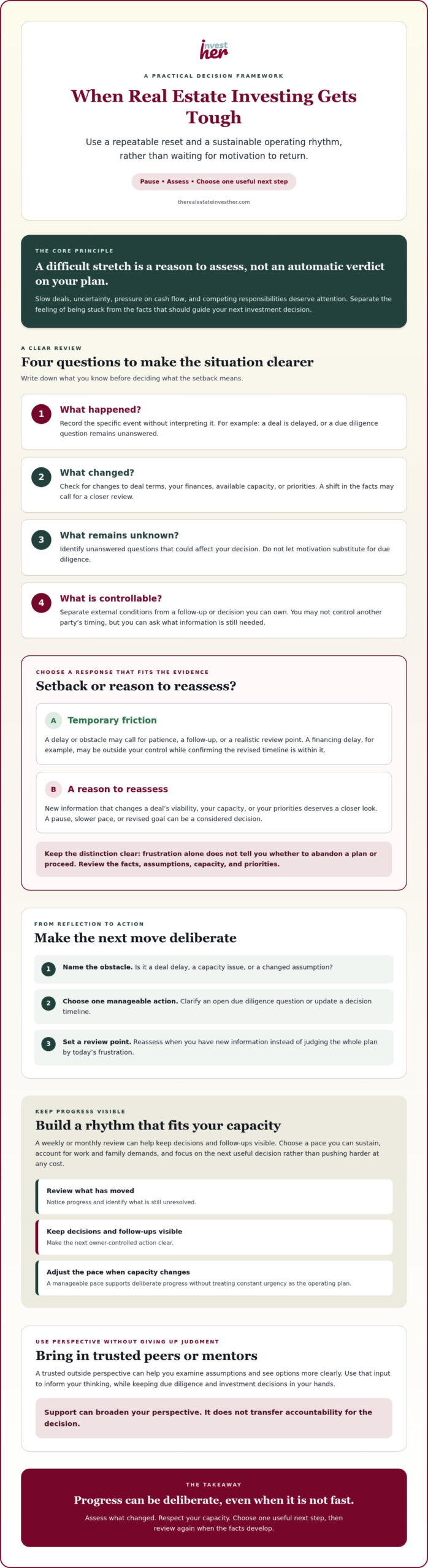
- Name the obstacle: Is it a deal delay, a capacity issue, or a changed assumption?
- Choose one manageable action: For example, clarify an open due diligence question or update a decision timeline.
- Set a review point: Reassess when you have new information, rather than judging the whole plan by today’s frustration.
This is a practical starting point for how to stay motivated when investing gets tough: make progress deliberate, not automatic. The next sections turn that approach into a reset process and a sustainable operating rhythm.
How to Tell a Temporary Setback from a Reason to Reassess
Before deciding what a setback means, examine the facts, the assumptions behind your plan, your current capacity, and your priorities. A delayed closing may be temporary friction; new information that changes a deal’s viability may call for a closer review. The distinction matters: reacting to frustration alone can lead you to abandon a sound plan or continue with one that no longer fits.
Use a simple four-part review to make the situation clearer:
- What happened? Record the specific event without interpreting it.
- What changed? Note changes to deal terms, your finances, capacity, or priorities.
- What remains unknown? Identify unanswered questions that could affect your decision.
- What’s controllable? List the next follow-up or decision you can own, separate from external conditions.
For example, a financing delay may be outside your control, while confirming the revised timeline or asking what information is still needed may be within it. That doesn’t mean you’re responsible for the delay. It means you can distinguish what deserves patience from what deserves action.
Which parts of the challenge are within your control?
Focus on choices, follow-ups, and information you can reasonably obtain. You may be able to request an update, revisit an assumption, or set a date to review the situation. You can’t control every market condition or another party’s timing. Ask: Which unanswered question would most improve my next decision? Start there, rather than treating every unknown as a problem you must solve today.
When does self-doubt deserve a closer look?
One disappointing outcome isn’t a verdict on your ability or your strategy. Repeated friction may still contain useful information. If the same plan regularly strains your time, conflicts with current priorities, or depends on assumptions you can no longer support, examine that pattern. A difficult experience and a poor fit aren’t the same thing. If self-doubt is clouding your judgment, this guide to imposter syndrome in real estate investing offers another perspective.
Use the review to choose a next step, not to force a predetermined answer. You might continue with a specific follow-up, pause while key information is missing, or revise the plan because the facts or your priorities have changed. For legal, tax, or individualized financial questions, seek advice from an appropriately qualified professional. A peer conversation can help you organize your thinking, but it doesn’t replace professional advice or your own due diligence. For connection and educational resources, explore The Real Estate InvestHER.
How to Stay Motivated When Investing Gets Tough: A Five-Step Reset
When a real estate decision feels stuck, use a short reset before you commit, walk away, or change direction. This five-step process helps replace vague overwhelm with facts, options, and one next action. It’s a practical way to approach how to stay motivated when investing gets tough without confusing activity with progress.
- Pause. Step back from the urge to solve everything at once. If you’re reacting to a new complication, give yourself room to assess it before making a commitment.
- Describe the facts. Write down what happened, what you know, and what remains unanswered. Keep interpretations separate from evidence. For example, “the contractor’s estimate hasn’t arrived” is a fact; “this deal is falling apart” is an interpretation.
- Review your options. Check the assumptions and due diligence that support your decision. You might proceed, pause while gathering information, or revise the plan. Consider what each option requires and what new information could change your view.
- Choose one action. Pick a step that creates clarity, not pressure. You could update your decision checklist, confirm which due diligence items remain open, or request missing information from the relevant professional.
- Schedule a check-in. Put a review point on your calendar. Use it to assess what the action revealed and decide whether to continue, pause, or adjust. A check-in keeps an unresolved issue visible without making it your only focus.
How do you turn overwhelm into a clear next action?
Start with three notes: what happened, what’s known, and what question remains open. Then choose the smallest useful action that could answer that question. If a key document is missing, for instance, request it rather than rushing to make a decision without reviewing it. Decide when you’ll revisit the issue after taking that step.
What progress can you measure before the outcome arrives?
Acquisitions and portfolio size aren’t the only meaningful measures of progress. Track actions that improve your decision-making and business: completing research, checking an assumption against current information, documenting a repeatable process, or having a useful conversation. Those steps build clarity even if they don’t lead to an immediate deal. If your growth goals need a deliberate review, see the strategic guide to scaling real estate investments.
Reassessing a plan is part of responsible investing, not proof of failure. The reset isn’t meant to guarantee a particular outcome. It gives you a steadier way to decide what the facts support next.
How to Build an Investing Rhythm That Supports Progress Without Burnout
A sustainable investing rhythm is a recurring review that fits your actual capacity and keeps important decisions visible. It doesn’t need to fill your calendar. A weekly check-in may suit an active project; a monthly review may be more realistic during a demanding season. The goal is consistent attention, not constant activity. That’s a practical foundation for how to stay motivated when investing gets tough.
Use the review to look at four areas: active decisions, upcoming commitments, outstanding questions, and one priority for the next period. Replace “make progress” with a defined action, such as reviewing an operating statement, confirming who owns a follow-up, or comparing an assumption with available information. If work, family, or business demands shift, adjust the cadence. A rhythm you can maintain is more useful than an ambitious routine you repeatedly miss.
What belongs in a realistic weekly or monthly review?
Keep the meeting with yourself short enough to repeat. For each active item, identify what needs attention, who owns the next action, and when you’ll revisit it. Then choose one priority for the coming week or month. You’re not trying to solve every open issue in one sitting; you’re making sure the right questions and commitments don’t disappear beneath daily demands.
A simple checklist can keep the review focused:
- Next action: What specific step moves this decision forward?
- Follow-up date: When will you check for an update or review progress?
- Open question: What information is still needed?
- Required support: Who or what can help, and what remains your responsibility?
How can simple systems reduce friction?
Start with a calendar or task list you already use. Record the owner, next action, and review date in one place. For repeatable work, document the steps so another person can follow the process. That can reduce dependence on your memory without automatically transferring judgment or decision authority. Decide in advance which choices still require your review.
Tools should solve a specific workflow problem, not create more upkeep. Consider automation or AI only when you can explain what task it supports, what information it may use, and where human review is required. Keep consequential investment decisions under accountable human judgment.
Choose a review cadence you can protect, then test it for a month and adjust if it adds strain instead of clarity. If connection and learning would support your routine, explore community and educational resources from The Real Estate InvestHER.
How Community and Perspective Can Help You Keep Moving
Peer conversations can help you see a decision from another angle, organize your questions, and feel less isolated. They shouldn’t replace due diligence, independent judgment, or advice from a qualified professional. When you’re working out how to stay motivated when investing gets tough, use support to strengthen your decision-making, not to outsource it. For leaders balancing multiple ventures or seeking deeper professional guidance, Rainmakers Coaching International offers executive and career development coaching to help maintain perspective and momentum.
Before choosing your next move, consider what the current facts and priorities support:
- Continue when the goal still fits, you understand the key risks, and you can name a responsible next action.
- Pause when your capacity is limited, essential information is missing, or you need input from a qualified professional before proceeding.
- Revise when new information or changed priorities materially affect the assumptions behind your original plan.
These choices aren’t judgments about your ambition. They’re operating decisions. A pause can protect the quality of your analysis; a revision can bring a goal back into alignment with your current life and business.
What kind of support fits your next decision?
Match the question to the right person. A peer may help you compare approaches or identify questions you haven’t considered. An experienced mentor may help you reflect on strategy and execution. Legal, tax, and individualized financial matters call for appropriately qualified advisers. Before a conversation, write down what you want perspective on and what you’ve already verified. That keeps the discussion useful and leaves responsibility for your decision where it belongs: with you.
Community and mentorship can provide connection and learning, but they don’t guarantee investment outcomes or replace professional advice. The Real Estate InvestHER offers an InvestHER Community Membership and the STRIVE Mentorship Program as optional resources for women building wealth through real estate. Consider whether peer connection or mentorship fits the question you’re working through.
You don’t need to force a decision simply to feel that you’re moving forward. Choose to continue, pause, or revise based on what you know and what matters now. If you’d like to explore a potential source of community, learn more about The Real Estate InvestHER.
Make Your Next Investing Decision With Clarity
Real estate investing doesn’t require constant confidence. A difficult stretch is a reason to assess the facts, not automatically a reason to abandon your goal or push ahead. Clarify what changed, choose one useful next action, and set a review point to decide what the new information means.
A sustainable rhythm matters, too. A regular review can keep decisions and commitments visible without demanding more time than your business and life can support. Measure progress through thoughtful actions, not acquisitions alone. When you need another perspective, use peer conversations or mentorship to explore your thinking while keeping due diligence and independent judgment at the center.
If you’re considering how to stay motivated when investing gets tough, start with one question: should you continue, pause, or revise based on what you know now? You don’t have to answer it alone. Founded in 2018 and led by Liz Faircloth and Andresa Guidelli, The Real Estate InvestHER offers community membership, the STRIVE Mentorship Program, and InvestHER CON as optional sources of connection and learning.
Explore The Real Estate InvestHER community to see whether it may be a fit for your next step. Keep your pace intentional, your decisions grounded, and your progress sustainable.
Frequently Asked Questions
How do I stay motivated when a real estate deal falls through?
Give yourself time to process the disappointment, then review what the deal taught you. Separate the reason it fell through from your judgment of your abilities. Note which assumptions held, what you’d verify earlier next time, and whether any follow-up is still useful. Then choose one small next step, such as updating your deal review checklist or returning to a priority that was delayed while you pursued the opportunity.
Is it normal to lose motivation when investing in real estate?
Yes. Slow progress, competing responsibilities, and uncertain decisions can all affect motivation, even for experienced investors. A dip in energy doesn’t by itself mean your strategy is wrong or that you’ve lost the ability to move forward. Check whether you need rest, a more manageable workload, or new information. If the underlying assumptions or your priorities have changed, review the plan rather than relying on motivation alone.
What should I do when I feel stuck as a real estate investor?
Write down what happened, what you know, and what remains unresolved. Then identify the question that would most improve your next decision and choose one action to address it, such as requesting a missing document or reviewing a deal assumption. Schedule a time to consider what you learn. This is a practical way to approach how to stay motivated when investing gets tough without making a rushed commitment.
How can I keep working toward real estate goals without burning out?
Set a recurring review that fits your actual schedule, then use it to choose one priority and track specific next actions. Group research and follow-ups into defined tasks instead of setting a vague goal to “make progress.” Adjust the cadence when work, family, or business demands change. A realistic routine can keep decisions visible without requiring you to be constantly available or add unnecessary systems.
Should I keep investing if I am feeling discouraged?
Discouragement alone isn’t enough information to decide whether to continue. Review the deal or strategy’s assumptions, current risks, your capacity, and your priorities. Continue if the goal still fits, key risks are understood, and the next action is clear. Pause if essential information or qualified professional input is missing. If the facts no longer support the original plan, consider revising it rather than pushing ahead automatically.
Can a real estate investing community help me stay motivated?
A community can offer connection, perspective, and opportunities to learn from peers, but it can’t replace due diligence or individualized professional advice. The Real Estate InvestHER offers community membership, the STRIVE Mentorship Program, and an annual InvestHER CON. Women investing across various locations may explore these as optional sources of connection and learning.
How do I know whether to keep going or change my investment plan?
Compare the plan’s original assumptions with current facts, capacity, and priorities. Continue if the goal remains aligned and the risks and next steps are clear. Pause while you gather essential information or appropriate professional guidance. Revisit the strategy if new facts or changed priorities materially alter the assumptions behind it. One disappointing outcome isn’t a personal verdict, but repeated evidence that the plan no longer fits deserves a thoughtful review.

Article by
Andresa Guidelli
Real estate investor, operator, and founder of The Real Estate InvestHER, a national platform supporting women real estate investors. With 15+ years of experience in real estate investing and business operations, she focuses on helping investors build stronger businesses behind their portfolios through better systems, clearer decision-making, leadership, and responsible use of AI.
Be the first to comment