


How to Invest in Real Estate With a Full-Time Job in 2026
How to invest in real estate with a full-time job starts with choosing an operating model that fits the time and attention you can reliably give it. Match the strategy to your capacity, then build clear processes around the work. Property decisions and tenant needs can compete with your job and personal responsibilities, so plan for how those demands will be handled before you commit.
You don’t have to choose between growing a portfolio and answering every operational question yourself. Decide which choices require your judgment, which tasks can follow a documented process, and who or what can handle routine work with appropriate oversight. Software and AI help only when they reduce owner dependency, with people accountable for consequential decisions.
This article will help you assess your capacity, compare investment approaches through an operational lens, and set practical decision boundaries. You’ll also learn how to build repeatable workflows and delegate without handing off judgment blindly. The aim is to grow intentionally, in a way that supports your business and your life outside it.
Key Takeaways
- To understand how to invest in real estate with a full-time job, assess your decision-making capacity and support, not just the hours you can spare.
- Compare active, partnered, and more passive approaches by the recurring tasks and decisions each requires.
- Build workflows around specific handoffs, so routine work moves forward without adding tools that create more oversight.
- Use a consistent sequence to screen, evaluate, and execute opportunities, with focused review time instead of constant reactions.
- Review where work waits for your approval, then address one bottleneck before taking on more.
Can you invest in real estate while working a full-time job?
Capacity-led real estate investing means choosing an investment and operating model that fits the time, attention, risk tolerance, and support you can realistically sustain. Yes, you can invest while working full time when the involvement and operating demands fit your capacity. The practical question isn’t only how many hours you have. It’s also which decisions need your judgment and what happens when work, property needs, and personal commitments overlap.
Keeping your job and investing can be compatible. Employment may provide stable income while you build a deliberate investment plan, but it doesn’t remove the need to assess each opportunity or plan for its operating demands. To understand how to invest in real estate with a full-time job, distinguish three kinds of work: acquiring an investment, overseeing the asset, and handling recurring operations. A useful overview of the activity’s scope is Real estate investing involves purchasing, owning, managing, renting, or selling real estate to generate profit or long-term wealth.
What does investing alongside a full-time job actually require?
Acquisition work includes reviewing opportunities, evaluating assumptions, coordinating diligence, and making a go-or-no-go decision. After closing, the work shifts to monitoring performance, reviewing expenses, and addressing decisions that affect the asset. Recurring operations may include tracking inquiries, coordinating maintenance, and following up on outstanding tasks. A demanding job doesn’t automatically make an investment unsuitable. The fit depends on how often responsibilities arise and how they’ll be handled.
Ownership doesn’t mean personally completing every task. It does mean knowing which decisions remain yours. A documented maintenance-request process can help someone else gather details, assign a task, and update its status. Deciding whether a major expense fits your plan may still require your review. Documenting steps makes work repeatable, but it doesn’t automatically transfer decision authority.
How do you assess your available capacity before investing?
Map a typical week before judging a particular opportunity. Include work demands, personal commitments, and the hours you can protect consistently, not just time available during an unusually quiet week. Then separate tasks that require your judgment, such as setting investment criteria, from administrative work that could follow a clear process. Include operational support in the picture: who handles routine coordination, and where would you need to step in?
- Recurring work: Note existing responsibilities that take time every week or month.
- Protected hours: Identify realistic blocks for reviewing opportunities and making decisions.
- Decision boundaries: Name the choices you retain and the tasks that can follow documented instructions.
- Support gaps: Identify what would happen if you were unavailable during a workday.
Use this map to set a boundary before an opportunity starts to feel compelling. For example, decide in advance how often you can review investment matters, which tasks require your direct involvement, and what level of operational coordination you’re prepared to manage. Treat that boundary as a screening tool, not a test of ambition. If an investment depends on attention you can’t reliably provide, adjust the operating plan or consider a different level of involvement before committing.
Which real estate investing approach fits your available time?
The right approach depends on the work you’re willing to own, the decisions you want to retain, and the coordination you can support. Compare options by involvement, not by assumptions about returns or a universal number of hours. Active ownership, partnered execution, and more passive participation can each fit a full-time schedule, but the demands vary by asset, team, and investment structure.
Start by clarifying what you want to learn or control. Active ownership may offer closer involvement in execution, while partnership or passive participation can reduce routine tasks without removing the need for informed oversight. This real estate investment strategy guide can help you connect those preferences to your broader goals.
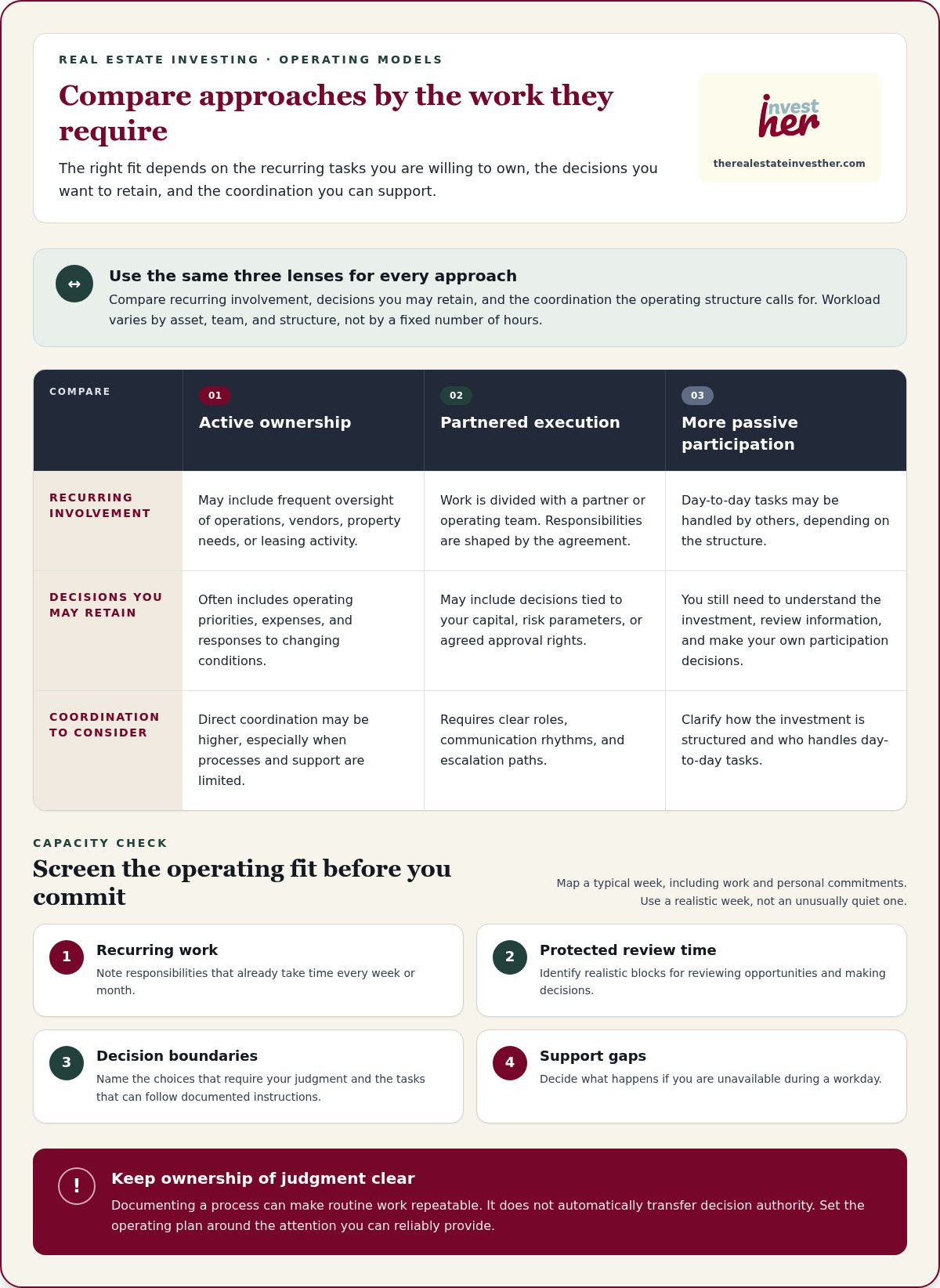
The comparison below focuses on recurring tasks, retained decisions, and coordination. Workload depends on context, not a fixed number of hours attached to any category.
| Approach | Recurring involvement | Decisions you may retain | Coordination to consider |
|---|---|---|---|
| Active ownership | May include frequent oversight of operations, vendors, property needs, or leasing activity. | Often includes operating priorities, expenses, and responses to changing conditions. | Direct coordination may be higher, especially when processes and support are limited. |
| Partnered execution | Work is divided with a partner or operating team, with responsibilities shaped by the agreement. | You may retain decisions tied to your capital, risk parameters, or agreed approval rights. | Requires clear roles, communication rhythms, and escalation paths. |
| More passive participation | Day-to-day tasks may be handled by others, depending on the structure. | You still need to understand the investment, review information, and make your own participation decisions. | Coordination may be less frequent, but reporting and oversight remain important. |
These are broad categories, not guarantees of workload or control. A partnership reduces owner dependency only when responsibilities and decision rights are explicit. Delegating a repeatable task is different from handing over judgment about a material choice. Deloitte’s commercial real estate outlook discusses alternative property types and market shifts, including commercial real estate shifts toward property types such as data centers and healthcare. The operating demands of any opportunity still depend on its specific structure.
How do active and less hands-on approaches differ?
Active approaches generally involve more direct coordination and a closer cadence of operational decisions. Less hands-on participation may reduce routine involvement, but it doesn’t eliminate the need to understand the investment, review updates, and respond to decisions reserved for you. Compare control, coordination, and decision frequency instead of assuming a label tells you exactly how much attention an investment requires.
How can you match a strategy to your work and responsibilities?
Consider whether your work offers predictable review windows or involves travel and shifting availability. Weigh those patterns alongside your relevant skills, capital plan, and appetite for operating responsibility. If you can reliably review information but can’t coordinate time-sensitive tasks, a model with defined operating support may fit better than one that routes every issue to you. Use this as a personal fit framework, not as investment advice or a ranking.
Peer perspective can help you test your assumptions without replacing your own due diligence. The InvestHER Community for women real estate investors offers a place to learn alongside peers as you refine your approach.
How do you build systems that keep real estate investing moving?
Build systems around recurring work and clear decision boundaries, not around adding more software. A useful workflow tells the people involved what starts a task, what information to capture, who acts next, and when an issue needs the owner’s judgment. For an investor with a full-time job, the goal is to keep routine work moving without making the owner the default answer to every question.
Decision rights define who can act, who must approve, and which situations require escalation. Documenting a process makes the steps repeatable, but it doesn’t automatically transfer judgment or authority. Keep important decisions with the person who has the context and accountability to make them.
Which recurring real estate workflows should you document first?
Start with work that happens often, creates repeated questions, or stalls when you’re unavailable. Pick one workflow rather than trying to document the whole business at once. For each process, name an owner, its trigger, the information needed to proceed, and the next action. Keep the instructions short enough to use while doing the work, then update them when the actual process changes.
Consider a new property inquiry. A workable process could track it from receipt through review and follow-up:
- Capture: Record the source, date, relevant property details, and any missing information.
- Screen: Compare the opportunity with established criteria and flag gaps, rather than treating an initial review as an investment decision.
- Route: Send opportunities that meet the screening criteria to the person responsible for deeper review. Escalate exceptions or unclear information.
- Close the loop: Record the decision, assign the next step, and set a follow-up date or status so the inquiry doesn’t disappear.
A shared tracker may be enough if it makes ownership and next steps visible. A separate app is useful only if it solves a defined problem the existing workflow cannot handle. If a tool creates more status updates or approval steps without removing a handoff or preventing work from being missed, it may add complexity instead of reducing owner dependency.
What should you delegate, and which decisions should you retain?
Delegate a defined task when the expected result, instructions, and limits are clear. For example, someone could gather property details and enter them into the inquiry tracker, while you retain the decision about whether an opportunity deserves deeper diligence. Specify escalation triggers, such as missing information, a request outside agreed criteria, or a proposed commitment that needs approval.
Set a consistent review rhythm for delegated work. A scheduled review of open items can replace a stream of individual interruptions, while urgent exceptions follow a separate path. If AI supports a workflow, use it for bounded assistance such as organizing information or drafting a follow-up. A human should review outputs and remain accountable for consequential decisions.
To put these principles into practice, choose one workflow that currently waits for you and document its owner, trigger, required information, next action, and escalation point. Peer learning through the InvestHER Community for women real estate investors can provide perspective as you strengthen the operating practices behind your portfolio.
How can you evaluate and execute real estate opportunities with limited time?
Use a consistent sequence to decide which opportunities deserve deeper attention, then protect focused time for due diligence and follow-through. A repeatable screen helps you use limited review time well, but it doesn’t replace deal-specific analysis or professional judgment. That distinction is central to how to invest in real estate with a full-time job: move routine evaluation forward in batches and reserve your attention for decisions that materially affect risk and fit.
Move each opportunity through four visible stages:
- Screen for fit: Compare the opportunity with your investment goals, capacity, and preferred level of involvement. Decide whether it merits more review, not whether to invest.
- Identify gaps: Record the information needed to assess the opportunity responsibly. Separate missing facts from assumptions that need testing.
- Complete diligence: Assign information requests and review tasks to the appropriate people. Keep material analysis and decisions with accountable decision-makers.
- Decide and hand off: Record the decision, rationale, open items, and next owner. If proceeding, make sure execution responsibilities and follow-up are clear.
What screening questions help you decide whether to spend more time on an opportunity?
Use the same initial questions across comparable opportunities: Does this fit the goals I’ve set? Can I support the involvement it requires? Do I understand the operating demands and who would handle them? What information is missing before I can responsibly proceed? Record one of three outcomes: stop, investigate further, or proceed to diligence. The screen narrows your focus; it doesn’t validate a deal.
A simple rule can flag when an opportunity falls outside your criteria, while deal-specific diligence tests its assumptions and risks. For example, a property may appear to match your intended strategy, but unanswered questions about its condition, operating plan, or financial assumptions could prevent a sound decision. Don’t let a quick fit score stand in for investigation, or let a compelling opportunity pressure you to fill gaps with guesses.
How can you organize due diligence around a full-time schedule?
Batch similar work into visible blocks: gather outstanding information in one pass, review comparable materials together, and schedule follow-ups instead of checking for updates throughout the day. Assign each request an owner and due date, and note which questions need your judgment. If the information isn’t ready or the review needs more time, adjust the decision timeline rather than compressing diligence to fit a work calendar.
Keep the workflow useful by recording the current status, unresolved questions, decision owner, and next action in one place. After a decision, hand off execution with the rationale and boundaries, not just a yes or no. As your approach evolves, the strategic guide to scaling real estate investments can help you assess whether your operating capacity can support future growth.
Choose one upcoming opportunity and schedule a focused review block before requests and deadlines begin to compete with your workday. For practical perspective on building a real estate investing business, explore resources for women real estate investors.
How do you grow your real estate investing business without becoming its bottleneck?
Grow by improving the operating model, not by treating every new acquisition as progress. A short operating review can show where decisions wait for you, where work has no clear owner, and whether actual demands still fit the capacity boundaries you set. Choose one bottleneck to address, then see whether the change helps work move forward without pulling you into every routine step.
How can you tell whether your operating model is sustainable?
Review the work itself, not just the portfolio’s activity. Look for repeated interruptions, delayed decisions, tasks that regularly return to you, and handoffs that lack an owner. Compare those patterns with the time and attention you intended to make available. If planned review windows are repeatedly displaced by routine requests, that’s evidence that responsibilities, escalation rules, or priorities may need adjustment.
Keep the review small and consistent. Look at recent work and ask:
- What waited for my response? Identify approvals or answers that could have followed a documented rule.
- Where did ownership become unclear? Find tasks that stalled between people or teams.
- What interrupted planned review time? Separate urgent issues from work that could have been batched.
- Which capacity boundary was exceeded? Decide whether the issue calls for a process change, clearer decision rights, or a change in priorities.
Then select one bottleneck with a clear next action. If routine expense questions repeatedly interrupt you, clarify what information should be gathered first and which cases require your approval. Don’t automate or delegate a process you haven’t made understandable. Documenting the steps can make routine work more repeatable, while decisions involving judgment remain with the accountable decision-maker. Revisit the workflow after the change to see whether work moves more smoothly.
Where can women investors find support as their operations evolve?
Peer learning can help you pressure-test assumptions, hear how other investors approach operating challenges, and notice options you may not have considered. Mentorship can offer strategic perspective as your business changes. Neither replaces your own due diligence or accountability for decisions. Use outside input to sharpen your questions, then decide what fits your goals, responsibilities, and operating capacity.
As your portfolio and responsibilities evolve, keep the review focused on the evidence: where work waits, what is creating the wait, and what change you’ll test next. You don’t need to solve every operational issue at once or acquire another property to make progress. A clearer handoff or decision boundary can be a meaningful next step toward a business that doesn’t rely on you to keep every task moving.
The InvestHER Community connects women real estate investors with peer support and educational resources. The STRIVE Mentorship Program provides strategic guidance and access to a network of experienced investors as your operations evolve.
Make your next move fit the business you want to build
The next step doesn’t have to be another acquisition. It can be a deliberate test of how your business operates: choose one recurring responsibility, make the handoff clear, and see whether work continues without you prompting each step. What you learn can guide what to strengthen before taking on more.
That’s a practical way to approach how to invest in real estate with a full-time job. Growth becomes more sustainable when investment decisions and operating responsibilities fit the life and business you’re building, rather than relying on constant owner attention.
You can use trusted perspective to examine a decision, challenge an assumption, or learn how other investors approach an operational question. The InvestHER Community offers peer support and educational resources, while the STRIVE Mentorship Program provides strategic guidance and access to experienced investors. Those perspectives can inform your thinking, while accountability for each investment decision remains yours.
Explore the InvestHER Community and educational resources as you shape the next stage of your investing business. Keep the next step focused, intentional, and aligned with the capacity you want to protect.
Frequently Asked Questions
How much time does real estate investing take each week?
There’s no dependable weekly estimate that applies across investment types and operating setups. To understand your likely workload, separate time spent evaluating opportunities, reviewing asset information, handling administration, and responding to unplanned issues. Those categories can look different during an active acquisition than in a routine operating period. Use your own calendar and task records to see what drives the workload instead of relying on a generic hours-per-week figure.
What is the best real estate investment strategy for someone with a full-time job?
No strategy is universally best for someone who works full time. Along with involvement and coordination, review how the investment handles reporting, approval rights, and decisions about a potential exit. Those terms shape how informed and involved you can remain. An arrangement with limited routine tasks may still require timely decisions or offer less control than you want. Compare the actual structure with your priorities before choosing.
Can I manage a rental property while working full time?
Yes, provided the property’s operating needs have workable coverage. Before self-managing, decide how you’ll receive and record requests, what information you need before acting, and who can coordinate next steps if you’re unavailable. Test the plan during a planned absence: can a request be received, assigned, and tracked without relying on informal messages to you? A handoff test can reveal gaps before they become recurring friction.
Should I quit my job to invest in real estate?
There isn’t enough information here to determine whether leaving your job makes sense for your financial situation. Before making that decision, prepare a written transition plan that accounts for household expenses, personal reserves, portfolio cash needs, and income uncertainty. Consider how you would respond if an expected source of income changed or a property needed additional attention. A financial or tax professional can help evaluate your circumstances; the decision remains yours.
How can I invest in real estate without managing every task myself?
Use a simple responsibility matrix for each recurring function: name who performs the work, who approves a consequential decision, who provides input, and who needs an update. For example, a team member may prepare an expense summary while the designated decision-maker approves an exception. This makes handoffs visible and reduces assumptions about authority. Keep a record of decisions and exceptions so you can refine the operating arrangement as the business changes.

Article by
Andresa Guidelli
Real estate investor, operator, and founder of The Real Estate InvestHER, a national platform supporting women real estate investors. With 15+ years of experience in real estate investing and business operations, she focuses on helping investors build stronger businesses behind their portfolios through better systems, clearer decision-making, leadership, and responsible use of AI.
Be the first to comment