


Negotiating Real Estate Deals as a Woman: A Practical Investor’s Guide
Strong real estate negotiations depend less on sounding forceful than on knowing your numbers, boundaries, and decision authority before the conversation starts. Negotiating real estate deals as a woman doesn’t require aggressive tactics or second-guessing your judgment. It requires a clear investment case, focused questions, and the discipline to distinguish a useful concession from one that weakens the deal.
When timelines tighten or several stakeholders need to weigh in, unclear priorities and decision rights can erode leverage. Gendered expectations may also affect how assertiveness or collaboration is interpreted, but they don’t have to dictate your approach. This guide offers a practical process for setting priorities, evaluating terms, responding to pressure with evidence, and reviewing the numbers before you agree. It also shows how to turn lessons from individual negotiations into repeatable team practices, so decisions rely less on your memory and availability and more on a clear operating rhythm.
Key Takeaways
- For negotiating real estate deals as a woman, focus on investment goals and deal evidence rather than gendered expectations or pressure to use aggressive tactics.
- Before making an offer, define your objective, verify assumptions, rank terms, set limits, and clarify who has authority to decide.
- Use collaboration to surface options, but assess every concession against its effect on deal economics and risk.
- Keep negotiations moving by assigning an accountable person, required information, and a next action to each decision.
- After reaching agreement, document responsibilities and open risks, then review the process to improve future decisions and handoffs.
What does negotiating a real estate deal involve for a woman investor?
Effective negotiation relies on preparation and sound choices, not gender-specific traits. Negotiating real estate deals as a woman means aligning transaction terms with your investment goals, risk tolerance, and capacity to execute. Price matters, but so do contingencies, timing, responsibilities, and the risks you accept in exchange for flexibility or certainty.
The aim isn’t to win every point. It’s to reach an agreement that still makes sense after you account for the work and obligations it creates. The foundational Principles of Negotiation apply across transactions, but investors need to evaluate each term in the context of the specific deal.
Negotiation looks different depending on what you’re trying to accomplish:
- Acquisitions: You’re assessing purchase terms, access for diligence, and conditions that affect whether the property fits your investment case.
- Dispositions: You’re balancing sale terms and timing with your desired outcome and responsibilities through closing.
- Financing: You’re discussing terms, requirements, and obligations that shape the capital structure and future cash demands.
- Partnerships: You’re clarifying contributions, responsibilities, decision rights, and how the parties will address risks or disagreements.
These discussions aren’t interchangeable. A concession that helps one transaction may introduce unacceptable risk in another.
Which terms matter beyond the purchase price?
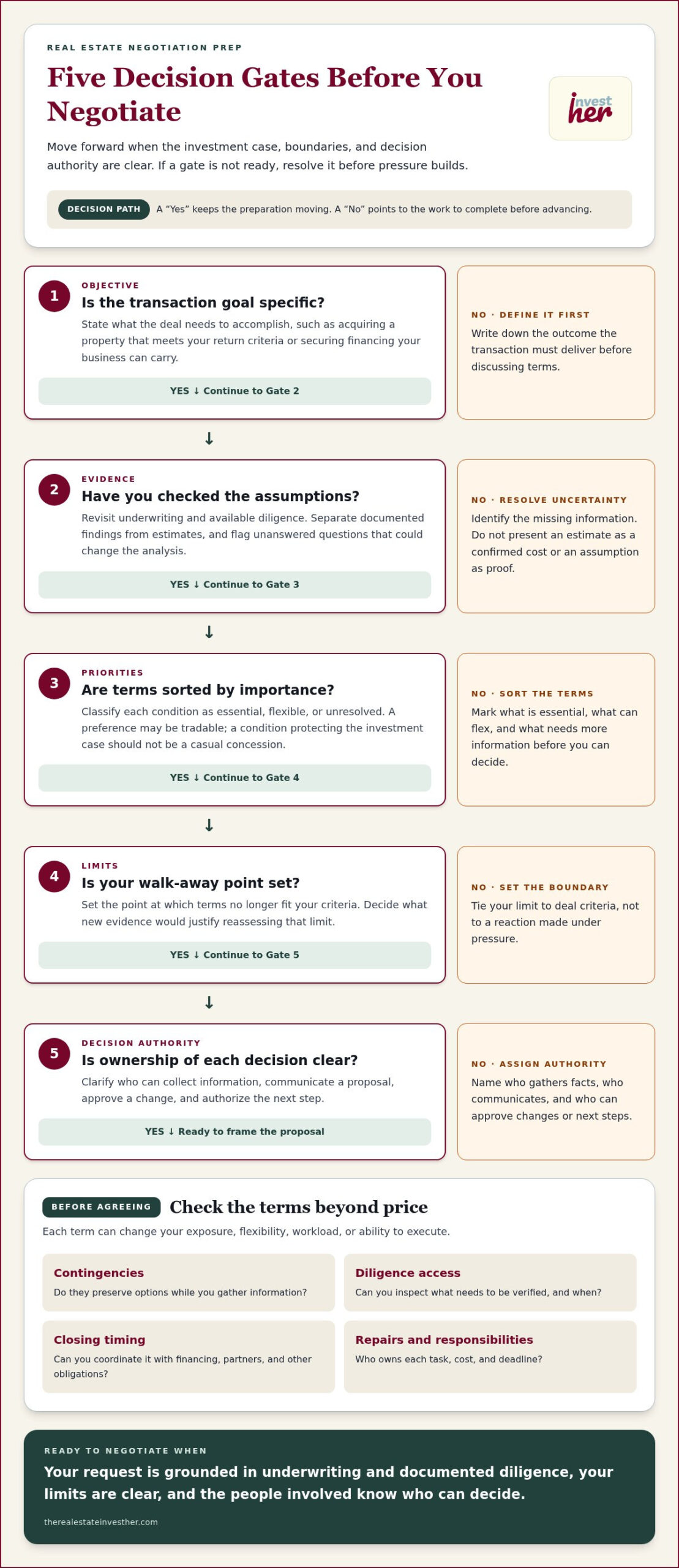
Terms beyond price can change your exposure, flexibility, and workload. Contingencies may preserve options while you gather information. Diligence access affects what you can inspect and when. Closing timing can shape coordination with financing, partners, or other obligations. Repair terms determine what work is agreed to before completion and what may remain your responsibility.
Pay particular attention to who is responsible for each task, cost, and deadline. If an agreement leaves one of these unclear, the ambiguity can become an operational problem after signing. For example, limited inspection access may leave an assumption in your analysis unverified. The headline price could still fit, but you’ll need to account for what you don’t know before committing. Evaluate each term in the context of the transaction.
Does negotiating as a woman require a different approach?
No single approach belongs to women as a group. Some investors may encounter expectations about how assertiveness or collaboration should look, but experiences differ. Rather than adapting to a stereotype, choose a communication style that helps you state your position, ask direct questions, and understand the other party’s constraints without giving up your diligence or boundaries.
Negotiation effectiveness shows up in preparation, clear requests, and sound decisions. A respectful tone can support information exchange, but rapport isn’t a substitute for evaluating the terms.
Test the full agreement against both your underwriting and your operating capacity. A favorable price may not compensate for obligations your team can’t meet, a timeline that strains execution, or unresolved responsibilities that depend on you personally. The useful question isn’t simply, “Did I secure better terms?” It’s, “Can this deal deliver the intended investment outcome, and can the business carry out what we’ve agreed to?”
How should you prepare before negotiating a real estate deal?
Prepare by turning your investment criteria into a clear negotiation plan. For negotiating real estate deals as a woman, that means defining the outcome you need, checking what the evidence supports, deciding which terms are flexible, setting a limit, and making decision authority explicit before pressure builds.
Use this five-step sequence before making or responding to a proposal:
- Define the objective. State what the transaction needs to accomplish, such as acquiring a property that meets your return criteria or securing financing terms your business can carry.
- Verify assumptions. Revisit the underwriting and available diligence. Separate documented findings from estimates, and identify unanswered questions that could change your analysis.
- Prioritize terms. Mark each condition as essential, flexible, or unresolved. A preference may be tradable; a condition that protects the investment case shouldn’t be treated as a casual concession.
- Set limits. Establish the point at which the terms no longer fit your criteria, including what new evidence would justify reassessing that limit.
- Assign authority. Clarify who can collect information, communicate a proposal, approve a change, and authorize the next step.
Ground requests in your underwriting and documented diligence, not in certainty you can’t support. If inspection findings point to a repair issue, use the available documentation to explain your request and its effect on the analysis. Don’t present an estimate as a confirmed cost or treat an assumption as proof. The Research on Gender and Real Estate Negotiation Outcomes offers context for considering negotiation outcomes without relying on assumptions about how women negotiate.
How do you set priorities and a walk-away point?
Separate non-negotiables, tradeable preferences, and risks that need more information. A walk-away threshold is a limit tied to your deal criteria, not a reaction made under pressure. Set it before discussions intensify, then revisit it only if new evidence changes the investment analysis. A seller’s deadline alone isn’t new evidence.
Who has authority to negotiate and approve terms?
Assign roles before conversations begin. Owning the process doesn’t automatically mean having authority to change the deal. Document who may:
- Gather diligence and report findings.
- Present proposals within agreed parameters.
- Approve concessions or terms outside those parameters.
- Record decisions and coordinate next steps.
Specify approval thresholds in a shared deal record so a team member can move the process forward without assuming they can make a judgment reserved for you or another decision-maker. Clear decision ownership supports scaling real estate investments without routing every conversation through the owner. Peer discussion through the InvestHER Community can also help you pressure-test assumptions and reflect on decisions with other women in real estate.
How can you balance assertiveness, collaboration, and deal economics?
Balance assertiveness and collaboration by staying open to solutions while testing every proposed change against the deal’s terms, risks, and investment criteria. Rapport can make it easier to exchange information, but it doesn’t replace diligence or clear boundaries. The aim isn’t to be agreeable or combative. It’s to understand the other party’s concern and decide whether addressing it makes sense for your investment.
Don’t treat communication styles as gender traits. Directness, warmth, patience, and firmness are individual choices, not qualities shared by all women. An interaction may include expectations about how assertiveness should sound, but those expectations don’t define your strategy. This is practical editorial advice, not a claim that one style produces better outcomes.
Keep the discussion tied to an observable issue and a specific request. For example: “The diligence materials identify a repair concern that affects our current analysis. Could we discuss an adjustment to the terms or another way to address that risk?” This wording states the basis for the request, invites a response, and avoids presenting an estimate or assumption as settled fact.
When does flexibility help a deal?
Flexibility is useful when an alternative addresses the other party’s need without weakening your core criteria. Depending on the transaction, possible trades might involve timing, documentation, or responsibility allocation. These are options to evaluate, not automatic concessions.
Before agreeing, name what you’re exchanging and what you receive in return. If you offer additional time, for instance, identify the corresponding term or certainty that makes the trade worthwhile. Record the exchange so a deliberate concession doesn’t become an open-ended obligation.
How do you respond to pressure or an unexpected counteroffer?
Pause before responding. Compare the counteroffer with your established criteria, and separate the substance of the proposal from its urgency or tone. Ask a focused question to understand the concern behind the change, such as, “What issue is this revised timing intended to address?” The answer may reveal an alternative that protects both parties’ priorities.
If the proposal changes the economics, risk, or workload, don’t commit until you have the information and approval needed to assess it. You can be firm without escalating the exchange:
- Request evidence: “Can you share the information supporting this change?”
- State the decision process: “I’ll review the revised terms against our analysis and confirm after the appropriate approval.”
- Offer a bounded alternative: “We can consider adjusting the timing, provided the remaining terms stay as proposed.”
These approaches make collaboration concrete. Evaluate each option by what it changes, what it costs the deal in risk or flexibility, and whether it still fits the investment case. If a proposed solution asks you to sacrifice a core condition without resolving the underlying concern, it may be a concession without a meaningful trade. A calm tone can keep the conversation productive, but the quality of the decision rests on the terms and evidence.
What practical steps keep a real estate negotiation on track?
Keep a real estate negotiation on track by moving each proposal through a consistent workflow: assess the terms, gather the information needed, assign a decision-maker, and record the next action. This reduces confusion when offers change or diligence raises new questions. It also helps your team act from shared information rather than scattered messages.
Use the same checkpoints from the initial proposal through documented agreement:
- Review the proposal. Decide whether its terms fit your priorities and deal assumptions. The communication owner compares the proposal with the current analysis, then logs questions or changes that need a response.
- Evaluate each counteroffer. Identify exactly what changed and how it affects the investment case. The accountable decision-maker reviews the relevant information, approves a response or requests more detail, and assigns who will communicate it.
- Address diligence findings. Decide whether new information changes the analysis or calls for a discussion about terms. The person responsible for diligence gathers and summarizes the findings; the designated approver decides whether they require a revised position.
- Confirm the agreement record. Check that negotiated business points and outstanding items are clearly captured. Assign one person to track open questions and coordinate next steps, while appropriate legal professionals handle contract interpretation.
Use a concise decision log as the shared record. For each change, capture the date, term under discussion, information considered, rationale, approval, unresolved questions, and next action with an owner. If a counteroffer changes timing, for example, log the proposed timing, why it matters operationally, who approved the response, and what still needs clarification. The log doesn’t replace transaction documents or professional advice. It helps the team follow how decisions were reached.
How should you handle offers and counteroffers?
Compare each change with documented deal assumptions and the priorities established for the transaction. Respond to the specific term, not presumed motives or personal character. If a counteroffer alters a deadline, ask what the revised timing requires and assess its effect before answering. Then summarize agreed changes in writing and list what remains open, including who will resolve each item and by when.
How do you keep a team aligned during negotiations?
Assign one owner for communications, but distinguish coordination from authority. A team member can follow a documented process, gather information, and prepare a response without permission to approve a material change. Define who can make that judgment, and make approval thresholds visible to everyone involved.
Set a brief, predictable review rhythm during active negotiations. Use it to confirm changes, decisions awaiting approval, diligence questions, and next actions. Keep the record in one shared location so a team member can understand the current position without reconstructing it from texts or relying on your memory. These practices make negotiating real estate deals as a woman part of a repeatable business process, not a series of owner-dependent exceptions.
For peer discussion and educational resources to support your decision-making, explore the InvestHER Community.
How do you turn negotiation outcomes into a stronger real estate business?
Turn an agreement into an operating plan that makes the next phase clear to the people responsible for carrying it out. A useful handoff connects negotiated commitments to the work they create and keeps unresolved assumptions visible for follow-up. This is also a chance to see whether your business has a repeatable way to move from agreement to execution.
What should happen immediately after terms are agreed?
Translate each commitment into an assigned action and a follow-up point. Make sure the person receiving the work understands what completion looks like, what could interrupt it, and which decisions still require approval.
- Responsibilities: Clarify who owns each deliverable and who receives updates.
- Deadlines: Add required dates to the team’s working calendar and assign someone to monitor them.
- Open risks: Record unresolved assumptions, what could change the plan, and who will track new information.
- Approvals: Note which steps can proceed under existing authority and which need a decision-maker.
Use the workflow your team already relies on rather than adding another layer of tracking without a clear purpose. Ask a practical question: can the responsible person find the commitment, understand their role, and identify when to escalate a decision?
How can peer learning strengthen future negotiations?
A structured debrief helps you distinguish a sound decision from a fortunate outcome. Review what the team knew at the time, which assumptions changed, where progress slowed, and what you would handle differently with the same information. If you’re looking for strategic guidance as you grow, real estate mentorship for women can offer a way to learn alongside experienced investors.
Keep the review focused on a few useful questions:
- Which piece of information arrived too late to shape the decision?
- Where did a handoff depend on informal knowledge rather than a clear role?
- What recurring judgment should remain with a decision-maker, and what steps can the team own?
- What single adjustment would make the next transaction easier to execute?
Document lessons likely to improve future work. A short change to an existing process can be more useful than a lengthy postmortem no one revisits. Over time, this helps the business retain its learning in shared practices instead of leaving it with the person who led the negotiation.
Put Your Next Deal Framework Into Practice
Choose an upcoming negotiation and make one improvement before the first conversation: clarify who can approve a change, prepare a decision threshold, or define how the team will track follow-up. After the deal, record what you learned and use it to refine the process. That’s how negotiating real estate deals as a woman becomes part of a stronger operating rhythm, not just an individual skill.
Start with one change your team can apply consistently. A clear next step, assigned owner, or documented decision point can make future negotiations easier to manage without adding unnecessary complexity.
For strategic guidance and a network of women investors, explore the InvestHER Community or STRIVE Mentorship Program, then bring one clear process improvement into your next deal.
Frequently Asked Questions
Are women better negotiators in real estate?
No gender has a single negotiation advantage. A more useful way to assess a negotiation is to ask whether the relevant terms were understood, claims were supported, and the final agreement served the investment objective. Deal type, available information, and each party’s authority all shape the conversation. Review your decisions across transactions to identify skills to strengthen instead of relying on assumptions about women as a group.
How can a woman investor negotiate without being perceived as aggressive?
You can’t control every perception, but you can keep communication focused on the transaction. Before a meeting, share the agenda and the specific decision needed. During the discussion, describe the issue, make a request, and allow space for a response. Afterward, send a neutral recap of what was discussed. These habits make your position clear and create a professional record without requiring you to soften a reasonable business position.
What should I decide before negotiating a real estate deal?
Before the conversation, determine who needs to participate, what information each person can share, and how decisions will be recorded. This is especially useful when partners, lenders, or team members are involved. For example, agree on who will communicate your position so two representatives don’t send conflicting messages. Also decide what you need to understand before responding, such as the basis for a proposed change or the source of a diligence concern.
Can empathy help you negotiate a better real estate deal?
Empathy can help you learn what problem the other party is trying to solve. Listen for the need behind a request, then consider whether another solution could address it. If a seller asks for a later closing, for example, clarify whether the concern is moving logistics or another constraint before considering options. Understanding the concern can improve the discussion, but it doesn’t establish that a proposed adjustment fits your investment plan.
How do you know when to walk away from a real estate deal?
Consider walking away when proceeding would require you to accept a risk you can’t explain or manage, or when the deal no longer compares favorably with your alternatives. Ask what else your capital, time, and team capacity could support. This opportunity-cost check can help separate the merits of the current terms from the emotional pull of a deal you’ve already spent time pursuing.
What should you do after reaching a real estate deal agreement?
Preserve a clear record of the final agreement and the decisions that led to it. Make sure the team knows which version is current, where transaction materials belong, and who will communicate updates to relevant parties. If a commitment depends on a later event or unresolved question, flag that dependency in the working record. This makes it easier to understand the deal’s history if questions arise during execution or review.
How can a real estate investor delegate negotiation tasks without giving up decision authority?
Give team members bounded assignments, such as collecting comparable information, scheduling discussions, or preparing a summary of requested changes. Pair each assignment with escalation triggers, such as a proposed change to a key term or an unanswered diligence question. The team member can complete the work and flag the issue while the designated approver retains the decision. This clarifies responsibility without asking the owner to manage every administrative step.

Article by
Andresa Guidelli
Real estate investor, operator, and founder of The Real Estate InvestHER, a national platform supporting women real estate investors. With 15+ years of experience in real estate investing and business operations, she focuses on helping investors build stronger businesses behind their portfolios through better systems, clearer decision-making, leadership, and responsible use of AI.
Be the first to comment