


Virtual Real Estate Mastermind for Women: How to Find the Right Fit in 2026
A virtual real estate mastermind for women is a structured peer forum where investors bring business challenges, compare perspectives, and leave with practical next steps. It’s worth considering when the group helps you make clearer decisions and follow through on work behind your portfolio, not simply expand your contact list.
Online networking can connect you with investors who understand your ambitions, but useful support also needs to fit your portfolio stage, strategy, and operating challenges. If meetings generate ideas without clarifying who will act or what happens next, the commitment may not reduce your dependence on yourself.
Assess a group by the relevance of its peers, how it structures discussion and follow-through, and whether the format fits the way you work. It also helps to distinguish a peer mastermind from networking, mentorship, or educational programming. The right kind of support should strengthen your decisions without adding complexity for its own sake.
Key Takeaways
- Look for a virtual real estate mastermind for women that turns relevant peer discussion into clear decisions, named ownership, and follow-through.
- Assess whether the group helps members frame challenges, examine options, and leave with a practical next step.
- Choose between a mastermind, mentorship, or community based on the kind of guidance and continuity your business needs.
- Before committing, identify your current bottleneck and consider whether the format fits your goals, workload, and capacity.
- InvestHER Community offers women investors a network and educational resources for peer connection and learning.
What is a virtual real estate mastermind for women, and what should it help you do?
A growing portfolio can outpace the systems supporting it. More properties often mean more decisions, handoffs, and exceptions, while too many processes still depend on you. A virtual real estate mastermind for women is a structured peer forum where investors bring real challenges, solve problems together, and commit to follow-through.
Its purpose is to strengthen your decisions and execution, not promise investment returns or replace your judgment. A useful session should leave you with something concrete: a sharper decision, an assigned next step, or an operating change to test. The broader idea of a mastermind group centers on peer exchange. For investors, that exchange is most useful when it connects to the work of running a portfolio and business.
How does a mastermind differ from a networking group?
A networking group helps you make introductions and start conversations. A mastermind creates space to return to challenges, examine options, and follow up on actions. The format alone doesn’t guarantee useful discussion. Bring a clear question and relevant context, such as where a property-management handoff stalls or which decisions still require your approval. The conversation should end with an agreed next step, not only a larger contact list.
Why might women investors seek a dedicated peer space?
A dedicated peer space can make candid discussion easier with people who understand investment decisions and the work of owning a business. Women investors don’t all have the same goals, portfolios, or constraints. A valuable group makes room for those differences while supporting honest questions, thoughtful challenge, and practical learning.
For example, if your team escalates every maintenance issue, peer discussion can help you distinguish between a process that needs documenting and a decision that needs a clear owner or decision right. The group can offer perspectives, but you remain accountable for choosing what fits your business.
Assess value by what changes after the conversation. Did you make a decision, assign responsibility, or identify an operating adjustment and a way to review it? If discussion generates ideas without ownership or follow-through, it may offer connection without the problem-solving structure you need.
How should a virtual real estate mastermind create useful discussion and accountability?
Useful sessions depend on a clear structure, peers with experience relevant to the challenge, and follow-through after the conversation. A virtual real estate mastermind for women should make space for candid thinking without treating another investor’s approach as a universal prescription.
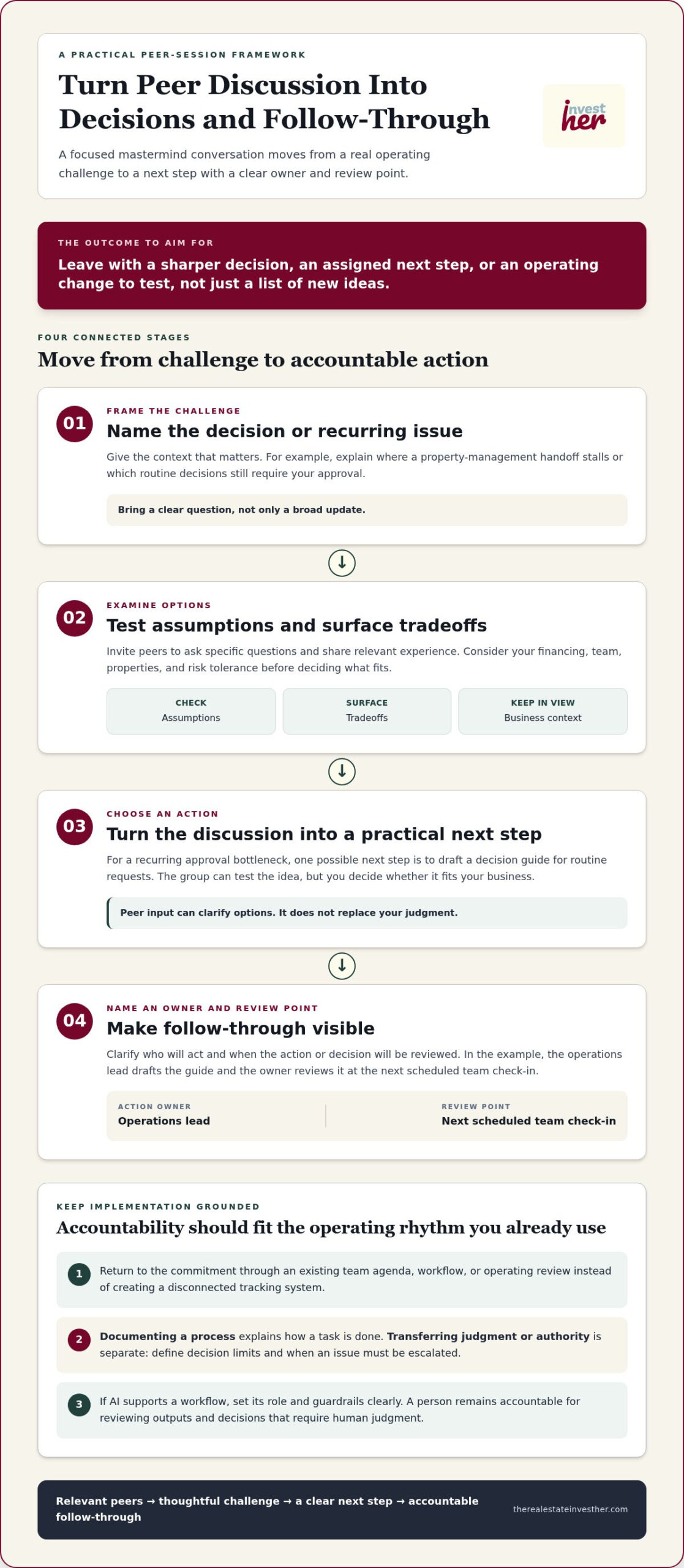
A focused discussion can move through four steps:
- Frame the challenge: State the decision or recurring issue and the context that matters.
- Examine options: Ask peers to test assumptions, surface tradeoffs, and share relevant experience.
- Choose an action: Identify a practical next step that fits your business.
- Name an owner: Clarify who will act and when the action or decision will be reviewed.
Good peer challenge is specific and curious. It helps you see what you may be overlooking while recognizing that your financing, team, properties, and risk tolerance shape the final decision. Advice that skips that context can sound confident and still be a poor fit.
What makes a virtual mastermind session productive?
Consider a recurring approval bottleneck: routine property decisions wait for the owner, even when a team member has the information to handle them. Peers might ask which decisions truly require your judgment, what information the team needs, and where an approval threshold could be documented. They can test the idea, but you retain responsibility for the decision.
A practical close might be for the operations lead to draft a decision guide for routine requests, with the owner reviewing it at the next scheduled team check-in. That gives the action an owner and a review point without assuming the change will solve every exception.
How should accountability support implementation?
Accountability should connect commitments to work already happening, not create another disconnected tracking system. Add the action to an existing team agenda, workflow, or operating review, then return to it at the agreed point. This makes follow-through visible without adding unnecessary administration.
Documenting a process explains how a task is done. Transferring judgment or authority is a separate decision: define which choices a team member can make, what limits apply, and when an issue must be escalated. If AI supports a workflow, set its role and guardrails clearly. A person remains accountable for reviewing outputs and making decisions that require human judgment.
Candid exchange also depends on shared norms. Clear expectations around confidentiality, preparation, respectful challenge, and participation help members discuss operating concerns thoughtfully. If peer connection is part of the support you’re seeking, explore the InvestHER Community, a network of women investors with educational resources.
Virtual mastermind, mentorship, or community: which format fits your need?
The right format depends on the support gap you need to close, not on a universal ranking. Compare options by who provides guidance, how peers interact, whether support continues over time, and how directly the format connects to implementation.
| Format | Guidance source | Peer interaction | Continuity and implementation focus |
|---|---|---|---|
| Mastermind | Members contribute experience and perspectives | Shared problem-solving among peers | Can support ongoing follow-through on member commitments |
| Mentorship | An experienced investor offers strategic guidance | May be one-to-one or structured around mentor guidance | Useful for working toward a defined investment or growth goal |
| Community | Members and educational resources offer broader learning | Connection across a wider investor network | Supports ongoing connection; implementation depends on the member’s next steps |
This comparison focuses on guidance, interaction, continuity, and implementation, not on which option is inherently superior. A virtual real estate mastermind for women may suit an investor who wants several peer perspectives on a live operating decision. Mentorship may fit when she wants experienced guidance toward a defined goal. A community can provide a wider network and educational resources without necessarily offering a focused problem-solving format.
When is peer problem-solving more useful than mentorship?
Peer exchange can help when you’re weighing a current decision and want to test assumptions against different investors’ experiences. Mentorship may be more useful when you want experienced guidance as you pursue a specific investment goal. For a closer look at guidance formats, read this women’s real estate mentorship guide. Neither format replaces advice from qualified financial, legal, or tax professionals.
When can a broader investor community be the better starting point?
A community may fit if you’re looking for ongoing connection with women investors and educational resources rather than a dedicated forum for one operating decision. The InvestHER Community offers membership for connection and learning. A conference can concentrate networking and learning into an event, but attending one doesn’t automatically provide continued accountability afterward.
Choose by naming the need first: diverse peer perspectives, experienced direction, or broader connection and learning. That distinction helps you select support that fits your current work instead of adding a commitment without a clear purpose.
How can you evaluate a virtual real estate mastermind before committing?
Evaluate a virtual real estate mastermind by how well it addresses a real business bottleneck, fits your capacity, and supports follow-through. Use this five-step assessment before deciding:
- Name the bottleneck: Identify the recurring decision, workflow snag, or ownership gap you want help thinking through.
- Define the support you need: Decide whether you want peer perspectives, experienced guidance, accountability, or a combination.
- Assess the format: Look for a clear way to bring challenges forward, discuss relevant context, and connect insights to implementation.
- Estimate your capacity: Consider the time and attention participation would require alongside current operating priorities.
- Choose a next step: Identify what you need to understand about the group’s expectations and how members follow through.
Pay attention to whether conversations reach beyond acquisitions and deal analysis. If your challenge is owner dependency, look for discussion of the business behind the portfolio: workflows, decision ownership, delegation, and operating rhythms that keep work moving. For related portfolio-growth decisions, see this strategic guide to scaling real estate investments.
What questions reveal whether the format fits your business?
Be specific about what you want the commitment to support. Which recurring decision or bottleneck would you bring to the group? What kind of implementation support or accountability would make participation worthwhile? What would you pause, delegate, or simplify to make room? Your answers help distinguish a relevant investment of attention from another obligation in an already full operating calendar.
How can you recognize a mismatch before joining?
Be cautious of broad promises of growth when the format doesn’t explain how members learn, solve problems, or follow through. A supportive environment should make room for constructive challenge and clear ownership, not only encouragement. If discussions avoid difficult questions or leave actions without an owner, the group may not address the operating issue you identified.
Fit is about alignment, not urgency. A group can be valuable and still be wrong for your current needs or capacity. Make your decision based on the support you need and the work you can realistically take on, not fear of missing out. If a broader network and educational resources are more relevant, explore the InvestHER Community.
How can The Real Estate InvestHER support your next step?
Choose a next step that matches the gap you’ve identified in your business. InvestHER Community membership offers women investors a network and educational resources. The STRIVE Mentorship Program provides strategic guidance and access to experienced investors to support women scaling their real estate investments. These options serve different needs, and neither promises returns or substitutes for your own investment judgment.
How can community and mentorship serve different goals?
Community provides a wider network of women investors and learning resources to draw on as your questions evolve. Mentorship is more focused, offering strategic guidance as you work toward investment goals. If you’re considering a virtual real estate mastermind for women, use the same distinction to clarify what you need: peer perspectives on a business challenge, expert guidance toward a defined goal, or ongoing connection and education.
What is a practical next step after reading?
Write down one recurring decision, bottleneck, or owner-dependent workflow that is taking attention away from higher-value work. Then identify the kind of support most relevant to it:
- Peer perspective: You want to compare approaches and test assumptions with other investors.
- Focused mentorship: You want strategic guidance as you work toward a defined investment goal.
- Broader community support: You want an investor network and educational resources for ongoing learning.
Before adding a commitment, consider what you can realistically make room for and what practical step you want the support to inform. The goal is not to join every useful-sounding format. Choose the support that aligns with your current priorities and capacity.
Explore The Real Estate InvestHER community and mentorship options to consider which next step fits the need you’ve identified.
Choose support that moves your business forward
The right virtual real estate mastermind for women should fit the challenge you’re working through and help turn discussion into decisions, ownership, and practical next steps. Clarify whether you need peer perspectives, focused mentorship, or broader connection and education, then weigh that need against your capacity.
The Real Estate InvestHER offers distinct ways to connect and learn. InvestHER Community membership includes a network of women investors and educational resources. The STRIVE Mentorship Program provides strategic guidance and access to experienced investors. InvestHER CON is an annual conference featuring industry leaders, networking sessions, and strategic workshops. Each serves a different purpose, so focus on the kind of support that fits your priorities.
Start with one recurring decision or owner-dependent workflow you want to address. Use it to choose a next step that supports your current work rather than adding a commitment simply because it’s available. Explore The Real Estate InvestHER’s community, mentorship, and conference opportunities to find the support that aligns with the business you’re building.
Frequently Asked Questions
What is a virtual real estate mastermind for women?
A virtual real estate mastermind for women is a structured online peer forum where women investors discuss challenges, share relevant experience, and identify practical next steps. Its value comes from focused problem-solving and follow-through, not simply meeting new contacts. A useful discussion can clarify a decision or surface an operating change to consider, but each investor remains responsible for deciding what fits her portfolio, team, and goals.
How is a real estate mastermind different from a networking group?
A mastermind is organized around peer problem-solving, while networking generally focuses on making connections and exchanging information. In a mastermind discussion, a member might bring a specific question about a property-management workflow, explain the context, consider peer perspectives, and leave with an action to review. A networking conversation may lead to a helpful introduction, but a larger contact list alone doesn’t resolve a decision bottleneck or assign responsibility for follow-through.
Is a virtual real estate mastermind worth it?
It may be worthwhile if the group’s experience and structure address a real challenge, and you have capacity to participate and act on what you learn. Assess the value by the relevance of the discussion and whether it supports clearer decisions or useful next steps. If sessions mainly add ideas without helping you apply them, or compete with more urgent operating priorities, the commitment may not fit your needs right now.
What should women investors look for in an online real estate mastermind?
Look for peers whose experience is relevant to your portfolio stage, strategy, or operating challenge, along with a clear discussion process and follow-through. Consider whether members can raise specific business questions, receive constructive challenge, and leave with a defined next step. Confidentiality and respectful participation norms also support candid exchange. A group should support your judgment, not treat another member’s preferred approach as a universal answer.
Can a virtual mastermind help me scale my real estate business?
It can help you think through decisions that affect growth, including how work is assigned, where approvals slow progress, and which processes depend too heavily on you. Peer perspectives may surface options or assumptions to examine, but a mastermind doesn’t scale a business on its own or guarantee results. You and your team still need to decide what to implement, clarify decision authority, and make sure changes fit your operations.
What is the difference between a mastermind and real estate mentorship?
A mastermind draws on peer perspectives to examine shared challenges, while mentorship centers on guidance from someone with relevant experience. Peer problem-solving may suit a live decision where you want to compare approaches. Mentorship may fit a defined investment goal where strategic direction is the main need. Neither format replaces qualified financial, legal, or tax advice, and your own context and judgment remain essential to any decision.
How do I get value from a virtual mastermind without adding more work?
Bring one focused question connected to a decision or workflow already on your plate. Before the session, identify the context peers need. Afterward, record the action, owner, and review point in an existing team workflow or meeting agenda. Avoid creating extra tracking systems just for the group. If you can’t identify what commitment you’ll pause or simplify to make room, reconsider whether this is the right time to participate.

Article by
Andresa Guidelli
Real estate investor, operator, and founder of The Real Estate InvestHER, a national platform supporting women real estate investors. With 15+ years of experience in real estate investing and business operations, she focuses on helping investors build stronger businesses behind their portfolios through better systems, clearer decision-making, leadership, and responsible use of AI.
Be the first to comment