


Real Estate Investment Due Diligence Checklist: What to Verify Before You Buy
A property can look compelling on paper and still carry risks that change the deal. A real estate investment due diligence checklist helps you verify the numbers, physical condition, records, and operating demands before you commit, so urgency doesn’t replace sound judgment.
Due diligence involves more than collecting documents. You need to know whether the information is complete, consistent, and relevant to the decision in front of you. This checklist gives you a repeatable way to assess what you’re buying, identify material unknowns, and decide whether to proceed, renegotiate, or walk away.
Use it to review financial performance and assumptions, inspect the property and its major systems, examine ownership and transaction records, and map the work required to operate the asset. Organize findings so diligence becomes a business process, not an owner-dependent scramble. The goal isn’t a thicker file. It’s a clearer decision and an acquisition rhythm you can use again.
Key Takeaways
- Use a real estate investment due diligence checklist to test deal assumptions against property-specific evidence, not to replace your judgment.
- Reconcile projected income, expenses, and capital needs with leases, payment history, concessions, deposits, and vacancy assumptions.
- Compare property condition and ownership records with the seller’s operating story, and assign an owner to each discrepancy and follow-up.
- Treat diligence findings as decision inputs: identify unresolved gaps, assess their impact, and decide whether to proceed, renegotiate, or walk away.
- Make diligence repeatable with a shared deal workspace that tracks evidence, status, responsibilities, and the reasoning behind your decision.
What belongs on a real estate investment due diligence checklist?
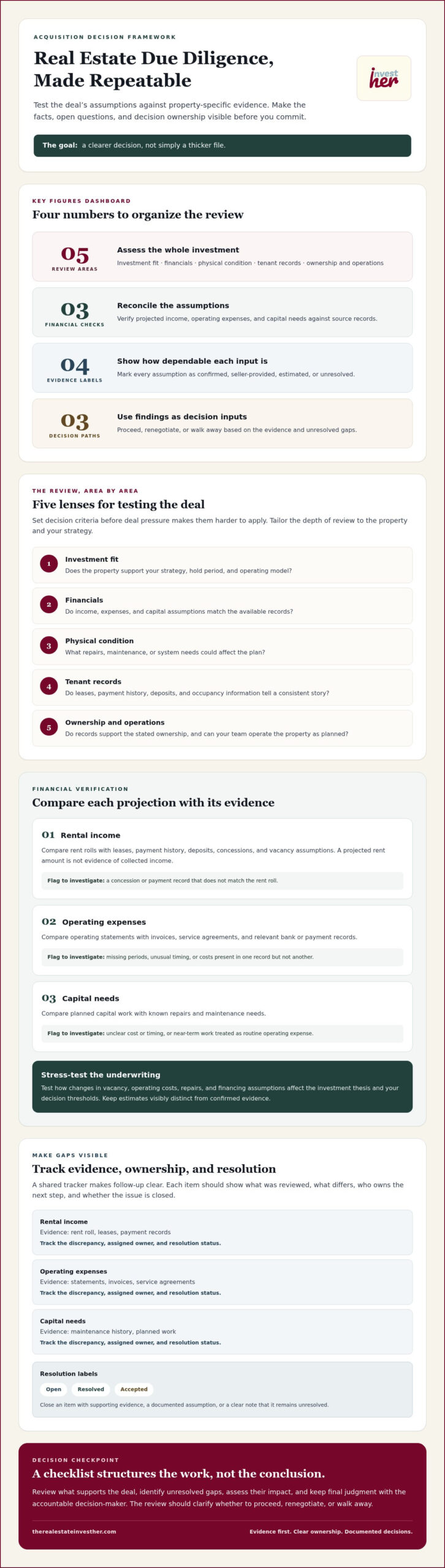
Due diligence tests a deal’s assumptions against property-specific evidence. A real estate investment due diligence checklist organizes that investigation across investment fit, financial performance, physical condition, tenants, ownership records, and operating demands. It makes evidence and gaps visible, but it can’t guarantee an outcome or replace your judgment.
Tailor the scope to the property and your strategy. For a rental property, examine leases and operating expenses closely. For a property with substantial deferred maintenance, focus on condition and future capital needs. The broader concept of due diligence is an investigation before a commitment; your checklist makes that investigation specific to the asset and the decision you need to make.
A practical checklist can include these review areas:
- Investment fit: Does the property support your strategy, hold period, and operating model?
- Financials: Do income, expenses, and capital assumptions match the available records?
- Physical condition: What repairs, maintenance, or system needs could affect the plan?
- Tenant records: Do leases, payment history, deposits, and occupancy information tell a consistent story?
- Ownership and operations: Do records support the stated ownership, and can your team operate the property as planned?
How does due diligence differ from analyzing a deal?
Initial analysis estimates a property’s potential using the information available at the time. Due diligence tests those estimates against records and property-specific findings before you commit. If a projection assumes steady occupancy, examine the evidence behind that assumption rather than treating it as established. Diligence turns deal assumptions into documented findings and open questions.
What should you establish before reviewing documents?
Set your decision criteria before deal pressure makes them harder to apply. Write down the investment thesis, intended hold period, operating model, financial thresholds, and non-negotiable requirements. Then assign roles: who makes the investment decision, who reviews each area, who tracks evidence, and where the diligence record lives. Each question should have an owner, while final judgment stays with the accountable decision-maker.
A checklist structures the work, not the conclusion. Use it to identify what supports the deal, what needs follow-up, and what could change your decision. As your portfolio and strategy evolve, adjust the review scope while keeping the core process consistent.
How should you verify a property’s financials and deal assumptions?
Verify the inputs behind projected income, expenses, and capital needs. Compare the seller’s figures with source records, note where the numbers don’t reconcile, and distinguish confirmed facts from estimates. Your real estate investment due diligence checklist should show what was reviewed and who owns each unresolved question.
Which income and expense records should you reconcile?
Review available rent rolls, leases, operating statements, invoices, service agreements, maintenance history, and relevant bank or payment records. Match each rent-roll entry to lease terms, payment history, deposits, concessions, and vacancy assumptions. A projected rent amount is not evidence of collected income. If a lease shows a concession or a payment record differs from the rent roll, log the discrepancy and assess its effect on the underwriting.
Reconcile operating expenses to bills and service records. Look for missing periods, unusual timing, or costs that appear in one record but not another. Compare planned capital work with known repairs and maintenance needs so the model doesn’t treat a near-term cost as a routine operating expense.
How do you stress-test the underwriting?
Test how changes in vacancy, operating costs, repairs, and financing assumptions affect the investment thesis and your decision thresholds. Label each input as confirmed, seller-provided, estimated, or unresolved. This prevents a polished projection from appearing more certain than its supporting records. An underwriting input is only as dependable as the evidence behind it.
Use a shared tracker to capture findings and follow-ups. For example:
| Item | Evidence | Reviewer | Discrepancy | Owner | Resolution status |
|---|---|---|---|---|---|
| Rental income | Rent roll, leases, payment records | Assigned reviewer | Concession not reflected | Assigned owner | Open, resolved, or accepted |
| Operating expenses | Statements, invoices, service agreements | Assigned reviewer | Expense period missing | Assigned owner | Open, resolved, or accepted |
| Capital needs | Maintenance history, planned work | Assigned reviewer | Cost or timing unclear | Assigned owner | Open, resolved, or accepted |
Close each item with supporting evidence, a documented assumption, or a clear note that it remains unresolved. A reviewer can organize and flag information, but the accountable decision-maker determines whether a gap changes the deal. For ongoing peer learning as you refine your acquisition process, explore peer learning for women investors.
What property, tenant, and ownership records should you examine?
Compare the property’s condition and ownership records with the deal’s stated operating story. A real estate investment due diligence checklist should connect each record to a question it can answer, a discrepancy to resolve, and a person responsible for follow-up. The aim isn’t to collect paperwork for its own sake. It’s to determine whether the documented property, tenancy, and operating arrangements match the assumptions behind the purchase.
Which physical and environmental records help test property condition?
Review available inspection and property-condition reports, repair history, warranties, service logs, and planned capital work. Where relevant, consider environmental reports and distinguish their documented findings from assumptions or unanswered questions. A prior report may describe a past condition, so note its date and scope when assessing what it tells you about the property now.
For each open item, track the evidence requested, the responsible person, and the date it must be resolved to inform the purchase decision. Technical, environmental, insurance, or legal findings may call for review by an appropriately qualified professional. The need and scope of that review depend on the asset and circumstances.
How do leases, title materials, and operating records fit together?
Compare lease terms, tenant obligations, deposits, renewal provisions, and recorded rent with the rent roll and payment records. Review available title materials, surveys, insurance information, service agreements, and permitting or zoning records for inconsistencies with the seller’s description or your planned use. These documents answer different questions. A mismatch is a prompt for follow-up, not a conclusion by itself.
| Record | Question it answers | Discrepancy to flag | Follow-up owner |
|---|---|---|---|
| Leases and tenant records | Do the rent, terms, deposits, and obligations match the rent roll? | Different rent, missing concession, or unclear renewal term | Assigned lease reviewer |
| Title materials and survey | Do available ownership and property materials align with the deal description? | Unclear boundary, recorded interest, or document inconsistency | Assigned transaction reviewer |
| Inspection reports and maintenance history | What condition issues or recurring repairs are documented? | Unresolved repair, missing service history, or unpriced capital work | Assigned property reviewer |
| Insurance, service, and permitting records | What coverage, agreements, or documented approvals relate to current operations or intended use? | Unclear coverage, agreement terms, or permitting status | Assigned reviewer for the relevant issue |
For legal, insurance, environmental, and technical questions, record what the material establishes and what still needs qualified review. Don’t treat a record or requirement as universal when applicability may depend on the property, its use, or the transaction. Assign an owner and decision deadline to keep open questions visible and make sure they are weighed before you commit, rather than rediscovered during handoff.
Can a due diligence checklist guarantee a safe deal?
No. A checklist can’t eliminate uncertainty or guarantee a safe deal. Its purpose is to make the available evidence, unresolved gaps, and decision choices visible. A completed checklist doesn’t prove every risk has been resolved. It shows what was reviewed, what remains unknown, and what the person accountable for the investment decision needs to weigh.
Use three possible outcomes:
- Proceed: The evidence supports the investment thesis, and remaining uncertainties fall within your stated risk limits.
- Renegotiate or revise assumptions: New information changes the price, terms, projected performance, or operating plan needed for the deal to make sense.
- Pause or walk away: A material issue remains unresolved, conflicts with a non-negotiable requirement, or makes the investment thesis no longer viable.
Keep a decision log alongside the real estate investment due diligence checklist. For each material finding, record the evidence reviewed, its potential effect on the investment thesis, any unresolved question, who owns the decision, and the rationale for the outcome. This captures the reasoning behind the decision, not just task completion.
How should you prioritize findings when time is limited?
Rank open items by their potential effect on the deal’s core assumptions, your ability to operate the property, and the timing of the purchase decision. Separate a missing document from a confirmed adverse finding and an assumption that hasn’t been tested. Each represents a different level of uncertainty. Escalate material legal, technical, environmental, or insurance questions for appropriate qualified review before deciding.
Also test whether the post-close operating plan is realistic for your business. A property may fit the financial model but still depend on owner time, oversight, or expertise that your current operating team can’t provide. Identify the capabilities, responsibilities, and decisions the asset will require. If the plan depends on unassigned work or constant owner intervention, account for that operating burden before proceeding.
What should happen when records conflict or remain incomplete?
Log each conflicting source, what it supports, and what evidence could resolve the difference. Don’t fill gaps with optimistic assumptions. If an unresolved item affects the deal, model its possible impact or set a decision threshold, such as requiring specific evidence before proceeding. A threshold keeps the review focused and prevents diligence from extending without a clear purpose.
The goal is a reasoned decision, not a perfect file. If you’re refining how your acquisition decisions and operating responsibilities fit together, explore The Real Estate InvestHER investor community for peer connection and educational resources.
How can you turn real estate due diligence into a repeatable business system?
Standardize recurring diligence work, but keep investment judgment and approval with accountable people. A repeatable process makes it easier to see what has been reviewed, what remains open, and who must act next, without making every acquisition depend on the owner’s memory.
Set up one deal workspace for each acquisition. Include the checklist version, links to source evidence, review status, assigned owners, due dates, and a decision log. Use consistent document names and status labels so a reviewer can distinguish a lease that has merely been collected from one that has been checked against the rent roll. Keep the decision record alongside the evidence that informed it.
Which parts of diligence can be standardized or delegated?
Standardize document requests, naming conventions, review tracking, follow-up reminders, and meeting preparation. Assign evidence collection and initial checks to named roles, with one owner for each open item. A delegated reviewer can confirm that a document is present, organize its details, or flag a mismatch. That assignment doesn’t automatically transfer authority to interpret material risk or approve the investment.
Write decision rights into the workflow. Specify which findings require escalation, who evaluates their effect on the investment thesis, and who can approve proceeding, renegotiating, or stopping the review. If AI helps sort documents or summarize information, treat its output as a working aid. A person should verify it against source records, assess materiality, and remain accountable for decisions.
How can you improve the process after each acquisition?
After each deal review, capture what slowed the process, which evidence was repeatedly missing, and which assumptions proved weak. Then decide whether the checklist, ownership assignments, or review sequence needs to change. Preserve version history so the team can see what changed and why, rather than silently replacing the process after every deal.
Keep the system proportionate. Add a tool only when it solves a clear operating problem, such as making evidence easier to find or ownership easier to track. A useful workflow isn’t measured by the number of steps or software features. It helps the team move diligence forward while the right people retain the right decisions.
This acquisition workflow is one part of building portfolio-wide operating capacity. For a broader view, read How to Scale Real Estate Investments: The Strategic Guide for Women Investors. InvestHER’s community membership and educational resources can also help women investors compare approaches and refine the systems behind their portfolios.
Make Your Next Acquisition More Deliberate
A strong real estate investment due diligence checklist does more than track documents. It tests the assumptions behind the deal, makes unresolved risks visible, and gives you a clear basis to proceed, renegotiate, or walk away. Reconcile financial projections with source records, compare property and ownership materials with the operating story, and record who owns each follow-up.
Then make the process reusable. Standardize evidence collection and task tracking, while keeping interpretation of material risks and final approval with accountable decision-makers. Each acquisition can also reveal where your workflow needs refinement, helping the business become less dependent on your memory and constant involvement.
For peer connection and strategic education as you grow your investing business, explore the InvestHER Community. Founded in 2018 by Liz Faircloth and Andresa Guidelli, InvestHER offers community membership and the STRIVE Mentorship Program. Explore the InvestHER Community to connect with other women investors and strengthen the operating practices behind your portfolio.
Frequently Asked Questions
What is included in a real estate investment due diligence checklist?
A real estate investment due diligence checklist typically covers investment-fit criteria, financial records, leases and tenant information, property-condition materials, ownership and title documents, insurance and service records, open questions, assigned follow-up, and a decision log. The exact scope depends on the property, strategy, and transaction. Use the checklist to organize evidence and decisions, not as a guarantee that every risk has been found or resolved.
How long does real estate investment due diligence take?
There’s no single timeline that applies to every acquisition. The review depends on the property, the completeness of available records, deal complexity, and how quickly open questions are resolved. Set milestones around evidence that could change your decision, then assign an owner to each follow-up. Use the current transaction documents to understand applicable deadlines rather than assuming every purchase follows a standard review period.
Can you buy an investment property without an inspection?
A checklist alone can’t determine whether skipping an inspection is appropriate for a particular transaction. Review the available property-condition evidence, identify what remains unknown, and assess how that uncertainty affects your investment thesis. If a technical or specialist assessment is relevant, account for it in the acquisition process. Seller descriptions and financial projections may inform your review, but they aren’t substitutes for property-specific evidence.
What happens if the seller does not provide all requested documents?
Record each missing item, why it matters, who requested it, and whether another reliable source could answer the question. A missing document is not automatically proof of a property problem, but it may leave an important assumption unverified. Assess whether the gap requires revised analysis, additional follow-up, or a pause in the decision. Don’t silently replace missing information with an optimistic estimate. Document the reasoning behind your next step.
How do you verify a rental property rent roll?
Compare the rent roll with available leases, payment records, deposits, concessions, vacancy information, and relevant operating statements. Check that tenant names, lease terms, amounts, and dates align across sources. Record discrepancies and request supporting evidence for material differences. A rent roll is a useful summary, but it doesn’t independently prove that rent was collected or that projected income will continue. Keep documented income separate from estimates.
Should you use AI for real estate due diligence?
AI can help organize documents, summarize records, flag inconsistent fields, or draft follow-up questions, but it shouldn’t make the investment decision. Protect sensitive information and check AI outputs against source documents. Assign a person to validate material findings, define clear human approval points, and retain the evidence and reasoning behind decisions. Used within a controlled workflow, AI can support repetitive review while people remain accountable for interpretation and judgment.
When should an investor walk away from a property deal?
Consider pausing or walking away when unresolved findings materially undermine the investment thesis, evidence can’t support key assumptions, or revised terms don’t address the risk. The decision depends on your strategy, stated thresholds, and the facts of the transaction. Document the issue, its potential impact, what evidence or change could alter your view, and who owns the final decision. A clear rationale helps keep urgency from substituting for judgment.

Article by
Andresa Guidelli
Real estate investor, operator, and founder of The Real Estate InvestHER, a national platform supporting women real estate investors. With 15+ years of experience in real estate investing and business operations, she focuses on helping investors build stronger businesses behind their portfolios through better systems, clearer decision-making, leadership, and responsible use of AI.
Be the first to comment