


Financing Your First Rental Property in Dallas: A Woman’s Guide to Strategic Wealth
What if the most powerful tool for financing your first rental property in Dallas isn’t just a high credit score, but a network of women who have already navigated the closing table? It’s common to feel like the only person in the room who truly understands how a 7.576% interest rate interacts with the unique pressure of North Texas property taxes. You want to build a lasting legacy, yet the technical gap between DSCR and conventional loans often feels like a barrier meant to keep you on the sidelines. We understand that tension because we have walked that same path.
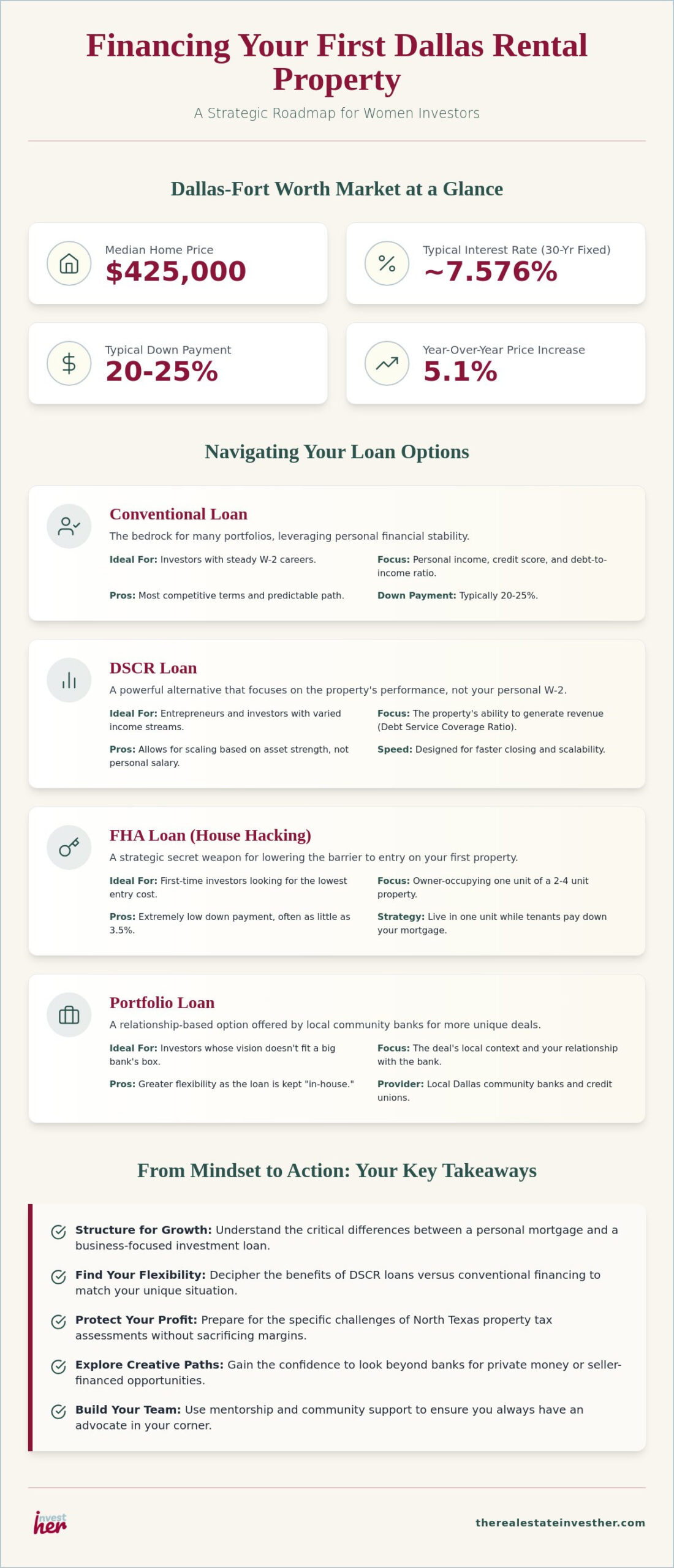
This guide will unlock the financial strategies and local DFW insights you need to fund your first investment with total confidence. You’ll learn how to navigate a market with a $425,000 median home price while finding partners who respect your professional ambition. We are moving past the confusion to provide a clear roadmap for your strategic growth, grounding your journey in the collective wisdom of a community that wants to see you thrive.
Key Takeaways
- Understand the essential differences between personal mortgages and investment loans to ensure your first DFW acquisition is structured for long-term growth.
- Decipher the benefits of DSCR loans versus traditional conventional financing to see which path provides the most flexibility for your unique situation.
- Prepare for the specific challenges of the North Texas market, including how to navigate property tax assessments without sacrificing your profit margins.
- Gain the confidence to explore creative paths for financing your first rental property in Dallas, such as private money or seller-financed opportunities.
- Learn how to build a reliable financing team through mentorship and community support, ensuring you are never the only woman in the room without an advocate.
Navigating the Dallas Rental Market as a First-Time Woman Investor
Entering the world of Real estate investing begins with a fundamental realization: financing your first rental property in Dallas is a different beast than buying your family home. In Texas, lenders view investment properties through a lens of risk and reward rather than personal stability. You’ll typically need a 20% to 25% down payment, and interest rates currently sit around 7.576% for a 30-year fixed loan. This isn’t just about finding a place to live; it’s about building a business. Many women walk into these meetings feeling like the only woman in the room, facing a wall of technical jargon and subtle skepticism. We are here to change that dynamic by turning your intentionality into a strategic advantage.
Whether you are seeking immediate cash flow to supplement your income or focusing on long-term appreciation for a family legacy, your “why” dictates your “how.” The Dallas market demands this level of clarity. DFW remains a top choice for rental portfolios because of its diverse economy and consistent growth. You aren’t just buying a house. You are claiming your stake in one of the most resilient economic engines in the country.
The DFW Real Estate Climate in 2026
The Dallas-Fort Worth metroplex continues to act as a magnet for major corporations, with relocations from across the country sustaining a robust demand for high-quality housing. While North Dallas remains a staple for stability, we see burgeoning suburbs offering unique entry points for new investors. The market is stabilizing, showing a 5.1% year-over-year increase in median home prices, which currently hover around $425,000. As of July 2026, the Dallas housing market maintains a balanced inventory of approximately 2.5 to 3.2 months, providing investors with more options than in previous years.
Mindset Shifts for Your First Deal
Success requires moving from a scarcity mindset to an abundance mindset. Instead of asking if you can afford the monthly payment, ask how the property will pay for itself and your future. Financial independence isn’t just a goal; it’s a tool for autonomy. It’s natural to feel a flutter of fear when signing for a significant loan, but remember that you aren’t just taking on debt. You are acquiring a performing asset. The Real Estate InvestHER community exists because we know that when women support each other, the fear of making a financing mistake transforms into the confidence of a well-vetted deal. Don’t let the paperwork obscure the vision of the legacy you’re building.
Traditional Financing Paths for DFW Rental Properties
Dallas-Fort Worth has consistently been recognized as a top metro for real estate investment, yet the bridge between a great deal and a closed escrow is the right loan product. For many, the journey begins with traditional routes that leverage personal financial stability. If you have a steady W-2 career, conventional loans offer some of the most competitive terms available. These loans are the bedrock of many portfolios, providing a predictable path for those who can document their income with tax returns and pay stubs. They offer stability in a market that moves fast.
However, the conventional path isn’t the only way to tackle financing your first rental property in Dallas. For women who are entrepreneurs or have varied income streams, Debt Service Coverage Ratio (DSCR) loans have become a powerful alternative. Instead of scrutinizing your personal debt-to-income ratio, these lenders look at the property’s ability to generate revenue. This shift in focus allows you to scale based on the strength of the asset rather than the limitations of your personal balance sheet. It empowers you to grow without being tethered to a traditional corporate salary.
For those just starting, house hacking via an FHA loan remains a strategic secret weapon. By occupying one unit of a duplex or fourplex, you can secure a property with as little as 3.5% down, significantly lowering the barrier to entry in neighborhoods like Bishop Arts or the M-Streets. If you find that big banks don’t quite understand your vision, local Dallas community banks often offer portfolio loans. These institutions keep the debt on their own books, giving them the flexibility to look at your deal with a more nuanced, local perspective. They value the relationship as much as the numbers.
Understanding DSCR Loans: The Investor’s Favorite
DSCR loans are designed for speed and scalability. Lenders calculate the ratio by dividing the property’s monthly rental income by the mortgage payment, including taxes and insurance. In the Dallas market, a ratio of 1.2 is often the magic number. This means the property generates 20% more income than its expenses. It’s a liberating option for women who want to keep their personal finances private or those who already have multiple conventional mortgages. If you’re looking for recommendations on Texas-based lenders who take women investors seriously, joining the InvestHER Community Membership can provide the peer-vetted referrals you need.
The Conventional Route: Rates and Requirements
While DSCR offers flexibility, the conventional route remains a standard for low interest rates. You’ll typically need a 20% to 25% down payment for a 1-4 unit property in Texas. While some programs allow for 15% down, these often come with higher rates or private mortgage insurance (PMI) that can eat into your cash flow. A credit score of 720 or higher is now the benchmark for securing the most favorable terms. Maintaining this score ensures that high property taxes in Dallas County don’t completely erode your monthly profit margins.
Creative Financing Strategies: Looking Beyond the Big Banks
Traditional banks are not the only gatekeepers to wealth. When you are financing your first rental property in Dallas, the most innovative solutions often happen outside the fluorescent lights of a branch office. Creative financing is about leverage, alignment, and finding a “yes” when a computer algorithm says “no.” It’s a way to maintain your autonomy while building a portfolio that reflects your long term goals. These strategies aren’t just workarounds. They are sophisticated tools used by seasoned investors to navigate changing market cycles.
One powerful starting point is the equity you have already built. A Home Equity Line of Credit (HELOC) on your primary residence can serve as the capital for your first investment down payment. This strategy allows you to put your existing assets to work without liquidating them. If speed is the priority for a competitive DFW deal, private or hard money lenders offer a fast, though more expensive, alternative. These lenders care less about your W-2 and more about the property’s potential. This makes them ideal for properties needing immediate stabilization or quick closings in neighborhoods where inventory is tight.
Partnering for Success
You don’t have to carry the financial burden alone. Many women in the InvestHER community find that joining forces is the fastest way to scale. You might act as the “operating partner,” finding the deal and managing the renovation, while a “money partner” provides the capital. This synergy allows both parties to grow without being limited by individual resources. In Texas, a robust partnership agreement is non-negotiable to protect your interests and your professional relationships. Local InvestHER meetups in Dallas are the perfect environment to find like-minded women who share your values and your drive for excellence.
Seller Financing in a High-Interest Environment
As the 2026 market stabilizes, some Dallas homeowners are more willing to act as the bank. Seller financing allows you to negotiate terms directly with the owner, often bypassing the rigid requirements of institutional lenders. You might also explore “Subject To” deals, where you take over the seller’s existing mortgage payments while the original loan stays in their name. This can be a brilliant way to secure a property with older, lower interest rates in today’s climate. The primary risk of seller financing for the buyer is the potential for a “due on sale” clause to be triggered by the original lender, which would require the entire loan balance to be paid immediately.
Financial Readiness: Preparing Your Portfolio for Texas Lenders
Securing financing your first rental property in Dallas requires more than a signature; it demands a meticulously prepared financial foundation. Lenders in North Texas are notoriously thorough, specifically because the high property tax environment directly impacts your debt-to-income (DTI) ratio. While your income might be strong, the “Dallas Tax Trap” can quickly shrink your borrowing power. For the 2026 tax year, the Dallas County tax rate is $0.215500 per $100 of assessed value. When combined with city and school district taxes, your monthly escrow payment can often rival the principal itself. This unique Texas reality means you must clean up personal debt and maximize your credit score well before you start touring homes in Oak Cliff or Richardson.
Preparation also involves building a robust cash reserve that acts as your safety net. Most lenders require at least six months of principal, interest, taxes, and insurance (PITI) in liquid accounts. However, a strategic investor knows that DFW weather patterns demand more. Between sudden spring hailstorms and summer wind events, your maintenance and insurance deductible funds should be readily accessible. Organizing these details into what we call an “InvestHER Binder” ensures you aren’t scrambling when a lender asks for the third version of your LLC operating agreement. This level of intentionality signals to banks that you aren’t just a borrower, but a professional business owner.
Dallas Property Taxes and Insurance
In Texas, property taxes are the trade-off for no state income tax. This makes protesting your annual assessment a vital skill for maintaining your financing margins. If your taxes spike, your DTI could shift, potentially affecting future loan approvals as you scale. Additionally, landlord insurance in North Texas is non-negotiable. You need coverage that specifically addresses liability and the high probability of roof damage from regional storms. High premiums are a reality here, so shopping for an investor-friendly agent is a crucial step in your strategic wealth journey. Maintaining these margins is what separates a hobbyist from a professional.
The Pre-Approval Process
In a market where homes stay on the market for 25 to 40 days, being “pre-qualified” isn’t enough. You need a full pre-approval to be taken seriously by sellers and their agents. Your lender should be a cornerstone of your “Core Four” team, alongside your contractor, property manager, and agent. Don’t be afraid to interview them. Ask if they have experience with women-led portfolios or if they understand the nuances of DSCR loans mentioned earlier. You deserve a partner who respects your ambition and offers clarity rather than condescension. For a list of peer-vetted lenders who understand the DFW market, join the InvestHER Community Membership and connect with women who have already closed their first deals.
Building Your Financing Team with The Real Estate InvestHER
You have decoded the numbers and studied the neighborhoods. Yet, the final hurdle in financing your first rental property in Dallas is often the psychological weight of the decision. Attempting to navigate the complexities of the DFW market in isolation often leads to second-guessing and analysis paralysis. We believe that true financial independence is a collaborative journey. By building a team that includes mentors and peers, you replace individual uncertainty with collective strength. You aren’t just looking for a loan; you are looking for a network that understands the specific challenges women face when entering the North Texas investment space.
A high level financing strategy requires more than just a lender. It requires a circle of advisors who can help you vet a deal when the property taxes seem high or the interest rates fluctuate. This community acts as a sounding board, ensuring your first acquisition is the start of a sustainable business rather than a one-time transaction. When you surround yourself with women who have already closed deals in Bishop Arts or the burgeoning suburbs of North Dallas, the path to wealth becomes visible and attainable.
The Power of Mentorship
Mentorship is the ultimate shortcut to professional excellence. It allows you to avoid the “rookie tax,” those expensive mistakes that often come from a lack of local experience. Through our mentorship, you gain access to a framework for vetting potential deals and funding sources. We focus on strategic goal setting, ensuring that every financing decision you make today aligns with the 10-year legacy you want to build for your family. This isn’t just about signing a mortgage; it’s about intentional growth and long-term sustainability. Join the STRIVE Mentorship Program to scale your portfolio today.
Community as Your Greatest Asset
Your network often determines your net worth. Finding investor-friendly lenders who respect your professional ambition is significantly easier when you have access to a pool of peer-vetted referrals. Within our community, women share the names of local Dallas banks and private lenders who actually understand the InvestHER mission. This shared knowledge base is your greatest asset in overcoming the fear of the first big loan commitment. You’ll find that being the “only woman in the room” is a thing of the past when you have a national community standing behind you. Get your InvestHER CON 2026 tickets to connect with top industry leaders.
Taking the next step requires courage and a clear roadmap. Whether you are leveraging a DSCR loan or exploring creative seller financing, you don’t have to do it alone. The resources and relationships you need to successfully fund your first property are waiting for you here. It is time to turn your vision of financial independence into a reality on the ground in Dallas.
Your Future in Dallas Real Estate Starts Now
Building a rental portfolio in North Texas is a journey toward autonomy and a lasting legacy. You’ve learned how to navigate the nuances of the DFW market, from managing the impact of local property taxes to selecting the right loan product for your specific goals. Whether you choose the stability of conventional lending or the flexibility of a DSCR loan, the key is moving forward with intentionality. Financing your first rental property in Dallas doesn’t have to be a solo endeavor where you feel like the only woman in the room.
By joining a network of over 50,000 women investors, you gain access to the collective wisdom and strategic guidance of the STRIVE Mentorship Program. We provide the empowering resources you need to vet your funding with confidence and scale your business with purpose. Don’t let uncertainty hold you back from the financial independence you deserve. Join the InvestHER Community and take control of your financial future! Your vision for strategic wealth is within reach, and we are here to help you secure it.
Frequently Asked Questions
How much down payment do I really need for a rental property in Dallas?
You typically need a down payment of 20% to 25% for a conventional investment loan in the Dallas market. For a property at the median price of $425,000, this equates to roughly $85,000 to $106,250 in liquid capital. While some specialized programs might allow for 15% down, these often come with higher interest rates or stricter reserve requirements. Having a full 25% ready ensures you can secure the most competitive terms and maintain a healthy monthly cash flow.
Can I use an FHA loan for a rental property in Texas?
You cannot use an FHA loan to purchase a property intended strictly as an investment, but you can use it to “house hack” a multi-unit property. By living in one unit of a duplex or fourplex, you can secure the asset with as little as 3.5% down while financing your first rental property in Dallas. This strategy requires you to occupy the property as your primary residence for at least one year. It’s a powerful way for beginners to enter the market with significantly less initial capital.
What is a DSCR loan, and is it better for beginners?
A DSCR loan qualifies you based on the rental income the property generates rather than your personal W-2 earnings or debt-to-income ratio. It’s often an excellent choice for beginners who are entrepreneurs or those with complex tax returns that make conventional financing difficult. While interest rates are typically higher than conventional loans, the focus on the property’s performance allows for faster scalability. It empowers you to build a portfolio based on the strength of your assets rather than your personal paycheck.
How do Dallas property taxes affect my ability to get a loan?
Dallas property taxes increase your total monthly payment, which can directly lower the maximum loan amount a lender will approve. Lenders calculate your debt-to-income ratio using the full PITI payment, and the 2026 Dallas County tax rate of $0.215500 per $100 of value adds a significant cost to that equation. You must account for these high assessments during your pre-approval phase to ensure your margins remain viable. Protesting your taxes annually is a vital habit to protect your borrowing power as you grow.
Is it better to finance a rental property in my own name or an LLC?
Most first-time investors finance in their own name to access lower residential interest rates, though many transition to an LLC later for liability protection. Financing directly in an LLC usually requires a commercial or DSCR loan, which may have different down payment requirements and slightly higher rates. You should balance the need for asset protection with your desire for the most affordable financing terms. Many women find that starting in their own name provides the easiest entry point before scaling into more complex structures.
What credit score is needed for an investment property loan in 2026?
You generally need a minimum credit score of 620 to 640 for most investment loans, but a score of 720 or higher is the gold standard for 2026. Higher scores are essential for securing the best interest rates, especially when the average rate for investment properties is currently around 7.576%. Maintaining excellent credit is a core part of your financial readiness when financing your first rental property in Dallas. It ensures that high property taxes don’t completely erode your monthly profit margins through high interest costs.
How do I find an investor-friendly lender in the DFW area?
Finding a lender who understands the InvestHER mission is best done through peer-vetted referrals within a dedicated community of women investors. Rather than calling traditional retail banks, seek out lenders who specialize in portfolio loans or DSCR products through local Dallas networking groups. These professionals are more likely to view you as a strategic partner rather than just a number on a spreadsheet. Having a lender who understands the nuances of the North Texas market is a critical component of your “Core Four” real estate team.
Can I use my 401k to finance my first rental property?
You can use a 401k loan or a self-directed IRA to fund your down payment, provided you understand the specific tax rules and repayment terms. A 401k loan allows you to borrow against your balance and pay yourself back with interest, which can be a quick way to access capital without a credit check. Alternatively, a self-directed IRA allows the account itself to own the real estate, though all income and expenses must stay within the plan. Both options require careful coordination with a financial professional to avoid unintended penalties.

Article by
Andresa Guidelli
Real estate investor, operator, and founder of The Real Estate InvestHER, a national platform supporting women real estate investors. With 15+ years of experience in real estate investing and business operations, she focuses on helping investors build stronger businesses behind their portfolios through better systems, clearer decision-making, leadership, and responsible use of AI.
Be the first to comment