


How to Get Started in Real Estate Investing in Austin: A Woman’s Strategic Guide for 2026
You don’t need a million-dollar inheritance or a seat at the “old boys’ club” to claim your stake in the Silicon Hills. Learning how to get started in real estate investing in Austin in 2026 is less about chasing the loudest voices and more about leveraging the city’s new density laws to create your own inventory. It is a bold time to enter the market; however, it’s also a time when many women feel priced out or isolated in male-dominated investment circles.
We understand the weight of balancing a high-stakes career or family life while trying to navigate a $525,000 median home price. You deserve a strategy that respects your time and amplifies your autonomy. This guide promises a clear, community-backed roadmap designed for women to build sustainable wealth without doing it alone. We will dive into the nuances of the HOME Act’s 2,500 square foot lot requirements, the power of suburban cash flow in areas like Pflugerville, and how to find the supportive network of female investors you’ve been looking for to secure your first deal.
Key Takeaways
- Uncover why Austin’s “Silicon Hills” expansion provides a robust economic safety net and consistent rental demand for new female investors.
- Gain clarity on how to get started in real estate investing in Austin by exploring creative financing options like house hacking to overcome high entry costs.
- Compare long-term, medium-term, and short-term rental strategies while staying ahead of 2026 city ordinances and zoning changes.
- Build your “Core Four” local team and learn specialized vetting techniques to protect your budget from the notorious “Austin Tax” on renovations.
- Follow a methodical five-step roadmap to move from your first successful closing to a scalable portfolio that supports your financial autonomy.
Why Austin Remains the “Gold Mine” for Women Investors in 2026
Austin isn’t just a city; it’s a legacy in the making. While some headlines whisper about market exhaustion, the reality of the 2026 “Silicon Hills” tells a story of resilience and strategic opportunity. For those looking to master real estate investing, the Austin market remains a premier classroom. Success here depends on looking past the noise to see the structural shifts. You don’t have to be a corporate giant to find your place. You just need to understand the new rules of engagement.
Women often approach investment through the lens of community and long-term stability. We call this the “InvestHER Advantage.” In a metro area where competition is fierce, the ability to build genuine relationships with tenants and local partners becomes a primary asset. It’s about moving away from transactional tactics and toward a more sustainable, holistic model of wealth. You are not just buying a property; you are providing a home in one of the most vibrant economies in the country.
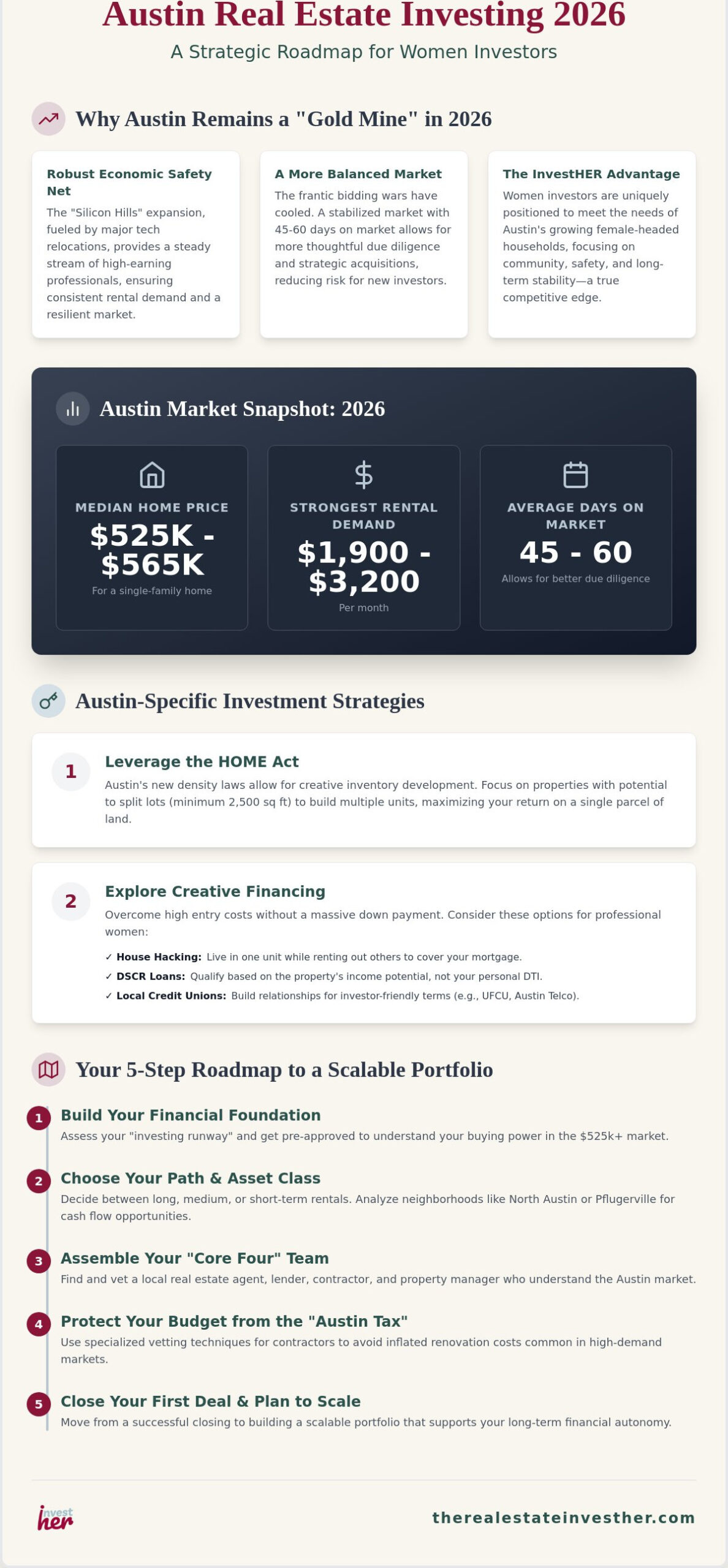
Fears of an Austin bubble often ignore the fundamental supply-demand imbalance. In 2026, we see a stabilized market with an average of 45 to 60 days on market. This allows for more thoughtful due diligence than the frantic bidding wars of years past. The demand is anchored by a diverse economic base that includes the state government, the University of Texas, and a tech sector that has matured far beyond its initial hype. This diversity creates a safety net, ensuring that even if one sector slows, the city’s pulse remains strong.
The 2026 Economic Landscape of Central Texas
Major tech relocations continue to anchor the region, bringing a steady stream of high-earning professionals who need quality housing. The “Path of Progress” is no longer just a theory; it’s a visible expansion stretching south toward San Marcos and east toward Bastrop. Investors are finding that the strongest rental demand sits firmly between $1,900 and $3,200 per month. In 2026, the median home price for a single-family home in Austin has settled into a range of $525,000 to $565,000, reflecting a market that has matured into sustainable growth.
Why Women are Leading the Austin Real Estate Shift
Austin is seeing a significant rise in female-headed households, a demographic that prioritizes safety, community, and functional living spaces. Women investors are uniquely positioned to understand these needs. By choosing collaborative investing over solo ventures, they are pooling resources and wisdom to navigate high entry costs. Emotional intelligence isn’t just a soft skill; it’s a financial strategy that reduces tenant turnover and fosters better property care. Knowing how to get started in real estate investing in Austin means recognizing that your perspective as a woman is your greatest competitive edge.
Building Your Financial Foundation: Austin-Specific Strategies
Success in Central Texas requires an honest assessment of your “investing runway.” With median prices for single-family homes hovering between $525,000 and $565,000, the traditional 20% down payment can feel like a daunting barrier. However, learning how to get started in real estate investing in Austin doesn’t always mean writing a six-figure check on day one. House hacking in North Austin or exploring the creative density permitted by the HOME Act allows you to enter the market with a smaller financial footprint while building equity in a high-growth zone.
Your financial foundation is about more than just the down payment; it’s about understanding the unique overhead of the Travis County area. While appreciation has moderated into a more balanced market, investors are now shifting their focus toward properties that generate immediate positive cash flow. This requires a disciplined approach to analyzing Austin housing market data to ensure your projections align with the current rental demand in the $1,900 to $3,200 monthly range.
Financing Your First Deal in “Silicon Hills”
For busy professional women, Debt Service Coverage Ratio (DSCR) loans offer a streamlined path to ownership. These loans focus on the property’s potential income rather than your personal debt-to-income ratio, which is ideal if you’re balancing a full-time career. If you prefer a more local touch, credit unions like University Federal Credit Union or Austin Telco often provide investor-friendly terms for those established in the community. While 30-year fixed mortgage rates are currently between 6.25% and 6.63%, creative financing like seller carry-backs is becoming more common as the market stabilizes.
The Reality of Austin Property Taxes and Insurance
Texas is famous for its lack of state income tax, but the trade-off is a robust property tax system. In the city proper, the effective tax rate is approximately 1.97%. You must proactively manage this expense by protesting your property appraisals every year. The general deadline for Travis County is May 15, and missing this date can significantly impact your annual ROI. Additionally, rising insurance premiums in Central Texas mean you should shop for coverage early in your due diligence period.
Maintaining cash flow despite high overhead is a skill that separates successful investors from those who struggle. Many women find that joining a community of female investors provides the shared wisdom needed to navigate these local financial hurdles. By pooling knowledge on everything from tax protest consultants to insurance brokers, you can protect your assets and ensure your Austin portfolio remains a source of sustainable wealth rather than a financial burden.
Choosing Your Path: Top Austin Neighborhoods and Asset Classes
Location is the heartbeat of any investment, but in a city as dynamic as Austin, your chosen asset class is the engine that drives your results. Selecting the right neighborhood requires a balance of data-driven logic and an intuitive understanding of the community’s future. Choosing your specific niche is a critical part of how to get started in real estate investing in Austin, especially as the market shifts toward higher density and specialized rental models. You don’t have to follow the crowd to find success; you just need to find the path that aligns with your financial autonomy.
The “Missing Middle” represents the most exciting opportunity for women in 2026. Duplexes, fourplexes, and properties with Accessory Dwelling Units (ADUs) have become the sweet spot for those seeking both cash flow and appreciation. Recent zoning changes allow for up to three residential units on a single lot, effectively lowering the barrier to entry for savvy investors who are willing to think creatively about density. This strategy creates multiple streams of income from one asset, providing the financial resilience that traditional single-family rentals sometimes struggle to achieve in the city core.
Emerging Neighborhoods for 2026
For those prioritizing cash flow, Pflugerville and Manor offer suburban cap rates ranging from 5% to 6.5%. These areas attract a steady workforce looking for affordability without sacrificing proximity to tech hubs. Conversely, South Congress (SoCo) and East Austin remain premium plays for long-term appreciation. While entry prices are higher, the demand for executive rentals and luxury living ensures these assets remain high-performing anchors in any portfolio. Cedar Park continues to provide remarkable stability, serving as a reliable choice for building legacy wealth through long-term family rentals.
Asset Class Comparison: LTR vs. STR vs. MTR
Long-term rentals (LTR) offer the most passive experience, but medium-term rentals (MTR) are gaining traction among professional women. These “nurse rentals” or corporate stays cater to Austin’s booming tech and healthcare sectors, often commanding higher premiums than standard leases without the high turnover of vacation guests. Short-term rentals (STR) remain viable but require navigating annual license fees between $285 and $565 alongside strict city ordinances. Analyzing Austin housing market data helps you decide which path aligns with your lifestyle. Whether you prefer the high-intensity returns of an Airbnb or the steady reliability of a corporate lease, your choice should reflect your personal capacity and long-term vision.
The “InvestHER” Way: Overcoming Local Barriers and Building Your Team
Real estate is often portrayed as a solo sport, but in a market as nuanced as Austin, your success is a direct reflection of the people you trust. Building a portfolio while managing a career or family requires more than just grit. It requires a specialized network that understands the intersection of market data and female-led wealth building. When you are learning how to get started in real estate investing in Austin, your first “deal” is actually the assembly of your Core Four: a Realtor, a Lender, a Contractor, and a Property Manager who all speak the language of investment.
One of the most significant hurdles for women in Central Texas is the notorious “Austin Tax.” This is the inflated pricing contractors often provide when they sense a lack of local construction knowledge or a busy professional schedule. To protect your margins, you must vet contractors with the same rigor you use for your financial analysis. Ask for recent references in the 2,500 square foot lot category and verify their familiarity with the HOME Act’s specific requirements. Avoiding this “tax” isn’t just about saving money; it is about ensuring your renovation timeline stays on track so your capital isn’t sitting idle.
The emotional weight of being the “only woman in the room” at traditional local meetups can be a silent barrier to growth. Many women feel isolated in spaces where high-pressure sales tactics and “shark” mentalities dominate the conversation. We believe in a different approach. By leveraging the power of a female-focused community, you move from a place of competition to one of collective wisdom. Sharing resources, from reliable HVAC specialists to tax protest consultants, creates a rising tide that lifts every woman’s portfolio.
Assembling Your Austin Power Team
When interviewing a real estate agent, look for someone who owns investment property themselves rather than just a retail specialist. You need a partner who understands cap rates and rental demand in specific pockets like Hutto or Bastrop. A local Austin attorney is also vital for navigating Texas-specific contracts and the unique short-term rental ordinances that vary by neighborhood. A mentor-partner can provide the final layer of confidence by reviewing your first pro forma to ensure your numbers are grounded in reality. If you are ready to surround yourself with these vital connections, consider joining our InvestHER Community Membership to find your local tribe.
Networking Without the Noise
High-level networking in 2026 is about depth, not just volume. Contributing value to a community before asking for a deal is the fastest way to build trust with high-performing peers. Whether you offer your expertise in project management or share insights on local tax trends, your contributions establish your authority. This shift toward collaboration ensures that you aren’t just finding deals; you are creating them through partnerships that respect your time and your long-term vision for financial autonomy.
Taking Action: From Your First Austin Deal to a Scalable Portfolio
The transition from curiosity to ownership is where your legacy begins. While the data and strategies we’ve discussed provide the foundation, the actual act of closing your first property requires a profound shift in mindset. You are moving from a spectator to an active participant in the Central Texas economy. Understanding how to get started in real estate investing in Austin is ultimately about taking that first calculated step toward the life you want to lead. It’s about aligning your financial goals with your personal well-being to ensure your portfolio serves your life, not the other way around.
Scaling beyond your first unit requires intentionality. Many investors fall into the trap of becoming “accidental landlords” who react to problems as they arise. A strategic portfolio owner, however, builds systems that allow for growth without sacrificing peace of mind. This is where the power of community becomes undeniable. By surrounding yourself with women who have already navigated the hurdles of Travis County property taxes and the HOME Act’s density bonuses, you bypass years of expensive trial and error. Mentorship is the ultimate shortcut to avoiding the analysis paralysis that often comes with high-stakes decisions in a competitive metro.
The First 90 Days: Your Austin Launch Plan
Your journey to closing should be methodical and confident. In a market where the average days on market is 45 to 60 days, you have the breathing room to perform thorough due diligence without the frantic pressure of years past. Start with a solid pre-approval; currently, 30-year fixed mortgage rates sit between 6.25% and 6.63%. Once you’re under contract, your “InvestHER” checklist must include a deep dive into foundation integrity and a clear plan for your first property tax protest. If you find yourself in a multiple offer situation, remember that terms often matter as much as price. A shorter inspection period or a flexible closing date can often win the deal in the Silicon Hills.
Scaling with Intentionality
True financial autonomy comes from a scalable model that grows with you. Our STRIVE Mentorship Program is designed to help women bridge the gap between their first deal and a sophisticated, multi-asset portfolio. It provides the high-level accountability and strategic wisdom needed to pivot from a single rental to a thriving investment business. Coupled with our InvestHER Community Membership, you gain access to a network that values sustainable progress over quick wins. It’s time to stop waiting for the “perfect” moment and start building the future you deserve. Join the InvestHER Community and scale your portfolio today to turn your Austin investment goals into a tangible reality.
Your Austin Legacy Starts Now
Austin’s skyline is a testament to growth, but your personal portfolio is the testament to your autonomy. You now have the blueprint for navigating 2026 market trends, from leveraging the HOME Act’s density bonuses to identifying high-performing suburban niches like Pflugerville. Mastering how to get started in real estate investing in Austin is no longer a mystery; it is a series of intentional, community-backed steps. By building your “Core Four” and focusing on sustainable cash flow, you are doing more than buying property. You are securing a legacy.
You don’t have to walk this path alone. Founded by Liz Faircloth and Andresa Guidelli, the Real Estate InvestHER community was built to ensure no woman feels like the “only one in the room.” Whether you seek the strategic scaling of our STRIVE Mentorship Program or the support of a global community of thousands of women investors, we are here to elevate your journey. Your vision for financial independence deserves a network that matches your ambition. Join the InvestHER Community and start your Austin investment journey today! The market is ready for your unique perspective.
Frequently Asked Questions
Is Austin still a good place to invest in real estate in 2026?
Austin remains a premier choice for investors due to its incredibly resilient and diversified economic foundation. While the frantic bidding wars of the early 2020s have cooled, the city’s role as a global tech hub, state capital, and educational center provides a reliable safety net for rental demand. The market has shifted toward a more balanced environment with 45 to 60 days on market, allowing you to perform deeper due diligence and secure assets with long-term appreciation potential.
How much money do I need to start investing in Austin real estate?
The capital required depends heavily on your entry strategy and your knowledge of how to get started in real estate investing in Austin. For a traditional single-family home at the median price of $525,000 to $565,000, a 20% down payment is approximately $105,000 to $113,000. However, creative strategies like house hacking or utilizing the HOME Act to build density can significantly lower your initial cash requirement. Many women also explore DSCR loans which focus on the property’s income potential rather than personal debt-to-income ratios.
What are the best neighborhoods in Austin for first-time investors?
Suburban areas like Pflugerville and Manor are currently the top picks for those prioritizing immediate cash flow, offering cap rates between 5% and 6.5%. If your goal is long-term stability and high-quality tenants, Cedar Park remains a reliable anchor for any portfolio. For investors with more capital seeking aggressive appreciation, East Austin and South Congress continue to see strong demand for executive and medium-term rentals. These areas benefit from proximity to major employers and vibrant lifestyle amenities.
How do I find a real estate mentor in the Austin market?
Finding a mentor is best achieved by joining specialized communities that value collaboration over competition. Platforms like the InvestHER Community Membership offer direct access to successful women who have already navigated the Central Texas landscape. You can also find mentorship by working with investor-friendly Realtors who own local rental property themselves. Surround yourself with peers who are willing to share their pro formas and contractor referrals to help you avoid common local pitfalls.
What are the current short-term rental (STR) laws in Austin for 2026?
Austin requires all short-term rentals to be licensed, with annual renewal fees currently ranging from $285 to $565. The city strictly categorizes rentals into three types based on whether the property is owner-occupied and the specific zoning of the lot. You must ensure your property complies with all safety codes and local hotel occupancy tax requirements to avoid significant fines. It’s vital to verify the specific density and occupancy limits for your neighborhood before committing to an STR strategy.
Can I invest in Austin real estate if I don’t live there?
You can absolutely build a successful Austin portfolio from anywhere in the world if you have a trusted “Core Four” team on the ground. A reliable property manager and a proactive Realtor are your eyes and ears in the local market. Learning how to get started in real estate investing in Austin as an out-of-state owner requires clear communication systems and a willingness to delegate daily operations. Focus on building your local network through virtual communities before your first purchase to ensure your assets are protected.
Is it better to buy a condo or a single-family home in Austin?
Single-family homes currently offer a distinct advantage due to the HOME Act, which allows for up to three residential units on lots as small as 2,500 square feet. This zoning flexibility provides significant opportunities for adding value through ADUs or multi-unit conversions. While condos offer a lower entry price and less exterior maintenance, they often come with high HOA fees and restrictive rental caps. For long-term wealth and autonomy, single-family homes in high-growth pockets typically provide superior control over your investment.
How do property taxes in Austin affect my investment cash flow?
Property taxes are one of the largest expenses for Central Texas investors, with effective rates in the city proper reaching approximately 1.97%. These costs can quickly erode your margins if they aren’t factored into your initial cash flow analysis. You must be prepared to protest your property appraisals annually before the May 15 deadline to keep your tax burden manageable. Factoring in the mandatory $140,000 school-district homestead exemption is also essential if you plan to live in one of your units.

Article by
Andresa Guidelli
Real estate investor, operator, and founder of The Real Estate InvestHER, a national platform supporting women real estate investors. With 15+ years of experience in real estate investing and business operations, she focuses on helping investors build stronger businesses behind their portfolios through better systems, clearer decision-making, leadership, and responsible use of AI.
Be the first to comment