


Real Estate Investing for Busy Professionals: The 2026 Strategic Guide for Women
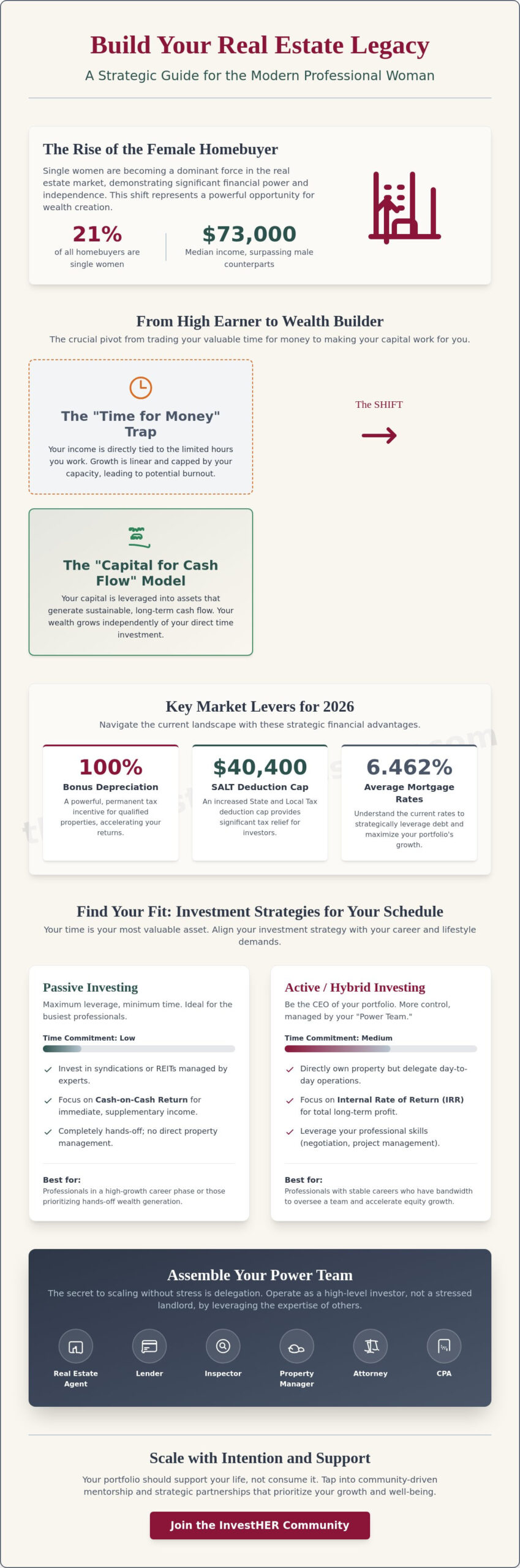
Did you know that single women now account for 21% of all homebuyers, with a median income of $73,000 that has officially surpassed their male counterparts? You’ve climbed the professional ladder and built a reputation for excellence, yet the thought of real estate investing for busy professionals often feels like another full-time job you simply don’t have the capacity to manage. It’s natural to feel a sense of analysis paralysis or fear that a single costly mistake could jeopardize the financial security you’ve worked so hard to achieve. You want to grow your legacy, but you’re already stretched thin by the demands of a high-stakes career.
We believe that your portfolio should support your life, not consume it. You deserve a strategy that aligns with your ambition without leading to burnout. This guide will show you exactly how to build a scalable real estate portfolio that generates wealth while you stay focused on your career and personal well-being. We’ll dive into the latest 2026 market shifts, including how to navigate the current 6.462% average mortgage rates and leverage the permanent 100% bonus depreciation. From understanding the increased $40,400 SALT deduction cap to finding a supportive network of like-minded women, this is your roadmap to intentional, sustainable growth.
Key Takeaways
- Shift your mindset from trading limited hours for a paycheck to leveraging capital for sustainable, long-term cash flow.
- Identify the specific passive and hybrid models that make real estate investing for busy professionals manageable without requiring a second full-time job.
- Master the art of the “Power Team” to ensure you are operating as a high-level investor rather than a stressed landlord.
- Evaluate high-potential out-of-state markets and learn why distance often leads to more disciplined, system-driven investment decisions.
- Scale your portfolio with intentionality by tapping into community-driven mentorship and strategic partnerships that prioritize your well-being.
Redefining Wealth: Why Real Estate is the Ultimate Professional Pivot in 2026
You’ve spent years honing your expertise and climbing the ranks. You command a room and manage complex projects with ease. But there’s a fundamental difference between being a high earner and being wealthy. Real estate investing for busy professionals serves as the ultimate bridge between professional success and true financial freedom. In 2026, this pivot is more than a trend; it’s a strategic necessity for those who want to protect their hard-earned capital from market volatility and inflation. While your career provides the capital, real estate provides the cash flow that eventually buys back your time.
The current economic landscape has shifted the way we view security. With the 2026 tax laws making 100% bonus depreciation permanent for qualified properties, the incentive to move from paper assets to tangible ones has never been stronger. A comprehensive overview of real estate investing shows that property offers a unique combination of leverage, tax benefits, and appreciation. It’s a “Capital for Cash Flow” model that contrasts sharply with the “Time for Money” trap of a traditional career. At the InvestHER community, we believe this journey isn’t just about the numbers on a spreadsheet. It’s about balancing your financial growth with your personal well-being, ensuring that your portfolio supports the life you want to lead rather than becoming another source of stress.
The Shift from Career Success to Financial Autonomy
High salaries can be deceptive. They offer a comfortable lifestyle, but they don’t equal long-term wealth unless they are converted into income-producing assets. Many women find themselves with a “growth mindset” in the office, focusing on how to scale their company’s revenue, yet they haven’t applied that same “investor mindset” to their personal balance sheet. Transitioning into real estate requires you to stop thinking like an employee and start thinking like an owner. Financial Autonomy is the ability to choose work based on passion, not necessity. It’s the moment your passive income covers your living expenses, allowing you to show up at your desk because you want to, not because you have to.
Addressing the #1 Professional Barrier: Time Poverty
The biggest myth holding women back is the idea that real estate requires 20 or more hours a week. It doesn’t. If you’re working a 40+ hour work week, you don’t need another job; you need a system. Real estate investing for busy professionals is about leveraging the skills you already possess, such as negotiation, project management, and leadership, to oversee a portfolio rather than swinging a hammer. You can choose where you fall on the spectrum of involvement. Whether you opt for a passive role in a syndication or a more active “hybrid” approach with a dedicated team, the goal is to remain the CEO of your investments. You don’t have to sacrifice your career to build a legacy; you just have to change how you spend your energy.
Active vs. Passive: Choosing the Right Strategy for Your Schedule
Your career doesn’t stay in one gear, and your investment strategy shouldn’t either. Real estate investing for busy professionals requires an honest assessment of your current “time budget.” If you’re in a high-growth phase, such as pushing for a partnership or launching a startup, your focus should likely lean toward passive vehicles. Conversely, if you’ve reached a plateau of stability, you might have the bandwidth to take a more active role to accelerate equity growth. Choose your season. Align your portfolio with your energy levels rather than fighting against them.
Understanding the metrics is vital for true alignment. Cash-on-Cash return measures the immediate cash flow relative to the money you’ve invested, which is ideal for those seeking to supplement their salary. Internal Rate of Return (IRR) accounts for the total profit over the entire holding period, including appreciation and debt paydown. While the median gross rental yield in the U.S. was recently reported at 8.3% in the National Association of Realtors’ 2024 report, your personal “yield” also includes the time you save or spend. A high return isn’t worth it if it costs you your peace of mind.
Passive Routes: Syndications and REITs
For the woman who has zero interest in managing a property but wants the benefits of ownership, real estate syndications offer a sophisticated solution. As a Limited Partner (LP), you pool your capital with others to acquire large-scale assets like multifamily complexes. You aren’t responsible for the daily operations; that’s the job of the General Partner (GP) or sponsor. Vetting these operators is the most critical step. Look for a track record of transparency and conservative underwriting. While you trade away control, you gain the ultimate luxury: a truly passive income stream. Many women find that overcoming the Barriers For Women Investing In Real Estate starts with these lower-barrier, high-impact passive entries.
Active Routes: Long-Term Rentals and STRs
Active investing, such as owning long-term rentals or Short-Term Rentals (STRs), typically builds wealth faster through direct control and higher tax incentives. High earners often target Real Estate Professional Status (REPS) to offset their W-2 income with depreciation losses, a powerful strategy when 100% bonus depreciation is available. You don’t have to be the one taking midnight maintenance calls. By hiring professional property management, you can maintain your executive focus while your assets grow. If you’re looking for a community that understands this delicate balance, you might find your tribe within The Real Estate InvestHER community. This “hybrid” approach allows you to stay in the driver’s seat of your financial future without losing your weekends to “tenants and toilets.”
Building Your ‘Power Team’: The Secret to Investing with a 40+ Hour Work Week
If you’re the one responding to a leaky faucet at 2:00 AM, you haven’t built a business; you’ve acquired a second job. Real estate investing for busy professionals is a team sport where your role is the CEO, not the technician. We call this the ‘InvestHER’ Rule: if you’re doing it all, you’re not an investor; you’re a landlord. True wealth building requires you to step away from the daily operations so you can focus on high-level strategy and your primary career. Success isn’t about how much you can do alone, but how well you can lead a collective of experts.
Your core team must include investor-friendly agents, lenders, and contractors who understand that your time is your most valuable asset. A retail agent might show you houses with beautiful curb appeal, but an investor-focused agent will bring you properties with strong debt-coverage ratios and value-add potential. Lenders should be well-versed in DSCR loans or commercial financing, while contractors must be reliable enough to work without constant supervision. Even if you choose to diversify your portfolio with Real Estate Investment Trusts (REITs) for total passivity, understanding how to vet a physical asset team remains a vital skill for direct ownership.
Vetting a property manager is perhaps your most critical task. They are the gatekeepers of your asset’s performance and your personal peace. Ask about their communication protocols, their average vacancy turnaround time, and how they handle maintenance emergencies. You shouldn’t be managing the property; you should be managing the manager. Use monthly reporting and digital dashboards to track your portfolio’s performance remotely. This allows you to see real-time data on rent collection and expenses without ever having to step foot on the premises.
Finding Investor-Friendly Partners in Local Markets
A retail agent focuses on emotions and aesthetics, but an investor-focused agent speaks the language of cap rates and cash flow. Beyond the agent, your CPA should be your most valuable strategic partner. With the 2026 tax changes, including the permanent 100% bonus depreciation and the increased SALT deduction cap, a savvy CPA will save you more money than any deal will make you. Focusing on Building a powerful real estate team is the first step toward reclaiming your calendar and ensuring your investments grow while you sleep.
Systems for Seamless Management
Efficiency is born from automation. Set up systems for rent collection and maintenance requests that require zero manual intervention from you. Establish ‘Standard Operating Procedures’ (SOPs) for your portfolio that dictate exactly how a vacancy is handled or when a repair is approved. By shifting to a model where you review monthly reports rather than micro-managing daily tasks, you create a sustainable ecosystem. This methodical approach ensures your real estate journey enhances your life instead of complicating it.
Navigating Local Markets: From Scottsdale to New York
Where you live shouldn’t dictate where you build your wealth. Real estate investing for busy professionals often requires looking beyond your own backyard to find markets where the numbers actually work. In high-cost hubs like New York or San Diego, the barrier to entry is steep; however, the potential for long-term appreciation remains a powerful draw for those with significant capital. Conversely, moving your focus to the sunbelt or mid-atlantic can unlock cash flow opportunities that are simply non-existent in coastal metros. By detaching your investment strategy from your zip code, you gain the freedom to follow the data rather than the commute.
The 2026 landscape offers distinct profiles for different goals. Phoenix and Scottsdale remain prime targets for short-term rental potential, provided you have a team to manage the evolving local regulations. If you prefer the stability of multifamily assets, Philadelphia and Orlando show positive demand driven by favorable demographics and a shortage of affordable for-sale housing. While home prices are expected to stabilize with a modest 2-3% growth this year, these regional pockets offer unique levers for value. Whether you’re chasing the high-reward dynamics of a Manhattan brownstone or the steady yields of a Florida apartment complex, your success depends on matching the market to your specific financial capacity.
Analyzing Regional Trends for 2026
Identifying “path of progress” neighborhoods in Austin and Dallas requires a look at infrastructure projects and corporate relocations scheduled for the coming year. As inventory levels increase and prices stabilize, the window for entry in these high-growth Texas hubs has widened. You must also stay vigilant regarding local regulations; major metros are increasingly restrictive with Airbnb and short-term rental permits. Cultivating deep local market knowledge serves as the ultimate hedge against unforeseen investment risk.
The ‘Only Woman in the Room’ Advantage
Being a professional woman in a male-dominated industry isn’t a hurdle; it’s a strategic advantage. You can leverage local InvestHER meetups to find off-market “pocket” listings that never hit the MLS, giving you an edge in competitive markets like Phoenix or San Diego. Building relationships with local lenders who understand your high-earning professional profile can also lead to more flexible financing terms. If you’re ready to connect with peers who are navigating these same markets, check out the Top Real Estate Events for Women to find your next partnership. You don’t have to analyze these markets in isolation when you have a community to lean on. Join our global network of professional women investors to start scaling your portfolio with confidence.
Scaling with Intention: How the InvestHER Community Supports Your Journey
Acquiring your first property is a milestone, but scaling into a portfolio is where the real transformation happens. Real estate investing for busy professionals can quickly become overwhelming if you try to navigate the complexities of 2026 market shifts alone. We’ve seen that the most successful women aren’t the ones with the most time; they’re the ones with the best support systems. Moving from a single rental to a scalable business requires a shift from individual effort to strategic partnerships. By surrounding yourself with a network that understands your high-level career demands, you can move past analysis paralysis and start making decisions rooted in collective wisdom.
Networking isn’t just a buzzword; it’s a critical professional development strategy. Events like The Real Estate InvestHER CON provide the space to connect with peers who have already solved the problems you’re currently facing. Whether you’re looking for a partner for a syndication or simply need a sounding board for a complex deal, the power of a tight-knit community cannot be overstated. It’s about finding those who have navigated the same obstacles and are dedicated to elevating others. This shared understanding turns a solitary, often stressful journey into a collaborative path toward excellence and strategic growth.
The Power of Mentorship and Peer Support
Professional women often thrive in structured environments where goals are clear and support is accessible. The STRIVE Mentorship program addresses the specific hurdles of scaling, providing a guide that is significantly faster and more reliable than a late-night Google search. A mentor offers the strategic wisdom you need to avoid costly mistakes, while a “Real Estate Bestie” provides the daily accountability to keep you moving forward. This combination of high-level guidance and peer-to-peer support ensures that you stay aligned with your vision even when your career gets demanding. It’s the difference between guessing your way through a deal and executing with the confidence of a seasoned pro.
Building a Legacy Beyond the Office
Real estate is about more than just numbers on a balance sheet; it’s about the legacy you leave behind. When you involve your family in the investment journey, you’re teaching the next generation the value of financial autonomy and intentional growth. The emotional ROI of taking control of your financial future is immense. It provides a sense of security and alignment that no corporate title can match. If you’re ready to stop dreaming and start doing, it’s time to find your tribe. Join The Real Estate InvestHER Community and start scaling today.
Your Journey to a Sustainable Legacy Starts Now
Building a portfolio isn’t about working harder; it’s about working with more intentionality. You’ve learned how to leverage your professional skills to vet markets and lead a power team that protects your most valuable asset: your time. Real estate investing for busy professionals is a strategic pivot that allows you to stop trading hours for dollars and start building a legacy that serves your family and your future. By choosing the right season for your investments and leaning into collective wisdom, you can scale without the burnout that often plagues high-level careers.
Founded by Liz Faircloth and Andresa Guidelli, our community is dedicated to ensuring no woman has to navigate this path alone. From our annual InvestHER CON featuring top industry leaders to our specialized programs, we provide the roadmap you need. If you’re ready to move from analysis to action with the support of a global network, it’s time to Scale Your Portfolio with the STRIVE Mentorship Program. You have the ambition and the expertise. Now, let’s build the freedom you deserve together.
Frequently Asked Questions
How much time does a busy professional realistically need to spend on real estate?
You can realistically manage a portfolio in two to five hours per week once your systems are established. This requires shifting from a “doer” to a “CEO” mindset where you oversee the strategy rather than the tasks. Your primary focus should be reviewing monthly reports from your property manager and analyzing new opportunities. By delegating daily operations to a power team, you ensure your investments support your lifestyle rather than draining your remaining energy.
Is it better to invest locally or look for out-of-state opportunities?
The best choice depends on your local market’s cap rates and your specific financial goals. If you live in a high-barrier city like New York, looking out-of-state to markets like Phoenix or Orlando often provides better cash flow. Modern technology and reliable local teams make distance irrelevant for the modern investor. Choosing the right market is about following the data and yields rather than staying within driving distance of your assets.
How do I find a real estate mentor who understands my career demands?
Finding a mentor requires looking for communities specifically tailored to high-achieving women who value their time. Structured environments like the STRIVE Mentorship Program are designed for those who need efficiency and strategic growth. You need a guide who recognizes the nuances of a demanding career and high-level decision making. A mentor who has navigated similar professional hurdles will provide faster, more actionable advice than a solo journey or a generic search.
Can I invest in real estate if I have a high-stress, 60-hour-a-week job?
You absolutely can invest while working sixty hours a week by prioritizing passive or hybrid strategies. Real estate investing for busy professionals isn’t about finding more time; it’s about leveraging the capital you’ve earned to buy back your time. Syndications or turnkey properties allow you to grow wealth without sacrificing your professional performance. Your career provides the necessary fuel, while the right strategy provides the engine for long-term growth.
What are the best real estate strategies for tax savings for high-earners?
High-earners should focus on strategies like 100% bonus depreciation and the Qualified Business Income (QBI) deduction. As of 2026, bonus depreciation is a permanent fixture for qualified properties, offering significant upfront tax relief. Additionally, the Section 199A deduction has been increased to 23% for those operating through pass-through entities. These provisions turn real estate into a powerful tool for preserving your professional income and building multi-generational wealth against heavy taxation.
How do I overcome the fear of my first out-of-state deal?
Overcoming fear starts with building a “Power Team” on the ground in your target market. You don’t need to see every property if you have a trusted investor-friendly agent and a vetted property manager. Start with deep market research and connect with local InvestHER meetups to gain confidence through others’ experiences. Once you have verified systems in place, the geographical distance becomes a source of investment discipline rather than a source of anxiety.
Is a real estate coaching program worth the investment for a beginner?
A coaching program is worth the investment if it provides a roadmap that saves you from costly beginner mistakes. For a professional woman, time is the most expensive resource you have. Programs that offer collective wisdom and a supportive network, such as those found in the InvestHER Community, accelerate your progress significantly. Investing in your education early ensures that your first deal is a strategic step toward a truly scalable portfolio.
What is the difference between active and passive real estate investing?
The difference lies in your level of daily involvement and direct control over the property. Active investing involves direct ownership where you make the final decisions on tenants, renovations, and management. Passive investing, such as through REITs or as a limited partner in a syndication, allows you to collect returns without any management responsibilities. Both paths build wealth, but your choice should align with your current career season and your desire for autonomy.

Article by
Andresa Guidelli
Real estate investor, operator, and founder of The Real Estate InvestHER, a national platform supporting women real estate investors. With 15+ years of experience in real estate investing and business operations, she focuses on helping investors build stronger businesses behind their portfolios through better systems, clearer decision-making, leadership, and responsible use of AI.
Be the first to comment