


Building Confidence as an Investor: A Strategic Guide for Women in Real Estate
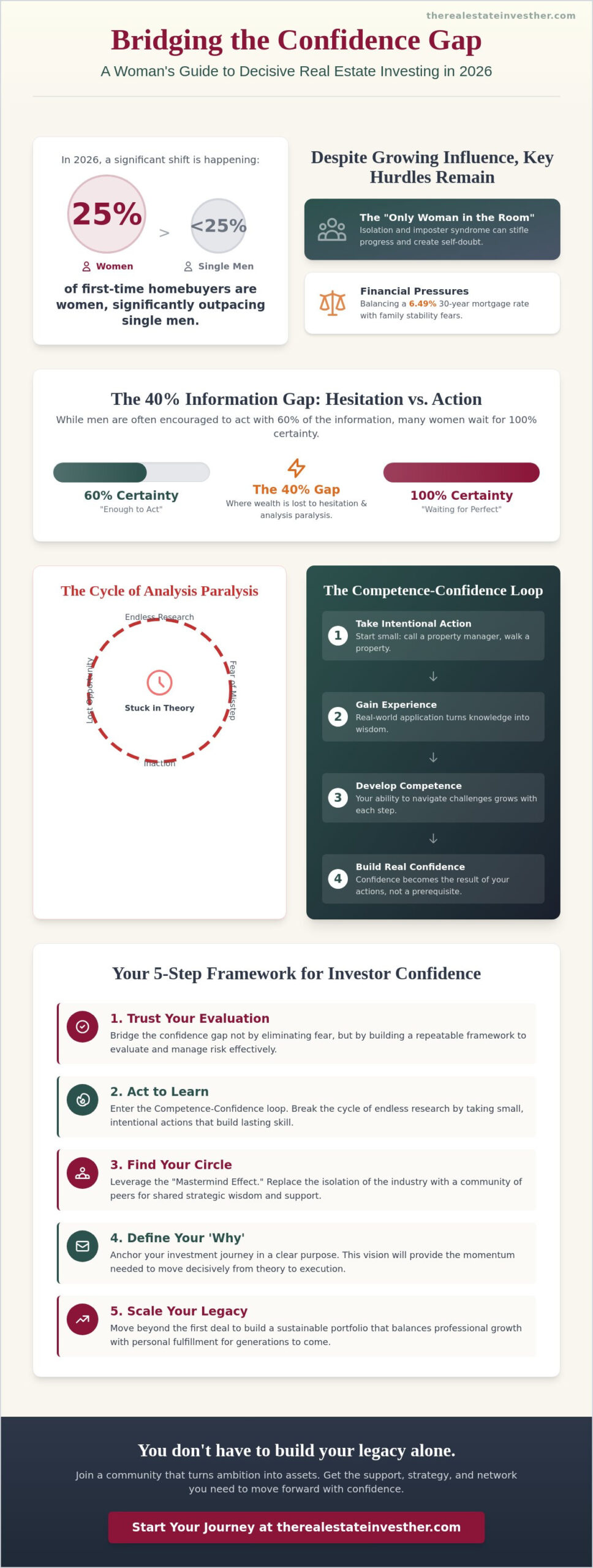
Did you know that in 2026, women represent 25% of all first-time homebuyers, significantly outpacing single men? Despite this growing influence, many of us still feel like the only woman in the room when we step into the investment arena. It’s natural to feel a sense of hesitation when 30 year mortgage rates sit at 6.49% and technical jargon seems designed to create barriers. You likely find yourself balancing the dream of financial independence with the very real fear that one misstep could impact your family’s stability.
Building confidence as an investor isn’t about waiting for the fear to disappear; it’s about creating a foundation that makes action possible. We understand the weight of these decisions. This guide will show you how to transform analysis paralysis into decisive, strategic moves by mastering the mindset used by successful women in our community. We’ll explore how to replace anxiety with a repeatable framework and find the supportive circle of peers you need to move from theory to execution. You don’t have to navigate these complexities alone. Together, we can turn your professional ambition into a sustainable legacy.
Key Takeaways
- Understand why waiting for total certainty is a hurdle and how to bridge the confidence gap by trusting your ability to evaluate risk.
- Learn to break the cycle of endless research by building confidence as an investor through the competence-confidence loop, where intentional action creates lasting skill.
- Discover the “Mastermind Effect” and how a community of peers can replace the isolation of the industry with shared strategic wisdom.
- Identify how to anchor your investment journey in a clear purpose to maintain momentum and move decisively from theory to execution.
- Explore the path to scaling your portfolio from a single deal to a sustainable legacy that balances professional growth with personal fulfillment.
Understanding the Confidence Gap in Real Estate Investing
Investor confidence is the quiet trust in your own ability to evaluate risk and execute decisions without being paralyzed by “what ifs.” It’s not the absence of fear, but the presence of a framework that allows you to move forward anyway. For many women, building confidence as an investor involves unlearning years of social conditioning that prioritized caution over calculated risk. While men are often encouraged to act when they have 60% of the information, many women feel they need 100% of the data before making a move. This 40% gap is where wealth is often lost to hesitation.
The journey of building confidence as an investor begins with identifying these internal barriers before they become external roadblocks. Real estate demands a unique kind of courage compared to traditional equities. Unlike stocks, where you can start with a few dollars on an app, real estate requires significant capital and a commitment to a physical asset. This high cost of entry triggers a specific “Real Estate Paralysis” that can stop even the most brilliant professional in her tracks. Social conditioning often tells us to be “safe” with our money, yet safety in an inflationary environment is often an illusion that costs us our long-term autonomy.
The “Only Woman in the Room” Phenomenon
Walking into a local investment meetup and realizing you’re the only woman in the room carries a heavy psychological weight. This isolation breeds impostor syndrome, making you wonder if your perspective on a deal is flawed simply because it’s different. Organizations like the Commercial Real Estate Women (CREW) Network have spent decades proving that professional visibility is the antidote to this isolation. Finding a “mirror” community where your goals are normalized is essential for growth. When you see other women successfully navigating the same hurdles, your own path transitions from “impossible” to “inevitable.”
Isolation is the enemy of progress. When you’re the only woman at a closing table or a renovation site, the lack of representation can feel like a constant tax on your energy. This environment makes you feel like a guest in a space where you should be the owner. Seeing a peer close a deal isn’t just inspiring; it’s proof of concept for your own dreams. A supportive circle replaces individual doubt with collective wisdom.
Analysis Paralysis vs. Strategic Due Diligence
Analysis paralysis isn’t a lack of intelligence; it’s a protective mechanism that has gone into overdrive. Your brain is trying to save you from a perceived threat, but in the process, it’s stealing your future. You must contrast this “endless learning” with “targeted research” focused on a specific outcome. If you’re looking at a specific market, stop reading general books and start analyzing specific zip codes. Knowledge becomes wisdom only when it’s applied to a real world scenario.
In a 2026 market where home price appreciation has slowed to 0.4%, the cost of inaction is the permanent loss of a rare window of market stabilization that may not return for years. Don’t let the search for a perfect deal stop you from making a profitable one. Strategic due diligence is about managing risk, while analysis paralysis is about trying to eliminate it entirely, which is a mathematical impossibility.
The Competence-Confidence Loop: Why Knowledge Isn’t Enough
Many aspiring owners believe they must feel certain before they sign a contract. This is a common misconception. Confidence is the result of action, not the cause of it. When you wait for total certainty, you’re actually feeding your imposter syndrome rather than overcoming it. Building confidence as an investor requires entering the competence-confidence loop: you take an action, gain experience, develop competence, and finally feel confident. Reading one more book won’t solve a mindset hurdle because theory lacks the emotional stakes of real world application. Action creates clarity.
Start with micro-wins to recalibrate your risk tolerance. A micro-win could be as simple as calling a property manager or walking through a fixer-upper with a contractor. These small steps prove to your brain that you can navigate the technical aspects of a deal without the world ending. By leveraging the unique perspective of being “the only woman in the room,” you can identify community needs or design features that others overlook. Your attention to long-term stability and holistic value is a competitive edge, not a weakness. Building confidence as an investor is a muscle that only grows through resistance and repetition.
Shifting from Passive Learning to Active Evaluation
Stop consuming and start calculating. Follow the 70/30 rule: spend only 30% of your time on general education and 70% analyzing actual deals. You can build a “Deal Sandbox” by running numbers on active listings in competitive markets like Scottsdale or Austin without committing capital. This practice sharpens your intuition. Local market immersion helps you understand why one street commands a premium while another doesn’t. This is how you move from general theory to specialized expertise. Practice until the numbers speak a language you understand fluently.
Embracing the “Ex-Ante” Decision Mindset
In the 2026 market, with 30-year mortgage rates averaging 6.49%, the margin for error feels slim. You must focus on the quality of your decision-making process rather than being distracted by short-term market volatility. A bad outcome is not always the result of a bad decision; it is often just a reflection of external variables you cannot control. Use a standardized checklist for your “Go/No-Go” phase to remove emotion from the equation. This system ensures that your choices are rooted in logic and purpose. If you’re looking for a structured way to sharpen these skills, you might find value in the community-driven resources at The Real Estate InvestHER.
Building Your “InvestHER” Circle: The Power of Community
Real estate investing is frequently presented as a solitary pursuit. This isolation is a quiet confidence killer. When you’re the only one looking at a pro-forma at midnight, every doubt feels amplified. Community changes the math. The “Mastermind Effect” allows you to tap into collective wisdom, reducing the fear of the unknown. Building confidence as an investor is significantly more sustainable when you aren’t reinventing the wheel in a vacuum. Collective strength replaces individual anxiety.
There is a distinct difference between a generic “networking group” and an intentional community. Generic groups often focus on transactional card-swapping. An intentional community focuses on shared growth, vulnerability, and long-term legacy. Research regarding the gender gap in housing returns suggests that women sometimes face hurdles in timing and negotiation that impact their bottom line. A tight-knit circle provides the peer-review process necessary to navigate these challenges with authority. You don’t just need contacts; you need a circle that normalizes your highest ambitions.
The Role of Mentorship in Scaling
A mentor provides the “borrowed confidence” you need to cross the finish line of your first major deal. When your own certainty wavers, you can lean on their experience to validate your steps. The STRIVE Mentorship Program is designed to bridge this gap by combining strategic technical knowledge with high-level accountability. It’s about finding a guide who aligns with your personal values and long-term legacy goals. A great mentor doesn’t just tell you what to do. They help you see the investor you are already becoming.
Finding Local Support in Major Investor Hubs
While digital connection is powerful, boots-on-the-ground support is irreplaceable. Local InvestHER chapters in hubs like San Diego, Dallas, or Philadelphia provide a space to discuss market-specific nuances. Whether you’re navigating local regulations in New York or tracking inventory shifts in Austin, community shortcuts save time and money. These meetups offer more than just advice. They provide the human connection that transforms a scary financial decision into a shared milestone. Building confidence as an investor often starts with a single conversation in a room where you finally feel at home.
5 Strategic Steps to Build Your Investor Confidence in 2026
Transforming your vision into a tangible portfolio requires more than just intent; it requires a structured path. Building confidence as an investor is a process of narrowing your focus until the path forward becomes undeniable. In a market where home price appreciation has slowed to 0.4% as of March 2026, precision is your greatest asset. You don’t need to know everything to start, but you do need a framework that minimizes noise and maximizes execution. Follow these five steps to anchor your journey in strategy rather than guesswork.
- Step 1: Define Your “Why.” Your purpose is your anchor. Whether you’re seeking time freedom or building a legacy for your family, a clear “why” provides the emotional fuel to push through technical hurdles.
- Step 2: Master One Strategy. Avoid the “shiny object syndrome” that leads to overwhelm. Choose one method, such as short-term rentals or the BRRRR method, and learn its nuances until you can spot a deal in your sleep.
- Step 3: Build Your “Core Four” Team. You don’t have to be an expert in every field. Surround yourself with a trusted agent, lender, contractor, and property manager who understand your specific goals.
- Step 4: Execute a “Low-Stakes” Action. Move from theory to reality. Schedule a property walkthrough or submit a formal offer on a property that fits your criteria to break the seal of inaction.
- Step 5: Review and Refine. Use the collective wisdom of your community to audit your progress. Adjustment isn’t failure; it’s the hallmark of a sophisticated professional.
Defining Your Investment Criteria
A strict “Buy Box” is your best defense against second-guessing. When you define exactly what a “good” deal looks like for Austin or Dallas markets, you gain the psychological relief of saying “no” to distractions. This clarity allows you to act with speed when a property finally checks every box. Your business plan doesn’t need to be a 50-page document. A focused, one-page criteria sheet ensures your decisions remain rooted in logic, especially when 30-year fixed rates sit at 6.49%.
Building Your Professional “Moat”
Your confidence is only as strong as the team standing behind you. Having a vetted lender in San Diego or Philadelphia means you can bid with the certainty that your financing is secure. This professional moat protects you from renovation anxiety because you’ve already interviewed contractors before the deal is even signed. Knowing your “worst-case scenario” is covered by a solid plan allows you to sleep at night. Building confidence as an investor is easier when you’re supported by experts who have navigated these waters before. If you’re ready to stop guessing and start growing, join the InvestHER Community Membership to connect with the partners you need to scale.
Scaling Your Legacy: From First Deal to Portfolio Growth
The transition from your first closing to a multi-unit portfolio is more than a financial shift; it’s a mental expansion. Once you prove the model works once, the primary question shifts from “Can I do this?” to “How big can I go?” Scaling requires a different set of tools than starting. You move from being a solo operator to a strategic leader who manages systems and partnerships. Building confidence as an investor at this level means trusting your ability to lead others and manage larger risks. It’s about moving from a mindset of scarcity to one of abundance and long-term legacy.
Your growth is accelerated when you stop trying to solve every problem alone. The InvestHER Community Membership provides the ongoing support system needed to sustain this momentum. When you surround yourself with women who are also scaling, high-level success becomes your new normal. An interesting phenomenon occurs as you grow: helping other women build their own confidence reinforces your own. Mentorship is a two-way street that solidifies your expertise while lifting others. This collective strength is the foundation of a lasting financial legacy. Building confidence as an investor becomes a shared mission rather than a lonely climb.
The InvestHER CON Experience
Immersive events are the fastest way to break through a confidence plateau. When you step away from the daily grind and enter a space filled with hundreds of intentional women, your “mindset battery” recharges. Networking with industry leaders allows you to see the human side of massive success. It demystifies the process of portfolio growth. By registering for InvestHER CON 2026, you lock in a dedicated time to focus on your vision. These three days provide more clarity than six months of solo research. You’ll leave with a notebook full of strategies and a heart full of conviction.
Joining the STRIVE Mentorship Program
Moving from community support to structured scaling requires expert guidance. The STRIVE Mentorship Program offers a roadmap for those ready to move from their first few deals to a professional-grade portfolio. Professional coaching eliminates the guesswork that often causes fear during the scaling phase. You gain access to proven systems that allow you to grow without sacrificing your personal well-being. This is the intersection of financial independence and a life well-lived. Take the next step in your journey and Join the InvestHER Community to start building your wealth on your own terms. Your future self is waiting for you to take the lead.
Own Your Financial Future through Decisive Action
You’ve navigated the complexities of the 2026 market and identified the frameworks that turn analysis paralysis into a professional strategy. True growth happens when you move beyond the “Only Woman in the Room” mindset and embrace the collective wisdom of a dedicated peer network. Building confidence as an investor isn’t a solo endeavor; it’s a collaborative process of taking calculated risks and celebrating shared wins. Action creates clarity.
Founded by Liz Faircloth and Andresa Guidelli, our community provides the structure you need to move from theory to execution. With over 50+ local chapters across the US and the expert-led STRIVE Mentorship Program, you have access to the exact tools required for high-level scaling. It’s time to replace the noise of conflicting advice with a repeatable system that honors your well-being and your ambition. Don’t let another market cycle pass while you wait for the “perfect” moment.
Join the InvestHER Community and Build Your Confidence Today. You’re ready to stop watching from the sidelines and start building a portfolio that reflects your highest potential. Your legacy starts with the next decision you make.
Frequently Asked Questions
How do I start investing in real estate if I am afraid of losing money?
You start by shifting your focus from the fear of loss to the systems of risk mitigation. Use conservative underwriting with current market data, such as the 2026 average 30 year mortgage rate of 6.49%, to ensure your cash flow remains positive even in a slow market. By running “worst case” scenarios and maintaining a six month reserve fund, you replace anxiety with a calculated plan. Starting small allows you to gain experience without overleveraging your family’s financial stability.
What is the best way for a woman to find a real estate mentor?
The most effective way to find a mentor is within intentional communities that prioritize shared values over transactional interactions. Look for environments where successful women are already dedicated to elevating others through structured programs. A mentor should provide more than just technical advice; they should offer high level accountability and a proven roadmap for scaling. Engaging with groups that have established local chapters ensures you find a guide who understands your specific market challenges.
How much money do I really need to feel confident starting my first deal?
The amount varies based on your chosen strategy, but confidence comes from having a clear “Buy Box” rather than a specific dollar amount. While some entry level strategies require less capital, having a 20% down payment plus a dedicated reserve for repairs and vacancies is a standard benchmark for long term stability. Knowing your numbers inside and out is what builds the certainty needed to sign a contract. Precision in your financial planning prevents mid deal anxiety when unexpected costs arise.
Is real estate investing more risky for women than men?
Real estate risk is tied to the asset and the market rather than gender, though social factors can create different hurdles for women. While the Equal Credit Opportunity Act protects against lender discrimination, some industry reports still show that single female applicants can face higher denial rates. This reality makes building confidence as an investor through a strong “Core Four” team even more vital. When you have a trusted lender and a supportive community, you navigate these external risks with the same authority as any other professional.
How do I overcome analysis paralysis when looking at my first rental property?
You overcome analysis paralysis by replacing endless learning with a standardized “Go/No-Go” checklist. Set a firm deadline for your research phase to prevent yourself from getting stuck in a loop of “one more data point.” If a property meets 80% of your criteria, it is often a signal to move forward rather than waiting for a perfection that doesn’t exist. Taking a low stakes action, like walking a property with a contractor, is the only way to start building confidence as an investor.
Can I build investor confidence without having a finance background?
You don’t need a finance degree to succeed; you need a willingness to master a specific, repeatable system. Real estate is a team sport where you can leverage the expertise of a professional lender or accountant to handle complex calculations. Focus on understanding core metrics like Cash on Cash return and Net Operating Income. As you execute small actions and see the numbers work in real life, your competence will grow regardless of your professional history.
What are the most important mindset shifts for new real estate investors?
The most critical shift is moving from a scarcity mindset to one of long term abundance and legacy. Instead of seeing a 6.49% mortgage rate as an insurmountable barrier, view it as a filter that reduces competition from less serious buyers. Focus on your “why” to stay anchored when challenges arise during a renovation or tenant search. Seeing every obstacle as a strategic puzzle rather than a personal failure is what separates successful owners from those who stay on the sidelines.
How does joining an investor community actually help me close more deals?
Joining a community helps you close deals by providing access to a “Mastermind Effect” where collective wisdom identifies opportunities you might miss alone. Peers can offer boots on the ground insights into specific neighborhoods or suggest vetted contractors who have a track record of excellence. This environment normalizes high level success and provides the accountability needed to submit offers consistently. When you see your peers closing deals, your own path to a successful closing feels inevitable.

Article by
Andresa Guidelli
Real estate investor, operator, and founder of The Real Estate InvestHER, a national platform supporting women real estate investors. With 15+ years of experience in real estate investing and business operations, she focuses on helping investors build stronger businesses behind their portfolios through better systems, clearer decision-making, leadership, and responsible use of AI.
Be the first to comment