


How to Start Investing in Real Estate: The 2026 Strategic Guide for Women
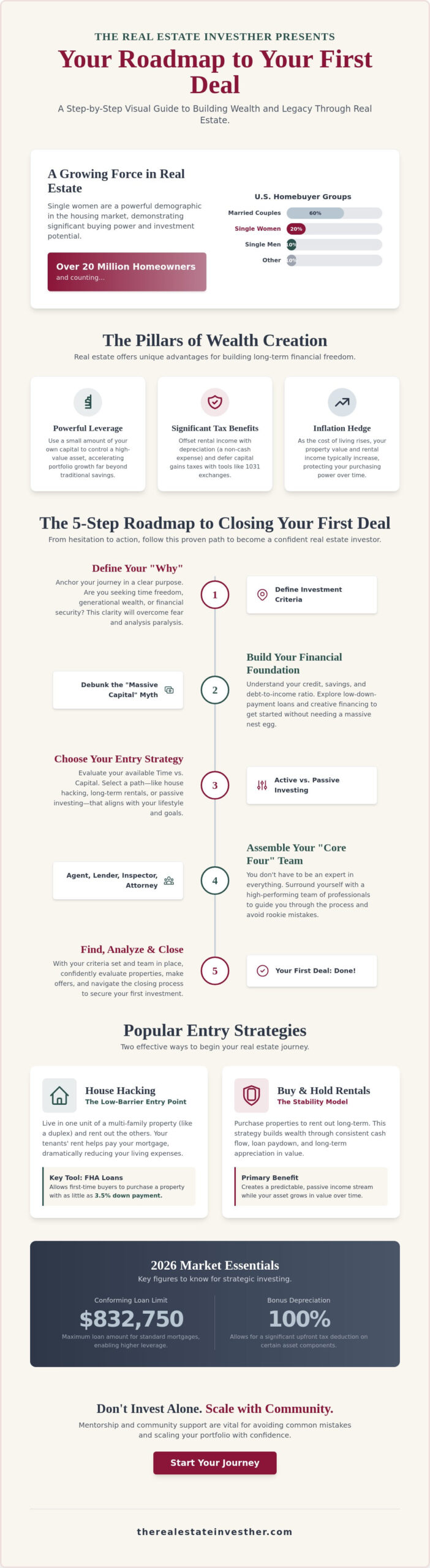
Did you know that single women now account for 20% of all homebuyers; making them the second-largest homebuyer group in the United States? Despite this record high of over 20 million homeowners, it’s easy to feel like the only woman in the room when the conversation turns to 6.3% mortgage rates or complex tax codes. You might find yourself stalled by analysis paralysis or the valid fear of making a costly financial mistake. Learning how to start investing in real estate shouldn’t feel like a solo trek through a landscape that wasn’t designed for your success.
You deserve a seat at the table where financial autonomy and intentional growth are the primary topics of conversation. This guide provides a comprehensive, step-by-step roadmap to closing your first deal while building a legacy of community support. We’ll break down the 2026 market essentials, including the latest $832,750 conforming loan limits and the strategic use of 100% bonus depreciation. You’ll gain the clarity needed to move from hesitation to action, ensuring your first investment is a foundation for long-term independence.
Key Takeaways
- Understand the 2026 market shift toward community-centric housing. Learn how to leverage real estate as a vehicle for personal autonomy and long-term legacy.
- Evaluate your unique ‘Time vs. Capital’ availability. This helps you choose an entry strategy that aligns with your current professional and personal goals.
- Discover the practical steps for how to start investing in real estate by building a strong financial foundation. You’ll learn to debunk the myth that massive capital is required.
- Learn the five-step roadmap to closing your first deal. This includes defining your investment criteria and assembling a high-performing ‘Core Four’ team.
- Recognize the importance of specialized mentorship. Community support is vital for scaling your portfolio while avoiding common rookie mistakes.
Understanding the Real Estate Landscape in 2026
Real estate investing is far more than a simple exchange of property for profit; it is a powerful vehicle for personal autonomy and the creation of generational wealth. In 2026, we are witnessing a significant shift in the market toward sustainable, community-centric housing. Investors are no longer just looking at square footage. They are looking at how a property fosters connection and environmental responsibility. This evolution plays directly into the strengths of female investors. Women are uniquely positioned to excel in this environment because our approach often prioritizes relationship-building and long-term stability over short-term, transactional wins. Whether you are managing a small multi-family unit or participating in a large-scale development, your ability to connect with tenants and partners is a competitive advantage.
When you explore how to start investing in real estate, you must first decide between active and passive paths. Active investing, such as managing long-term rentals or executing property flips, requires significant time and direct oversight. It offers higher control and potentially higher returns. Passive investing, through vehicles like Real Estate Investment Trusts (REITs) or syndications, allows you to grow your capital alongside experienced operators without the burden of daily management. Gaining a firm grasp on the Fundamentals of Real Estate Investing will help you determine which strategy aligns with your current capacity and future vision.
Why Real Estate is the Ultimate Wealth-Building Tool
The true magic of this asset class lies in the power of leverage. You don’t need to fund the entire purchase price yourself; instead, you use a small percentage of your own capital to control a high-value asset. This allows you to scale your portfolio much faster than traditional savings ever could. Beyond leverage, the tax benefits are a cornerstone of wealth preservation. Depreciation acts as a non-cash expense that can offset your rental income, while strategies like 1031 exchanges allow you to defer capital gains taxes when you sell one property to buy another. In our 2026 economy, these assets serve as a vital hedge against inflation. As the cost of living climbs, your property value and rental rates typically follow suit, protecting your purchasing power.
The ‘InvestHER’ Perspective: Mindset Over Matter
Analysis paralysis is the most common hurdle for women entering this space. The fear of making a costly mistake often leads to endless research without action. To break this cycle, you must anchor yourself in “Your Why.” Are you seeking time freedom to be with your family, a legacy to pass down, or the security of a diversified income stream? When your purpose is clear, the risks become manageable steps in a larger journey. The InvestHER mindset is a blend of strategic execution and empathetic leadership. It’s about moving past the fear of being the only woman in the room and recognizing that your perspective is exactly what the market needs for sustainable growth.
Choosing Your Entry Strategy: Where Do You Fit In?
Every investor’s journey is deeply personal. You shouldn’t force a high-intensity strategy like flipping if you’re currently balancing a demanding corporate career and family life. Instead, analyze the risk-to-reward ratio through the lens of your “Time vs. Capital” availability. Finding the right path for how to start investing in real estate begins with an honest assessment of your resources. Core markets like San Diego offer stability and long-term appreciation, while growth markets like Phoenix present opportunities for faster equity gains. Learning how to start investing in real estate is about aligning your financial goals with the lifestyle you want to lead. Your investment choice must serve your life, not consume it.
House Hacking: The Low-Barrier Entry
House hacking is the ultimate entry point for those wanting to minimize out-of-pocket costs. By living in one unit of a duplex or triplex and renting out the others, you can effectively use your tenants’ rent to cover your mortgage. FHA loans are a primary tool here. They allow first-time buyers to enter the market with as little as 3.5% down. When evaluating a potential house hack, look for properties with separate utility meters, ample parking, and clear zoning for multi-unit use. This strategy allows you to learn the ropes of landlording while significantly reducing your own living expenses.
Long-Term Rentals and the ‘Buy and Hold’ Model
Stability is the hallmark of residential rentals in markets like Austin and Dallas. These cities benefit from diverse economies and consistent housing demand. For those looking to scale a portfolio with limited initial funds, the BRRRR method (Buy, Rehab, Rent, Refinance, Repeat) is a proven framework. It allows you to “recycle” your capital by refinancing the property after increasing its value through renovations. While single-family homes are often easier to finance, small multi-family units (2-4 units) typically offer more robust cash flow. If you have capital but zero interest in being a landlord, Understanding REITs provides a strictly passive way to benefit from real estate without managing physical assets.
Short-Term Rentals and Niche Strategies
The 2026 outlook for vacation rentals in destination spots like Scottsdale or Orlando remains positive, provided you offer a high-end guest experience. Niche strategies like mid-term rentals are also gaining traction in cities like New York or Philadelphia. These properties cater to traveling nurses or digital nomads who need stays of 30 days or longer. Before diving in, perform deep due diligence on local laws. Regulatory environments can shift quickly, and staying compliant is non-negotiable for long-term success. Connecting with a supportive community of women can provide the local insights you need to choose your market wisely.
Building Your Financial Foundation and Funding
One of the most persistent barriers for women is the misconception that you need a massive windfall to enter the market. This myth often leads to unnecessary delay. In reality, single women are leading the charge; they currently represent 20% of all homebuyers. With a median income of $76,685, many are finding that how to start investing in real estate is less about having a huge bank account and more about understanding financial leverage. Your credit score and debt-to-income (DTI) ratio are the true gatekeepers of your success. In 2026, with average 30-year fixed mortgage rates hovering between 6.3% and 6.5%, a strong financial profile ensures you qualify for the best possible terms. If your capital is limited but your ambition is high, consider the power of partnerships. Aligning with a partner who has capital while you provide the “sweat equity” or deal-finding expertise can launch your portfolio faster than going it alone.
Sustainability requires a safety net. Never underestimate the importance of a dedicated cash reserve. This fund protects your legacy from the stress of unexpected repairs or temporary vacancies. It transforms a potential crisis into a simple maintenance task. Balancing professional ambition with personal well-being means ensuring your investments don’t become a source of financial anxiety.
Traditional vs. Creative Financing
Conventional bank loans remain a staple, especially with current conforming loan limits at $832,750 for one-unit properties. However, don’t overlook creative avenues. Hard money lenders offer speed for flips, while private money from your network can provide more flexible terms. Seller financing is particularly effective in the 2026 market. It allows you to bypass traditional banks by making payments directly to the seller. This creates a win-win scenario where the seller receives steady income and you secure a property with potentially lower entry costs. For homeowners, a Home Equity Line of Credit (HELOC) can serve as a strategic source for a down payment on your first investment property.
The Importance of Pre-Approval and Financial Readiness
Talking to a lender is your actual first step. You need a clear picture of your purchasing power before you fall in love with a property. A solid Beginner’s Guide to Real Estate Investing often highlights pre-approval as the foundation of a serious offer. In 2026, be prepared with two years of tax returns, recent pay stubs, and bank statements. Finding investor-friendly lenders in competitive markets like San Diego is crucial. These professionals understand that your goal is a scalable portfolio, not just a single residence. They can guide you through the nuances of investment property rates, which typically sit 0.5% to 1% higher than primary residence loans. Knowing how to start investing in real estate starts with a firm grasp of these numbers.
Your 5-Step Roadmap to Closing the First Deal
Closing your first deal is the moment theory transforms into a tangible asset. It is a milestone that requires a shift from passive learning to strategic execution. When you are learning how to start investing in real estate, the process can feel overwhelming without a structured path. You must first define your investment criteria, often called a “buy box.” This includes your target location, the specific property type, and your required return on investment. Having these boundaries prevents you from being distracted by deals that don’t align with your long-term legacy. Clarity is your best defense against analysis paralysis.
Success is rarely a solo endeavor. Once your criteria are set, you must build your “Core Four” team. This group consists of an investor-friendly agent, a lender, a contractor, and a property manager. With your team in place, you begin the high-volume work of the 100-10-3-1 rule. You will review 100 properties, perform deep analysis on 10, make offers on 3, and eventually close on 1. This funnel ensures you remain objective. You are looking for the best data, not the best-looking house. Confidence comes from numbers; it does not come from a gut feeling. Knowing how to start investing in real estate means trusting the process over the property.
The final phase involves making confident offers based on data and executing due diligence. You don’t just buy a house; you acquire a business. Closing with a clear management plan is essential for long-term sustainability. Ensuring you have a property manager ready on day one allows you to maintain your professional focus elsewhere. This transition from buyer to owner is where your legacy begins to take shape.
Building Your Local ‘Core Four’ Team
As a busy professional, you don’t have the time to be a “jack of all trades.” Attempting to manage every detail leads to burnout and missed opportunities. Vetting an investor-friendly agent in competitive markets like New York or Austin is essential. These agents understand that you care about the cap rate, not the color of the kitchen cabinets. A property manager is equally vital; they are the key to making your income truly passive. They handle the daily operations so you can focus on scaling your portfolio and spending time with those who matter most.
Mastering the Art of Deal Analysis
You must become fluent in the language of returns. Focus on key metrics like Cash-on-Cash Return, Cap Rate, and Net Operating Income (NOI). These numbers tell the story of a property’s health and its ability to weather market shifts. Due diligence is the process of verifying every assumption made during your initial analysis. This involves a thorough physical inspection and “walking the property” to identify hidden costs. If you want to master these steps alongside a supportive network, consider joining the InvestHER Community Membership to connect with women who have already walked this path.
Scaling for the Long Term: The Power of Community
The “Lone Wolf” approach is a fast track to burnout. While you can certainly learn how to start investing in real estate through individual research, scaling a portfolio requires a collective effort. Growth is about more than just accumulating properties; it’s about the people who support your vision. In high-growth hubs like Scottsdale or Dallas, the most lucrative off-market deals aren’t found on a listing site. They’re found through high-level networking and trusted partnerships formed over shared values. The InvestHER community serves as the essential bridge between your first deal and a truly scalable portfolio that provides long-term autonomy. Moving from isolated effort to collective strength transforms the way you view every new opportunity.
Scaling requires a shift in perspective. You’re no longer just a property owner; you’re the CEO of a growing enterprise. This evolution demands a network that matches your ambition. Surrounding yourself with like-minded women ensures you aren’t just building a bank account, but a legacy that reflects your personal well-being. A supportive community provides the emotional resilience needed to navigate market shifts and the strategic wisdom to pivot when necessary. When you have a network to lean on, the challenges of 2026 become manageable steps in a much larger, more rewarding journey.
Why Mentorship Accelerates Your Journey
Rookie mistakes are expensive. Contrast the investment in specialized mentorship with the devastating cost of a $50,000 renovation gone wrong or a poorly vetted tenant. Through the STRIVE Mentorship Program, you gain access to strategic wisdom from experts who have already navigated the obstacles you’re currently facing. These mentors help you see around corners, ensuring your growth is both rapid and sustainable. Accountability Circles within the program are vital for maintaining momentum. They turn your “someday” goals into weekly action items, ensuring you never stall in the face of uncertainty. It’s about moving from a place of questioning to a place of decisive, expert-backed action.
Networking and Events: InvestHER CON 2026
There’s a transformative power in being in a room where you aren’t the only woman. Events like InvestHER CON allow you to find the partners, lenders, and lifelong friends who will help you scale your business. These gatherings are the heartbeat of the community, where abstract strategies become concrete partnerships. You’ll hear stories of resilience that mirror your own and find the collective wisdom needed to overcome any hurdle. Join us at InvestHER CON 2026 to take your first or next step with confidence. Success is a shared journey; don’t feel like you have to walk it alone.
Your Path to Financial Autonomy and Legacy
You’ve explored the 2026 landscape and defined your unique entry strategy. You’ve learned that how to start investing in real estate is as much about your mindset as it is about conforming loan limits or cap rates. By building your “Core Four” team and following a data-driven roadmap, you’ve moved past analysis paralysis toward strategic execution. Success isn’t just about the numbers on a spreadsheet; it’s about the freedom and community you build along the way.
Real growth happens when you step out of isolation and into collective strength. Whether you’re scaling through the STRIVE Mentorship Program or connecting with industry leaders at our annual InvestHER CON, you don’t have to navigate this journey alone. Our specialized resources, including “The Only Woman in the Room,” are designed to support your evolution from your first deal to a flourishing, sustainable portfolio. Scale your portfolio and join our community of driven women investors. Your future of financial independence is a legacy you’re building today with every intentional choice.
Frequently Asked Questions
How much money do I really need to start investing in real estate in 2026?
You can start with as little as 3.5% down for a primary residence or a house hack, but you should also budget for closing costs and a solid reserve fund. Closing costs usually range from 2% to 5% of the property’s purchase price. Having a cash reserve of three to six months of expenses ensures you can handle unexpected repairs without compromising your family’s security or your peace of mind.
Can I invest in real estate if I have a full-time job and kids?
Yes, balancing a career and family is entirely possible if you prioritize delegation over DIY management. By building a reliable property management team, you transition from a hands-on landlord to a strategic owner. This approach allows you to focus on your primary income and your children while your assets build equity. Many successful women start with passive options or small multi-family units that require less daily oversight.
Is it better to invest locally or out-of-state?
Investing locally is often best for your first deal because you already understand the neighborhoods and can visit the property easily. However, if your local market is prohibitively expensive, out-of-state investing in growth markets can offer better cash flow. The key is having a trusted “boots on the ground” team to manage the physical asset. Your choice should depend on where the numbers align with your target returns and lifestyle.
What are the biggest risks for first-time real estate investors?
The most significant risks involve underestimating maintenance costs or overestimating the potential rental income. New investors often forget to account for “capital expenditures,” such as roof replacements or HVAC failures, which can erode profit margins. Performing thorough due diligence and using conservative numbers during your analysis will help mitigate these financial hazards. Always leave a buffer in your budget for vacancies and market fluctuations to ensure long-term sustainability.
How do I find an ‘investor-friendly’ real estate agent?
Look for agents who personally own investment property and understand metrics like cap rates and cash-on-cash returns. Ask potential agents how many investor clients they’ve represented in the last year. A true investor-friendly agent will provide data-driven insights rather than just focusing on aesthetic features. They should be able to help you identify “value-add” opportunities that a typical homebuyer might overlook during their search.
What is the best type of property for a beginner to buy?
A single-family home or a small multi-family unit with two to four units is typically the best entry point. Single-family homes are easier to understand and finance, making them a great way to learn how to start investing in real estate without excessive complexity. If you want a more hands-off experience, consider a “turnkey” property that is already renovated and tenanted. This allows you to collect rental income from day one.
How do I overcome the fear of making a mistake on my first deal?
Education is the most effective antidote to fear. By deeply understanding the mechanics of how to start investing in real estate, you replace anxiety with calculated confidence. Try running the numbers on a “worst-case scenario” to see if you can still survive the investment financially. Remember that every successful investor started with a single, imperfect deal. Surrounding yourself with a supportive network of women provides the emotional safety net you need to move forward.

Article by
Andresa Guidelli
Real estate investor, operator, and founder of The Real Estate InvestHER, a national platform supporting women real estate investors. With 15+ years of experience in real estate investing and business operations, she focuses on helping investors build stronger businesses behind their portfolios through better systems, clearer decision-making, leadership, and responsible use of AI.
Be the first to comment