


Investing in Real Estate Without Being a Landlord: A 2026 Guide
What if reducing landlord work starts with choosing a different investment structure, not simply hiring someone to handle the calls? Investing in real estate without being a landlord can mean buying REIT shares, investing in a private real estate fund or crowdfunding offering, or owning a rental and hiring a property manager. Each option changes how much work you take on, as well as how much control and access to your money you retain.
If tenant issues and property decisions are crowding out time for your broader business, a hands-off investment may appeal. But delegating work doesn’t remove your responsibility to understand the investment. You still need to assess its risks, fees, liquidity, and who makes key decisions.
This guide compares the main options by workload, control, liquidity, fees, and risk. You’ll also learn what oversight remains yours, what to investigate before committing, and how to match a structure to your goals and capacity. The aim isn’t to find one answer for every investor. It’s to help you ask sharper questions before choosing a specific opportunity.
Key Takeaways
- Investing in real estate without being a landlord can mean delegating rental operations or choosing an investment vehicle, but neither removes risk or the need for oversight.
- Compare each structure by ownership rights, workload, control, liquidity, fees, and principal risks, not projected returns alone.
- Check the sponsor’s claims, property assumptions, financing, and potential conflicts before signing or transferring funds.
- Rank your priorities, including time commitment, control, liquidity, learning needs, and investment horizon, before selecting a strategy.
- Use peer conversations to sharpen your diligence questions, then verify the opportunity independently.
What Does Investing in Real Estate Without Being a Landlord Mean?
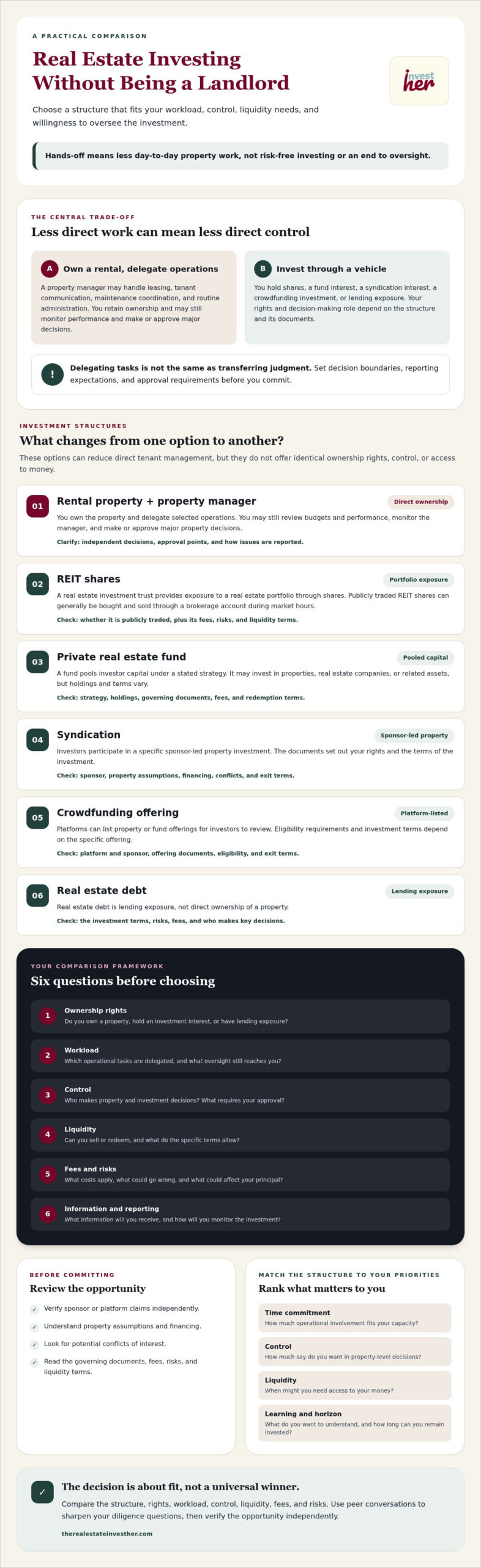
Investing in real estate without being a landlord generally means either delegating rental operations on property you own or gaining real estate exposure through an investment vehicle. “Hands-off” means less day-to-day property work, not a risk-free investment or an end to oversight.
These are different arrangements. If you own a rental and hire a property manager, you retain ownership of that property while delegating some operations. If you invest in a pooled fund, you hold an interest in an investment that may own or finance real estate, and your rights depend on the fund’s documents. Publicly traded REITs are another option. A Real Estate Investment Trust (REIT) can provide real estate exposure without requiring you to manage tenants at an individual property.
Landlord-free investing reduces direct involvement in rental operations, but it doesn’t remove investment risk or the need to understand who controls decisions.
What responsibilities can you delegate as a property owner?
A property manager may handle leasing, tenant communication, maintenance coordination, and routine administration. That can reduce the operational tasks reaching your desk, but delegation doesn’t transfer ownership or every investment decision. You may still need to monitor the manager, review budgets and property performance, and make or approve major decisions under your management agreement.
Set expectations before delegating. Define what the manager can decide independently, what requires your approval, and how performance and issues will be reported. A clear process can make oversight more manageable, but it doesn’t automatically transfer judgment or decision-making authority.
What does passive real estate investing not remove?
No structure removes uncertainty: an investment can lose value, and performance can change. Your oversight depends on the arrangement and its agreements. A rental owner working with a manager may still be involved in property-level decisions, while an investor in a pooled vehicle may have less direct control but still needs to understand the investment’s terms.
Before committing, read the relevant documents and make sure you understand the fees, risks, decision rights, and reporting to expect. Don’t assume that limited day-to-day involvement means limited responsibility for evaluating the opportunity. Ask not only how much work you can delegate, but also what information you’ll receive and which decisions remain yours.
Which Real Estate Investments Let You Avoid Managing Tenants?
REITs, real estate funds, syndications, crowdfunding offerings, and real estate debt can provide real estate exposure without requiring you to manage tenants directly. They aren’t interchangeable: each offers different ownership or lending rights, levels of control, liquidity, and risks. Availability, eligibility, investment minimums, and redemption terms depend on the specific investment.
Owning a property gives you a direct ownership interest and property-level responsibilities; owning an investment interest gives you rights defined by the investment’s structure and documents. Less involvement with leasing and maintenance may also mean less say over property-level decisions.
How do REITs and real estate funds differ?
A REIT gives investors exposure to a real estate portfolio through shares. Some REITs trade on public exchanges, where shares can generally be bought and sold through a brokerage account during market hours. Other REITs are not publicly traded, so their liquidity and redemption arrangements may differ. The SEC’s overview of investing in REITs explains key features and risks.
A real estate fund pools investor capital under a stated strategy. It may invest in properties, real estate companies, or related assets, but holdings and terms vary. Publicly traded investments and private funds can differ in pricing, access to information, and ability to sell or redeem an investment. Review the strategy, holdings, fees, governing documents, and liquidity terms rather than relying on the label “fund.”
How do syndications, crowdfunding, and real estate debt work?
A syndication typically brings investors into a specific sponsor-led property investment. Crowdfunding platforms can list property or fund offerings for investors to review, subject to each offering’s eligibility requirements and terms. For either option, investigate the sponsor or platform, the underlying property, financing assumptions, conflicts of interest, and how and when investors may exit.
Real estate debt is lending exposure, not direct ownership of rental operations. An investor may lend to a real estate borrower through an offering or fund, with repayment terms set by the relevant documents. Review how the loan is secured, what happens if the borrower can’t repay, and what risks apply to the collateral and financing.
For any option, read the investor documents before committing. Confirm what you own, who makes decisions, how fees are charged, what reporting you’ll receive, and whether there’s a defined route to liquidity. Peer conversations can help sharpen those questions. The Real Estate InvestHER’s investor learning and connection opportunities can be one place to exchange perspectives, but they don’t replace independent diligence.
How Should You Compare Hands-Off Real Estate Investments?
Compare hands-off real estate investments by ownership, workload, control, liquidity, fees, and risk, not by projected returns alone. Two opportunities with similar return projections may rely on different assumptions, terms, and exit options. Use a consistent checklist to make those differences visible before committing capital.
The table provides a general comparison. Actual rights and terms depend on the investment documents, manager, and offering.
| Structure | Ownership | Workload | Control | Liquidity | Fees and principal risks |
|---|---|---|---|---|---|
| Rental with a manager | Direct property ownership | Lower day-to-day operations, ongoing owner oversight | Property-level decisions remain with the owner, subject to agreements | Usually requires a property sale or refinance to access property equity | Management and transaction costs; property, market, and financing risks |
| Publicly traded REIT | Shares in a real estate company or trust | No direct tenant management | Limited influence over individual property decisions | Shares trade on public markets, but price can fluctuate | Fund or company expenses; market and portfolio risks |
| Private fund | Interest in a pooled investment | Generally no direct property operations | Decisions follow fund documents and manager authority | Redemptions or transfers may be restricted | Fund-level and transaction fees; manager, property, and liquidity risks |
| Syndication or crowdfunding offering | Interest in a specific sponsor-led offering | No direct tenant management | Sponsor typically leads property decisions, as set out in offering documents | Exit timing and transfer rights depend on the offering | Offering or platform fees; sponsor, property, financing, and liquidity risks |
| Real estate debt | Lending exposure, not direct property ownership | No direct tenant management | Terms and lender rights depend on loan documents | Repayment follows the agreed terms, but delays or default may affect access to capital | Loan or fund fees; borrower, collateral, and repayment risks |
How much control and liquidity do different structures provide?
Public-market access can make shares easier to trade than private interests, but a sale price may not match your expectations. Private funds and sponsor-led offerings may limit redemptions or transfers. Direct owners retain more property-level authority, while pooled investors generally rely on the manager or sponsor within the authority granted by the documents. Verify exit provisions, transfer restrictions, and redemption terms before investing. For another overview of ways to invest in real estate without being a landlord, compare its discussion with the actual terms of any opportunity you’re assessing.
Which fees and risks should investors examine?
Ask for a complete explanation of management, transaction, platform, and fund-level fees, including when and how each is charged. Then separate the risks: property performance, broader market conditions, sponsor execution, platform operations, financing terms, and the ability to exit. Less hands-on work can mean less control and flexibility, a trade-off to weigh against your capacity to operate assets directly. Tax implications vary by structure and individual circumstances, so consult qualified professionals for personal legal, tax, or financial questions.
What Should You Check Before Investing in a Hands-Off Real Estate Deal?
Before signing or transferring funds, verify the investment’s documents, assumptions, decision-making structure, and exit terms. A disciplined review helps you assess whether the opportunity fits your liquidity needs, time horizon, existing portfolio, and capacity for potential loss. Projected returns are assumptions, not promised outcomes.
Which documents and assumptions should you review?
Use this sequence to organize your diligence. The documents available will vary by investment type, so confirm what applies to the offering you’re considering.
- Understand the business plan. Identify the strategy, intended hold period, and how the investment is expected to generate value or income.
- Verify the property information. Review available details about the asset and independently question key assumptions, such as rents, occupancy, expenses, renovation scope, and timing.
- Examine financing. Understand the debt terms, repayment obligations, and how changes in financing costs or availability could affect the plan.
- Reconcile projected distributions with the assumptions. Ask what must happen for distributions to be made, whether they can change, and how delays or underperformance would affect investors.
- Review fees and conflicts. Identify all fees and expenses, who receives them, and whether the sponsor or manager has interests that differ from yours.
- Confirm decision rights and reporting. Check who can make major decisions, what information investors receive, and how often performance is reported.
- Read the exit provisions. Find out how the investment may end, whether transfers or redemptions are restricted, and what happens if the plan takes longer than expected.
Ask directly how the sponsor would handle delays, changed assumptions, or a need for additional capital. The documents should explain the process; don’t rely on verbal assurances alone.
How can you test whether an opportunity is understandable?
Compare projections with their underlying assumptions and information you can check independently. If a deal depends on a major rent increase, for example, ask what supports that assumption and how the investment might perform if it doesn’t occur. For any property under consideration, examine information relevant to that specific asset and market rather than assuming one region’s conditions apply elsewhere. Consider how the commitment fits your time horizon, liquidity needs, portfolio concentration, and ability to absorb a loss.
Pause if you can’t get clear answers, feel pressured to act quickly, or can’t find a meaningful explanation of downside scenarios. Peer conversations can help you sharpen questions, but they don’t replace reviewing the documents or verifying claims. Seek qualified legal, tax, or financial guidance when the offering or your circumstances call for it.
For more perspectives to inform your research, explore Real Estate InvestHER learning and community resources. Use what you learn to strengthen your questions, then make your decision through independent diligence.
How Can You Choose a Hands-Off Strategy That Fits Your Goals?
Choose a hands-off strategy by ranking what matters most to you: workload, control, liquidity, learning needs, and time horizon. There isn’t one structure that fits every investor. A written decision framework helps you compare opportunities against your goals and constraints instead of copying someone else’s strategy.
How do you match an investment structure to your priorities?
Start by ranking these priorities from most important to least important. Use your ranking to decide which structures deserve closer research:
- Market access: If you value the ability to buy or sell through public markets, research publicly traded options and consider their market-price volatility.
- Private investment opportunities: If you’re considering a private fund or sponsor-led deal, focus on lockups, sponsor oversight, transfer restrictions, and exit terms.
- Property-level control: If you want to own a rental but reduce the daily workload, consider the ongoing manager oversight and property decisions you’ll still retain.
- Learning and involvement: Clarify whether you want to build direct operating experience or prefer an investment structure with less property-level involvement.
Record your time horizon and liquidity needs alongside these preferences. For example, a private investment with limited exit options may not fit money you might need to access on a predictable schedule. The goal of investing in real estate without being a landlord isn’t simply to minimize tasks. It’s to choose a structure whose trade-offs you understand and can live with.
How can peer learning support better investment decisions?
Peer conversations can help you spot gaps in your questions and learn how other investors think through decisions. They can’t verify an offering’s claims, replace your own diligence, or provide professional advice for your circumstances. For broader context, read the guide to starting real estate investing. The strategic guide to scaling real estate investments offers related context on portfolio operations. You can also explore the women’s real estate investing community as an optional place for peer connection, not a substitute for independent review.
What is a sensible next step after comparing options?
Choose one structure to research next. Write down your goals, constraints, risk questions, and the facts you still need to verify. Bring that list to your document review and, where appropriate, to qualified professionals who can address your personal legal, tax, or financial questions. Explore The Real Estate InvestHER for optional learning and community resources as you build your decision-making process.
Make Your Next Investment Decision With Clarity
Investing in real estate without being a landlord can reduce day-to-day property work, but it doesn’t remove investment risk or the need to understand your rights, fees, decision-makers, and exit options. The right structure depends on the trade-offs you’re prepared to accept, including how much control you want and when you may need access to your capital.
Before acting, choose one investment structure to research and write down the questions you still need answered. Verify the offering’s assumptions independently, and seek qualified professional guidance for personal legal, tax, or financial questions. Peer perspectives can help sharpen your thinking, but your diligence remains your responsibility.
Founded in 2018 and led by Liz Faircloth and Andresa Guidelli, The Real Estate InvestHER offers a women-focused investor community, the STRIVE Mentorship Program, and annual InvestHER CON. These are optional opportunities for learning and connection, not a substitute for independent investment review. Explore The Real Estate InvestHER as you continue building a portfolio and business aligned with your priorities.
Frequently Asked Questions
Can I invest in real estate without owning a rental property?
Yes. You can invest through publicly traded REITs, real estate funds, private syndications, crowdfunding offerings, or real estate debt without owning an individual rental. Each structure gives you different rights and has its own fees, liquidity terms, and risks. Review the specific investment documents and consider your financial circumstances before committing. An investment described as passive doesn’t guarantee income or remove your responsibility to understand and monitor it.
Is investing in real estate without being a landlord truly passive?
It can reduce tenant communication and property-management work, but it isn’t automatically effortless or risk-free. You’re still responsible for understanding the investment structure and disclosures, reviewing reporting, and deciding whether it remains appropriate for your goals. Private offerings may restrict withdrawals or resale, so check how and when you could exit. Treat “passive” as a description of your operating involvement, not a promise of performance or freedom from investor oversight.
What is the difference between hiring a property manager and investing passively?
Hiring a property manager means you still own the rental while delegating tasks such as leasing, tenant communication, and maintenance coordination. You may continue to oversee budgets, property performance, and major decisions. Investing through a REIT, fund, or sponsor-led deal gives you a different kind of interest, with rights defined by its structure and documents. That may reduce direct property involvement, but it can also change your control, liquidity, and fees.
Can you lose money investing in real estate passively?
Yes. Property performance, local market conditions, financing, operating costs, sponsor decisions, and liquidity limits can all affect an investment. Assumptions in Scottsdale or Phoenix, for example, may differ from those in San Diego, New York, Austin, Dallas, Philadelphia, or Orlando, so assess the specific property and market rather than relying on broad projections. Read risk disclosures, verify claims, and treat projected returns as assumptions, not guaranteed outcomes.
Are REITs a good way to invest in real estate without being a landlord?
REITs can provide real estate exposure without requiring you to manage tenants directly, but whether one fits depends on your goals and circumstances. Publicly traded and private REITs can differ in liquidity, fees, and how their values respond to market conditions. Before investing, review the REIT’s strategy, holdings, disclosures, and relevant tax information. Consider how its risks and potential price changes fit with your broader portfolio and time horizon.
How much money do you need to invest in real estate without being a landlord?
There isn’t one investment amount that applies to every structure. Minimums, eligibility requirements, account requirements, and fees depend on the specific provider and offering, so check current documents rather than relying on a general estimate. Also consider when you may need access to the money and whether you could manage a loss. Avoid committing funds you may need soon to an investment with limited redemption or resale options.
Do I need a real estate license to invest without being a landlord?
Don’t assume that investing for yourself and selling, arranging, or managing investments have the same requirements. Rules can depend on the activity, offering, and jurisdiction, so the answer may differ based on what you plan to do. This general information isn’t legal advice. If licensing, securities, or other legal requirements affect your decision, check current authoritative information and consult qualified legal counsel familiar with the relevant jurisdiction.

Article by
Andresa Guidelli
Real estate investor, operator, and founder of The Real Estate InvestHER, a national platform supporting women real estate investors. With 15+ years of experience in real estate investing and business operations, she focuses on helping investors build stronger businesses behind their portfolios through better systems, clearer decision-making, leadership, and responsible use of AI.
Be the first to comment