


Mastering the Pitch to Hard Money Lenders in 2026
What if the first call with a hard money lender isn’t a test of your experience, but a chance to show how thoughtfully you’ve built your deal? Feeling confident talking to hard money lenders doesn’t mean having every answer memorized. It means knowing your numbers, explaining your plan, and asking clear questions when something doesn’t add up.
If lending jargon like LTC and LTV makes you second-guess yourself, or you worry a lack of experience could leave you vulnerable, you’re not alone. Those concerns can make a financing conversation feel intimidating. But lenders need more than polished language: they need to understand the property, the project, and how you plan to repay the loan.
This guide will help you prepare a clear script for your first call, explain your deal with confidence, and assess terms beyond the interest rate. You’ll learn how to present your exit strategy, compare lender offers, and approach the conversation as the start of a partnership, not a request for approval. With practice and support from a community of women investors, you can bring authority to the table while staying grounded in your own judgment.
Key Takeaways
- Feeling confident talking to hard money lenders starts with treating the conversation as a professional discussion about a deal, not a test of your worth.
- Learn how ARV, LTV, LTC, and points shape a financing offer so you can discuss the numbers clearly and compare terms thoughtfully.
- Evaluate potential lending partners by asking about the full terms and fit for your project, not just the interest rate.
- Organize your pitch around the key deal numbers, a clear renovation plan, and an exit strategy lenders can understand.
- Build a track record file as you complete projects, and use mentorship and community to strengthen your pitch and prepare for future financing conversations.
The Psychology of Funding: Why ‘Hard Money’ Doesn’t Have to Be Hard
A lender may sound like a gatekeeper, especially when you’re new to financing conversations or don’t see your background reflected in the room. But a useful reframe is this: you’re not asking someone to believe in you without evidence. You’re presenting a property and a plan that may offer the lender a potential return, while giving your project access to capital. That’s the beginning of a business conversation, not a verdict on your worth.
Hard money is generally tied to real estate collateral and used for short-term financing. The Hard money loan overview provides foundational context, but each lender sets its own criteria. Asset-based underwriting can make a strong property and well-supported plan central to the discussion, which may be helpful if your career, finances, or investing path doesn’t fit a traditional mold. It doesn’t mean your experience or finances never matter. It means you can ask how the lender weighs the asset, your track record, and the project’s risks.
Overcoming the ‘Newbie’ Fear in Professional Finance
You don’t need to pretend you know everything to sound capable. If a lender asks something you can’t answer, try: “I don’t have that figure in front of me. I’ll verify it and follow up.” Then do exactly that. Preparation helps quiet the imposter voice: know your purchase price, rehab assumptions, timeline, and intended exit, and keep supporting documents organized. You’re not auditioning for permission. You’re assessing whether the lender’s terms and process fit your project, too.
That shift from borrower to partner starts with curiosity. Ask clear questions, listen closely, and take time to understand the answers before making a commitment. A good conversation doesn’t require bravado. It requires honest numbers and follow-through.
Understanding the Asset-Based Lending Advantage
A compelling deal can help address a short track record, but it can’t erase risk or guarantee approval. Show how you reached your assumptions, where costs could change, and what you’ll do if the project takes longer than planned. This gives a lender something concrete to evaluate and gives you a clearer basis for deciding whether the financing works.
Short-term capital can be a tactical tool for a defined project, such as a renovation followed by a sale or refinance. Its speed and flexibility may suit a specific opportunity, but the timeline and repayment plan matter. Feeling confident talking to hard money lenders grows as you practice explaining both the upside and the risks. A supportive investor community can be a place to rehearse your pitch; mentorship, including STRIVE, can also help develop financing conversations as a skill. Autonomy isn’t having every answer. It’s knowing your plan, asking for clarity, and choosing your next step deliberately.
Speaking the Language: Key Terms That Signal You’re a Pro
Clear language helps a lender understand how you’ve assessed risk, not just how excited you are about a property. You don’t need to memorize a glossary. You do need to know what the key numbers mean for the loan amount, your cash contribution, and the plan for repayment. That’s how feeling confident talking to hard money lenders becomes a practical skill.
Mastering the Math: ARV, LTV, and LTC
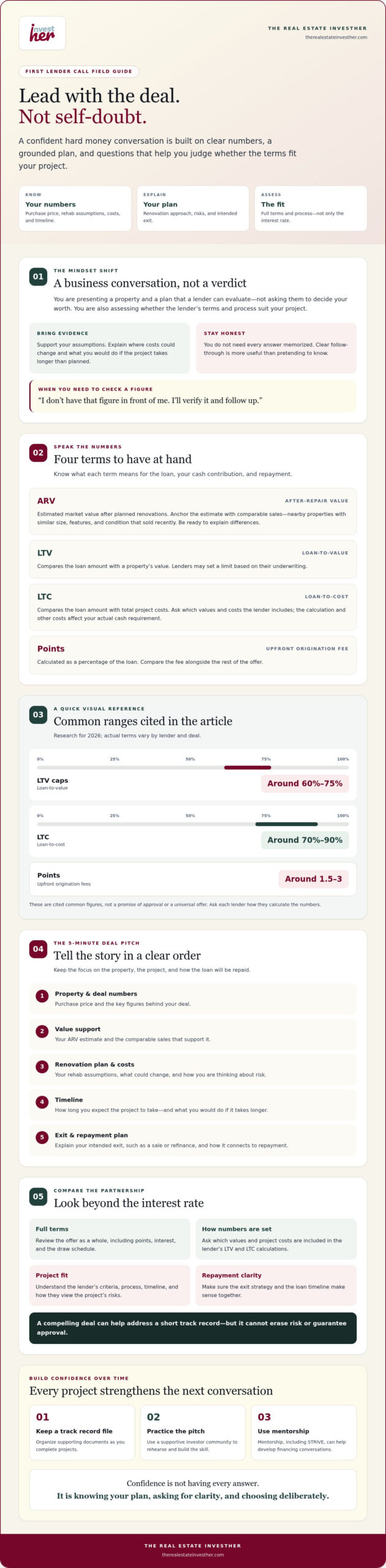
After-repair value (ARV) is the estimated market value of a property after planned renovations are complete, making it the anchor of your deal pitch. Support your estimate with comparable sales, or “comps”: nearby properties with similar size, features, and condition that have sold recently. Explain why each one is a useful comparison, and be ready to discuss differences rather than presenting the highest sale as your only evidence.
LTV, or loan-to-value, compares the loan amount with a property’s value; LTC, or loan-to-cost, compares it with total project costs. Lenders may evaluate both and set limits based on their underwriting. Research for 2026 indicates that common LTV caps are around 60% to 75%, while LTC may fall between 70% and 90%, though terms vary by lender and deal. LTC often gives a more direct view of how much project cost you may need to cover yourself, but the lender’s calculation and other costs affect your actual cash requirement. Ask what values and costs they include in each formula.
Understanding Points, Interest, and Draw Schedules
Points are upfront origination fees calculated as a percentage of the loan. Research for 2026 places common points around 1.5 to 3, with actual offers varying. Compare the total fees as well as the rate. If a loan is interest-only, ask whether monthly interest is calculated on the full commitment or the amount already advanced, and model the payments across your expected timeline.
Renovation funds may be released through a draw schedule, rather than delivered all at once. Before signing, ask what work must be completed for each draw, whether an inspection is required, how to request funds, and how long review typically takes. These details help you plan contractor payments and avoid assuming cash will be available before it’s approved.
Then explain your exit strategy: how you expect to repay the loan, such as selling the renovated property or refinancing. Share the conditions your plan depends on and what alternatives you’d consider if timing or costs change. Ask questions freely, and review a lender’s process and treatment of borrowers. The Consumer Financial Protection Bureau explains the role of fair lending laws; you can also ask how the lender evaluates applications and handles concerns.
Practice saying the numbers aloud before a call. An investor community can offer a supportive place to rehearse your pitch and learn from peers; explore InvestHER’s real estate investor community as one place to connect.
The Vetting Process: Choosing a Lending Partner, Not Just a Check
The lowest rate can look like the obvious win, but financing has more moving parts than interest alone. Points, inspection costs, draw timing, prepayment terms, and delays can change what a loan costs and whether it fits your project. Compare the complete written terms, then consider whether the lender’s process supports your timeline. Feeling confident talking to hard money lenders also means remembering that you’re evaluating the lender, not just waiting to be chosen.
Local Expertise vs. National Lending Platforms
A local lender may understand area sales and renovation expectations, while a national platform may have a different process or reach. Neither is automatically faster or better. In Scottsdale, Austin, or Philadelphia, ask how the lender assesses comparable sales and whether they understand differences between nearby neighborhoods. A citywide ARV estimate may miss distinctions in property type, condition, or buyer demand. The Corporate Finance Institute explains how hard money lenders determine loan amounts; ask a prospective lender how their valuation approach applies to your specific property and comps.
Local knowledge should be demonstrated, not assumed. Ask the lender to explain what could make your ARV estimate too optimistic and what documentation they need to review it. A Phoenix lender isn’t necessarily quicker than a national lender; compare their stated underwriting, appraisal, and closing steps rather than relying on location alone. Investors can also build lender connections through professional networking, including InvestHER CON, and learn from peers about the questions worth asking.
The ‘Lender Interview’ Checklist
Bring a short list of direct questions. You’re gathering information, not being difficult. For example:
- “Are there prepayment penalties, and when would they apply?”
- “Can you provide an itemized list of points, fees, and other closing costs?”
- “How do renovation draws work, including inspections and expected processing time?”
- “What documentation do you provide to verify available funds for an offer, and at what stage?”
- “Which assumptions or project changes could affect the terms after the initial quote?”
Clarifying fees before signing helps you distinguish a competitive offer from one that only looks inexpensive at first. Ask for key terms in writing and compare the same details across lenders. Their answers can also show whether they communicate clearly when the conversation gets specific.
Pause if a lender pressures you to commit before you understand the terms, avoids explaining fees, changes major conditions without clear explanation, or won’t document what they’ve offered. Verify their identity and funding process independently, and take time to review agreements with qualified professionals as needed. A strong lending relationship is built on transparent expectations and mutual respect. Choose the partner whose terms, communication, and process align with the deal you’re actually pursuing.
The 5-Minute Deal Pitch: How to Present Your Project with Authority
A focused pitch makes it easier for a lender to assess the opportunity and ask useful follow-up questions. Start with the property address, then lead with the deal’s core figures rather than a long story. Feeling confident talking to hard money lenders comes from being prepared to explain how each number connects to your plan, not from delivering a perfect performance.
The Essential Deal Executive Summary
In the first minute, be ready to share four key figures: purchase price, estimated renovation budget, projected after-repair value (ARV), and the loan amount you’re seeking. Then give the expected timeline and intended exit, such as selling after renovation or refinancing. Explain what supports your ARV, including relevant comparable sales, and state your assumptions clearly.
Keep your scope of work at the level that matters to the project: major repairs, improvements, and estimated costs. You don’t need to begin with paint colors or fixture choices. A simple before-and-after plan, supported by photos, contractor estimates, or a concise scope document, helps the lender picture the transformation and understand how the budget ties to the projected value.
Also name a Plan B when it’s realistic. For example, if your primary exit is a sale, explain whether renting and refinancing could be an alternative, and what conditions would need to make that option workable. A backup isn’t a promise that the numbers will work; it shows you’ve considered how you’d respond if the original timeline or market assumptions change.
Handling Tough Questions Without Flinching
Lenders may ask about your experience, budget assumptions, timeline, or what happens if the market softens. Answer directly. If you’re newer, say so, then point to relevant preparation: a detailed scope, contractor estimates, comparable sales, and the people supporting execution. With permission, identify your contractor or other team members by role and describe their relevant experience. Your team can strengthen the story, but it doesn’t replace a sound deal or guarantee an outcome.
If a lender questions the market, don’t argue from optimism. Refer to your specific comps, their sale dates and differences from the subject property, and how you’d adjust your ARV or exit assumptions if conditions shift. If you need to verify a detail, say you’ll confirm it and follow up.
Keep a steady rhythm: present the summary, pause for questions, and answer one point at a time. Practice with peers or mentors so the numbers feel familiar before the call. To rehearse your pitch and build investor connections, connect with The Real Estate InvestHER community.
Beyond the First Deal: Scaling with Strategic Capital Partners
Your first closing is a milestone. Your record of how you managed the project is what helps make the next funding conversation more specific. Keep a track record file for each deal with the original budget and timeline, key updates, final costs, exit outcome, and lessons learned. Include supporting documents you can share, while protecting private financial and property information.
Consistent communication during a project matters, too. If costs shift or the timeline changes, tell your lender promptly and explain what you’re doing in response. Once the work is complete, you might invite the lender to see the finished property if they’re interested and access is appropriate. These steps can build a professional relationship, though they don’t guarantee more favorable terms on a future loan.
The Power of the Repeat Borrower Relationship
After a successful project, ask whether your updated track record could affect terms on a future deal. Instead of expecting a rate drop after a set number of flips, try: “Now that we’ve completed this project, what factors would help me qualify for more favorable pricing next time?” A lender may consider the new deal, market conditions, leverage, and their own criteria. Request an itemized quote and compare the full terms, not just the rate.
As your experience and capital needs change, you may also explore private money alongside hard money. The sources, underwriting, costs, and legal documents can differ, so evaluate each arrangement on its own merits. Don’t assume a personal connection makes funding simpler or safer; clarify repayment expectations and get the agreement reviewed before committing.
Finding Your Tribe: Funding Is a Team Sport
Investor communities can help you prepare for the next lender conversation. Bring a draft pitch, ask peers which questions helped them compare offers, and request referrals based on firsthand experience. A referral is a starting point, not a guarantee that a lender is suitable or independently vetted. Confirm credentials, review written terms, and make your own decision.
Sharing a funding win can help another investor see what preparation looks like. Keep it useful: describe what you learned about communication, documentation, or deal structure, without revealing confidential terms or identifying details without permission. A community of thousands of women investors offers opportunities to learn from different experiences and practice your pitch before the next call. STRIVE Mentorship Program supports strategic scaling, including the skills and decisions involved in developing a funding strategy. Feeling confident talking to hard money lenders grows with experience, reflection, and support.
Ready to learn alongside fellow investors? Join the InvestHER Community Membership and bring your next deal conversation into a network built around shared growth.
Take Your Next Funding Conversation Forward
Strong financing conversations aren’t built on perfect answers. They grow from preparation, clear communication, and the confidence to ask whether a lender’s terms fit your project. As you complete deals, document what you learn and let each experience strengthen your next conversation.
Feeling confident talking to hard money lenders is a skill you can keep developing, especially when you have a supportive network to practice with and learn from. The Real Estate InvestHER, founded by Liz Faircloth and Andresa Guidelli, is dedicated to advancing women’s financial independence through community, mentorship, and strategic networking at InvestHER CON.
Your next step can be a more intentional funding strategy, shaped by shared experience and practical mentorship. Explore the STRIVE Mentorship Program and scale your portfolio.
You don’t have to know everything before you begin. Bring your plan, ask thoughtful questions, and keep building toward the investor you’re becoming.
Frequently Asked Questions
Is it okay to tell a hard money lender I’m a beginner?
Yes, be honest about being new, then show how you’re managing the learning curve. Share your deal analysis, renovation budget, comparable sales, timeline, and exit plan, and explain who’s supporting the project, such as an experienced contractor. If you don’t know an answer, say you’ll verify it and follow up. Clear communication and preparation build more trust than overstating your experience or track record.
Can I get a hard money loan with a low credit score?
Possibly, but approval depends on the lender and the full deal, not just your credit score. Hard money lenders often focus on the property and project, though they may also consider borrower experience, finances, and repayment plans. Some lenders consider scores as low as 640, while others may not set a minimum. Ask what criteria apply, and compare written terms before relying on an offer.
How much ‘skin in the game’ do hard money lenders usually require?
There isn’t one standard amount; it depends on the lender’s leverage, valuation, project costs, and your qualifications. In 2026, research indicates that lenders may fund 70% to 90% of total project costs, while common loan-to-value limits fall around 60% to 75%. The gap, plus costs the loan doesn’t cover, can affect your cash contribution. Ask how the lender calculates LTC and LTV and what expenses you must fund yourself.
What happens if I can’t finish the project before the loan is due?
Contact your lender as soon as you see a delay, not just before maturity. Review your loan documents to understand the due date, extension options, fees, and consequences of late repayment; an extension isn’t automatic, so get any change in writing. Update your budget and timeline, and discuss realistic repayment options. A sale or refinance may be possible, but neither is guaranteed, so build contingency time into your original plan.
Do hard money lenders care about my debt-to-income ratio?
Some do, but requirements vary. Hard money underwriting is often asset-focused, so the property’s value and the project plan may carry substantial weight. A lender may still review your income, existing obligations, liquidity, or experience when assessing repayment risk. Ask directly which personal financial details they evaluate and how those factors affect approval or terms. Don’t assume a flexible credit approach means your overall financial picture won’t matter.
How do I find hard money lenders in Scottsdale or Phoenix?
Start by asking local real estate investors, attorneys, and other deal professionals which lenders they’ve worked with, then independently check each lender’s process and written terms. Compare how they assess neighborhood comps, renovation draws, timelines, fees, and exit plans for your specific property. Feeling confident talking to hard money lenders in Scottsdale or Phoenix starts with preparation and comparison. InvestHER’s network and InvestHER CON can support investor connections, but referrals still need your own due diligence.
What is the difference between a point and an interest rate?
A point is an upfront origination fee calculated as a percentage of the loan amount; the interest rate is the rate used to calculate borrowing costs over time. In 2026, research places common origination points around 1.5 to 3, though offers vary. Ask whether points are due at closing and request a complete fee breakdown. Compare the rate, points, term, and other charges together rather than judging an offer by one number.
Should I use hard money for my first rental property?
It may fit a first rental if you need short-term capital for a defined project and have a credible repayment plan, but it isn’t automatically the right choice. Hard money loans commonly run 6 to 36 months, so consider whether renovation, leasing, and refinancing can realistically fit the term. Model interest, fees, reserves, and delays, then compare alternatives. Review the loan documents carefully and make sure the plan still works if your timeline changes.

Article by
Andresa Guidelli
Real estate investor, operator, and founder of The Real Estate InvestHER, a national platform supporting women real estate investors. With 15+ years of experience in real estate investing and business operations, she focuses on helping investors build stronger businesses behind their portfolios through better systems, clearer decision-making, leadership, and responsible use of AI.
Be the first to comment