


Women Real Estate Investors in Austin: A Local Guide to Investing with Intention
A promising Austin property can still be the wrong investment if the numbers, neighborhood, or your goals don’t align. For women real estate investors in Austin or considering the area, broad market headlines rarely answer the questions that matter most: What should you investigate before making a move, and who can help you think it through?
It’s understandable to feel unsure when local information is broad, due diligence has many moving parts, and trusted peers can be hard to find. You don’t need to rush toward a deal to make progress. A clear investment plan starts with your priorities, careful property research, and informed conversations with qualified professionals.
This guide will help you assess Austin-area opportunities, find useful local data, and prepare questions about property condition, neighborhood factors, and potential risks. You’ll also learn how peer connection can complement independent research and professional advice. The Real Estate InvestHER’s community membership, STRIVE Mentorship Program, and InvestHER CON offer ways to learn and connect with other women investors, without replacing local expertise. The goal is steady, intentional progress and greater clarity about your next step.
Key Takeaways
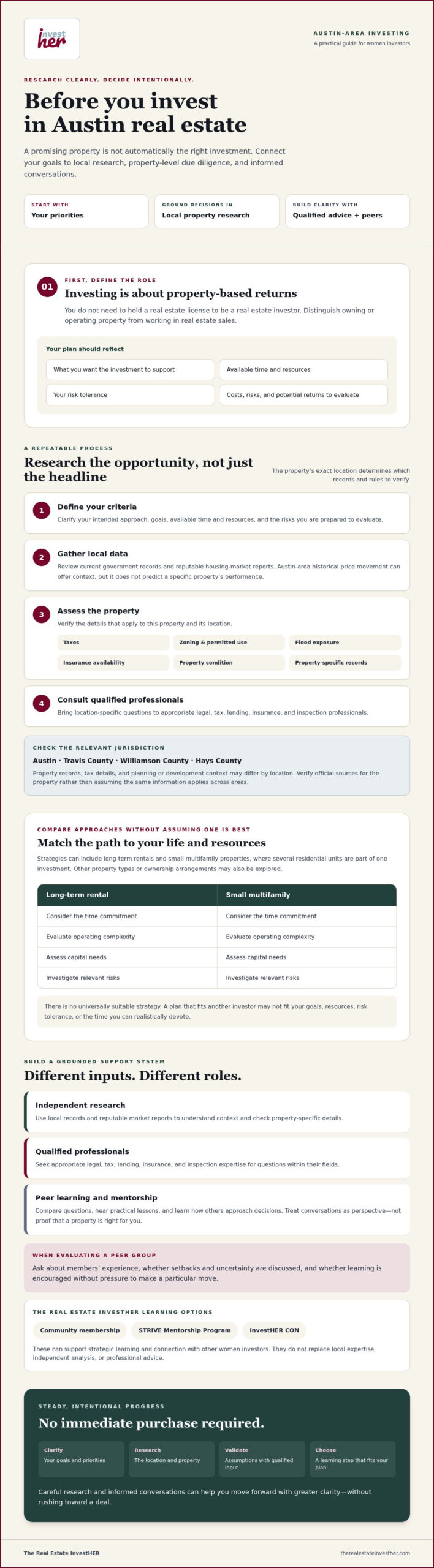
- Real estate investing means pursuing property-based returns, not holding a real estate license. Start by clarifying what you want an investment to support.
- Build a local research checklist that considers Austin, Travis County, Williamson County, and Hays County. Then assess each property and consult qualified professionals.
- Compare long-term rentals and small multifamily properties by time commitment, operating complexity, capital needs, and risks to investigate. Don’t assume one approach is best.
- Women real estate investors in Austin can strengthen their decisions by combining independent research and qualified advice with peer learning and mentorship.
- You can make progress without an immediate purchase. Clarify your goals, research, validate assumptions, and choose a learning step that fits your plan.
Women Real Estate Investors in Austin: What Makes the Local Journey Different?
How can you invest thoughtfully in the Austin area without relying on broad market headlines or someone else’s assumptions? Start by defining what you mean by investing, then connect your goals to local research. A real estate investor pursues property-based returns; she doesn’t have to be a licensed real estate agent. For a foundational overview of real estate investing, distinguish owning or operating property from working in real estate sales.
Local context matters because an opportunity in Austin may differ from one in nearby Travis, Williamson, or Hays County. City and county boundaries can shape which information you need to verify, including property records, tax details, and planning or development context. Check the relevant official sources for each property instead of assuming what applies in one area applies in another. Networking can help you identify questions and learn from other investors, but it can’t replace property-level due diligence or advice from qualified professionals.
What counts as real estate investing in the Austin area?
Approaches range from owning a long-term rental to investing in a small multifamily property, where several residential units are part of one investment. Investors may also explore other property types or ownership arrangements. Each approach has practical considerations, including how much time you can commit to operations and how you’ll evaluate costs, risks, and potential returns.
There’s no universally suitable strategy. Consider your goals, available resources, risk tolerance, and the time you can realistically devote. A plan that fits another investor may not fit your life, even if the properties appear similar.
Why women investors may value a strong peer network
Entering a traditionally male-dominated field can feel isolating for some women, especially when it’s difficult to find peers who understand the questions behind a potential investment. Experiences vary, though. Women investors don’t all share the same backgrounds, resources, ambitions, or challenges.
A relevant peer network can give you space to compare questions, hear practical lessons, and learn how others approach decisions. Treat those conversations as perspective, not proof that a property is right for you. Ask what members have experience with, whether they discuss setbacks and uncertainty, and whether the group encourages learning without pressure to make a particular move.
For women real estate investors in Austin, local research grounds decisions, while thoughtful peer connection can support learning and confidence. The Real Estate InvestHER supports women investors through its community membership, STRIVE Mentorship Program, and InvestHER CON. These are options for strategic learning and a broader investor network, not substitutes for local expertise, independent analysis, or professional advice.
How to Research Austin-Area Real Estate Opportunities Before You Invest
A thoughtful investment decision starts with a repeatable process, not a compelling listing or broad market headline. For women real estate investors considering Austin, the relevant area may include the city itself and parts of Travis, Williamson, and Hays counties. The property’s exact location determines which jurisdiction’s records and rules to check, so confirm those details before relying on them.
- Define your criteria. Clarify your intended approach, goals, available time and resources, and the risks you’re prepared to evaluate.
- Gather local data. Review current government records and reputable housing-market reports. The Federal Reserve Bank of St. Louis publishes Austin-area housing market trends, which can help you understand historical price movement, but not predict a specific property’s performance.
- Assess the property. Verify taxes, zoning and permitted use, flood exposure, insurance availability, property condition, and property-specific records.
- Consult qualified professionals. Bring location-specific questions to appropriate legal, tax, lending, insurance, and inspection professionals.
Citywide trends can’t establish whether an individual property is viable. A metro-level report provides context, but the property’s records, condition, permitted use, and operating assumptions need their own careful review.
Which Austin-area data sources should investors check?
Start with the local government sources responsible for the property’s location. Check the relevant county appraisal district for appraisal and property information, and the appropriate tax office for current tax records. For zoning, land use, and flood exposure, consult the applicable city or county department and mapping tools. Austin, Travis County, Williamson County, and Hays County records may be relevant, but don’t assume one jurisdiction’s information covers another.
Compare official records with reputable housing-market reports. Note each report’s publication date, geographic coverage, and methodology. If sources use different boundaries or time periods, their figures may not be directly comparable. Confirm current details before making decisions.
What property-level questions belong in early due diligence?
Ask what an inspection reveals about the property’s condition and likely maintenance needs. Confirm whether the intended use is permitted, and test operating assumptions against documented expenses and information from qualified professionals. Investigate flood exposure and ask an insurance professional about coverage availability and relevant terms. Check property-tax assumptions against applicable records rather than relying on a listing estimate.
Peer conversations can help you spot questions, but they can’t verify a parcel’s records or replace professional judgment. The Real Estate InvestHER’s community membership is one option for women seeking strategic learning and investor connection. Explore investor learning and community resources to complement your independent research and qualified local advice.
How to Compare Austin Investment Paths Without Chasing Market Hype
A property can look compelling in a headline or spreadsheet and still demand more time, capital, or operational attention than you want to commit. Rather than asking which strategy is best, compare what each would require from you. For women real estate investors considering Austin, the decision should reflect personal capacity and property-level facts, not market hype.
A sound comparison weighs operating assumptions and risks alongside potential income. Use a simple framework to identify how two approaches differ, then investigate the details of any specific property.
Long-term rental ownership
- Time commitment: Ongoing coordination of leasing, tenant communication, maintenance, and records.
- Operating complexity: Consider the responsibilities involved in keeping a rental property operating.
- Capital needs: Evaluate the funds required for acquisition, upkeep, and periods without rental income.
- Risks to investigate: Vacancy, repairs, insurance, taxes, and the assumptions behind expected rent.
Small multifamily ownership
- Time commitment: Assess whether managing multiple units fits your schedule and operating plan.
- Operating complexity: Account for coordinating needs across units and reviewing property-specific records.
- Capital needs: Compare acquisition and ongoing obligations with your available resources.
- Risks to investigate: Unit-level vacancy, maintenance needs, permitted use, and expense assumptions.
How do common property strategies differ for Austin investors?
Long-term rental ownership and small multifamily differ in scale and day-to-day demands, but neither is automatically a better fit. A single rental may involve a different operating structure from a property with several units, while both require attention to expenses, maintenance, and income assumptions. Match the approach to your goals, available time and resources, and tolerance for uncertainty.
Short-term rentals require separate research. Verify current local rules and the specific property’s eligibility before including this approach in your comparison. Don’t assume permission in one location or for one property applies elsewhere.
How can an investor stress-test a deal?
Build a conservative version of your assumptions. Consider what happens if the property is vacant longer than expected, repairs cost more, financing terms differ from an initial estimate, or taxes, insurance, and other operating costs change. Ask qualified professionals to review relevant inputs rather than treating a projected figure as settled fact.
Keep verified information separate from estimates. For example, label advertised rent as an asking figure until you’ve assessed its relevance, and identify projected expenses as estimates until supported by property records or professional review. A comparison can’t remove uncertainty, but it can make tradeoffs visible and show what needs more investigation before you move forward.
Build an Austin Investor Support System That Strengthens Your Decisions
Good support doesn’t mean handing someone else the decision. It means knowing who can offer perspective, who can teach from experience, and who is qualified to advise on a specific issue. For women real estate investors in Austin, connections can be valuable, but the right support system should strengthen independent judgment rather than replace it.
- Peers can share questions, lessons, and perspectives from their own investing journeys.
- Mentors can offer guidance drawn from relevant experience and help you think through your goals and approach.
- Qualified professionals can address matters within their expertise, such as property inspections, legal questions, taxes, lending, or insurance.
How do you evaluate an investor group or mentor?
Before committing your time, ask whether the group welcomes your experience level, preferred strategy, and goals. A useful learning environment makes room for thoughtful questions, practical education, and independent judgment, not pressure to follow someone else’s path.
- Are expectations, costs, and participation requirements clearly explained?
- Does the group’s experience relate to the questions and strategies you’re exploring?
- Can members discuss uncertainty and lessons learned, as well as successes?
- Are you encouraged to verify information and make your own decisions?
A peer or mentor may help you identify what to investigate, but specific deal, tax, and legal questions belong with qualified professionals. Be cautious of any environment that presents general experience as a substitute for advice tailored to your circumstances or a particular property.
Where can women investors find strategic learning and connection?
The Real Estate InvestHER offers an InvestHER Community Membership and the STRIVE Mentorship Program for women seeking investor connection and strategic learning. Its InvestHER CON is an annual conference with professional development opportunities. The Real Estate InvestHER has a presence in Scottsdale, Phoenix, San Diego, New York, Austin, Dallas, Philadelphia, and Orlando. These resources may suit different learning preferences, but check current program details and expectations directly. Don’t assume that the organization’s resources include an Austin chapter, local introductions, or in-person services.
If you’re looking for a broader investor network, explore InvestHER community and mentorship resources and consider how they fit alongside local research and professional support. A strong network can help you learn and ask sharper questions. The final decision remains yours.
Choose Your Next Step as a Woman Real Estate Investor in Austin
You don’t need to buy a property today to move forward. A thoughtful next step might be clarifying your goals, closing a research gap, or finding a learning environment where you can ask better questions. Women real estate investors exploring Austin can assess opportunities at their own pace, with decisions guided by preparation rather than pressure.
What should you do before pursuing your first or next deal?
Give yourself a clear sequence. First, write down what you want investing to support, the time and resources you can commit, and how involved you want to be. Then identify questions that require input from qualified professionals. This makes it easier to separate personal priorities from assumptions that still need verification.
Next, choose a specific Austin-area opportunity or property type to research. Use the local due-diligence steps in this guide to note what you know, what’s estimated, and what remains unconfirmed. If a record, permitted use, insurance detail, or operating cost is unclear, make it a research task rather than filling the gap with a guess.
Set one learning milestone before making a commitment. You might review relevant property records, speak with a qualified professional, or discuss your questions with a mentor. Small, deliberate steps can build clarity without requiring an immediate purchase.
How can InvestHER support your continued learning?
InvestHER offers several options to explore: an InvestHER Community Membership, the STRIVE Mentorship Program, and InvestHER CON, its annual conference with professional development opportunities. Consider which format, if any, aligns with your goals and preferred way of learning, and confirm current program details before deciding. These resources can support connection and education, but they aren’t brokerage, property management, or financial advisory services. They don’t replace independent research or qualified professional advice.
Your next step can be simple: clarify one goal, identify one open question, and choose one way to keep learning. There’s no need to force a timeline that doesn’t fit your circumstances. If the community and learning opportunities sound relevant, explore them and decide whether they support the path you want to build.
Explore The Real Estate InvestHER
Move Forward With Clarity and Community
Intentional investing starts with knowing what you want, researching the right local details, and testing assumptions before you commit. Austin offers possibilities, but no broad trend can determine whether a specific property or strategy fits your goals. Take your time, seek qualified professional advice where needed, and let your next step be guided by what you still need to learn.
You don’t have to make a purchase to make progress. A conversation with a peer or mentor, a closer look at property records, or a focused learning milestone can help you build confidence and move at a pace that feels right.
Founded in 2018 by Liz Faircloth and Andresa Guidelli, The Real Estate InvestHER offers community membership, the STRIVE Mentorship Program, and InvestHER CON. Explore these learning and connection opportunities to see whether they align with your goals.
Explore The Real Estate InvestHER community and learning opportunities. Your investing journey is yours to shape, one thoughtful step at a time.
Frequently Asked Questions
Are there real estate investing groups for women in Austin?
Yes. Women looking for investor connections can explore women-focused communities and local real estate groups, then verify that a group is active and focused on property investors rather than only real estate professionals. Ask about member experience, learning formats, and expectations before joining. The Real Estate InvestHER serves Austin, Scottsdale, Phoenix, San Diego, New York, Dallas, Philadelphia, and Orlando. Confirm current offerings directly.
How can a beginner start investing in real estate in Austin?
Start by defining your goals, available time and resources, and comfort with risk, then learn how different property approaches work. Beginners can build a local research habit by reviewing relevant property records and comparing potential operating costs before pursuing a deal. Write down unanswered questions and bring legal, tax, lending, inspection, and insurance matters to qualified professionals. Education and conversations can be meaningful first steps.
What should women investors research before buying property in Austin?
Research the specific property and its jurisdiction, not just broad Austin-area trends. Verify current property-tax information, zoning and permitted use, flood exposure, insurance availability, property condition, and relevant property records. Check sources for their dates and geographic coverage, since city and county information may differ. Test assumptions about rent, vacancy, repairs, financing, and ongoing costs, separating documented facts from estimates. Ask qualified professionals to review specialized questions.
Is Austin a good place for women to invest in real estate?
Austin may suit some investors, but no market is automatically a good fit for every person or property plan. Your goals, resources, risk tolerance, timeline, and the details of a specific opportunity all matter. Review current local data and property-level costs, then test conservative assumptions rather than relying on market enthusiasm. A qualified professional can help assess questions in their area of expertise, but no general market view can promise an investment outcome.
How do I find a real estate mentor in Austin?
Look for learning communities, investor networks, and mentorship programs, then assess whether their experience and approach align with your goals and knowledge. Ask about expectations, learning structure, and how they support independent decision-making. The Real Estate InvestHER offers the STRIVE Mentorship Program and a community membership; check current details to see whether either fits. Treat mentors as sources of perspective, not substitutes for qualified legal, tax, or financial professionals.
What risks should Austin real estate investors consider?
Consider vacancy, unexpected repairs, changing operating costs, property taxes, insurance availability, flood exposure, and whether the intended use is permitted. Financing terms and income projections also need careful review. Risks vary by property and location, so verify records and assumptions for the opportunity you’re assessing instead of applying a citywide average. Stress-test the numbers with conservative estimates, label projections clearly, and consult qualified professionals about specialized concerns.
Does The Real Estate InvestHER provide real estate brokerage or financial advice?
No. The Real Estate InvestHER supports women investors through strategic learning, networking, community membership, the STRIVE Mentorship Program, and InvestHER CON. It does not provide real estate brokerage services, direct property management, or financial advisory services. Peer connection and mentorship can help you learn and develop questions, but they don’t replace independent property research or advice from qualified professionals. Confirm current program details directly before deciding whether a resource meets your needs.

Article by
Andresa Guidelli
Real estate investor, operator, and founder of The Real Estate InvestHER, a national platform supporting women real estate investors. With 15+ years of experience in real estate investing and business operations, she focuses on helping investors build stronger businesses behind their portfolios through better systems, clearer decision-making, leadership, and responsible use of AI.
Be the first to comment