


Stories of Successful Women in Real Estate: Paths, Decisions, and Lessons
What if the most useful lesson from successful women in real estate isn’t how they built a portfolio, but how they built a business that doesn’t depend on them for every decision? The stories of successful women in real estate reveal varied paths, shaped by different goals, resources, risks, and trade-offs. Their experience can offer practical lessons, but it isn’t a formula to copy.
It’s easy to see the milestone and miss the work behind it: changing course after a deal, clarifying who can make which decisions, building repeatable systems, or asking for support before owner dependency becomes a constraint. Understanding those choices can help you separate lessons that may transfer to your business from circumstances unique to someone else’s journey.
This article explores different routes women have taken through real estate and the operating decisions that helped shape their businesses. You’ll find takeaways on leadership, systems, delegation, and support, plus a practical way to identify a next step that fits your portfolio and priorities. The goal isn’t to follow another investor’s path. It’s to make your own business more intentional and sustainable.
Key Takeaways
- Use stories of successful women in real estate to examine the decisions and trade-offs behind different business paths, not as a formula to copy.
- Compare investing, entrepreneurship, leadership, and education by their responsibilities and operating demands to see which aligns with your goals.
- Turn another investor’s documented choices into questions you can test against your own decision rights, operating rhythms, and owner dependency.
- Choose one business question before seeking advice or learning resources, so you can judge which perspectives are relevant to your situation.
- Consider community, mentorship, or an industry event as ways to find useful perspectives, including InvestHER Community Membership, the STRIVE Mentorship Program, and InvestHER CON.
Why stories of successful women in real estate deserve more than admiration
Women build real estate success through varied roles, choices, and business models. The stories of successful women in real estate can show how an investor, entrepreneur, executive, or educator approached a challenge, made a decision, and managed its consequences. Their value isn’t that they offer a guaranteed playbook. It’s that they can help you ask sharper questions about your own business.
Look beyond the visible milestone. A larger portfolio may be one measure of progress, but it doesn’t show how decisions are made, what operating demands sit behind each property, or whether growth fits the owner’s priorities. A useful account makes room for trade-offs: the resources and support available, the responsibilities accepted, and the adjustments made as circumstances changed.
An inspiring example can broaden your thinking, but it cannot reliably predict your investment results. Treat a story as a prompt for investigation, not proof that the same strategy will work in a different market, business, or season of life.
What makes a woman’s real estate story useful to another investor?
A useful story gives enough verified context to understand what happened and why a decision mattered. Look for documented choices, obstacles, pivots, and consequences rather than praise alone. Then separate facts from interpretation: what the person did is different from what you might learn from it.
For example, if an investor describes delegating a recurring task, the transferable question isn’t simply “Should I delegate?” Ask what was documented, which decisions stayed with the owner, and how the handoff was monitored. Those details help you test the lesson against your own operations.
How should readers define success beyond acquisition volume?
Success can include a business that makes sound decisions consistently, operates with less owner dependency, develops capable leaders, and supports the owner’s personal priorities. These are useful measures to consider, not universal definitions. One investor may value steady operations and time flexibility, while another prioritizes leadership responsibility or a particular investment model.
Choose measures that fit your goals, then assess a story against them. Ask whether it offers insight into business durability or decision quality, not just visible scale. If you’re exploring commercial real estate, an organization such as Commercial Real Estate Women (CREW) Network can provide additional industry context to investigate. Start by naming the decision or operating challenge you want other investors’ experiences to help you examine.
Stories of successful women in real estate: distinct paths and pivotal choices
Women’s real estate journeys can lead through investing, entrepreneurship, executive leadership, or community building. The useful comparison isn’t who achieved the most. It’s what role each woman took on, what choices are documented, and what the available evidence can actually tell us.
For context, the National Association of REALTORS® reports women make up 66% of its membership in 2026. That figure describes membership, not the range of work women do across real estate. The National Association of REALTORS® on women in the industry offers additional historical and industry context.
What can investor and entrepreneur profiles show about strategic choices?
A profile is most useful when it connects a documented decision to its business context. A career transition, new venture, or change in operating model may be a pivotal choice, but a public account rarely proves that one choice caused later success. Treat claims about cause and effect as interpretation unless the evidence supports them.
Barbara Corcoran and Dottie Herman are potential examples for deeper research. Before drawing conclusions about their turning points or lessons, check reliable biographical sources and look for evidence supporting the specific claims. An appealing origin story is not a substitute for a well-supported account.
How can founders build influence beyond individual investing?
Liz Faircloth and Andresa Guidelli offer a grounded example of a different route: building a community-centered real estate organization. Confirmed information identifies them as the founders of The Real Estate InvestHER, established in 2018. The organization offers a community membership and the STRIVE Mentorship Program, and hosts InvestHER CON.
That documents a contribution through connection and learning, not evidence of members’ investment outcomes. It also highlights a distinct leadership choice: creating an organization around a shared professional community rather than presenting individual portfolio growth as the only measure of influence. The available information doesn’t establish each founder’s separate responsibilities, career pivots, or investment results, so those details shouldn’t be assumed.
As you assess stories of successful women in real estate, note what’s known, what remains unclear, and which lesson is your own interpretation. Then test that lesson against your business. To explore a community-centered approach to learning, review The Real Estate InvestHER’s community and mentorship resources.
Do successful women in real estate follow the same path?
No. Women build real estate careers and businesses through different routes, including direct property investing, entrepreneurship, executive leadership, and education. Each path involves distinct responsibilities and operating demands, so public profiles are useful for comparison, not for deciding which path is right for you.
The table compares the work involved, not the quality or likely returns of each route. A visible title or public profile can show influence, but it doesn’t establish investment performance, business durability, or what resources supported the person’s progress. For example, the Real Estate Almanac’s directory of women executives in real estate can help readers identify leadership examples, but a directory alone can’t establish how an executive’s business performs.
| Path | Core responsibilities | Operating demands | Decisions to examine |
|---|---|---|---|
| Investing | Evaluating, acquiring, and overseeing property or investment activity. | Property-level execution, ongoing oversight, and clear ownership of decisions. | How opportunities are assessed, what risks are accepted, and which tasks require the owner’s judgment. |
| Entrepreneurship | Creating and running a real estate business, which may include services, products, or an organization. | Building repeatable operations, defining roles, and managing business priorities. | What the business will focus on, what to delegate, and where the founder must retain decision authority. |
| Executive leadership | Guiding an organization, team, or business function. | Setting direction, aligning people, and making decisions through others. | How priorities are set, accountability is assigned, and leadership responsibilities are shared. |
| Education | Sharing knowledge through teaching, mentorship, or learning resources. | Developing useful material and creating structures for people to learn and connect. | Which audience and questions to serve, and how to distinguish education from individualized business decisions. |
How do investing, entrepreneurship, and leadership differ?
Investing centers on property-level choices. Entrepreneurship adds the challenge of designing a business that delivers consistently, while leadership focuses on setting direction and enabling a team to execute. Education contributes by helping others learn, but it isn’t the same as owning or operating the investments being discussed. These paths can overlap, yet none is inherently more profitable, accessible, or secure.
Why does each investor’s context matter?
A career example can’t determine which route fits your goals or resources. Consider your experience, available time, capacity to manage uncertainty, responsibilities outside the business, and willingness to build a team or operating structure. Relationships and access may be relevant context, but they aren’t guaranteed advantages or a substitute for sound decisions.
Public stories often leave important details unanswered, including financing arrangements, setbacks, operating costs, or the division of work among partners. Mark those gaps instead of filling them with assumptions. Use each profile to identify a question worth investigating in your own business, then assess it against your actual constraints and priorities. No matter where you operate, evaluate a story against the conditions and responsibilities relevant to your own market and portfolio.
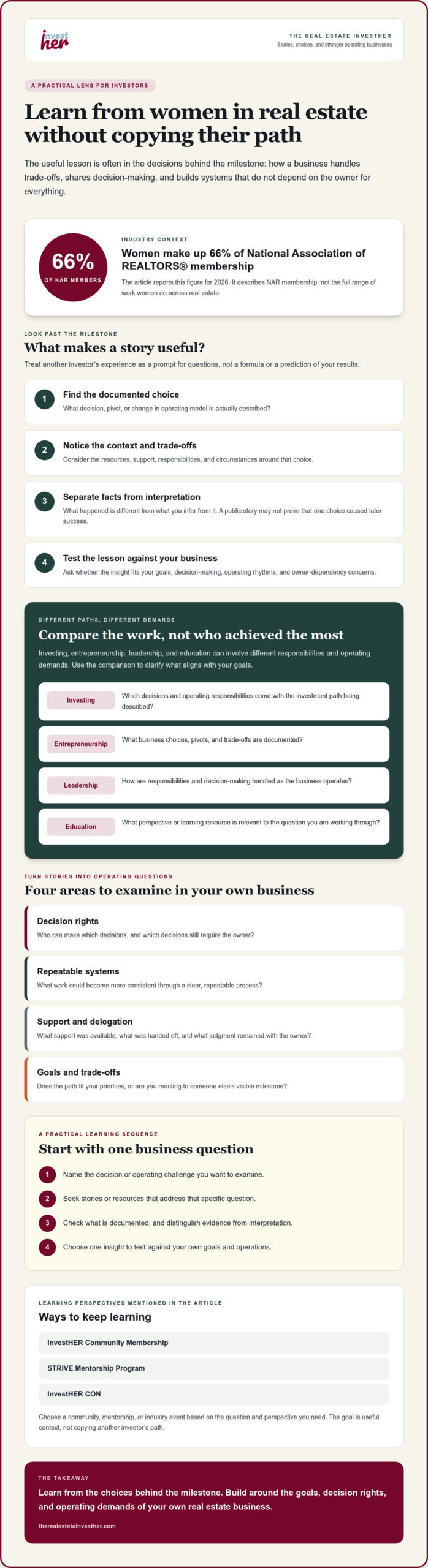
What operating lessons can investors apply without copying someone else?
Turn a profile into a testable operating question, not an instruction to imitate. The stories of successful women in real estate may describe a decision or system, but your useful takeaway is the question it raises for your portfolio: What work still depends on me, what judgment does it require, and what would need to be true before someone else could own it?
How can a reader turn a profile into an operating question?
Start with a specific, verified choice from the story, such as introducing a regular review of property performance or handing off a recurring administrative task. Then identify the context behind it. What information informed the decision? Who was involved? What checks or safeguards kept the work on track? If the account doesn’t say, mark that as unknown rather than assuming.
Use the answers to choose one low-risk next step. For example, document how you currently review a recurring report, then note what requires your judgment and what follows a clear rule. Test a small process improvement before changing a high-impact investment decision.
- Decision rights: Specify who gathers information, who recommends an action, and who has authority to approve it.
- Operating rhythm: Set a consistent time to review exceptions, unresolved items, and upcoming decisions.
- Owner dependency: Track where work stalls because only you know the process or can make the call.
Documentation and delegation are related, but they aren’t the same. A written procedure can help someone complete defined steps; it doesn’t automatically transfer the judgment to approve an expense, respond to an unusual property issue, or change an investment plan. Set decision boundaries explicitly, including when to pause and escalate to you.
What should investors check before adapting a business practice?
Compare the person’s known circumstances with your goals, capacity, and operating constraints. Consider your team’s experience, available time, tolerance for uncertainty, and the consequences if a task is handled incorrectly. Separate what the profile documents from what it leaves out, such as the resources, partner roles, or safeguards behind a decision.
If you use AI to support a repeatable task, keep it within a human-supervised process. Define what information it may use, what output a person must review, and which decisions remain human-owned. Begin with a bounded task, such as organizing information for review, rather than giving a tool authority over consequential investment or operating decisions.
Choose one practice to investigate, identify its risks and decision owner, then test it in a limited way before making it part of your operating system. For peer learning and perspective, explore Real Estate InvestHER’s community resources.
How to keep learning from women building real estate businesses
Make your next step specific: choose one business question, then look for relevant evidence and perspectives that can help you examine it. The stories of successful women in real estate can prompt useful questions, but your own decisions still need to reflect your goals, operating constraints, and due diligence.
When can peer community or mentorship be useful?
Peers can offer a place to discuss operating challenges, compare approaches, and build professional connections. Mentorship can help you explore a decision with another perspective. Neither replaces independent research, careful evaluation of an opportunity, or qualified professional advice where needed. Treat what you hear as input to assess, not as a guarantee of deal access, returns, or a particular outcome.
Real Estate InvestHER was founded in 2018 by Liz Faircloth and Andresa Guidelli. Its confirmed offerings include InvestHER Community Membership and the STRIVE Mentorship Program, and it hosts the annual InvestHER CON. These are optional ways to explore community, mentorship, and industry connection. Consider whether the format and focus match the question you’re trying to answer, and confirm current program and event details directly.
Which resource fits your current question?
Start with the question, not the resource. If you’re considering what to look for in a mentor, read this real estate mentorship guide. If your priority is growing the operating capacity behind your portfolio, explore the strategic guide to scaling real estate investments. If you’re looking for peer connection, the women’s real estate investing community guide may be more relevant.
Before acting on advice, note what evidence supports it, what information is missing, and which decisions remain yours to make. That simple check helps turn outside perspective into better questions for your own business. To learn about its community and programs, visit The Real Estate InvestHER.
Turn what you’ve learned into one clear next step
The stories of successful women in real estate show that there isn’t one route to building a meaningful career or business. The useful lessons are in the choices behind each path: how decisions are made, what work can be systematized, and which trade-offs fit an investor’s goals and circumstances.
Choose one question to work on next. It might be clarifying who can approve a recurring decision, documenting a process that currently depends on you, or identifying what evidence you need before changing your operating model. Use other investors’ experiences to sharpen your thinking, then test ideas against your own portfolio and responsibilities.
For another avenue to learn and connect, Real Estate InvestHER was founded in 2018 by Liz Faircloth and Andresa Guidelli. Its confirmed offerings include community membership, the STRIVE Mentorship Program, and the annual InvestHER CON. These are optional resources, not substitutes for independent research or advice suited to your situation. Explore The Real Estate InvestHER to learn more.
Your next move doesn’t need to copy someone else’s. Make it a deliberate choice that strengthens the business you want to build.
Frequently Asked Questions
Who are some successful women in real estate?
Examples include Liz Faircloth and Andresa Guidelli, founders of The Real Estate InvestHER in 2018. Their confirmed contribution is building a community-centered organization, not proof of member investment outcomes. Successful women also work across investing, entrepreneurship, executive leadership, and education. When researching other names, verify their roles and accomplishments with reliable sources before drawing lessons about their decisions or business results.
What can women learn from successful real estate investors?
Look for the decisions and operating practices behind a visible milestone. A story may prompt you to examine how you evaluate opportunities, assign decision rights, or build repeatable processes. For example, investors in Austin or Philadelphia might use a profile to frame questions about their own portfolio, then check those questions against local conditions, available resources, and their responsibilities. A story offers perspective, not a guaranteed investment outcome.
Do successful women in real estate follow one common path?
No. Some focus on property-level investing, while others build companies, lead organizations, or create educational and community resources. These routes involve different responsibilities, skills, time demands, and decisions. Public visibility doesn’t establish investment performance or business durability, and one person’s career can’t determine which path fits another investor’s goals, resources, or risk tolerance. Compare the work involved, not just the title or portfolio size.
How can I tell whether a real estate success story is credible?
Check who is making the claims, whether specific roles and milestones are supported by reliable sources, and whether the account explains relevant context. Distinguish documented facts from interpretation, especially when a story attributes success to one decision. Notice what remains undisclosed, such as operating responsibilities, setbacks, or resources. Treat missing information as unknown rather than filling gaps with assumptions about performance or cause and effect.
How can women real estate investors build a business that depends less on the owner?
Start by identifying recurring work that stalls when you’re unavailable. Document the steps, information needed, and exceptions, then clarify who can complete the task and who can approve decisions. A written process doesn’t automatically transfer judgment or authority. Set escalation rules, review the handoff, and use a regular operating rhythm to surface issues. If AI supports a task, keep human review and accountability for consequential decisions.
Is mentorship useful for women in real estate investing?
Mentorship can help you examine a business question, hear another perspective, and reflect on decisions with someone more experienced in a relevant area. Its usefulness depends on the fit between your question and the mentor’s experience. It doesn’t replace independent research, due diligence, or qualified professional advice, and it can’t guarantee returns or a specific outcome. Bring a clear question and assess any guidance against your own circumstances.
What is The Real Estate InvestHER?
The Real Estate InvestHER is a women-focused real estate investing community founded in 2018 by Liz Faircloth and Andresa Guidelli. Confirmed offerings include InvestHER Community Membership, the STRIVE Mentorship Program, and the annual InvestHER CON. The organization’s geographic focus includes Scottsdale, Phoenix, San Diego, New York, Austin, Dallas, Philadelphia, and Orlando. These resources offer options for community, mentorship, and connection, not guaranteed investment results. Explore The Real Estate InvestHER’s community and programs.
Article by
Andresa Guidelli
Real estate investor, operator, and founder of The Real Estate InvestHER, a national platform supporting women real estate investors. With 15+ years of experience in real estate investing and business operations, she focuses on helping investors build stronger businesses behind their portfolios through better systems, clearer decision-making, leadership, and responsible use of AI.
Be the first to comment