


Should I Invest in Real Estate or the Stock Market? A 2026 Decision Framework
What if the better investment isn’t the one with the higher headline return, but the one whose risks and workload you can sustain? If you’re asking, “should I invest in real estate or the stock market,” the answer depends on your goals, time horizon, available capital, and appetite for hands-on decisions. Neither option is automatically superior.
Real estate can offer rental income, leverage, and control over how an asset is managed, but ownership also brings operating costs, financing decisions, and ongoing responsibilities. Stocks are generally easier to buy and sell, yet market swings can test your ability to stay invested. Comparing returns without accounting for leverage, expenses, income, and time can lead to the wrong conclusion.
This guide compares real estate and stock investing using the same criteria: return potential, risk, liquidity, capital requirements, and operating demands. You’ll see how each approach may fit different financial goals and personal capacities, what to assess before committing capital, and when holding both could help diversify your portfolio. Use the framework to make a decision that fits your circumstances, not to find a one-size-fits-all verdict.
Key Takeaways
- To answer “should I invest in real estate or the stock market,” start with your goals, time horizon, and desired level of involvement, not headline returns alone.
- Compare potential outcomes over the same period and account for income, appreciation, costs, liquidity, and leverage.
- Assess how you would handle market volatility alongside property-specific demands such as vacancies, repairs, and concentrated exposure.
- Use a decision framework to weigh your available capital, liquidity needs, risk tolerance, and capacity to manage operations.
- Holding both investments may provide different kinds of exposure, but a REIT is not the same as owning and operating property directly.
Should you invest in real estate or the stock market? Start with what you are comparing
Neither real estate nor stocks are universally better investments. If you’re asking, “should I invest in real estate or the stock market,” begin with your goal, risk tolerance, and preferred level of involvement. Directly owning a rental property is different from buying a diversified stock fund, just as owning shares in one company differs from investing across the market.
Compare like with like as much as possible. An individual property exposes you to one asset, location, financing structure, and set of operating decisions. A diversified fund can spread investment across many companies. Historical performance describes what happened during a particular period, but it doesn’t predict your personal results or guarantee future returns.
For another perspective on the comparison, watch this video:
What does investing in real estate mean?
Direct real estate investing means owning property, such as a rental home, and making decisions about its financing and operation. Rental income is money collected from tenants. Appreciation is an increase in the property’s value. Operating costs are expenses involved in maintaining and managing the property. Leverage means using borrowed money, such as a mortgage, to acquire an asset. These factors can affect both potential gains and losses.
Real estate exposure can also be indirect. Shares in Real Estate Investment Trusts (REITs) provide an investment in a real estate company or portfolio, rather than direct ownership of a particular rental property. A REIT can provide real estate exposure through the stock market, but it doesn’t give you the same control or operating responsibilities as owning property.
What does investing in the stock market mean?
Buying an individual company’s stock means owning a share of that company. Its price can rise or fall as the market’s view of the company changes. Mutual funds and exchange-traded funds (ETFs) hold collections of investments, which may include shares in many companies. Funds don’t all behave alike: their holdings and risk depend on what they invest in.
Diversification means spreading investments across different assets or companies, so your outcome isn’t tied to just one holding. Liquidity describes how readily an investment can be turned into cash. Publicly traded stocks and funds can generally be bought or sold through a brokerage, while selling a property involves a separate transaction and timeline.
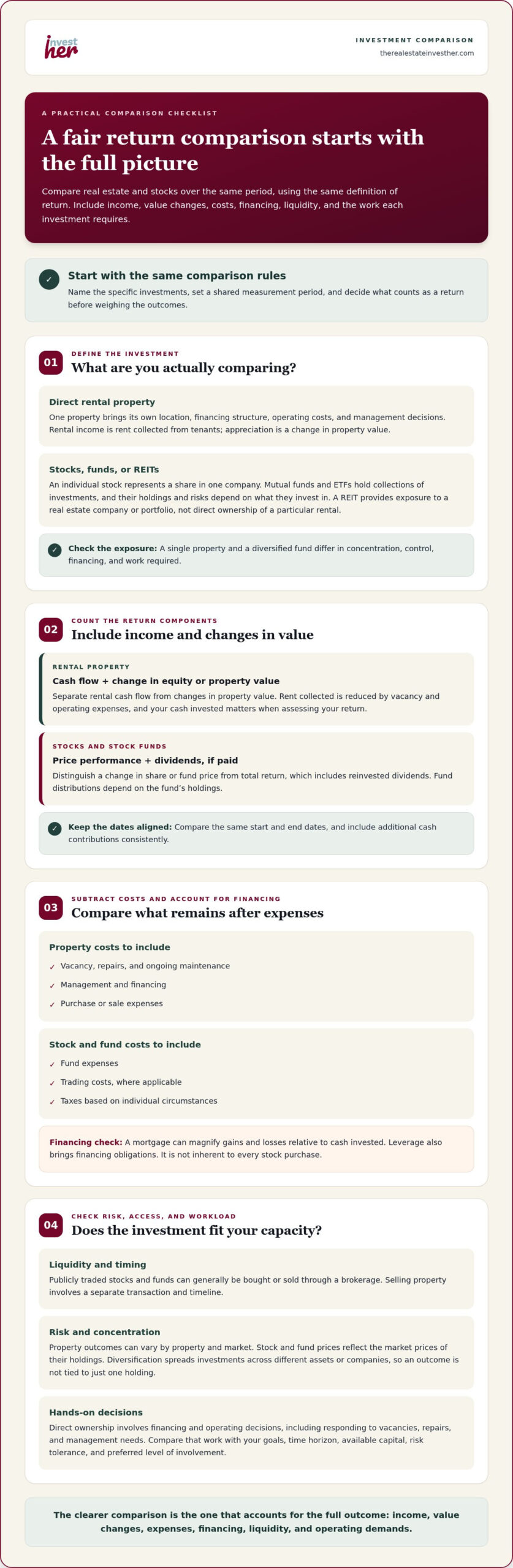
For a fair comparison, identify the actual investments first. A single rental home and a broad stock fund differ in concentration, control, financing, and work required. Then assess each against the same goals and holding period. That gives you a clearer basis for comparing returns and risk.
How do real estate and stock-market returns compare over time?
Compare net outcomes over the same period, not headline returns alone. A property’s rent and change in value aren’t directly comparable to a stock index’s price change. Neither tells you what you personally would have earned after financing, expenses, fund costs, taxes, and the timing of your investment.
A fair comparison starts by defining the investment, measurement period, and what counts as a return. For property, distinguish cash flow and change in equity from the return on your cash invested. For stocks, distinguish price performance from total return, which includes reinvested dividends. Then account for costs and additional capital contributions consistently.
| Factor | Direct rental property | Stocks or stock funds |
|---|---|---|
| Income | Rent collected, less vacancy and operating expenses. | Dividends, if paid, with fund distributions depending on holdings. |
| Appreciation | Change in property value, which may differ by property and market. | Change in share or fund value, reflecting the holdings’ market prices. |
| Costs | Maintenance, management, financing, and purchase or sale expenses. | Fund expenses, trading costs where applicable, and taxes based on individual circumstances. |
| Leverage | A mortgage can magnify gains and losses relative to the owner’s cash invested. | Leverage depends on the investment and account strategy, and isn’t inherent to every stock purchase. |
Which factors belong in a fair return comparison?
For a rental, estimate income after vacancy, repairs, ongoing maintenance, management, financing, and transaction expenses. Include any additional cash you contribute over the holding period. For stocks, compare the same start and end dates, include dividends if measuring total return, and account for fund expenses and relevant taxes. Leverage can raise the return on invested cash when an investment performs well, but it can also amplify losses and financing obligations.
For example, a property that appears to generate strong rent before repairs may produce a different net result after vacancies and management costs. A stock fund’s price gain also isn’t its full total return if dividends were paid. Compare complete outcomes rather than a property’s appreciation with a fund’s total return.
What can historical performance data tell you?
Historical data describes a defined past period, not what an investor will earn. Before relying on a comparison, identify the source, dates, index or property measure, whether returns are nominal or inflation-adjusted, and whether income, costs, and leverage are included. If the methods aren’t comparable, don’t treat the figures as a direct contest.
Past performance describes a specific history; it cannot predict the return an individual investor will earn from a different asset, financing plan, or holding period. Use historical results as context, then model a prospective investment with assumptions you can explain and stress-test.
If real estate is part of your strategy, peer learning can help you examine the operating assumptions behind a deal. The InvestHER community for women investors offers a place to discuss real estate strategy with peers.
Which investment carries more risk, work, and commitment?
Neither real estate nor stocks is risk-free. Their risks differ in visibility, concentration, and control. Public market prices can move sharply and visibly, while property risks may emerge through vacancies, repairs, financing pressure, or changes in demand. Deciding whether you should invest in real estate or the stock market means assessing not only the chance of loss, but also the work and decisions each investment puts on your plate.
Direct ownership may give you influence over leasing, maintenance, and operating choices, but one property can concentrate your exposure in a single asset and location. A property can also create obligations that continue through periods of lower income, such as mortgage payments and essential upkeep. Stocks and funds carry market risk, and an investor may be tempted to react to short-term price changes rather than follow a considered plan.
Owner dependency is a business risk: when essential decisions and workflows rely on one person, the portfolio can stall or become harder to manage if that person is unavailable. This is distinct from the property’s market value. It affects how reliably the business can respond to tenants, manage expenses, and keep routine work moving.
How much work does direct real estate investing require?
Direct ownership brings recurring decisions across the investment lifecycle. Acquisition involves evaluating assumptions and deciding whether a deal fits the portfolio. Leasing requires a consistent process for inquiries, applications, agreements, and tenant communication. Maintenance requires tracking requests, coordinating work, and deciding what needs escalation. Financial oversight includes reviewing income, expenses, reserves, and financing obligations. Portfolio oversight means monitoring performance and deciding when the plan needs to change.
Documenting a repeatable process makes the steps clear, but it doesn’t automatically transfer judgment. A team member might follow a maintenance intake checklist while you retain authority over a major repair decision. To reduce owner dependency, define roles, escalation thresholds, and a regular rhythm for reviewing open issues. Delegate routine decisions within those boundaries, and reserve higher-impact choices for the person with the appropriate authority.
This distinction matters as a portfolio grows. If every lease question, vendor issue, or expense requires your approval, the work can expand even when individual tasks seem small. Clear ownership of tasks and decisions helps the business keep moving while you retain oversight of material risks.
What risks come with stock-market investing?
Stock prices fluctuate, and an investor can lose money if a holding falls in value. An individual company’s stock concentrates exposure in that business. A diversified fund spreads holdings across multiple companies, which can reduce reliance on any one company, but it can still decline when its holdings or broader markets fall.
Liquidity can make publicly traded investments easy to trade, but that ease may create pressure to react to short-term price moves in ways that conflict with a long-term plan. Decide in advance how you’ll respond to volatility. For property, identify the operational risks you can control, such as maintenance tracking and decision rights, and the market risks you’ll need to withstand. Both approaches call for a plan, but only direct ownership requires you to operate the underlying property.
How can you decide which investment fits your goals and capacity?
Choose based on the job you need the investment to do and the time, capital, and attention you can commit. If you’re weighing whether you should invest in real estate or the stock market, use this framework to clarify your priorities before comparing specific opportunities. It’s an educational tool, not personalized financial advice.
- Set your time horizon and financial objective. Decide when you may need the money and what you want it to support. Income, long-term growth, liquidity, and diversification are different goals. Rank them rather than assuming one investment must meet all of them equally.
- Protect the capital you may need. Separate funds for planned expenses and unexpected needs from money you can commit for a longer period. Direct property ownership can tie up capital in an asset that may take time to sell. Publicly traded investments are generally easier to sell, but their value can be down when you need cash.
- Define your tolerance for loss and uncertainty. Consider how you would respond to a falling account balance, a period of lower rental income, or an unplanned property expense. Think about both the financial impact and your ability to stay with a plan during a difficult stretch.
- Set your owner-involvement limit. Decide how much time you can realistically give to acquisition, tenant and vendor decisions, financial reviews, and portfolio oversight. Be specific about what you’ll manage, what can be handled by someone else, and which decisions you’ll retain.
- Test the operating plan, not just the asset. If considering property, map who owns each recurring workflow and how issues get escalated. If that plan depends on you approving every routine task, account for the capacity it will require. If considering market exposure, decide whether a diversified fund’s lower day-to-day involvement fits your approach.
What should you clarify before choosing?
Write down your primary objective, when you may need access to the funds, the amount you can commit without disrupting other plans, and the level of involvement you’re willing to sustain. Then identify the trade-off you can accept. For example, prioritizing liquidity may point away from direct property ownership, while wanting greater control means including the operating demands in your decision.
How do your real estate goals change the decision?
Direct ownership is not only an asset choice. It’s also a commitment to the business behind the portfolio. Consider whether your workflows, decision rights, and available support can handle the property sustainably. Investors developing an initial plan can use this guide to starting real estate investing to structure their next steps. For market exposure, diversified funds may suit investors seeking less direct operating involvement, though they still carry investment risk.
Use your answers to narrow the options, not to force a single winner. For peer learning as you think through real estate strategy and operating capacity, connect with the InvestHER community. Your allocation should reflect your circumstances, and personalized financial decisions may benefit from advice tailored to your situation.
Can you invest in both real estate and the stock market?
Yes. You can hold direct real estate and stock-market investments together, with an allocation shaped by your goals, risk tolerance, liquidity needs, and capacity to manage property. A blended approach can give different investments different roles, but it doesn’t guarantee gains or prevent losses. The practical question is whether the full mix is sustainable financially and operationally.
When might a blended approach make sense?
A mix may suit you if you want direct control over some real estate while keeping another portion of your portfolio in market investments. Each holding can serve a distinct purpose, provided the combined plan fits your financial priorities and the time you can give it.
Consider your total exposure, not just the number of investments. Owning several properties in one market may leave you more concentrated than the property count suggests. A stock fund may spread exposure across companies, but it can still move with the broader market. Diversification can spread risk across different investments, but it cannot eliminate the possibility of loss.
REITs are another way to include real estate exposure in a portfolio. Unlike direct ownership, they don’t add a particular rental property’s operating workflow to your business. Consider how that exposure fits alongside the assets you already hold and the level of property responsibility you want.
What is a practical next step after comparing the options?
Before changing your allocation, write down the decision you’re actually making. Clarify:
- Your goal: What role should each investment play?
- Your limits: How much fluctuation, illiquidity, and operating work can you accept?
- Your assumptions: What income, expenses, time commitment, and holding period are you relying on?
- Your review plan: What changes in your goals or circumstances would prompt you to revisit the decision?
For property, include the business capacity required to support the investment. As a portfolio grows, documented workflows, clear decision rights, and consistent review routines can help prevent every operational issue from landing with the owner. If your next step is expanding direct ownership, the strategic guide to scaling real estate investments can help you consider the operating work alongside portfolio growth.
Bring questions about your personal financial situation or tax treatment to qualified professionals. Peer learning can also help you examine assumptions and compare how other women investors approach the business behind a portfolio. Explore the InvestHER Community to connect with women real estate investors.
Turn your investment decision into a clear next move
The question “should I invest in real estate or the stock market” becomes more useful when it leads to a decision you can explain and revisit. Before moving capital, write a brief investment plan: what the money is for, what trade-offs you accept, and what would make you change course. For direct property ownership, include who handles routine operations and which decisions stay with you. That clarity helps keep an investment aligned with both your financial priorities and the business you want to run.
You don’t have to make that plan in isolation. The InvestHER Community offers membership for women real estate investors, and the STRIVE Mentorship Program provides strategic guidance and access to experienced investor networks. Both create opportunities for peer learning as you think through your approach.
Explore the InvestHER Community as you consider your next step. A decision grounded in your goals, capacity, and informed perspective gives you a stronger basis for moving forward.
Frequently Asked Questions
Is real estate a better investment than the stock market?
No investment type is better for every investor. Real estate may suit someone who wants direct control and is prepared to make property-level decisions, while market investments may fit someone who values easier trading and less direct operating work. To decide whether you should invest in real estate or the stock market, compare specific options against the same goal, time horizon, and available capital, rather than judging either asset class in isolation.
Can you invest in real estate and stocks at the same time?
Yes. Some investors hold rental property alongside stocks or funds, assigning each a different role in their plan. For example, you might want property to support a long-term ownership strategy while keeping some investments more accessible for future needs. The combined portfolio still needs review: overlapping risks, cash needs, and property responsibilities matter. A mix can diversify exposure, but it cannot ensure positive returns or prevent losses.
Which investment is more passive, real estate or stocks?
Stocks or diversified funds usually require less routine work than directly operating a rental, especially if you follow a long-term plan rather than trading frequently. Direct property ownership can involve tenant, maintenance, and financial decisions, even when you hire help. Delegation changes who handles tasks, but it doesn’t remove the need to set expectations, review performance, and remain accountable for the investment.
Do stocks historically outperform real estate?
There isn’t one answer that applies across every time period and comparison method. Results can change depending on the dates, stock index, property measure, and whether the calculation includes dividends, rent, expenses, inflation, and leverage. A stock index’s price return alone isn’t equivalent to a rental property’s full return. Treat historical comparisons as context, and check the underlying assumptions before using them to inform a decision.
Are REITs the same as owning rental property?
No. A real estate investment trust, or REIT, is a way to invest in a real estate company or portfolio through shares. You don’t directly own a particular rental property or make its leasing and maintenance decisions. REIT shares may be bought and sold through the stock market, so their trading experience differs from selling a property. Consider them real estate-related market exposure, not a substitute for direct ownership.
How should I choose between real estate and stocks for my financial goals?
Start by naming the goal and when you may need the invested funds. Then assess how much capital you can commit, how you’d respond to losses, and how much time you can give to property operations. If you’re deciding whether to invest in real estate or the stock market, write down your assumptions and identify questions about your personal finances or tax circumstances for a qualified professional. Revisit the plan when your priorities or capacity change.

Article by
Andresa Guidelli
Real estate investor, operator, and founder of The Real Estate InvestHER, a national platform supporting women real estate investors. With 15+ years of experience in real estate investing and business operations, she focuses on helping investors build stronger businesses behind their portfolios through better systems, clearer decision-making, leadership, and responsible use of AI.
Be the first to comment