


How to Fire Your Property Management Company Without Losing Control of Your Rentals
Firing a property management company is easier to manage when you treat it as a planned handoff, not just a difficult conversation. Knowing how to fire your property management company starts with reviewing the agreement’s termination and renewal terms, then planning how rent collection, maintenance, resident communication, and records will continue.
If you’re unsure whether performance issues justify a change, or concerned that notice requirements or exit fees could catch you off guard, pause before acting. A rushed decision can create operational gaps, while an unclear corrective plan can leave the same problems in place. The goal is to make a deliberate business decision, not react in the moment.
This article explains how to assess the relationship, identify what your agreement requires before you give notice, and organize a professional transition to a new management plan or self-management system. Clear responsibilities, reporting, and repeatable processes can help keep rentals operating through the change without making you the point person for every task.
Key Takeaways
- Assess whether management problems reflect a recurring performance pattern or a single issue before deciding to end the relationship.
- To understand how to fire your property management company, review the signed agreement’s term, renewal, notice, fee, and transfer provisions before taking action.
- Compare the possible consequences of compliant notice, early termination, a missed deadline, a disputed breach, or a negotiated exit.
- Use a transition tracker to assign responsibility and deadlines for each property’s records, funds, keys, resident communication, and open maintenance issues.
- Set clear reporting expectations and decision rules for the next management plan so routine operations don’t depend on you for every answer.
How to Fire Your Property Management Company
To fire your property management company, review the agreement, document service problems, plan how operations will continue, and give notice using the method and timing the agreement requires. Treat the decision as an operating choice rather than a reaction to one frustrating exchange. A clear record helps you distinguish a persistent performance gap from a temporary breakdown and decide whether a corrective plan is worth trying.
Start with the responsibilities the manager agreed to handle. Property management can include coordinating maintenance, managing tenants, and overseeing property operations, but your agreement defines the scope and standards of your relationship. Compare those written expectations with actual performance, prior written commitments, and the level of oversight your portfolio needs.
What problems justify considering a management change?
Consider a change when service gaps recur, particularly when they affect financial visibility, property conditions, resident communication, or agreed responsibilities. Track observable facts rather than broad conclusions: when a report was due and received, which maintenance requests remain open, what accounting item is unclear, or which commitment was missed.
Separate service issues within the manager’s control from factors that may be outside it. A repair delay may depend on circumstances beyond the manager’s control. Repeatedly failing to update you or explain the next step is a separate performance concern. Look for patterns across issues and properties, not just the most recent incident.
Should you fire the manager or set a corrective plan?
A corrective plan can make sense when the issue is specific, trust remains intact, and both sides can agree on a measurable standard. Define the problem, who is responsible for correcting it, the expected outcome, and a review date. For example, if monthly reporting has been inconsistent, specify what the report must include and when it is due, then review whether the process improves by the agreed date.
Termination may be the more appropriate business decision when reporting integrity, responsiveness, trust, or agreed performance cannot be restored. Before communicating your decision, record the rationale and open risks, such as unresolved maintenance or accounting questions. That record clarifies what needs attention during the handoff without turning the decision into a debate about frustration.
- Document: Dates, missed commitments, open issues, and relevant communications.
- Assess: Whether the gap is recurring, material to operations, and within the manager’s control.
- Decide: Set a time-bound correction standard or prepare to end the relationship.
The practical answer to how to fire your property management company begins before notice: make the performance decision based on evidence, then move to the agreement and transition plan. Next, identify exactly what the agreement requires before you act.
What to Check in Your Property Management Agreement Before Giving Notice
The signed agreement and applicable law determine how notice must be given and what consequences may follow. Before deciding how to fire your property management company, review your actual contract rather than relying on another owner’s experience. Agreements differ, and the same wording may have different implications depending on the governing jurisdiction.
Which contract clauses should you review first?
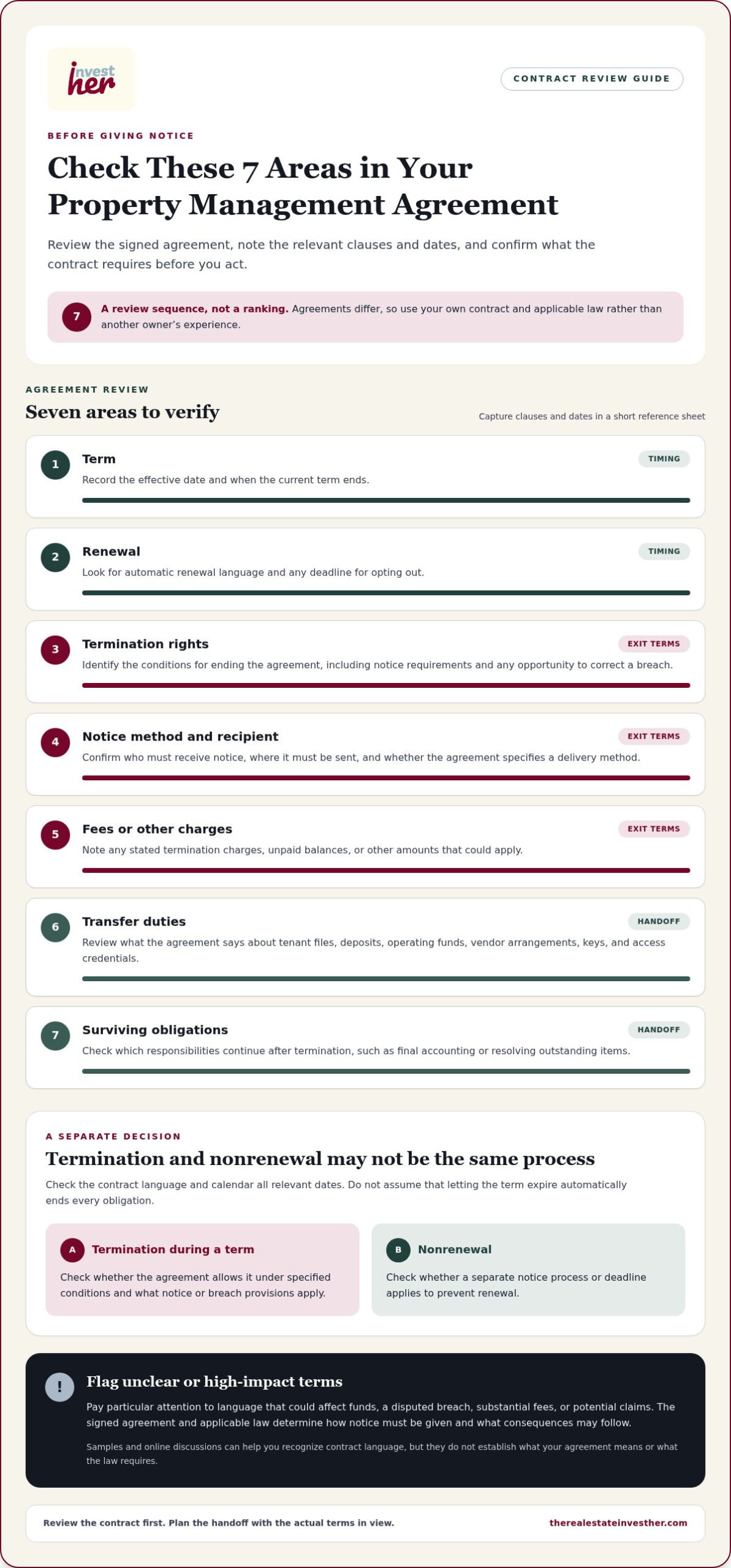
Read the agreement from start to finish, then make a short reference sheet with the relevant clauses and dates. Review these seven areas:
- Term: Record the effective date and when the current term ends.
- Renewal: Look for automatic renewal language and any deadline for opting out.
- Termination rights: Identify the conditions for ending the agreement, including notice requirements and any opportunity to correct a breach.
- Notice method and recipient: Confirm who must receive notice, where it must be sent, and whether the agreement specifies a delivery method.
- Fees or other charges: Note any stated termination charges, unpaid balances, or other amounts that could apply.
- Transfer duties: Review what the agreement says about tenant files, deposits, operating funds, vendor arrangements, keys, and access credentials.
- Surviving obligations: Check which responsibilities continue after termination, such as final accounting or resolving outstanding items.
Termination and nonrenewal may be separate processes. A contract might allow an owner to end the relationship during a term under specified conditions while requiring a different notice process to prevent renewal. Don’t assume that letting the term expire automatically ends every obligation. Check the language and calendar all relevant dates.
Termination Clause Samples can help you recognize examples of contract language, but samples and online discussions don’t establish what your agreement means or what the law requires. Treat forum posts as individual experiences, not standard notice periods, fee rules, or universal termination rights.
How do you handle unclear or high-impact terms?
Flag language that is ambiguous or could affect funds, a disputed breach, substantial fees, or potential claims. Organize the signed agreement, amendments, relevant notices, and records of the issue before seeking guidance from qualified counsel familiar with the relevant jurisdiction. This is especially prudent when you’re considering termination for cause or disagree with the manager about money or responsibilities.
For a second perspective on the operational decisions around your portfolio, the InvestHER Community for women investors offers peer connection and educational resources. Keep contract interpretation and legal advice with qualified counsel.
Can You Fire a Property Management Company Without Fees or Legal Risk?
You can’t rule out fees or legal exposure without reviewing the management agreement and applicable law. A careful review and documented handoff can reduce uncertainty, but they can’t guarantee a cost-free exit. The potential consequences depend on the contract, what has happened, and the relevant jurisdiction.
Separate possible amounts and risks into categories before estimating the impact. A contractual termination charge is different from an unpaid balance for work already performed. Transition expenses, ongoing property costs, vendor commitments, and a dispute about whether either party breached the agreement are separate considerations. Don’t combine them into one assumed “exit fee.”
How can different termination scenarios affect your risk?
This comparison is a planning framework, not a prediction of what you’ll owe. The agreement and jurisdiction determine the actual outcome.
| Scenario | What to examine |
|---|---|
| Compliant notice | Whether the notice follows the agreement’s timing, recipient, and delivery requirements, and what amounts remain payable. |
| Early termination | Whether the contract addresses ending the relationship before the term expires, including any stated charge or continuing obligation. |
| Missed notice | Whether missing a deadline affects renewal, fees, or the effective end date under the agreement. |
| Disputed breach | What evidence supports each party’s position and whether the agreement specifies a process for addressing the dispute. |
| Negotiated exit | Whether both parties can agree in writing on an end date, outstanding payments, and transition responsibilities. |
What can affect the financial consequences of termination?
Check the agreement for terms addressing early exit, missed notice, outstanding fees, and services already performed. Also list recurring payments, vendor commitments, and property expenses that may continue during the transition. Without the contract, relevant records, and jurisdictional context, a reliable estimate isn’t possible.
When should you pause before sending notice?
Pause if funds, resident records, alleged contract breaches, or responsibility for ongoing property operations are disputed. Preserve the agreement and amendments, account statements, relevant messages, notices, and a dated timeline. If the uncertainty could create material financial or legal consequences, seek guidance from qualified counsel familiar with the jurisdiction before acting.
Online examples can help you identify questions to investigate, but they don’t establish your rights. Treat any external resources as general educational guides rather than legal authority. Before deciding how to fire your property management company, ground the decision in your agreement, records, and qualified jurisdiction-specific advice where needed.
How to Transition Away From a Property Management Company Without Disrupting Operations
A smooth transition starts with a handoff plan, not just a termination notice. Where the agreement and circumstances allow, prepare the plan before giving notice without disclosing confidential information or taking steps that conflict with the contract. Assign a responsible person and deadline to every transfer item so residents, payments, maintenance, and records don’t fall between management arrangements.
Use one tracker for each property. Include the asset, responsible party, deadline, open issue, item expected, date received, and any follow-up needed. Keep the tracker as the shared source of truth for the transition instead of relying on scattered emails or memory.
What records and responsibilities should transfer?
Build the transfer inventory around the information needed to operate each property and answer questions about its history. Include leases, resident contact details, payment ledgers, maintenance histories, invoices, insurance records, and property files. Add operational items that can otherwise be missed:
- Open repairs, resident concerns, pending approvals, and upcoming deadlines
- Vendor contacts, active commitments, and relevant service records
- Keys, access credentials, and system permissions
- Funds and financial records that need reconciliation
For funds and records, follow the agreement and applicable requirements. Request a written accounting that identifies amounts transferred, outstanding items, and the period covered. Record what was delivered and received, including anything missing or incomplete. A dated receipt or acknowledgment creates a clear handoff record without implying that every discrepancy is resolved.
How do you keep residents and property operations informed?
Prepare clear resident communication that states the effective date of the change and the new contact for rent questions, maintenance requests, and other operational issues, when applicable. Coordinate the timing with the actual handoff so residents aren’t directed to a contact or process that isn’t ready. Keep the message factual, and don’t promise service changes that haven’t been put in place.
Assign an owner for each active issue, including emergencies, pending repairs, payment questions, and vendor follow-up. Track whether communication was sent and acknowledged, and note anything that still needs action. This is especially useful when a repair request begins under the outgoing manager but must be completed after the new arrangement takes effect.
Knowing how to fire your property management company includes controlling the transfer, not only ending the relationship. Use the handoff to make responsibilities visible and reduce the need to personally chase every open item. For peer connection and educational resources as you strengthen your real estate operations, explore the InvestHER Community for women investors.
What to Put in Place After You Fire Your Property Management Company
A successful management change requires clear expectations and operating controls, not only a new contract. Set a regular reporting rhythm, define who can make which decisions, and document how recurring work moves from issue to resolution. These controls help you maintain oversight without becoming the approval point for every routine task.
How can you reduce owner dependency without losing oversight?
Start by documenting the workflows that keep each property running. For rent questions, maintenance requests, financial reviews, and resident concerns, note the steps, who owns each one, when an issue must be escalated, and what information you need to make a decision. Then establish decision thresholds: routine tasks a manager can handle independently, items requiring owner approval, and urgent exceptions that need immediate attention.
Delegation works best when the task and authority are both clear. Assigning someone to gather maintenance bids, for example, doesn’t automatically mean they can approve the work. Document who recommends, who decides, and who confirms completion. That distinction keeps accountability visible while avoiding unnecessary approvals.
Use software or AI to organize records, summarize routine reports, or flag missing information only when access is controlled and a person reviews the output. Assign a human owner to each decision. Tools can support the operating process, but they shouldn’t silently approve expenses or resolve resident issues without accountable oversight.
What reporting rhythm should you establish?
Choose a recurring schedule that gives you useful visibility without creating reports no one uses. A concise property review might cover performance against expectations, financial records, maintenance status, resident issues, and exceptions requiring a decision. Give every exception an owner and next step. For instance, a repair awaiting approval should show the estimated scope, decision deadline, and person responsible for follow-up.
Keep the reporting format consistent across properties when possible. A repeatable view makes it easier to spot missing information and compare operations over time. Review the process itself periodically: if the same issue keeps reaching you, clarify the decision threshold or workflow before adding another tool.
How can operating controls support portfolio growth?
Management responsibilities should connect to broader asset oversight, cash-flow review, acquisition plans, and portfolio goals. As the portfolio changes, revisit whether current roles and reporting still provide the visibility you need. The guide How to Scale Real Estate Investments: The Strategic Guide for Women Investors offers a related perspective on aligning operations with growth. The InvestHER Community also provides peer connection and educational resources as you consider how other investors structure their businesses.
Your next step is practical: before choosing the next operating arrangement, write down the management requirements your portfolio needs, including responsibilities, decision rights, reporting, and escalation paths. That gives you a clearer basis for evaluating whether a new arrangement can support the business you’re building, not just take over tasks. This is the operating foundation for learning how to fire your property management company without recreating the same owner bottlenecks.
Make Your Next Management Decision With a Clear Plan
Knowing how to fire your property management company means treating the change as both a contract decision and an operational handoff. Review the agreement before giving notice, assess documented performance rather than acting on frustration alone, and plan how residents, records, funds, maintenance, and open issues will move forward.
The work doesn’t end when the relationship does. Set clear reporting expectations, decision rights, and escalation paths for the next management arrangement so you can stay informed without approving every routine task. Start by writing down what your portfolio needs from management, including the information and decisions you expect to retain as owner.
Peer perspective can help you think through the business behind your portfolio. The InvestHER Community connects women real estate investors through peer support and educational resources, while STRIVE offers strategic mentorship for women working to scale their investments. Explore the InvestHER Community for women building stronger real estate businesses and identify the operating decisions you want to make next.
Frequently Asked Questions
Can I fire my property management company at any time?
Not necessarily. Your agreement and applicable law determine when and how you can end the relationship, including any conditions for early termination. To understand how to fire your property management company, review the contract’s term, termination rights, renewal language, and notice requirements before acting. If you believe the manager breached the agreement, document the specific events and get jurisdiction-specific legal guidance before relying on that as a basis to terminate.
How much notice should I give my property management company?
Give the notice required by your signed agreement and applicable law. Check when the notice period starts, who must receive notice, and whether the agreement specifies a delivery method. Also review renewal deadlines, since notice to end the agreement early may differ from notice not to renew it. Don’t rely on another owner’s timeline as a rule for your contract. Keep a dated copy of your notice and delivery record.
Can a property management company charge a fee if I fire it?
It may, depending on the agreement and applicable law. Review any terms covering early termination, missed notice deadlines, outstanding balances, and services already performed. Separate a stated contract charge from unpaid management fees, continuing vendor commitments, and transition expenses. These are different potential costs, not necessarily one fee. If the amount or contractual basis is disputed, preserve the relevant records and seek qualified legal guidance before agreeing to a payment or withholding funds.
What is the difference between terminating a property manager and not renewing the contract?
Termination generally means ending the management relationship under a provision that applies during the contract term. Nonrenewal means giving notice that you don’t want the agreement to continue into another term. The agreement may set different conditions, deadlines, or procedures for each. Read both sections and calendar the relevant dates. Don’t assume that allowing the current term to expire automatically completes the required nonrenewal process.
How do I transfer tenants and records when changing property managers?
Use a written handoff tracker for each property. List leases, resident contacts, payment ledgers, maintenance histories, invoices, insurance records, keys, access credentials, and open issues, along with the responsible party and deadline for each item. Reconcile funds and financial records against the agreement and applicable requirements. Record what was received, what remains outstanding, and who owns each follow-up so resident questions and property operations have a clear point of contact.
Should I tell tenants before firing my property management company?
Communicate with residents once the change and its operational details are clear enough to give accurate information. The message should state the effective date and explain where to direct rent questions, maintenance requests, and other concerns after the transition, as applicable. Coordinate timing with the handoff so residents aren’t sent to an inactive contact or process. Follow the agreement and applicable requirements, and avoid promising changes that aren’t yet in place.
What should I do if my property manager will not cooperate with the transition?
Make a specific written request for each outstanding record, fund reconciliation, key, credential, or open-work update, and refer to the relevant agreement terms. Keep copies of communications, account statements, and a dated list of items not received. Don’t assume you can bypass access controls or resolve disputed funds on your own. If important records or money are withheld, or responsibilities are contested, consult qualified counsel familiar with the relevant jurisdiction.

Article by
Andresa Guidelli
Real estate investor, operator, and founder of The Real Estate InvestHER, a national platform supporting women real estate investors. With 15+ years of experience in real estate investing and business operations, she focuses on helping investors build stronger businesses behind their portfolios through better systems, clearer decision-making, leadership, and responsible use of AI.
Be the first to comment