


Avoiding Bad Real Estate Partnerships: 2026 Guide
Avoiding bad real estate partnerships starts with testing how you will work together before committing capital, then putting expectations for money, labor, decisions, and disagreements in writing. The property matters, but so do the assumptions you and your partner have not discussed.
A potential partner’s experience, network, or financial contribution can add value. But shared enthusiasm does not automatically mean shared goals, equal effort, or compatible decision-making. A partnership needs to work through routine operations as well as pressure, from a delayed renovation to a disagreement about whether to hold or sell.
Use this guide to assess alignment and working behavior, clarify who contributes capital and labor, and define decision rights and escalation paths before the venture begins. You will also consider how regular check-ins, transparent records, and a clear plan for changing goals or exiting can keep the partnership from depending on one owner to resolve every issue. The aim is not to eliminate every risk. It is to make important expectations visible while there is still time to decide whether to move forward together.
Key Takeaways
- Assess a partnership by whether expectations, incentives, responsibilities, and decision-making align, not by whether you occasionally disagree.
- Use warning signs such as vague contributions or pressure to rush as reasons to ask more specific questions before moving forward.
- Written terms can define roles and decisions, but ongoing communication and operating discipline are still needed to keep partners aligned.
- For avoiding bad real estate partnerships, test how a potential partner responds to realistic scenarios, including delays, disagreements, and changing goals.
- Set a regular review rhythm to track decisions, owners, risks, and unresolved issues as the partnership grows.
What makes a real estate partnership risky before a deal closes?
Partnership risk often comes from a mismatch in expectations, incentives, responsibilities, or decision-making. Avoiding bad real estate partnerships means finding those gaps before capital is committed, rather than assuming that a promising property or a strong personal connection will resolve them later. A deal can look sound on paper while the partners disagree about who will manage operations, when to distribute profits, or who can act when the plan changes.
Disagreement alone does not mean a partnership will fail. Partners can reasonably see a renovation, refinance, or hold strategy differently. The greater concern is a repeated pattern that undermines execution or trust, such as avoiding decisions, changing commitments without discussion, or withholding information. A general overview of a business partnership can provide context, but the practical test is how this specific group will work together.
To explore how partnership problems can develop, watch this conversation:
Which expectations should partners align on first?
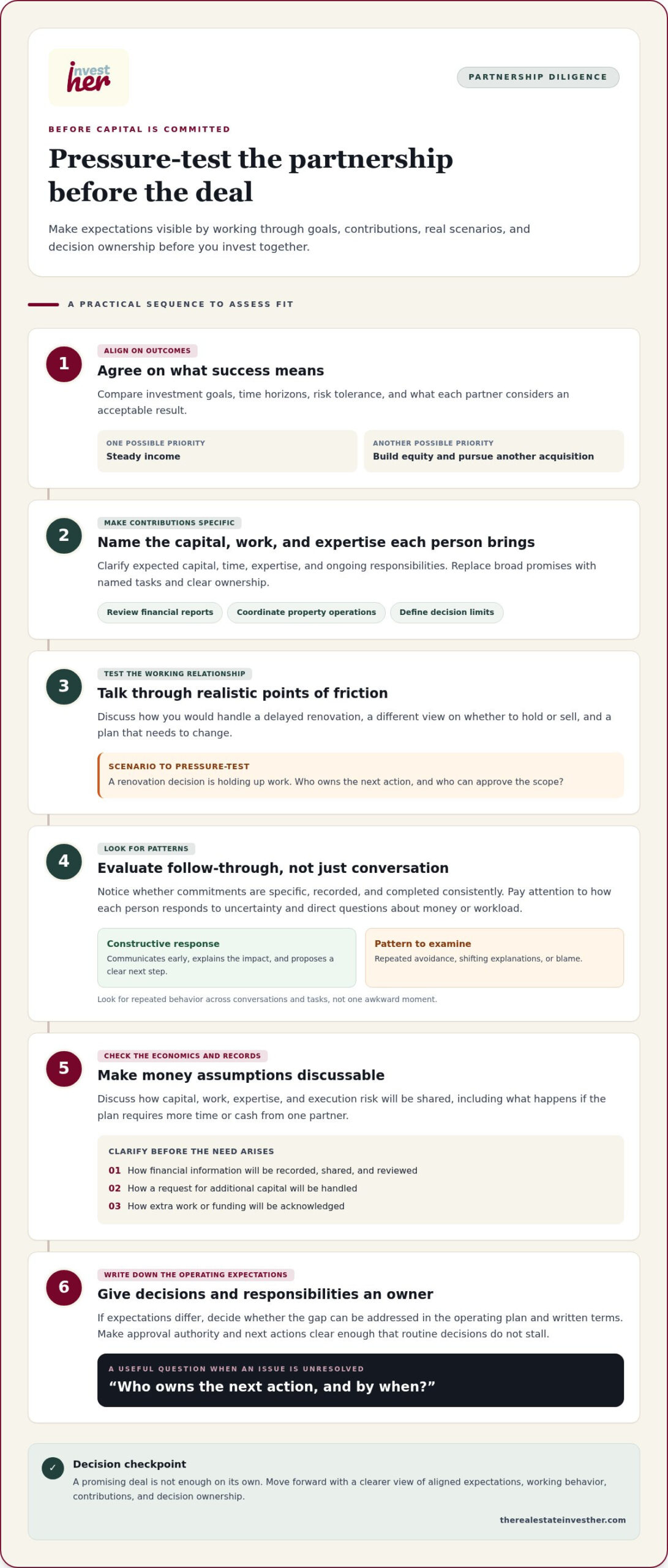
Align on the intended outcome before debating deal details. Compare investment goals, time horizons, risk tolerance, and what each partner considers an acceptable result. One person may prioritize steady income, while another wants to build equity and pursue another acquisition. Clarify each partner’s expected capital, time, expertise, and ongoing responsibilities. Be specific about recurring work, such as reviewing financial reports or coordinating property operations, and identify who owns each task. Discuss assumptions about future acquisitions, refinancing, distributions, and reinvestment. If expectations differ, decide whether the difference can be addressed in the operating plan and written terms.
How can early behavior reveal a poor fit?
Early working behavior can show whether expectations are likely to translate into reliable execution. Notice whether commitments are specific, recorded, and completed consistently. Pay attention to how each person responds to uncertainty, disagreement, and direct questions about money or workload. A missed follow-up may be a correctable communication gap; repeated avoidance, shifting explanations, or blame can point to a deeper operating concern. Look for patterns across conversations and tasks, not one awkward moment. When a commitment slips, note whether the person communicates early, explains the impact, and proposes a clear next step.
Standalone takeaway: Assess both the deal and the operating relationship before committing. Write down the assumptions shaping your decision, then discuss the areas where partners see things differently. Peer perspectives, including those available through the InvestHER Community, can help you pressure-test assumptions while you remain accountable for your own decision.
What are the warning signs of a bad real estate partnership?
Warning signs are reasons to ask more questions and do closer diligence, not proof that a person or partnership will fail. Pay attention to vague contributions, unreliable follow-through, missing financial information, and pressure to decide before you understand the implications. One missed email or a difference of opinion may be manageable. A recurring pattern that leaves responsibilities unclear or decisions stalled deserves closer scrutiny.
Consider a renovation decision that needs approval before work can proceed. One partner thinks the other is obtaining an updated quote; the other assumes the first partner has already approved the scope. Nobody owns the next action, so the decision stalls and the work is delayed. The issue is not simply disagreement. Authority, ownership, and follow-through are not clear enough to keep the project moving.
Which financial and contribution patterns deserve scrutiny?
Compare contributions in concrete terms. “I’ll help with operations” is difficult to assess; named responsibilities, decision limits, and expected availability make the commitment clearer. Discuss how capital, work, expertise, and execution risk will be shared, including what happens if the original plan requires more time or cash from one partner. Ask how financial information will be recorded, shared, and reviewed. If one person carries additional work or funding without that contribution being acknowledged, the partnership’s economics and expectations may be out of step. Clarify how you will handle a request for additional capital before one arises.
What communication patterns can undermine the partnership?
Look for recurring communication problems that affect execution. If decisions are repeatedly reopened, approval authority or decision thresholds may be unclear. If a concern is deferred, identify who owns the response and when the partners will revisit it. Silence can leave risks unaddressed; blame can make them harder to resolve; surprise changes can erode trust. The useful test is whether partners can raise an issue, agree on a next step, and follow through.
Before committing, write down what you observe and ask direct questions about the pattern. For example: “Who owns the next action, and by when?” A clear answer and consistent follow-through help distinguish a fixable gap from a deeper mismatch. For another perspective as you evaluate your assumptions, explore The Real Estate InvestHER community and its peer support for women investors.
Can a written agreement prevent a bad real estate partnership?
A written agreement can clarify expectations and provide a shared reference point, but it cannot guarantee alignment or reliable follow-through. It records what partners intend to do. Communication and operating discipline determine whether those terms guide decisions as the venture changes.
For avoiding bad real estate partnerships, treat the agreement and the working relationship as connected safeguards. Discuss the venture’s structure with qualified legal and tax professionals, who can tailor documentation to the arrangement and applicable law. Partners also need practical routines for sharing information, resolving open questions, and carrying out decisions.
What should partners clarify in their written terms?
Use the drafting process to surface assumptions, not just record percentages. Clarify contributions, responsibilities, decision authority, financial reporting, and how decisions are made. Discuss how partners will address disagreements, material changes, a partner’s exit, and unexpected circumstances. Qualified counsel can prepare or review documents for the specific venture. If a term is difficult to define, use that as a prompt to resolve the underlying expectation before committing.
What needs a repeatable process beyond the agreement?
Agree on an operating rhythm for reviewing financial information, open decisions, risks, and next steps. For important decisions, identify who recommends, who approves, who communicates the decision, and who carries it out. Completing a delegated task does not automatically grant authority to change the plan. Set an escalation path and require human review when a decision involves significant risk or uncertainty.
The distinction is straightforward: written terms define the intended framework; recurring practices help partners use it consistently.
Topic
Question to resolve
Operating practice to maintain
Contributions and responsibilities
Who contributes capital, time, and expertise, and who owns each ongoing responsibility?
Review assigned work and upcoming commitments together.
Authority and decisions
Who can recommend, approve, communicate, and execute each type of decision?
Record decisions, owners, and next steps in a shared place.
Changes and disagreements
How will partners handle unresolved issues, changed priorities, or a proposed exit?
Escalate unresolved questions through an agreed process and review significant risks together.
A signed document will not replace candid conversations or make every future decision automatic. Use it alongside clear roles and regular reviews, and pressure-test assumptions with experienced peers, including through the Real Estate InvestHER community.
How do you evaluate a potential partner before committing?
Evaluate a potential partner in stages: clarify your goals, test assumptions with specific scenarios, observe how you work together, document the terms, and pause before committing capital. This helps you assess both the property plan and the partners’ capacity to carry it out consistently. Trust matters, but clear answers and observed behavior give you more to base a decision on.
Which questions reveal whether goals and working styles align?
Ask each person to describe their priorities, acceptable risks, and definition of a successful outcome. Then test those answers against a scenario: if a renovation takes longer or costs more than expected, what decisions need to be made, who makes them, and how will you communicate? Discuss availability, strengths, operating responsibilities, and realistic limits on time. Specific answers can reveal mismatched assumptions that broad statements about shared values may leave hidden.
Growth plans can also change what a partnership needs from each person. If one partner wants to pursue additional properties while another prefers to focus on the current asset, clarify how that affects workload, capital, and decision authority. The guide to how to scale real estate investments can help frame how portfolio growth connects to operating capacity.
How can you test execution before increasing commitment?
Agree on a small planning task with a clear owner and deadline, such as organizing the next steps for evaluating a property. Observe whether updates arrive when expected, questions are addressed, and decisions are recorded accurately. Treat this as a chance to spot process gaps, not as a verdict on someone’s character. If handoffs are unclear, clarify ownership and try a more structured approach before relying on the same workflow for a larger commitment.
Use this sequence to keep the evaluation grounded:
- Clarify goals: Compare priorities, risk tolerance, and desired outcomes.
- Test assumptions: Discuss realistic delays, cost changes, and strategic disagreements.
- Review working behavior: Notice follow-through, communication, and how responsibilities are handled.
- Document terms: Record agreed contributions, roles, and decision processes.
- Pause: Take time to consider unresolved questions before committing capital.
A deliberate pause is part of due diligence, not a lack of confidence. For an additional peer perspective as you evaluate partnership decisions, explore the InvestHER Community for women real estate investors.
How can you keep a real estate partnership accountable as it grows?
Partnership accountability depends on visible ownership, an agreed review rhythm, and clear next actions. As a portfolio expands, informal updates can leave partners with different views of priorities, cash needs, or who is responsible for moving work forward. A repeatable operating routine keeps those details visible without making every decision depend on one partner.
What operating rhythm helps partners catch problems early?
Set a recurring review to cover current priorities, commitments, financial information, risks, and decisions awaiting action. For each agreed next step, record one accountable owner and a follow-up date. Keep a shared decision log that notes what changed and why, so a revised plan does not look like an unexplained reversal later.
A simple meeting record can capture:
- Decision: What was agreed, and who had approval authority?
- Responsibility: Who owns the next action, and when will it be reviewed?
- Risk or open issue: What needs attention, and who will bring back an update?
- Changed assumption: What new information led the partners to adjust the plan?
Documentation supports continuity, but it does not transfer judgment or authority by itself. A written process can help a team member prepare a property update or organize records; it does not automatically authorize that person, or an AI tool, to make a high-impact financial or strategic decision. Define who reviews the information and who has the authority to decide.
What should partners do when expectations begin to drift?
Address drift with observable details rather than labels. Identify the specific commitment, what happened, and when. Then agree on a corrective action, an accountable owner, and a review point. For example, if operating reports arrive later than agreed, decide who will prepare them, what information they must include, and when partners will check whether the process is working. If the issue raises legal or tax questions, revisit the written terms and seek qualified advice.
Clear records make it easier to discuss a problem before it becomes a larger disagreement. Peer perspective can also help you reflect on partnership practices and operating expectations while keeping the decision yours. The InvestHER Community for women real estate investors offers peer support and learning as you build sustainable ways to work together.
Build a Partnership That Can Work in Practice
A strong real estate partnership depends on more than a promising deal or personal trust. Before committing, clarify each partner’s goals, contributions, responsibilities, and decision authority. Then use specific scenarios and shared planning tasks to see how expectations hold up in practice.
Written terms give partners a reference point, while regular reviews keep decisions, financial information, risks, and next steps visible as the venture grows. For avoiding bad real estate partnerships, the practical aim is to make important assumptions explicit and address gaps before they become operating problems.
You do not have to pressure-test every decision alone. InvestHER Community membership offers peer support and resources for women real estate investors, and the STRIVE Mentorship Program provides strategic guidance and access to experienced investors. Explore the InvestHER Community for peer support and strategic perspective as you build a partnership and an operating foundation that support your goals.
Frequently Asked Questions
What are the biggest red flags in a real estate partnership?
Major red flags include unclear contributions, repeated missed commitments, reluctance to share financial information, and pressure to commit before questions are answered. Pay attention to patterns, not one imperfect conversation. For example, if decisions repeatedly stall because no one owns the next step, clarify responsibility and authority. Avoiding bad real estate partnerships means treating these behaviors as prompts for closer diligence, then assessing whether partners can address the underlying issue together.
Can a written agreement prevent problems with a real estate partner?
A written agreement can clarify expectations, but it cannot guarantee that partners will stay aligned or follow through. Use it to document contributions, responsibilities, decision processes, financial reporting, and how partners plan to address disagreements or exits. Then support those terms with regular communication and clear operating practices. Discuss the structure with qualified legal and tax professionals, who can tailor documents and guidance to the venture and applicable law.
How do you evaluate a potential real estate investment partner?
Evaluate both the partner’s stated goals and how they work in practice. Compare priorities, acceptable risks, time availability, expertise, and definitions of a successful outcome. Discuss a realistic challenge, such as a renovation delay, and notice how each person handles uncertainty, questions, and next steps. You can also agree on a small planning task with a clear owner and deadline. Use what you observe to identify process gaps, not to make sweeping judgments about character.
What should real estate partners agree on before buying a property together?
Before buying, agree on investment goals, expected capital and nonfinancial contributions, operating responsibilities, and who can recommend, approve, and execute decisions. Discuss how partners will share and review financial information, address additional cash needs, and approach distributions, refinancing, or reinvestment. Also identify how you will handle material changes, disagreements, and a potential exit. Put key terms in writing with appropriate professional guidance, so important assumptions are not left to memory.
How should partners handle disagreements about a real estate investment?
Start by stating the specific decision in dispute and the information each partner is using. Refer to the agreed decision process, clarify who has authority, and set a next step, owner, and review date. For example, partners debating whether to approve a renovation change can compare its effect on budget, schedule, and investment goals before deciding. Record the outcome and rationale. If discussion stalls or raises legal or tax questions, revisit the written terms and seek qualified advice.
When should you walk away from a real estate partnership?
Consider pausing or walking away before committing if material expectations remain unresolved, financial information is withheld, commitments repeatedly go unmet, or you are pressured to proceed without time for due diligence. First distinguish a correctable gap from a pattern that undermines trust, execution, or your investment objectives. Ask direct questions and assess whether the partner can agree to practical changes. If important concerns remain unanswered, declining the opportunity may be more responsible than relying on hope.
Can real estate partners change their roles after a deal closes?
Partners can discuss changing responsibilities after closing, but the change should be agreed, documented, and consistent with the venture’s existing terms. Clarify what work is moving, who will own it, whether decision authority is changing, and how the transition will be reviewed. Documenting a process does not automatically transfer judgment or approval rights. If a proposed change could affect contractual, legal, or tax matters, review the relevant documents and consult qualified professionals before relying on the new arrangement.

Article by
Andresa Guidelli
Real estate investor, operator, and founder of The Real Estate InvestHER, a national platform supporting women real estate investors. With 15+ years of experience in real estate investing and business operations, she focuses on helping investors build stronger businesses behind their portfolios through better systems, clearer decision-making, leadership, and responsible use of AI.
Be the first to comment