


Fear of Taking on Investment Property Debt: A Practical Decision Framework
What if the fear of taking on investment property debt is asking for better numbers, not a quick yes or no? Treat it as a useful warning when it points to a specific risk, such as a payment your cash flow can’t support during a vacancy. If the concern stays vague after you’ve tested realistic assumptions and set clear limits, it may be keeping you stuck rather than protecting your portfolio.
It’s reasonable to consider what happens if occupancy drops, expenses rise, or personal income changes. Confidence alone won’t answer those questions, and neither will a lender’s approval. A sound decision comes from understanding whether the property can carry its debt, what resources you could draw on if conditions worsen, and which boundaries you’re willing to maintain.
This article offers a practical framework for assessing a proposed loan through operating cash flow, downside scenarios, and clear guardrails for leverage, reserves, decision authority, and ongoing reviews. You’ll be better equipped to distinguish a risk that needs a plan from a fear that needs more clarity, then make a deliberate decision without treating caution as either a flaw or a final answer.
Key Takeaways
- Treat fear of taking on investment property debt as a prompt to identify specific exposures, not as an automatic yes or no.
- Assess how loan terms, property performance, available reserves, and portfolio concentration interact before deciding how much debt fits.
- Compare base, downside, and severe-but-plausible scenarios, and label each figure as an assumption.
- Use a repeatable decision workflow to document your evidence, debt boundaries, and review points.
- Use experienced peer feedback to challenge assumptions and surface questions, while keeping underwriting and professional advice distinct.
Why does investment property debt feel risky, even when a deal looks promising?
Fear can signal a real exposure, an unclear plan, or both. It doesn’t determine whether a deal is sound. Investment property debt is borrowed capital tied to a property and the obligation to repay it under agreed loan terms. The fear of taking on investment property debt may come from leverage, uncertain rental income, personal guarantees, or concern about losing control if the property underperforms.
A promising projection doesn’t remove those risks, and confidence alone doesn’t establish affordability, safety, or investment merit. Debt can amplify gains and losses, so it helps to understand both the property-level numbers and how leverage can contribute to broader market instability. For background, see the risks of a real estate bubble.
For another perspective on using debt to buy rental real estate, watch this video:
What is the difference between prudent caution and fear-driven avoidance?
Prudent caution turns concern into questions, evidence, and decision criteria. For example, if you doubt a deal’s vacancy assumption, check comparable rental evidence, rerun the projection with a longer vacancy period, and decide what level of cash flow still works. Avoidance looks different: you keep postponing the decision without identifying or investigating the uncertainty. A clear question creates a next step. Repeated delay without one leaves the concern unresolved.
Which parts of taking on property debt can feel most exposed?
Separate what’s contractually due from what’s uncertain. Loan payments follow the agreement, while rent, occupancy, repairs, taxes, insurance, and other operating costs can change. That mismatch can make even a well-performing property feel exposed, especially if reserves or income from other properties are limited.
A personal guarantee may add another layer of concern because it can create personal obligations beyond the property itself. Its scope depends on the actual documents and circumstances, so review the loan terms and guarantee with qualified professionals rather than assuming what is covered. Then name the feared outcome plainly: a stretch of vacancy, an unaffordable payment, a call on a guarantee, or less flexibility elsewhere in the portfolio. Specific concerns can be evaluated; a general sense of danger is harder to act on.
How does investment property debt create risk across a portfolio?
Debt risk depends on repayment terms, property performance, available reserves, and how concentrated your portfolio is. A loan creates scheduled obligations, while rental income and operating costs can shift. If one property has a vacancy or an unexpected repair, the impact may extend beyond that asset when the same cash reserves or owner attention support multiple properties.
Each payment may include principal, the amount borrowed that you repay, and interest, the cost of borrowing. Amortization describes how payments reduce principal over time. The payment schedule sets when amounts are due. These are loan terms. Rent, vacancy, repairs, and other operating figures in your deal analysis are investment assumptions, not lender promises or guaranteed results.
A debt-service coverage ratio (DSCR) compares a property’s income available for debt payments with its scheduled debt service, but its calculation and interpretation depend on the context and inputs used.
How do loan terms and property cash flow interact?
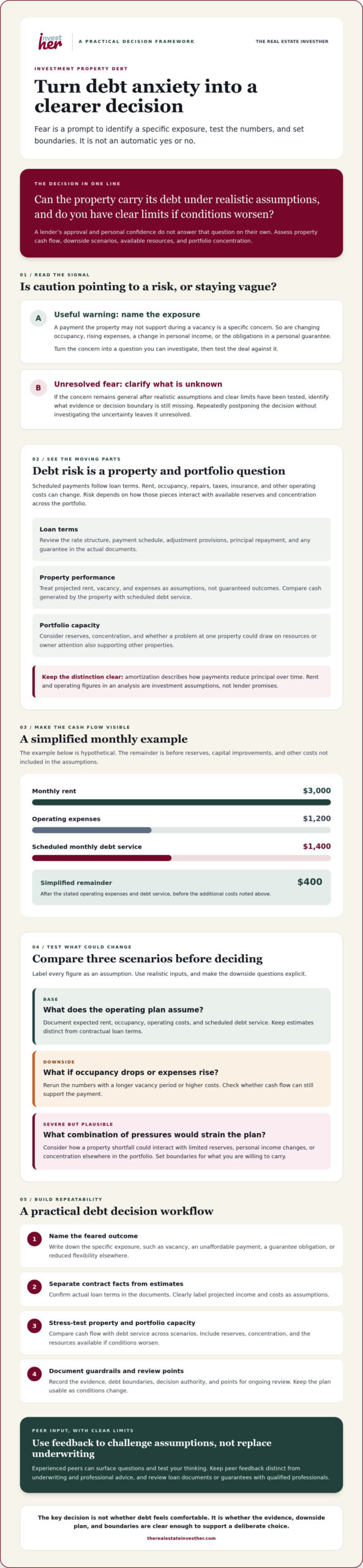
Compare the payment obligation with cash generated by the property, using clearly labeled assumptions. For example, a hypothetical property brings in $3,000 in monthly rent and has $1,200 in monthly operating expenses before debt service. If its scheduled monthly debt service is $1,400, the simplified remainder is $400 before reserves, capital improvements, and other costs not included in the assumptions.
A fixed-rate loan generally keeps its rate fixed as stated in the agreement; an adjustable-rate loan may change according to its terms. Confirm the actual rate structure, payment schedule, and adjustment provisions in your loan documents. Treat projected rent and expenses as estimates, not certainties.
How can leverage affect the wider portfolio and operating business?
Map obligations together, not only property by property. A repair at one building and delayed leasing at another could draw on the same reserves, while follow-up work competes for management time. Check whether guarantees or agreements connect properties, but don’t assume they do. The documents determine whether there are shared obligations or cross-property dependencies.
For each property, keep reliable records of rent received, expenses, debt payments, and reserve balances. Assign someone to update and review those records, and name an owner for decisions that require judgment. Set escalation triggers in advance, such as cash flow falling below your chosen threshold or reserves reaching a limit. That way, a review leads to action rather than surprise.
The fear of taking on investment property debt becomes more manageable when you can see how each loan fits the whole operating picture. Peer discussion through The Real Estate InvestHER can help you examine assumptions and questions, while your own underwriting and professional advice remain essential.
How can you stress-test an investment property loan before deciding?
Test the deal against downside assumptions before deciding what level of debt is acceptable. A stress test compares how cash flow and reserves respond when operating conditions or financing inputs differ from the base case. It won’t predict what will happen. It shows which assumptions the deal depends on.
A stress test reveals sensitivity to assumptions, not certainty about future performance. Label every input as an assumption, even when it is informed by a rent comp, contractor estimate, or lender quote. Evidence can support an estimate, but it doesn’t turn a projection into a guarantee.
Which assumptions should an investor test?
Review expected rent, vacancy, operating expenses, repairs, and timing against evidence relevant to the property. Mark each input as verified, estimated, or uncertain, and record its source and date. Use the actual financing proposal to test loan terms, including rate changes or payment terms where applicable. Don’t substitute broad market averages or universal thresholds for deal-specific information.
How do the scenarios compare?
Use three cases to make the trade-offs visible. The examples below are illustrative only. Replace every assumption with property-specific evidence and actual loan terms.
| Scenario | Operating assumptions | Financing and reserves | What to assess |
|---|---|---|---|
| Base | Assumption: expected rent and vacancy; anticipated operating costs and repair timing. | Assumption: quoted payment schedule and planned reserve availability. | Does expected property cash flow cover obligations and planned reserves? |
| Downside | Assumption: lower collected rent, longer vacancy, higher expenses, or a repair sooner than planned. | Assumption: actual payment terms; reduced reserves after a repair or delayed lease-up. | Can the property and wider portfolio absorb the shortfall without breaching your limits? |
| Severe but plausible | Assumption: several adverse operating conditions occur together, such as extended vacancy and a major repair. | Assumption: less accessible cash, plus any relevant change in financing terms. | What action would protect liquidity, and at what point would the deal no longer fit? |
What would make you proceed, renegotiate, pause, or decline?
Set decision thresholds before attachment to the property makes it harder to evaluate the numbers objectively. Compare each scenario with your available reserves, existing obligations, and stated risk boundaries. Then define the response in advance:
- Proceed if the assumptions are supportable and the downside remains within your boundaries.
- Renegotiate if a change in price, financing, or terms could address a specific weakness.
- Pause if important inputs or documents remain unverified.
- Decline if the severe-but-plausible case exceeds what your portfolio can absorb.
Have qualified professionals review loan documents, tax questions, and financial projections within their areas of expertise. A clear decision rule turns the fear of taking on investment property debt into a reviewable process, not a guess about your confidence.
What practical steps help you make a debt decision without analysis paralysis?
Use a defined workflow to turn the fear of taking on investment property debt into a decision you can explain and revisit. The goal isn’t to eliminate uncertainty. It’s to identify which open questions can be answered with more information, which risks remain after due diligence, and whether those risks fit your boundaries.
- Define the decision. Write a one-sentence decision brief that states the property, proposed loan, deadline, and what you need to decide. Separate the decision itself from questions you can resolve, such as confirming a payment schedule or obtaining a repair estimate.
- Gather evidence. Assemble the lender’s proposal and loan documents, rent support, expense estimates, inspection findings, and current portfolio obligations. Record the source and date for each material figure. Ask a qualified lender about loan terms, an attorney about contractual obligations, an accountant about tax questions, and a financial professional about how the decision fits your broader finances.
- Model scenarios. Use your underwriting worksheet to compare expected operations with downside cases, including changes to income, vacancy, expenses, and repair timing. Mark what is verified, estimated, or still uncertain. If a missing fact could materially change the result, pause to obtain it instead of filling the gap with optimism.
- Set boundaries. Compare the scenarios with your available reserves, existing debt obligations, and personal and business risk limits. Define what would make you proceed, renegotiate, pause, or decline before you become attached to the deal.
- Record the outcome. Save a decision memo with the assumptions, evidence, unresolved risks, chosen action, and conditions that would trigger another review. A record helps you distinguish a deliberate decision from pressure or repeated second-guessing.
How do you set debt boundaries that fit your portfolio?
Set boundaries around your own capacity rather than adopting a universal leverage or reserve threshold. Document the conditions that require a fresh review, such as a material change in financing, purchase terms, projected income, or reserve availability. A written process tells the team what information to gather and when to escalate. It doesn’t automatically transfer authority to approve borrowing. Name who can recommend, who can review, and who holds final decision rights.
How can operating systems reduce repeated uncertainty?
Use one underwriting template across properties, retain the source and date for key assumptions, and assign responsibility for tracking payments, property performance, reserves, and review dates. Set escalation triggers so concerns reach the right decision-maker promptly. AI can help organize documents, extract figures, or flag missing information, but its outputs require human verification. Keep the investor accountable for the final decision, especially when assumptions, loan obligations, or risk boundaries require judgment.
Build a clearer operating rhythm for your portfolio with the InvestHER Community, where peer perspectives can help you examine your decision process. Use discussion as educational support, not a substitute for underwriting or qualified professional advice.
How can peer support help you manage investment property debt responsibly?
Peer support can help you test assumptions, spot unanswered questions, and learn how other investors approach similar decisions. It can’t replace property underwriting, review of your actual loan documents, or advice from a qualified professional. The value of discussion is perspective, not permission to borrow. Your property, financing, portfolio obligations, and risk boundaries still determine whether a decision fits.
Advice is most useful when you understand the context behind it. Ask what asset type, financing structure, operating conditions, and time period the investor is describing. A strategy that worked for a different property or market may not transfer to yours. Treat personal experience as a perspective to investigate, not proof of what your deal will do.
How do you evaluate advice from other investors?
Listen for transparent assumptions and a willingness to discuss downside, not only successful outcomes. Separate opinion from verifiable facts, then take deal-specific loan, legal, tax, or financial questions to the appropriate professional. Another investor’s comfort with leverage reflects her own circumstances and risk tolerance. It isn’t a template for yours.
- Relevant experience: Does the investor understand your asset type and financing structure?
- Clear context: What operating conditions and time period shaped the advice?
- Transparent assumptions: Are projected income, expenses, and reserves identified as estimates?
- Downside awareness: Is the person willing to discuss what could go wrong and how they would respond?
When might InvestHER Community or mentorship be relevant?
InvestHER Community offers peer support and educational resources for women real estate investors. STRIVE is a mentorship program for women seeking strategic guidance as they scale investments. These settings can help you compare decision approaches, articulate concerns, and surface questions to investigate. They don’t replace underwriting or individualized financial, legal, or tax advice.
Repeatable review processes make that learning useful beyond one conversation. Keep a consistent record of assumptions, open questions, review dates, and decision owners. This creates a reliable reference for your team and reduces the need to reconstruct every past decision from memory. Documenting the workflow can make follow-up easier, but approval authority should remain with the person explicitly responsible for borrowing decisions.
If peer perspective would help you examine your process, Explore the InvestHER community.
For a practical next step, write down the specific debt question you haven’t resolved and identify who can answer it, whether that’s a lender, attorney, accountant, financial professional, or experienced peer. That turns the fear of taking on investment property debt into a clear request for information, while keeping the final decision grounded in your own analysis.
Make your next debt decision with clear guardrails
The fear of taking on investment property debt doesn’t have to make the decision for you. Use it to identify what needs scrutiny, then assess the loan against property cash flow, portfolio obligations, and realistic downside scenarios. A decision framework also gives you a clear point to proceed, renegotiate, pause, or decline.
Set your boundaries before pressure or attachment takes over. Record which assumptions still need evidence, what conditions would change your decision, and who has authority to approve borrowing. Then schedule a review so monitoring the debt becomes part of how your business operates, not another concern that depends on your memory.
Peer support can help you pressure-test your thinking, while underwriting and qualified professional advice remain essential. The InvestHER Community offers peer support and educational resources for women investors, and STRIVE offers mentorship and strategic guidance for women scaling their investments. Explore the InvestHER Community to learn alongside other investors.
Frequently Asked Questions
What does fear of taking on investment property debt usually mean?
Fear of taking on investment property debt can reflect a specific concern about repayment, uncertain rental income, personal exposure, or unclear decision criteria. Fear alone doesn’t prove a loan is unsuitable, just as confidence doesn’t prove it’s sound. Name the concern, identify what evidence could help answer it, and assess the property and loan terms. For questions involving legal, tax, financing, or personal financial considerations, seek guidance from a qualified professional.
Is taking on debt for an investment property always risky?
Borrowing creates repayment obligations, but the type and level of risk depend on the loan terms, property performance, reserves, portfolio context, and your circumstances. Debt isn’t automatically good or bad. Review the actual loan documents and test how the deal performs under reasonable downside assumptions, such as lower income or higher expenses. Consult qualified professionals for legal, tax, or financing questions specific to your situation rather than relying on general rules.
How do I know if I am taking on too much debt for a rental property?
There’s no single debt threshold that fits every investor or property. Compare expected loan payments and other obligations with evidence-based income and expense assumptions. Then test weaker scenarios and consider available reserves, existing commitments, and your own risk boundaries. Set decision limits before committing, including conditions that would make you pause or decline. A qualified financial or lending professional can help assess details that a general framework can’t resolve.
Can a real estate investment still make sense if the debt makes me nervous?
It may, but nervousness is a reason to investigate, not an automatic reason to proceed or withdraw. Pinpoint the concern, such as payment changes, vacancy, repairs, or a personal guarantee. Check the loan documents and test how the property performs if assumptions weaken. Before deciding, define what would lead you to proceed, renegotiate, pause, or decline. If key facts remain unclear, seek relevant professional input before making a commitment.
What should I include in an investment property debt stress test?
Test how the deal responds to lower income, longer vacancy, higher operating expenses, unexpected repairs, delayed leasing, or different financing terms where relevant. Use assumptions supported by property-specific information, and record each input’s source. Compare the results with scheduled obligations, available reserves, and your risk boundaries. A stress test shows how sensitive the deal is to changed assumptions. It can’t predict or guarantee future property performance.
Should I pay off investment property debt before buying another property?
The choice depends on your loan terms, cash position, portfolio concentration, investment plans, and personal risk limits. Compare the effect of paying down debt with keeping liquidity or pursuing another investment, using figures specific to your properties and financing. Consider how each choice affects your ability to meet obligations and handle unexpected costs. Ask qualified professionals about relevant tax and financing questions, then document the criteria behind your decision.
How can an investor manage debt decisions across multiple properties?
Maintain a current record of each loan obligation, property income and expenses, available reserves, applicable guarantees, and upcoming review dates. Assign responsibility for keeping the information current, and define which changes require owner review or professional input. A consistent process helps you see how obligations interact across the portfolio and reduces reliance on memory. It supports informed decisions, but doesn’t remove the need for human judgment or guarantee a financial result.

Article by
Andresa Guidelli
Real estate investor, operator, and founder of The Real Estate InvestHER, a national platform supporting women real estate investors. With 15+ years of experience in real estate investing and business operations, she focuses on helping investors build stronger businesses behind their portfolios through better systems, clearer decision-making, leadership, and responsible use of AI.
Be the first to comment