


Philadelphia Sheriff Sale Guide for Investors: Navigating the 2026 Market
What if the most intimidating hurdle in your real estate journey isn’t the lack of capital, but the perceived “boys’ club” atmosphere of the local auction block? Many ambitious women feel sidelined by the technical jargon and the fear of inheriting hidden title issues that could drain their legacy. We understand that hesitation because the stakes are high, especially when a $10,000 deposit is required just to enter the digital arena. This Philadelphia sheriff sale guide for investors is your invitation to step into the 2026 market with absolute clarity and professional confidence.
We agree that the complexities of the 10/90 payment rule and the 15-day final settlement window can feel overwhelming without a trusted community by your side. Our promise is to help you master these legal nuances so you can secure high-equity properties below market value with intentionality and grace. We’ll walk through the modernized Bid4Assets platform, explain the 1.5 percent buyer’s premium, and show you how to build a scalable investment system that prioritizes both your financial independence and your personal well-being.
Key Takeaways
- Understand the 2026 landscape of public auctions and how the Philadelphia Sheriff’s Office utilizes the Bid4Assets platform for all real estate transactions.
- Protect your investment capital by prioritizing professional title searches to uncover hidden liens and navigate the “buyer beware” nature of local auctions.
- Master the digital bidding process with this Philadelphia sheriff sale guide for investors, including the “single deposit” rule that unlocks multiple property opportunities.
- Prepare your finances for the strict 10/90 payment structure to ensure you meet the non-negotiable 15-day calendar deadline for the remaining balance.
- Scale your local portfolio by leveraging the InvestHER Community Membership to connect with “boots on the ground” experts and reliable contractor networks.
What is a Philadelphia Sheriff Sale? Understanding the 2026 Landscape
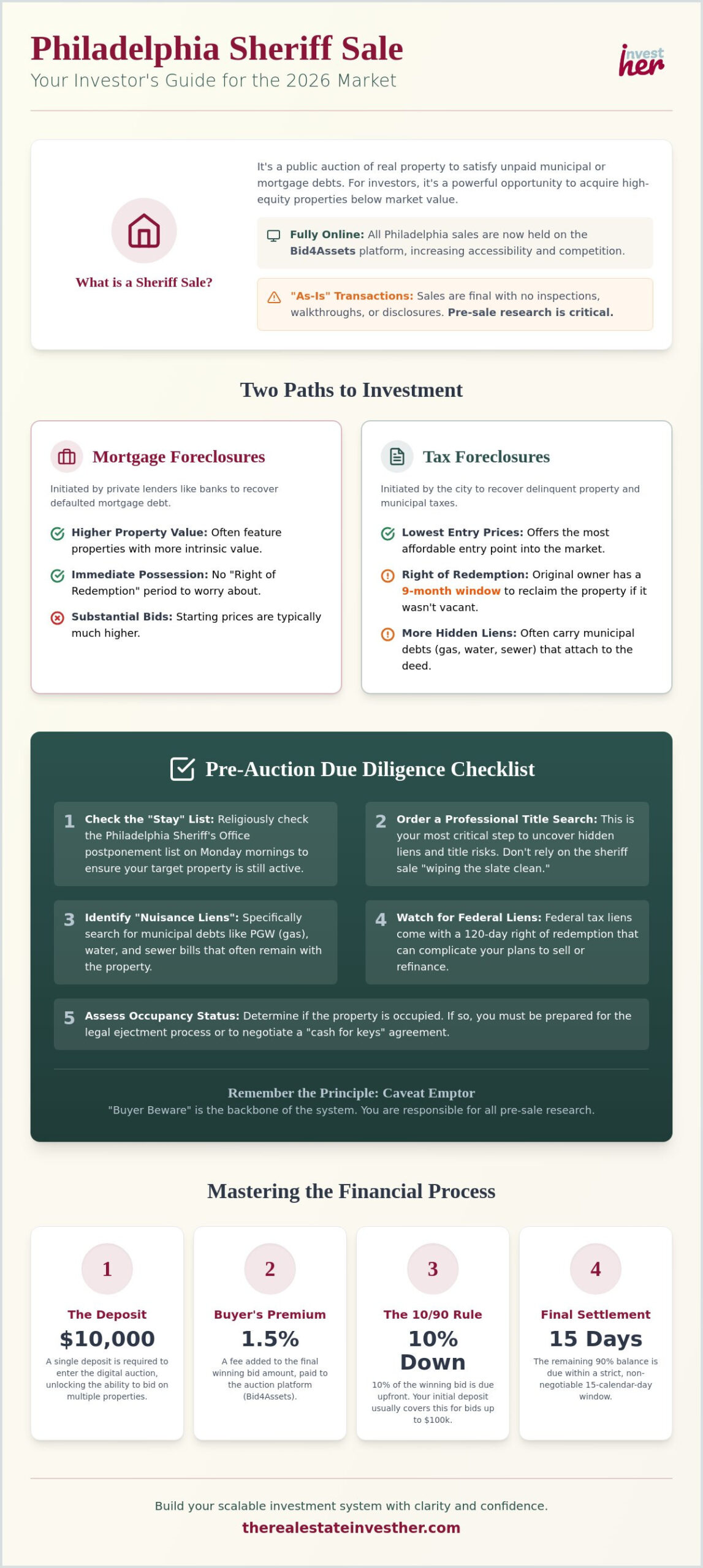
A Philadelphia Sheriff Sale is a public auction designed to satisfy unpaid municipal or mortgage debts through the forced sale of real property. It’s the final stage of Understanding the Foreclosure Process, where the legal system transitions ownership to recover what is owed to lenders or the city. For those using this Philadelphia sheriff sale guide for investors, it represents a powerful opportunity to acquire property at a fraction of market value. You aren’t just buying brick and mortar; you’re stepping into a legal process that requires both strategic patience and a growth mindset.
The landscape changed significantly when the city moved to a 100% online format via the Bid4Assets platform. This shift removed the physical barriers of the old downtown basement auctions, opening the door for out-of-state investors to participate from anywhere. While this increased accessibility, it also sharpened the competition. Unlike traditional real estate transactions, these are strictly “as-is” sales. You won’t get a home inspection, a walkthrough, or a disclosure statement before the hammer falls. You’re bidding on the legal title and the physical structure exactly as they stand, which makes your pre-sale research the foundation of your success.
Mortgage Foreclosure vs. Tax Foreclosure Sales
Investors typically choose between two distinct paths. Mortgage sales are initiated by private lenders and often feature properties with higher intrinsic value, though the starting bids are usually more substantial. Tax sales are city-driven and offer the lowest entry prices in the market. However, tax sales carry a “Right of Redemption” for properties that aren’t vacant. This means the original owner has a nine-month window to pay back the debt and reclaim the property. Choosing between these paths depends on your capital and whether you’re seeking immediate possession or long-term equity growth.
The Role of the Philadelphia Sheriff’s Office (PSO)
The PSO acts as the neutral auctioneer, not the seller or the property manager. Their authority is triggered by a Writ of Execution, a court order that mandates the sale to satisfy a judgment. While the PSO handles public advertising in the Legal Intelligencer, your most valuable resource is the “Stay” or “Postponement” list. Properties are frequently pulled from the auction at the last minute because owners reached a settlement or filed for bankruptcy. Successful investors check this list religiously on Monday mornings to ensure their target properties are still active, preventing wasted effort on deals that won’t cross the finish line.
Due Diligence: Identifying Hidden Liens and Title Risks
The principle of “Caveat Emptor” or “Buyer Beware” is the backbone of the Philadelphia auction system. Unlike a traditional home purchase where you’re protected by warranties and disclosures, a sheriff sale transfer is raw. You’re responsible for every ghost in the machine. This is why a professional title search is the most critical step in this Philadelphia sheriff sale guide for investors. While common wisdom suggests that a sheriff sale wipes the slate clean, reality is far more nuanced. Federal tax liens, for instance, have a 120-day right of redemption that can complicate your exit strategy if you aren’t prepared for a potential clawback.
Municipal debts like PGW (gas), water, and sewer bills are notorious for staying attached to the deed. These “nuisance liens” can quietly add thousands to your acquisition cost if you don’t account for them in your initial bid. You can find official Philadelphia Sheriff Sale Information to help categorize these debts, but a private title report remains your true shield. Beyond the paperwork, there’s the human element. If a property is occupied, you’ll need the emotional intelligence to navigate the ejectment process or negotiate a “cash for keys” agreement. It’s a delicate balance of professional firmness and empathy. If you feel stuck in the research phase, connecting with a mentor through the InvestHER Community Membership can provide the “boots on the ground” perspective you need to move forward with confidence.
The Right of Redemption in Philly Tax Sales
Tax sales come with a specific hurdle: the nine-month right of redemption. If the property is occupied or has been used by the owner, they have nearly a year to pay the back taxes and costs to reclaim the home. This window effectively freezes your ability to perform major structural renovations or flip the property for a quick profit. Smart investors often focus on “vacant and abandoned” certifications to bypass this risk, ensuring their capital isn’t locked in a legal limbo.
Navigating Philadelphia’s L&I Violations
The Department of Licenses & Inspections (L&I) maintains records of “Unsafe” or “Imminently Dangerous” notices. An “Imminently Dangerous” tag means the city could demolish the structure at any time, billing you for the cost. Using tools like “Grounded in Philly” helps you cross-reference these violations against the sheriff’s list. Never bid on a property without checking the L&I portal first; a low bid isn’t a bargain if the building is scheduled for demolition next week.
The Online Auction Process: Mastering Bid4Assets
Success in the digital arena begins long before the first bid is placed. To participate, you must establish an account on Bid4Assets and complete the registration process at least 48 hours before the auction begins. This clearance window is non-negotiable; it’s the city’s way of ensuring all participants are vetted and ready to perform. For those using this Philadelphia sheriff sale guide for investors, understanding the “Single Deposit” rule is a game-changer. A single $10,000 deposit for mortgage sales allows you to bid on every property listed for that specific auction date, providing the flexibility to pivot if your primary target becomes too expensive or is stayed at the last minute.
Beyond the initial deposit, you must account for the $35 non-refundable administrative fee for each parcel you intend to bid on. While these costs are small compared to the potential equity, they require precise management of your acquisition capital. The most dangerous element of any auction isn’t the competition; it’s “Auction Fever.” This emotional state can lead even seasoned professionals to over-bid, eroding their profit margins in the heat of the moment. We believe that financial independence is built on discipline, not impulse. By setting your maximum bid during your due diligence phase and refusing to budge, you protect your legacy and your peace of mind.
Deposit Requirements and Timelines
The Philadelphia Sheriff’s Office requires a specific Deposit ID for every transaction. While certified checks were once the norm, wire transfers are now the preferred method for speed and reliability in the 2026 market. If you don’t win a bid, your funds aren’t lost; the 10-day refund rule ensures your deposit is returned to your account, though many choose to keep it on file for the next month’s cycle. However, the stakes for winning are absolute. Defaulting on a bid, which means failing to provide the required funds after the hammer falls, results in the forfeiture of your deposit and a permanent ban from future sales. You can review the full legal consequences within the official Sheriff Sale Process documentation.
Winning Bid Tactics for Women Investors
Utilizing the “Auto-Bidding” feature is your best defense against emotional over-bidding. This tool allows you to enter your absolute ceiling in private, and the system will only bid the minimum increment necessary to keep you in the lead. Watch the “Overtime” period closely; if a bid is placed in the final minutes, the clock resets, preventing “sniping” and ensuring the true market value is reached. To secure your win, you must submit the remaining balance of your 10% down payment by 5:00 PM on the first business day following the auction. This level of precision transforms a chaotic auction into a predictable, scalable system for growth.
Closing the Deal: The 10/90 Payment Rule and Post-Sale Logistics
Winning the bid is an exhilarating moment, but the real work begins the second the digital hammer falls. This Philadelphia sheriff sale guide for investors highlights a critical reality: the clock is your fiercest competitor once you’re the high bidder. You must reconcile the 10% down payment by 5:00 PM on the next business day. Since your initial $10,000 deposit is already with Bid4Assets, you only need to wire the difference if your winning bid exceeds $100,000. It’s a test of your operational readiness and your commitment to your financial goals.
The 90% balance is due within 15 calendar days. This deadline is absolute and offers no room for error or extension. Traditional mortgages are virtually impossible here because banks cannot move fast enough, and they often require property access that you won’t have yet. Successful investors rely on cash reserves or pre-arranged hard money lending to bridge this gap. If you’re feeling the pressure of this tight window, the STRIVE Mentorship Program can help you refine your financing strategy before you ever place a bid.
Step-by-Step Post-Auction Checklist
- Step 1: Confirm your winning bid status on the platform and initiate the 10% wire transfer immediately to ensure it clears before the next day’s deadline.
- Step 2: Contact your hard money lender or mobilize your cash reserves to meet the 15-day settlement requirement for the remaining 90%.
- Step 3: Secure the property with insurance and physical security measures once the deed is issued to protect your new asset.
- Step 4: Navigate the ejectment process with empathy and professionalism if the property is occupied, often starting with a “cash for keys” conversation.
Managing the Sheriff’s Deed Process
Owning the winning bid doesn’t mean you own the property yet. The Philadelphia Sheriff’s Office (PSO) Civil Division must prepare and record the deed, a process that can take several weeks or even months depending on the current backlog. You must also be aware of the “Petition to Set Aside Sale.” This is a legal move where the previous owner asks a judge to void the auction due to procedural errors. For this reason, we advise that you never start renovations until the deed is firmly in your hand and recorded with the city. Your legacy is built on patience and strategic timing, not just speed.
Scaling Your Philadelphia Portfolio with the InvestHER Community
Real estate investing, particularly within the high-stakes environment of public auctions, often feels like a solitary journey. While this Philadelphia sheriff sale guide for investors provides the technical roadmap, the emotional and strategic support of a collective is what ensures long-term success. Philadelphia is a city built on neighborhoods and relationships. Tapping into the local Philadelphia InvestHER meetup allows you to access a curated network of contractor and lender recommendations that are essential for a quick renovation turnaround. If you’ve spent months watching the Bid4Assets clock without placing a bid, the STRIVE Mentorship Program offers the focused guidance needed to move from “analysis paralysis” to a confident first win. This program provides the structure to turn your professional ambition into a tangible, high-equity reality.
Looking ahead, preparing for InvestHER CON 2026 offers a unique opportunity to connect with national experts on distressed assets. You’ll gain insights that go beyond local nuances, allowing you to bring sophisticated, institutional-level strategies back to your Philadelphia portfolio. We believe that professional excellence and personal fulfillment are not mutually exclusive; they’re deeply intertwined. This Philadelphia sheriff sale guide for investors is a foundational tool, but the community is the engine that drives your growth. By surrounding yourself with women who share your vision, you turn individual effort into collective power and sustainable progress.
The Power of a Mastermind for Auction Investors
The “loneliness” of real estate can lead to burnout or costly mistakes. Collective wisdom acts as a safety net. By utilizing the InvestHER Community Membership, you can find accountability partners committed to rigorous due diligence. Sharing “lessons learned” from Philly auctions, like handling specific municipal liens, creates a culture of mutual elevation. You’re a partner in a community dedicated to rewriting industry norms and supporting collective strength.
Your Next Steps to Financial Independence
True financial independence is a marathon, not a sprint. Moving from a single sale to a strategic, multi-property portfolio requires a mindset shift toward scaling. Every property should align with your personal well-being and the legacy you wish to build. This isn’t just about accumulating assets; it’s about creating a life of autonomy and intentionality. When your strategy aligns with your core values, the work feels like a contribution.
Join the Philadelphia InvestHER Community today and start your journey!
Your Future in the Philadelphia Market Starts Now
Mastering the auction block is about more than just the highest bid. It’s about the depth of your research and the speed of your execution. This Philadelphia sheriff sale guide for investors provides the foundation for understanding the Bid4Assets system and the non-negotiable 10/90 payment rule. Success in this arena means balancing professional ambition with the strategic support of a community that understands your journey. You don’t have to navigate these legal nuances alone.
You can leverage the STRIVE Mentorship program, built by women for women, or find clarity in “The Only Woman in the Room” resource hub to ensure your first win is a profitable one. With over 50 local meetups across the US, our network offers the solidarity and wisdom needed to scale with confidence. Your path to financial independence is clearer when you walk it with peers who share your vision for excellence and growth. It’s time to move from the sidelines to the center of the arena and build the legacy you deserve.
Secure Your InvestHER CON 2026 Ticket and Scale Your Portfolio
Frequently Asked Questions
Can I inspect the interior of a property before the Philadelphia Sheriff Sale?
No, you cannot inspect the interior of a property before the auction. These are strictly “as-is” sales where the Sheriff’s Office doesn’t have keys or the legal authority to grant access to the premises. Entering a property without permission is considered trespassing. You must rely on exterior observations, public records, and local knowledge to estimate repair costs and potential value before placing your bid.
What happens if the previous owner refuses to leave after I win the auction?
You must initiate a judicial ejectment process through the Philadelphia Court of Common Pleas to gain possession. Winning the auction grants you the deed, but it doesn’t provide immediate physical access if the property is occupied. We often recommend a “cash for keys” offer as a first step. It’s a professional and empathetic way to resolve the situation quickly while protecting your investment timeline and avoiding lengthy legal fees.
Are all liens cleared when I buy a property at a Philly Sheriff Sale?
No, not all liens are automatically extinguished by the auction process. While mortgage and many municipal debts are cleared, certain “super-priority” liens like federal tax liens or specific city water and sewer debts may persist. This is why this Philadelphia sheriff sale guide for investors emphasizes the necessity of a private title search. You’re responsible for any debt that isn’t legally wiped away by the specific type of sale.
How much of a deposit do I need to start bidding on Bid4Assets?
You need a $10,000 deposit plus a $35 non-refundable processing fee to participate in mortgage foreclosure auctions on the Bid4Assets platform. This single deposit allows you to bid on any number of properties during that specific auction date. If you’re the winning bidder, this amount is applied directly to your required 10% down payment. If you don’t win, the funds can be refunded or held for future sales.
What is the ‘Right of Redemption’ and how does it affect my investment?
The Right of Redemption is a nine-month window during which a previous owner can reclaim a property sold at a tax lien sale. This rule applies to properties that aren’t certified as vacant or abandoned. It means you shouldn’t start major renovations during this period. If the owner redeems the property, they must pay your bid price plus costs, but your development plans will be effectively halted.
Can I use a traditional bank loan to pay for a Sheriff Sale property?
No, traditional bank loans aren’t a viable option due to the strict 15-day payment deadline. Most conventional lenders require at least 30 days to close and mandate an interior appraisal, which isn’t possible for these auctions. Successful participants in this Philadelphia sheriff sale guide for investors use cash or hard money loans. Having your financing ready before the auction is the only way to meet the city’s non-negotiable timeline.
What is the difference between a ‘stayed’ sale and a ‘postponed’ sale?
A “stayed” sale means the property has been removed from the auction entirely, usually because the owner filed for bankruptcy or settled the debt. A “postponed” sale simply moves the auction to a future date, often due to a procedural delay or a lender’s request. You should check the official list on the morning of the auction to see which properties are still active and which have been pulled.
How long does it take to get the deed after paying the full balance?
It typically takes several weeks to a few months to receive and record the Sheriff’s Deed after your final payment. The Sheriff’s Office must process the legal paperwork and ensure the sale is sound before the deed is recorded with the City of Philadelphia. It’s a steady process, but you shouldn’t plan to start construction or market the property until you have the recorded deed firmly in your possession.

Article by
Andresa Guidelli
Real estate investor, operator, and founder of The Real Estate InvestHER, a national platform supporting women real estate investors. With 15+ years of experience in real estate investing and business operations, she focuses on helping investors build stronger businesses behind their portfolios through better systems, clearer decision-making, leadership, and responsible use of AI.
Be the first to comment