


Failed Real Estate Deals: Investor Recovery Checklist
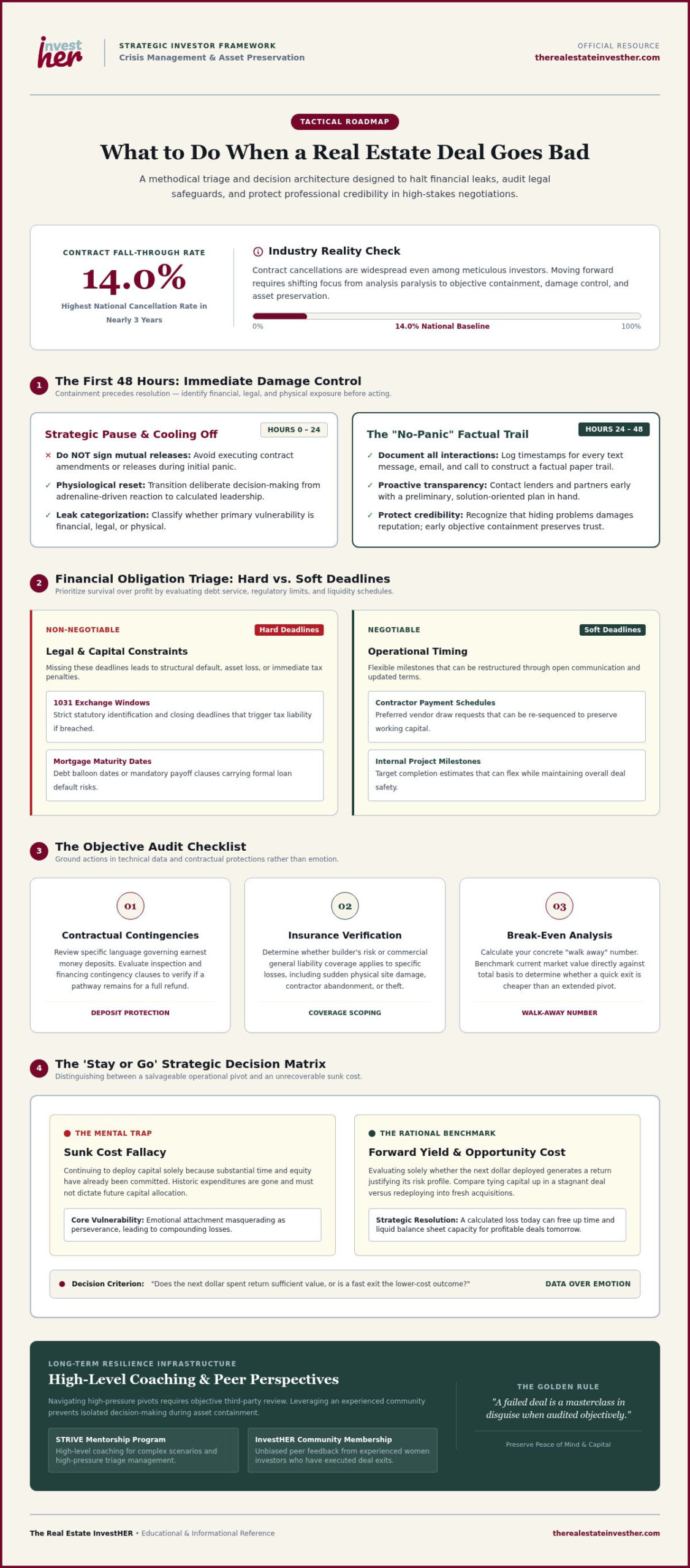
In July 2026, 14.0% of pending home-sale contracts fell through nationwide, a figure that represents the highest cancellation rate in nearly three years. It’s a sobering reality that even the most meticulous investors eventually face a transaction that begins to crumble. You might feel the weight of potential financial loss or the quiet fear of being judged by your peers and lenders. It’s natural to feel stuck in analysis paralysis when your capital is on the line. Understanding what to do when a real estate deal goes bad is not just about damage control; it’s about preserving your professional integrity and your peace of mind.
We promise to provide you with a strategic, step-by-step framework designed to navigate this crisis with grace and precision. This article outlines a comprehensive recovery checklist that covers everything from protecting your personal assets to executing a clean exit strategy. You’ll learn how to audit your situation objectively, communicate with stakeholders transparently, and find the renewed confidence to continue your investment journey. A failed deal is often a masterclass in disguise; this guide ensures you emerge from it stronger, wiser, and ready for your next win.
Key Takeaways
- Master the critical first 48 hours of a failing deal by performing a “No-Panic” audit to identify and stop financial or legal leaks immediately.
- Learn exactly what to do when a real estate deal goes bad by applying the “Stay or Go” framework, helping you distinguish between a salvageable pivot and a sunk cost.
- Protect your professional reputation and personal assets through strategic mediation and transparent communication with your private lenders and local network.
- Turn every setback into a masterclass by conducting a post-mortem that identifies missed red flags and human errors, ensuring a stronger foundation for your next acquisition.
- Build a resilient investment career by leveraging high-level support systems like the InvestHER Community or the STRIVE Mentorship program to navigate crisis with expert guidance.
Immediate Damage Control: The First 48 Hours of a Failing Deal
When a transaction begins to unravel, your adrenaline spikes. This physiological response is designed for survival, but it rarely leads to sound investment decisions. The first 48 hours of a crisis are about containment, not resolution. You must stop the bleeding by identifying whether the leak is financial, legal, or physical. Knowing what to do when a real estate deal goes bad begins with a strategic pause. Avoid signing any mutual releases or contract amendments in the first 24 hours. This cooling off period allows you to move from a state of panic to a position of calculated leadership.
Transparency is your greatest asset in preserving your reputation. Communicate with your lenders and partners early, but do so with a preliminary plan in hand. Investors often fear that admitting a deal is struggling will destroy their credibility. In reality, hiding the truth is what causes permanent damage. Professionals respect those who identify hurdles early and approach them with an objective, solution oriented mindset. Document every text, email, and phone call. This “No-Panic” audit creates a factual trail that protects you if the situation escalates into a legal dispute.
Triage Your Financial Obligations
Deal triage is the act of prioritizing survival over profit. During this phase, you must look at your liquidity and debt service with brutal honesty. Identify which deadlines are “hard,” such as a 1031 exchange identification window or a mortgage maturity date, and which are “soft,” like a contractor’s preferred payment schedule. If you are scaling and find yourself overwhelmed by these complexities, having an expert team to lean on is vital. Programs like the STRIVE Mentorship Program provide the high level coaching necessary to manage these high pressure moments without losing your footing.
The Objective Audit Checklist
Once the initial shock subsides, you need to conduct a technical review of your position. This is the time to look for “out” clauses that you might have overlooked during the excitement of the acquisition. Use this checklist to ground your next steps in data rather than emotion:
- Contractual Contingencies: Review the specific language surrounding earnest money deposits to determine if your inspection or financing contingencies still offer a path to a full refund.
- Insurance Verification: Check if your builder’s risk or general liability policy covers the specific failure, such as sudden physical site damage or theft.
- Break-Even Analysis: Calculate your “walk away” number. Compare the current market value against your total basis to see if a quick exit is cheaper than a long, expensive pivot.
Understanding what to do when a real estate deal goes bad requires you to balance professional ambition with personal well being. By following a methodical triage process, you protect your capital and your sanity, ensuring this single deal remains a lesson rather than a legacy-ending event.
The ‘Stay or Go’ Framework: Is the Deal Salvageable?
Deciding whether to walk away from a project is one of the most taxing decisions an investor makes. It’s easy to fall into the sunk cost fallacy, where you believe that because you’ve already invested significant time and capital, you must see it through. This is a trap. Your previous expenses are gone. The only question that matters is whether the next dollar you spend will yield a return that justifies the risk. Knowing what to do when a real estate deal goes bad requires a shift from emotional attachment to objective leadership.
Determining what to do when a real estate deal goes bad often involves calculating the cost of your own time. This is your opportunity cost. If your capital is tied up in a stagnant project, you’re missing out on fresh acquisitions that could be generating cash flow. Sometimes, the most profitable move you can make is to take a small, calculated loss today to free up your resources for a better opportunity tomorrow. Seeking an outside perspective is crucial here. Our InvestHER Community Membership provides a space to get honest feedback from women who have navigated these exact crossroads.
Quantitative vs. Qualitative Evaluation
Evaluating a deal requires looking at both the ledger and your life. Use the following framework to weigh your options:
| Factor | Exit Now | Pivot | Stay the Course |
|---|---|---|---|
| Financial Impact | Known loss; capital is freed. | Reduced profit; capital remains tied. | Potential for gain or deeper loss. |
| Emotional Burnout | Immediate relief. | Extended stress during transition. | High risk of total exhaustion. |
| Portfolio Legacy | Protects long-term scaling. | Builds resilience through creativity. | Tests grit but may delay growth. |
Emotional burnout is a real expense. If a deal is draining your energy to the point where you can’t manage the rest of your portfolio, it’s no longer a financial asset. It’s a liability to your well-being and your legacy.
Alternative Exit Strategies
If the numbers don’t work for your original plan, you don’t necessarily have to lose everything. Consider these creative pivots:
- Wholesaling: Pass the deal to a better-capitalized investor who has the bandwidth to finish the project.
- Seller Financing: Offload the property to a buyer while retaining an interest through a note, creating passive income without the management headache.
- Rescue Partners: Bring in a partner who provides the “save” capital in exchange for equity, allowing you to stay in the deal while reducing your personal risk.
If you choose to walk away entirely, review your contract’s liquidated damages clause to understand your exact financial exposure. Often, forfeiting a deposit is a strategic move that saves you from a much larger disaster down the road. True growth comes from knowing when to fight and when to fold.
Navigating the Exit: Protecting Your Assets and Reputation
Exiting a deal requires as much strategic finesse as entering one. While the financial loss is painful, the true risk lies in how you handle the fallout with your network. Reputation is your most valuable currency in this industry. Navigating what to do when a real estate deal goes bad involves more than just reading the fine print; it requires a commitment to radical transparency and professional maturity. A graceful exit ensures that while this specific transaction ends, your future opportunities remain secure.
While it might be tempting to fight for every dollar in court, litigation is often a financial and emotional drain that prevents you from moving forward. Mediation is usually a superior path. It allows for a private, professional settlement that keeps your business out of the public record. Understanding the risks of canceled purchase contracts is essential to avoid legal snafus that can haunt your portfolio for years. Ultimately, understanding what to do when a real estate deal goes bad means prioritizing long-term relationships over short-term pride.
Leveraging Your Professional Team
You don’t have to carry the weight of a failing deal alone. Your first call should be to a real estate attorney who specializes in contract disputes to clarify your obligations and rights. They can help you navigate the risks of canceled purchase contracts while protecting your other assets. Simultaneously, consult your CPA to discuss “tax loss harvesting.” Under IRC § 165, certain abandoned transaction costs may be deductible, providing a small silver lining to a difficult situation. If you are feeling isolated, the experts in our STRIVE Mentorship Program can provide the high-level perspective needed to negotiate from a position of strength rather than fear.
Communication Scripts for Investors
The “bad news” conversation is often the one investors dread most. When speaking with private lenders, lead with ownership and a plan. Use a script that focuses on facts: “The project has hit a significant hurdle due to [specific reason], and I am currently executing a recovery plan to protect your principal.” Avoid over-promising, but emphasize your commitment to their security. Sharing these challenges within a trusted circle, like our InvestHER Community Membership, allows you to practice these difficult conversations in a safe, supportive environment. Maintaining a growth mindset during these interactions transforms a professional setback into a testament to your integrity and resilience.
The Deal Post-Mortem: A Checklist for Future Success
The final signature on a cancellation agreement isn’t the end of your journey. It is the beginning of your evolution as a strategic investor. Most people walk away from a loss trying to forget it as quickly as possible. However, the most successful women in our community know that the real profit is found in the data left behind. Analyzing what to do when a real estate deal goes bad requires the courage to look at your own processes with brutal honesty. This post-mortem phase ensures that your next acquisition is built on a foundation of hard-won wisdom rather than hope.
Start by analyzing the “Human Element” of the failure. Real estate is a people business, and often, deals collapse because the wrong individuals were in the wrong roles. Perhaps a contractor was over-leveraged, or a partner’s risk tolerance didn’t align with the project’s complexity. Use this time to update your Standard Operating Procedures (SOPs). If a due diligence step was missed, create a mandatory checklist item to prevent a repeat. Rebuilding your capital reserves is also a priority. Create a six month financial recovery plan that focuses on high-margin activities, such as wholesaling or consulting, to replenish your liquidity before your next big move.
Refining Your Due Diligence
Your due diligence process should be a living document that grows with every experience. Create a “Never Again” list that identifies specific property types, zip codes, or structural red flags that are now non-negotiable deal breakers for you. This isn’t about being fearful; it’s about being intentional with your capital. Refine your contractor vetting process by requiring more recent references or implementing stricter milestone-based payment schedules. The post-mortem is the bridge between a mistake and an expert insight. By documenting these shifts, you transform a temporary setback into a permanent upgrade to your business model.
The Mindset Reset
It’s natural to feel the sting of imposter syndrome after a deal fails. You might wonder if you are truly cut out for high-stakes investing. This is the moment to lean into your growth mindset. Transparency about your journey doesn’t diminish your authority; it builds a legacy of integrity and resilience. Set strategic, smaller goals for your next acquisition to rebuild your confidence. Finding empowerment in your ability to survive and pivot is what separates the hobbyist from the professional. If you want to refine these risk mitigation strategies alongside a network of high-level peers, secure your InvestHER CON Ticket to join workshops dedicated to sustainable growth and crisis management.
Building a Support System for Long-Term Resilience
Real estate is often portrayed as a solitary pursuit of wealth. However, the most resilient investors in high-growth markets like Scottsdale and Austin understand that community is actually a competitive advantage. When you are deciding what to do when a real estate deal goes bad, the quality of your support system determines whether you pivot or perish. Isolation breeds fear, while a high-level network provides the perspective needed to see a failing deal as a strategic hurdle. Mentorship programs, such as our STRIVE Mentorship Program, offer more than just advice; they provide a safety net for scaling investors who are navigating the complexities of high-stakes transactions.
Professional growth is rarely a linear path. It is often forged in the moments of peer-to-peer vulnerability where we share our losses as openly as our wins. This transparency creates a culture of collective strength. Investing in yourself through high-level education and community support is the most reliable way to change your trajectory after a financial or professional loss. Autonomy is powerful, but alignment with a supportive network is what makes that autonomy sustainable over a decades-long career.
The InvestHER Community Advantage
The InvestHER Community Membership is built on the principle of psychological safety. It is a space where women can access collective wisdom to solve complex deal problems without the fear of judgment. Finding partners who complement your strengths and cover your weaknesses is essential when a project shifts from a standard flip to a complex recovery. Within this community, you aren’t just a number; you are part of a partnership dedicated to sustainable progress and personal well-being. This alignment of purpose ensures that you have the emotional and strategic resources to face any market challenge with confidence.
Strategic Networking at InvestHER CON 2026
Sometimes, the best way to move forward is to step away from the spreadsheets and into a room filled with industry leaders. InvestHER CON 2026 is designed for the investor who refuses to let a single failure define her legacy. These sessions are specifically crafted for scaling through adversity, offering workshops on risk mitigation and strategic growth. You will connect with pioneers who have navigated their own hurdles and are ready to share the lessons they learned from their own failed deals. Don’t weather the storm alone. Secure your InvestHER CON 2026 ticket today and build your resilient network. By surrounding yourself with a community that values intentionality and excellence, you ensure that your next deal is your strongest yet.
Turning Setbacks into Your Strategic Edge
A failing deal doesn’t define your career; it refines your expertise. By mastering the first 48 hours of damage control and conducting a rigorous post-mortem, you transform a financial hurdle into a masterclass in risk management. Protecting your reputation through transparent communication ensures your legacy remains intact even when a transaction doesn’t go as planned. Knowing what to do when a real estate deal goes bad is the hallmark of a seasoned investor who prioritizes long-term growth over short-term ego.
You don’t have to navigate these complexities alone. Our community spans major hubs like San Diego, Phoenix, and New York, offering a network of collective strength. Whether you’re attending InvestHER CON, the premier event for women investors in the US, or seeking high-level coaching, we are here to support your journey. The STRIVE Mentorship has helped hundreds of women scale their portfolios through both booms and busts. Join the STRIVE Mentorship Program to scale your portfolio with expert guidance and ensure your next acquisition is your most successful yet. Your resilience is your greatest asset.
Frequently Asked Questions
What is the very first thing I should do if a contractor disappears mid-deal?
Document the current state of the job site immediately with detailed photos and videos. This creates a factual baseline of completed work versus the payments you’ve already disbursed. Change the locks and notify your insurance carrier to protect the property from theft or liability issues. In active markets like Phoenix or Dallas, acting quickly prevents further project stagnation. Always consult a legal professional before hiring a replacement to ensure you’ve formally terminated the original agreement.
How do I know if I should keep putting money into a failing renovation?
You should stop funding a project if the projected after-repair value no longer covers your total basis plus a minimum acceptable profit. Perform a “Stay or Go” audit by obtaining fresh broker price opinions to reflect current market shifts in cities like San Diego or Orlando. Focus entirely on the return of the next dollar you spend. If the numbers don’t align, it’s often more profitable to sell the asset “as-is” than to chase a break-even point.
Will one bad real estate deal ruin my ability to get a loan in the future?
One failed transaction won’t ruin your borrowing power as long as you avoid a foreclosure or a bankruptcy filing. Lenders in competitive hubs like Scottsdale or Austin value transparency and a documented explanation of the setback. If you managed the exit professionally and protected your creditors, you maintain your credibility. Focus on rebuilding your liquidity and maintaining a strong credit profile before you apply for your next acquisition to show you’ve recovered successfully.
How can I protect my personal assets if my real estate LLC is facing a lawsuit?
Maintaining a strict “corporate veil” is your primary defense against personal liability during a lawsuit. Ensure you haven’t commingled personal funds with business accounts and that every contract was signed strictly in the LLC’s name. While we don’t provide legal advice, we recommend consulting an attorney to review your operating agreement for weaknesses. Strong insurance coverage, including an umbrella policy, provides an essential second layer of protection for investors in Philadelphia or New York.
Is it possible to wholesale a property that has significant structural issues?
Yes, you can wholesale properties with structural damage, but you must disclose every known defect to your buyers. Investors seeking deep-value projects in Dallas or Philadelphia often look for these specific challenges if the entry price justifies the repair risk. Transparency is vital for your reputation when deciding what to do when a real estate deal goes bad. Ensure your assignment contract clearly states the property condition to prevent any future legal disputes with your end-buyer.
What are the tax benefits of taking a loss on a real estate investment?
Under IRC § 165, you may be able to deduct abandonment losses for expenses like legal fees, surveys, and architectural plans from a deal that failed. These costs are often deductible as ordinary losses in the year the transaction is formally abandoned. Always consult a CPA to ensure you’ve documented an “affirmative act of abandonment” as required by the IRS. In high-tax environments like New York, these deductions can provide a helpful financial silver lining during a difficult year.
How do I explain a failed deal to my private money lenders?
Approach your lenders with total honesty and a concrete plan for protecting their principal investment. Lead the conversation with facts rather than excuses, explaining exactly what happened and how you are mitigating the fallout. Lenders value a proactive partner who takes ownership of a crisis. By communicating early, you preserve the trust necessary for future partnerships. Sharing these challenges within a supportive network like the InvestHER Community can help you practice these high-stakes conversations with confidence.
When is the right time to hire a real estate mentor after a setback?
The right time to hire a mentor is as soon as you identify a gap in your due diligence or crisis management skills. A mentor provides the high-level perspective needed to turn a mistake into a strategic masterclass. Programs like the STRIVE Mentorship offer the expert coaching required to rebuild your confidence and scale your portfolio safely. Surrounding yourself with experienced guides ensures that a single setback becomes a catalyst for long-term resilience rather than a stopping point.

Article by
Andresa Guidelli
Real estate investor, operator, and founder of The Real Estate InvestHER, a national platform supporting women real estate investors. With 15+ years of experience in real estate investing and business operations, she focuses on helping investors build stronger businesses behind their portfolios through better systems, clearer decision-making, leadership, and responsible use of AI.
Be the first to comment