


Austin Real Estate Market Trends 2026: A Strategic Guide for Women Investors
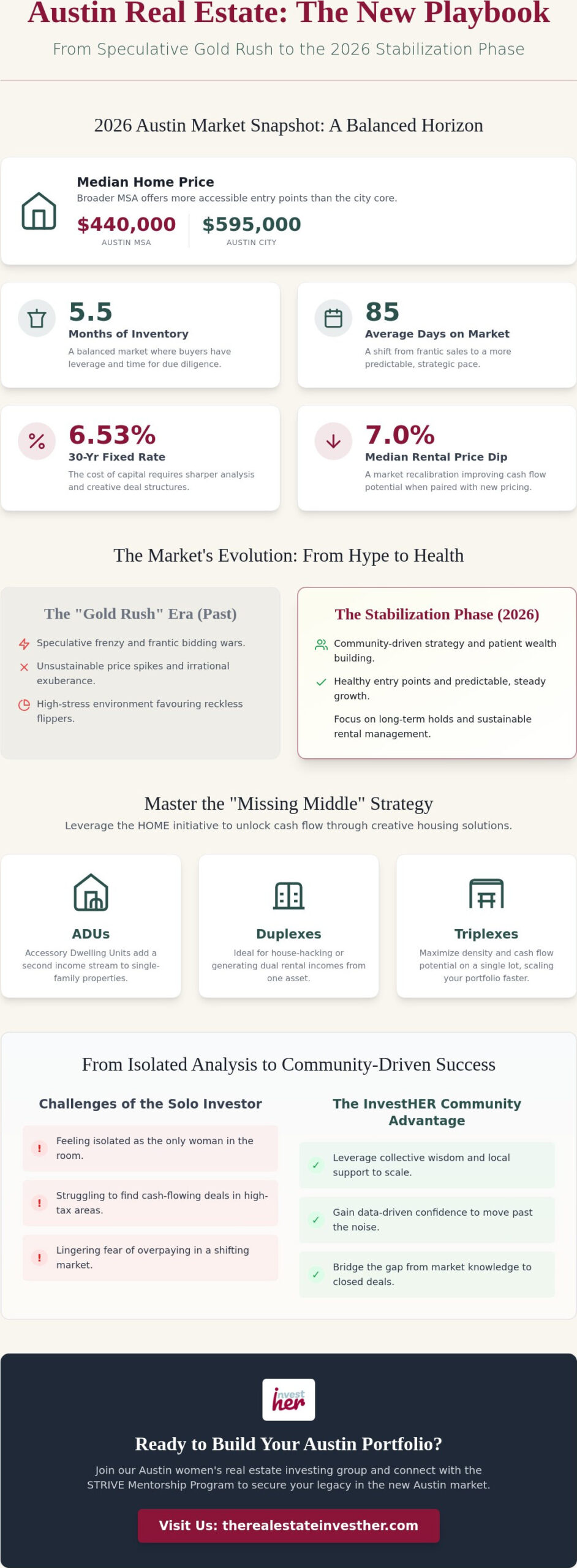
The era of easy appreciation in Austin has officially ended, but for the strategic woman investor, the real opportunity is just beginning. While headlines focus on a 7.0% dip in median rental prices and homes sitting for an average of 85 days, these numbers signal a vital shift from a speculative frenzy to a balanced, predictable market. You might feel a lingering fear of overpaying or find yourself struggling to locate cash-flowing deals in high-tax areas like Travis County. That is exactly why joining an Austin women’s real estate investing group is no longer just a networking choice; it’s a competitive necessity.
We understand that navigating this landscape alone can feel isolating, especially when you are often the only woman in the room. This guide will help you master the 2026 stabilization strategy by identifying submarkets where the $440,000 MSA median price still offers room for growth. We’ll break down the impact of mandatory buyer representation agreements and show you how to leverage collective wisdom to build sustainable wealth. By the end of this article, you’ll have the data-driven confidence to move past the noise and secure your legacy in the new Austin.
Key Takeaways
- Understand the shift from a speculative “gold rush” to the 2026 stabilization phase, offering a more predictable and healthy entry point for building sustainable wealth.
- Navigate the current 6.53% interest rate environment and inventory shifts by focusing on high-performing submarkets that maintain a strong lifestyle moat.
- Master the “Missing Middle” investment strategy by leveraging the HOME initiative to unlock cash flow through ADUs, duplexes, and triplexes.
- Join an Austin women’s real estate investing group to transition from isolated analysis to a community-driven approach that provides the local support needed to scale.
- Discover how the STRIVE Mentorship Program can bridge the gap between understanding market data and successfully closing your next deal in a cooling market.
Austin’s Market Evolution: From Tech Gold Rush to 2026 Stability
Austin has shed its skin as a speculative playground. The “gold rush” years, characterized by unsustainable spikes and frantic bidding wars, have given way to what we define as the 2026 Stabilization Phase. This isn’t a period of stagnation; it’s a maturation of the market. For the members of our Austin women’s real estate investing group, this shift represents a move toward steady, predictable growth that favors the patient strategist over the reckless flipper. It’s a time for intentionality and building a legacy grounded in data rather than hype.
The post-2024 correction acted as a necessary recalibration for the city. It purged the market of irrational exuberance and created a healthier entry point for those focused on longevity. With the median home price in the city holding at $595,000 as of May 2026, we’re seeing a market that finally respects fundamentals. This stability allows you to plan your financial future without the constant fear of a bubble bursting. It is a buyer-friendly window that rewards those who prioritize long-term strategic holds and community-centric assets.
The 2026 Correction: Why it Matters for Your Portfolio
Normalized price-to-rent ratios are the pulse of this new era. While rental prices saw a 7.0% decrease earlier in the year, the correction in purchase prices has actually improved cash flow potential for those using strategic financing. We’ve moved away from the high-stress environment of speculative flipping toward sustainable rental management. The 2026 Austin Value Gap is the unique window where stabilized inventory pricing meets the unstoppable momentum of Austin’s metropolitan growth, creating a rare opportunity for equity capture.
Tech Anchors and Workforce Housing Demand
Austin remains the “Silicon Hills” for a reason. Tech giants like Tesla and Oracle aren’t just corporate logos on a skyline; they’re massive anchors for workforce housing demand. Corridors like SH-130 are seeing significant industrial expansion, drawing in Tier 2 tech workers who prioritize quality of life and proximity to their hubs. These professionals often choose high-quality rental housing over immediate homeownership in the current interest rate environment.
- Tesla and Oracle: Continue to drive high-income tenant pools into suburban submarkets.
- Tier 2 Tech Workers: Seek “lifestyle” rentals that offer more than just a place to sleep.
- Strategic Alignment: Investing in these corridors aligns your portfolio with the city’s economic engines.
Connecting workforce housing needs to your portfolio is a core part of being in an Austin women’s real estate investing group. It’s about more than just transactions; it’s about providing housing that serves the local workforce while securing your own autonomy. When we invest with purpose, we create a ripple effect of stability that benefits the entire community.
The 2026 Data: Inventory, Interest Rates, and the Affordability Gap
Numbers tell the most honest story of a market’s health. In 2026, the Austin metro area holds 5.5 months of housing inventory, a figure that represents a truly balanced environment. This shift away from the scarcity of previous years is confirmed by 2026 Texas housing data, signaling a market where buyers finally have the leverage to breathe. While the city’s median home price sits at $595,000, the broader MSA offers more accessible entry points at a median of $440,000. These figures aren’t just statistics; they’re the foundation of your next acquisition strategy.
Interest rates remain a pivotal factor in every deal’s math. With the 30-year fixed mortgage rate at 6.53% as of June 2026, the cost of capital requires a sharper pencil than it did during the era of free money. For those utilizing DSCR loans, these rates mean that achieving a 1.2 coverage ratio often requires higher down payments or more creative deal structures. High entry costs and these interest rates have forced many Austinites to become long-term renters by necessity. This creates a stable, high-quality tenant pool that values the security of a well-managed rental home over the volatility of current ownership costs.
Navigating the Travis County Tax Landscape
Property taxes in Travis and Williamson counties remain the primary hurdle for cash flow. To protect your margins, you must project these costs with precision. We recommend a simple checklist: verify current millage rates, project a 10% annual assessment increase, and always budget for professional protest services. Protesting your valuation isn’t an optional task; it’s a critical component of creating a real estate business plan for Austin deals. Managing these overheads effectively is what separates a hobbyist from a professional investor.
Inventory Shifts: From Shortage to Strategic Selection
The days of blind bidding are over. Homes in the Austin-Round Rock MSA are taking an average of 85 days to sell as of March 2026, providing a generous window for deep due diligence. This extended timeline allows you to negotiate seller concessions that were unthinkable two years ago. Whether you’re asking for interest rate buy-downs or significant repair credits, the power has shifted back into your hands. Connecting with an Austin women’s real estate investing group can help you identify which submarkets are currently seeing the most flexible sellers. Gaining this level of local insight is much simpler when you’re supported by the InvestHER Community Membership.
Austin vs. The Texas Triangle: Where Should Women Investors Pivot?
Choosing where to deploy capital within the Texas Triangle requires a nuanced understanding of varying market personalities. While Dallas often boasts higher immediate cap rates and San Antonio offers lower entry points, Austin maintains a unique “Lifestyle Moat” that keeps high-income tenants rooted. This stickiness is a powerful hedge against vacancy. Even as costs remain higher than neighboring metros, the cultural and economic gravity of the Silicon Hills ensures that premium renters aren’t just passing through; they’re building lives here. For those in an Austin women’s real estate investing group, the focus is less on chasing the cheapest doors and more on securing assets that command long-term desirability.
Austin remains the undisputed innovation capital of the region. The concentration of venture capital and research anchors creates a resilient ecosystem that other cities struggle to replicate. While the “gold rush” has cooled, the underlying demand for high-quality housing in proximity to top-tier employers hasn’t wavered. It’s a market built on intellectual capital, which historically provides a more stable foundation for long-term strategic holds than markets driven purely by industrial volume.
Cap Rates vs. Appreciation: The 2026 Trade-off
Every investor must eventually choose between immediate cash flow and legacy-building equity. In 2026, Dallas may provide a slight edge in monthly income, but Austin continues to lead in long-term appreciation potential due to its restricted supply and high-tech job density. Your decision should align with your specific financial season. If you’re focused on replacing your W-2 income quickly, the higher yields of San Antonio might beckon. However, if you’re utilizing the STRIVE Mentorship Program to build a portfolio of high-value, low-maintenance properties, Austin’s stability is unmatched. It’s about balancing the “now” with the “forever.”
The Austin-San Antonio Corridor Opportunity
The most compelling story of 2026 isn’t just one city; it’s the emergence of the Austin-San Antonio Corridor as a unified mega-region. Hays County, specifically the cities of San Marcos, Buda, and Kyle, serves as the strategic middle ground for investors seeking the best of both worlds. Recent Austin-Round Rock Housing Market Data shows that while the urban core stabilizes, these suburban hubs are benefiting from massive infrastructure projects designed to support the 2030 population surge. These areas offer more attractive price-to-rent ratios while remaining close enough to Austin’s innovation anchors.
Finding the right deal in this competitive corridor often requires “boots on the ground” intelligence. Joining an Austin women’s real estate investing group allows you to tap into a collective network that uncovers off-market opportunities before they hit the MLS. We believe that partnership and shared wisdom are the ultimate competitive advantages in a maturing market. By leveraging local meetups and community insights, you can navigate the nuances of Hays County with the confidence of a seasoned pro.
Strategic Investing in Austin: Emerging Neighborhoods and Asset Classes
While many investors chase the high-gloss luxury market, the true opportunity in 2026 lies in the “Missing Middle.” This asset class, consisting of duplexes, triplexes, and townhomes, serves the backbone of Austin’s workforce. These properties offer a unique blend of residential stability and commercial-style cash flow. Being part of an Austin women’s real estate investing group provides the collaborative environment needed to identify these multi-unit opportunities before they are absorbed by institutional buyers. It is about moving beyond the single-family mindset to build a portfolio that thrives on density and diversification.
For those just beginning their journey, House Hacking remains the most effective strategy for market entry in 2026. By purchasing a multi-unit property or a home with a secondary dwelling, you can live in one portion while the rental income from the other offsets your mortgage. This approach reduces your personal housing expense while accelerating your education in property management. It’s a practical, low-risk way to gain a foothold in high-demand areas like Del Valle or Manor, where industrial tech expansion is driving a consistent need for quality workforce housing.
The ADU Revolution: Maximizing Single-Family Lots
The HOME initiative has fundamentally changed the value proposition of traditional residential lots. Zoning laws now allow for significantly more density, enabling owners to add Accessory Dwelling Units (ADUs) where they were previously prohibited. In established zip codes like 78745 and 78723, adding a backyard cottage can transform a standard rental into a high-yield asset. This strategy allows you to maximize the utility of the land you already own without the cost of acquiring a second lot. As of 2026, the streamlined permit timeline for Austin ADUs has been reduced to an average of four to six months, making these projects a predictable component of a growth-oriented business plan.
North Tech Ridge: Round Rock and Cedar Park
The suburbs of Round Rock and Cedar Park have evolved into primary targets for family-oriented rentals. These areas are anchored by high-performing school districts, which serve as a natural filter for high-quality, long-term tenants. Rental stability in these submarkets is exceptionally high because families prioritize educational consistency for their children. However, navigating the specific zoning nuances of these municipalities requires a careful touch. Understanding the benefits of a real estate mentor is particularly helpful when dealing with suburban ordinances that differ from the city of Austin’s core regulations.
Success in these emerging submarkets is rarely a solo endeavor. Connecting with a support network ensures you have the “boots on the ground” data required to make informed decisions. We invite you to join our InvestHER Community Membership to gain access to the collective wisdom of women who are actively scaling their portfolios in the North Tech Ridge and beyond.
Building Your Austin Portfolio with the InvestHER Community
Data and trends provide the map, but a community provides the fuel. Even with the best spreadsheets, navigating a maturing market like Austin can feel like a solitary uphill climb. This is where an Austin women’s real estate investing group becomes your most valuable asset. By connecting with local operators who understand the specific nuances of Travis and Williamson counties, you transition from a spectator to a strategic player. We believe that financial independence is not a solo destination; it is a collective journey built on shared wisdom and mutual support.
For out-of-state investors, the challenge is even greater. Managing a portfolio from a distance requires “boots on the ground” you can trust implicitly. Our community serves as that trusted filter, offering real-time insights that you won’t find in a standard market report. Whether you are looking for the best property tax protest firm or a reliable contractor for an ADU build, the collective experience of our members saves you time and capital. You don’t have to guess when you have a network of peers who have already paved the way.
STRIVE Mentorship: Austin Edition
Mentorship is the bridge between analysis paralysis and a closed deal. In a high-stakes environment where property taxes and interest rates demand precision, a single miscalculation can erase years of progress. Our specialized coaching helps you master the “Austin affordability math” required to thrive in a balanced market. It is about more than just finding a property; it is about ensuring that every acquisition aligns with your long-term vision for autonomy and well-being. Apply for the STRIVE Mentorship Program today to gain the clarity needed to execute your 2026 stabilization strategy with confidence.
The Power of Collective Wisdom
Isolation is often the greatest hurdle for women in this industry. You might be tired of being the only woman in the room during negotiations or at local meetups. Our community changes that narrative by providing a space where your ambition is celebrated rather than questioned. This atmosphere of solidarity transforms the way you approach business, moving from a mindset of competition to one of collaboration. We are here to ensure you never have to navigate a complex deal alone.
Stay connected to the heartbeat of the market by joining the InvestHER Community Membership for regular updates on local shifts and off-market opportunities. To truly immerse yourself in this transformative environment and find your next investment partner, get your InvestHER CON 2026 ticket today. Your legacy in Austin is waiting to be built. Let’s do it together.
Securing Your Legacy in the Austin Stabilization Phase
Austin in 2026 is no longer a landscape of speculative gambles. It has matured into a market that rewards intentionality and data-backed strategy. We’ve seen how the transition to a balanced 5.5 months of inventory and the expansion of the HOME initiative provide unique opportunities for those focusing on long-term equity and cash-flowing ADUs. Success in this environment isn’t just about finding the right zip code; it’s about finding the right people to help you analyze the math and manage the risk.
Connecting with an Austin women’s real estate investing group ensures you have the community support and “boots on the ground” intelligence required to scale. Whether you’re looking for high-level guidance through our STRIVE Mentorship Program or want to network with industry leaders at our annual InvestHER CON, we provide the professional infrastructure for your growth. Our local chapters are here to ensure you never have to navigate a complex deal in isolation.
Join the InvestHER Community and Scale Your Austin Portfolio today to start building your legacy with clarity and confidence. The future of Austin real estate belongs to the women who lead with purpose and partnership.
Frequently Asked Questions
Is Austin real estate a good investment in 2026?
Yes, Austin is currently a strategic value market that favors long term holds over speculative flips. While the frenzied “gold rush” has passed, the presence of tech anchors like Tesla and Oracle ensures a steady demand for quality housing. With a more balanced 5.5 months of inventory, investors can now perform deeper due diligence to secure assets that align with sustainable wealth goals.
Will Austin home prices drop in 2026?
Prices have largely stabilized following the post 2024 correction. While Travis County saw a modest 3.9% decrease in median prices as of May 2026, the city core remains resilient at a median of $595,000. Most experts now project a return to healthy, modest appreciation of 3% to 6% annually, making this a predictable entry point for strategic buyers.
What are the best neighborhoods to invest in Austin for 2026?
High growth potential is currently concentrated in East Riverside, Del Valle, and the North Tech Ridge suburbs like Cedar Park and Leander. These areas benefit from industrial tech expansion and high performing school districts, which attract stable, high quality tenants. Investors are also finding success in established zip codes like 78745 by utilizing new density laws to add value.
How much are property taxes in Austin for 2026?
Property taxes remain a significant line item, with rates in Travis and Williamson counties often exceeding 2% of assessed value. It is vital to budget for these costs and incorporate a professional tax protest strategy into your annual business plan. Managing these overheads effectively is essential for protecting your net cash flow in the current 6.53% interest rate environment.
Is it better to invest in Austin or Dallas in 2026?
The decision depends on your financial goals and whether you prioritize immediate yield or long term equity. Dallas often offers higher initial cap rates, but Austin boasts a unique “Lifestyle Moat” that keeps high income tenants rooted even during economic shifts. Many members of our Austin women’s real estate investing group prefer Austin for its superior long term appreciation and tenant quality.
How do I find an Austin women’s real estate investing group?
The most effective way to find a supportive community is to join a local chapter of a national network like the InvestHER Community. These groups provide a mix of virtual resources and in person meetups where you can connect with local operators and mentors. Joining an Austin women’s real estate investing group helps you move past the isolation of a male dominated industry.
What is the HOME initiative in Austin and how does it affect investors?
The HOME initiative is a zoning reform that allows for increased density on residential lots, enabling owners to build up to three units on a single property. This policy has sparked an ADU revolution, allowing investors to maximize the ROI of existing single family lots. It significantly lowers the barrier to creating “Missing Middle” housing in high demand urban neighborhoods.
Can I still find cash-flowing properties in Austin?
Yes, but finding cash flow in 2026 requires more creativity than in previous years. Investors are successfully generating income by targeting multi unit properties or adding secondary dwellings through the HOME initiative. While the city’s median rental price saw a 7.0% dip earlier this year, strategic acquisitions in the $440,000 MSA price range still offer viable paths to positive monthly returns.

Article by
Andresa Guidelli
Real estate investor, operator, and founder of The Real Estate InvestHER, a national platform supporting women real estate investors. With 15+ years of experience in real estate investing and business operations, she focuses on helping investors build stronger businesses behind their portfolios through better systems, clearer decision-making, leadership, and responsible use of AI.
Be the first to comment