


Dallas Multifamily Real Estate Market 2026: A Woman Investor’s Guide to Scaling
With Dallas-Fort Worth vacancy rates reaching 12.2 percent and rent growth hitting -2.1 percent in early 2026, the era of passive multifamily investing is officially over. The rules have changed. It’s a challenging moment where permit fees have climbed to $652 per unit and institutional firms seem to be tightening their grip on the most visible assets. You might feel the weight of these shifts, wondering if there’s still room for an independent investor to build a sustainable legacy without getting lost in the noise. Finding your place within a Dallas women’s real estate investment group provides more than just networking; it offers the collective wisdom needed to see opportunities where others only see risk.
Growth is still possible. We understand that mastering this market requires more than just capital. It demands a deep understanding of the 2026 Texas representation laws and the nuances of submarket stabilization. This guide will unlock the strategic insights and community-backed tactics you need to navigate the 2026 Dallas multifamily landscape and build lasting wealth. We’ll explore how to identify high-yield submarkets, build a reliable local power team, and find a supportive circle for deal-sharing that ensures you’re never the only woman in the room.
Key Takeaways
- Capitalize on a historic 10-year low in construction starts to position your portfolio for the next wave of market absorption.
- Shift your focus from Dallas proper toward high-yield corridors like Haltom City-Meacham, where submarket dynamics favor local expertise over institutional volume.
- Utilize your agility as an individual investor to secure off-market multifamily deals that larger firms miss due to their rigid acquisition criteria.
- Join a Dallas women’s real estate investment group to find the mentorship and collective support needed to scale your wealth with confidence.
- Build a resilient power team by prioritizing property managers who understand the specific shifts in Texas landlord-tenant laws and property tax valuations.
The 2026 Dallas Multifamily Landscape: Why the Supply Shrink is Your Opportunity
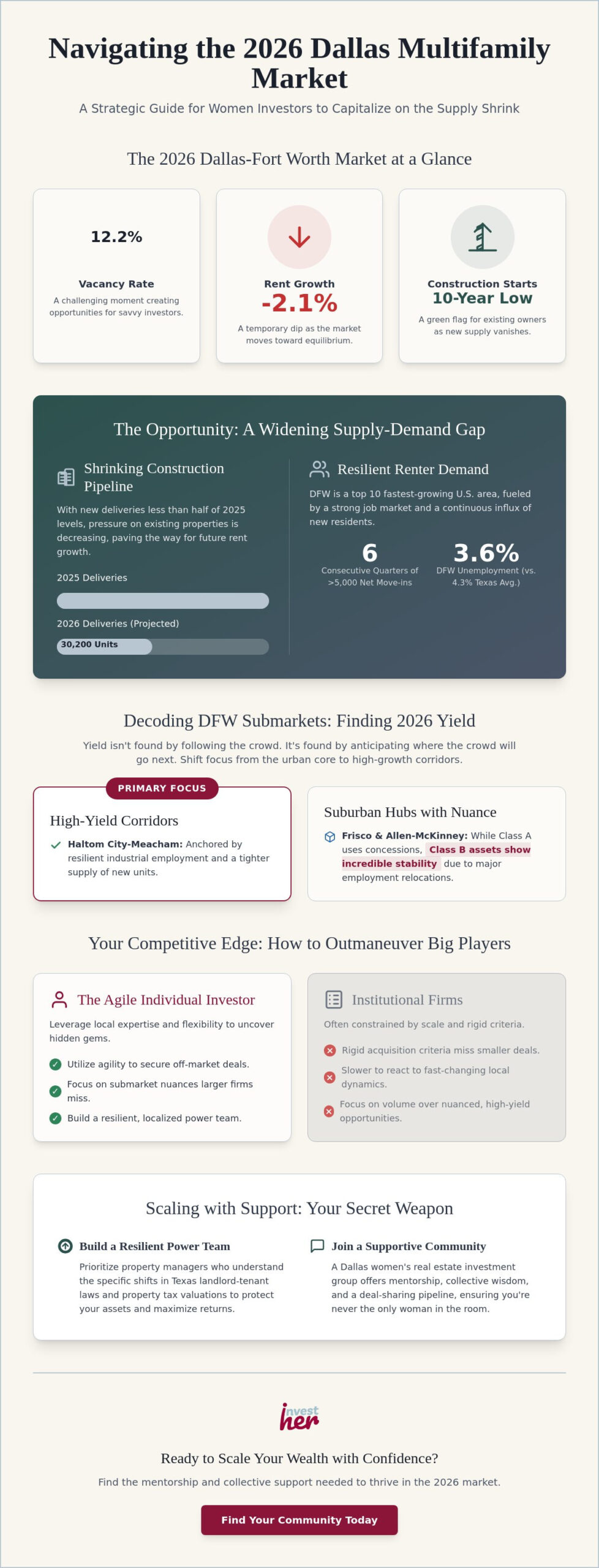
Dallas-Fort Worth remains a powerhouse. It’s projected to be one of the top 10 fastest-growing areas in 2026. This influx of new residents creates a floor for demand that institutional giants often overlook in their quarterly reports. The 2026 Dallas real estate market is defined by a tightening supply-demand gap where a historic slowdown in new deliveries meets a resilient surge in renter household formation. For those active in a Dallas women’s real estate investment group, this data isn’t just a spreadsheet entry; it’s a signal to pivot toward intentional, long-term holds. The local economy is bolstered by a 3.6 percent unemployment rate, which is significantly lower than the Texas average of 4.3 percent.
Absorption Trends and Renter Demand
Demand isn’t just recovering; it’s stabilizing. We’ve seen a six-quarter streak where net move-ins exceeded 5,000 units, a pace that mirrors the 2024 peak. This demand is split between two distinct groups. First, there are renters by necessity who are priced out of a housing market where commercial interest rates range from 5.05 percent to 11.75 percent. Second, we see a growing segment of renters by choice. These are professionals who prefer the flexibility of Class A assets in high-growth North Texas corridors over the burdens of homeownership. Understanding these demographics allows you to tailor your value-add strategies to what residents actually need, rather than what you hope they want.
The Shrinking Construction Pipeline
The cranes are disappearing from the skyline, and that’s good news for you. With only 30,200 units under construction in early 2026, deliveries are set to be less than half of 2025 levels. This 10-year low in construction starts acts as a green flag for existing owners. When new supply vanishes, the pressure on asking rents begins to reverse. We are moving away from the -2.1 percent rent growth seen in early 2026 toward a more balanced equilibrium. It’s a moment for patience and precision.
Developers have pulled back from the urban core, leaving a vacuum that agile, community-backed investors can fill. Organizations like Commercial Real Estate Women (CREW) have long highlighted the importance of localized market intelligence in these cycles. By staying connected with your Dallas women’s real estate investment group, you can identify which “path of progress” neighborhoods are actually absorbing these new residents. You don’t need a thousand units to build wealth; you just need the right units in the right submarket at the right time.
Decoding DFW Submarkets: Where Women Investors Find Yield in 2026
Yield isn’t found by following the crowd. It’s found by anticipating where the crowd will go next. In 2026, the DFW multifamily story is moving beyond the urban core. We’re seeing a strategic shift from the crowded South Fort Worth submarket toward the Haltom City-Meacham corridor. This area is anchored by resilient industrial employment and a tighter supply of new units. Mixed-use developments are fueling net absorption across the metroplex, creating the walkable environments that 2026 renters demand. These developments integrate housing with retail and office space, providing the “live-work-play” lifestyle that keeps vacancy rates low even when the broader market fluctuates.
High-Growth Suburban Hubs: Frisco and Allen-McKinney
Frisco and West Plano are currently navigating a stabilization timeline for the massive influx of units delivered over the last two years. While Class A properties often use concessions to lure tenants, Class B assets in these hubs show incredible stability. Major employment relocations continue to drive demand in these northern corridors, as companies seek the business-friendly environment North Texas provides. Being active in a Dallas women’s real estate investment group helps you distinguish between temporary market noise and long-term submarket health. If you’re looking for sustainable growth, finding a supportive community can help you identify these nuances before the institutional firms catch on. The 2026 investment forecast for these zip codes suggests that the “renter by choice” demographic will continue to anchor Class A performance while supply begins to rebalance.
Emerging Vintages: Celina, Mansfield, and Richardson
Celina and Mansfield have transitioned from rural outskirts to primary investment targets. We’re seeing 2020-vintage assets trade frequently as developers look for liquidity in a higher-interest-rate environment. However, don’t overlook the 1980s and 1990s assets. These vintages offer the best value-add potential in the current climate. In the Richardson tech corridor, the renter profile is highly specialized. These tenants prioritize reliable infrastructure and proximity to major employers over the flashy amenities of new builds. They are often tech professionals who value stability and functionality. This focus on “vintages” allows you to build a portfolio that isn’t just large, but resilient. By targeting these assets, you can implement moderate renovations that justify rent increases without pricing out the core workforce that keeps the Dallas economy moving forward.
Institutional vs. Individual: How to Outmaneuver the Big Players
Big firms move slowly. They are often bound by rigid investment committees that require 200 units or more to even consider an acquisition, leaving a massive opening for those willing to look at smaller, more nuanced assets. This institutional Achilles heel is your greatest advantage. While large funds struggle with “efficiency” mandates, individual investors can dive into the details of a specific neighborhood or a mismanaged 40-unit property. Finding your tribe through a Dallas women’s real estate investment group allows you to pool resources and insights that the big funds simply can’t replicate. While institutional funds prioritize a five-year exit strategy to satisfy shareholders, the women in our network often build for legacy wealth that spans generations.
Agility wins in 2026. Leveraging local knowledge is the only way to find off-market multifamily deals in a city where the sales volume reached $43.3 million in the first quarter of the year. You don’t need to outbid the giants; you just need to out-relate them. By building direct relationships with owners who are tired of the “big box” brokerage experience, you can secure assets at a fair price before they ever reach the open market. This community collaboration turns the “only woman in the room” syndrome into a collective force that can take down larger, more profitable assets together.
Targeting the Sweet Spot Assets
The 20-60 unit range is the ultimate sweet spot. REITs and large private equity funds generally ignore these properties because they are too small to move the needle for their multi-billion dollar portfolios. This lack of competition creates a stabilized entry point for you. We are seeing significant opportunities in Class C assets where high vacancy rates can be turned into value-add wins through better management and targeted renovations. A balanced Dallas portfolio should include a mix of these older “emerging” vintages and more modern assets to hedge against shifting economic cycles. Precision matters when the average price per unit in Dallas is $183,000.
Financing Strategies for 2026
Capital is available, but it requires a strategic touch. With the average capitalization rate for Dallas multifamily sitting at 5.8 percent in early 2026, your debt service coverage is the most critical metric in your pro forma. Commercial loan interest rates currently range from 5.05 percent to 11.75 percent, which means traditional financing isn’t always the best path. We’re seeing a rise in creative financing, including seller financing and bridge loans, as the market matures and owners look for flexible exit options. If you’re feeling overwhelmed by the numbers, using the STRIVE Mentorship Program is an excellent way to vet your first multifamily deal with experts who have navigated these exact interest rate environments before. Don’t let the math intimidate you; let it guide you toward the deals that actually cash flow.
Building Your Dallas Power Team and Deal Pipeline
Real estate is a relationship business, and in a market as competitive as North Texas, your team is your moat. Your property manager is undoubtedly your most critical hire. In 2026, Texas has implemented several new housing laws that shift eviction procedures and landlord responsibilities. You need a partner who doesn’t just collect rent but understands the nuances of these legislative updates to protect your asset. Beyond management, specialized real estate coaching can be the catalyst that accelerates your team-building process. It moves you from a place of trial and error to a position of strategic execution. Vetting a Dallas-based contractor in 2026 also requires a new lens; with local unemployment at a tight 3.6 percent, labor costs remain elevated. Always request a detailed breakdown of labor versus materials to ensure your value-add budget stays on track.
The Essential DFW Team Members
You need specialists who speak the language of Texas real estate. Since Texas law now requires a signed written agreement before a professional can show you a property, finding a multifamily-specialized broker early is paramount. This broker should align with the InvestHER mission of transparency and long-term growth. Additionally, a local tax strategist is non-negotiable. While we enjoy the absence of state income tax, the adopted ad valorem tax rate for Dallas County for Fiscal Year 2026 is $0.215500 per $100 of assessed valuation. This makes property tax protests a standard part of your annual operations. If you’re an out-of-state investor, a “boots on the ground” partner is your eyes and ears, ensuring that the property’s physical condition matches the pro forma.
Generating Consistent Deal Flow
Wait-and-see is not a strategy. Today, the most successful investors combine direct-to-owner marketing with deep-rooted pocket listings. While institutional players wait for broad market shifts, you can find opportunities by connecting directly with owners of 20-60 unit properties who may be looking for a graceful exit. Networking within a Dallas women’s real estate investment group is often where these “quiet” deals surface. These local meetups are fertile ground for finding partners and lenders who understand the local submarket dynamics. To stay agile, you must master a 5-step analysis process that allows you to vet a DFW multifamily deal in under 15 minutes, focusing on the cap rate, debt coverage, and expense ratios. If you’re ready to stop searching and start securing, it’s time to join our community and build your pipeline with confidence.
Scaling with Support: Why Community is Your Secret Weapon
Scaling a multifamily portfolio is a lonely pursuit when you’re the only woman in the room. In the high-stakes world of Dallas real estate, the pressure to perform can feel overwhelming, especially when institutional firms seem to set the pace and the rules. However, your perspective is your greatest asset. Overcoming the isolation of this male-dominated industry isn’t just about finding friends; it’s about finding strategic partners who recognize your potential. By active participation in a Dallas women’s real estate investment group, you replace fear with a collective strength that allows you to analyze a $183,000 per unit acquisition with total confidence. You don’t have to fight for a seat at the table when you’ve built your own.
Collective wisdom is the ultimate antidote to analysis paralysis. When you’re looking at a market with 12.2 percent vacancy rates, the numbers can look intimidating on a solo spreadsheet. Within a community, those numbers become a puzzle to solve together. Deal-vetting within a supportive network means having dozens of experienced eyes looking for the hidden risks and untapped opportunities in your pro forma. This shared intelligence allows you to move from “what if” to “what’s next,” ensuring that your first Dallas closing is the beginning of a legacy rather than a one-time win.
The STRIVE Mentorship Advantage
Mentorship is the fastest way to avoid the expensive beginner mistakes that often plague new investors in a maturing market. The STRIVE Mentorship Program bridges the gap between where you are and where you want to be. Expert coaching helps you scale from your first duplex to a 100-unit portfolio by providing a clear framework for decision-making. These mentors have managed properties through the negative rent growth of early 2026. They understand how to find yield when the broader market is still rebalancing. Real-world examples of women scaling through strategic knowledge show that it’s not about having the most capital; it’s about having the best information. Accessing a network of women who have already conquered DFW means you aren’t just guessing. You’re executing a proven plan with a mentor who has walked the path before you.
Joining the InvestHER Community
Long-term success requires long-term accountability. The InvestHER Community Membership provides a subscription-based support system that keeps you focused on your legacy wealth goals month after month. This isn’t a transactional network; it’s a home for your ambition. You’ll gain access to a network of experienced investors who are navigating the same 5.8 percent cap rate environment and the same Texas legislative shifts as you. Attending InvestHER CON 2026 puts you in the center of the conversation, ensuring you’re prepared for the next supply-and-demand rebalance before it hits the headlines. It’s time to stop watching from the sidelines and start building the portfolio you deserve. Join the InvestHER Community and start scaling your Dallas portfolio today!
Building Your Legacy in the 2026 Dallas Market
The 2026 Dallas multifamily landscape offers a rare window for those who look beyond the headlines of temporary vacancy spikes. Success in this environment isn’t about competing with institutional giants on their terms; it’s about leveraging the agility and local insight you’ve developed through this guide. By prioritizing Class B and C assets in resilient corridors, you’re not just buying property, you’re securing a future grounded in the strength of the North Texas economy. Joining a Dallas women’s real estate investment group ensures you have the community-backed tactics needed to turn these strategic insights into tangible wealth.
The Real Estate InvestHER, founded by Liz Faircloth and Andresa Guidelli, exists to provide the support and specialized knowledge required for this journey. Through our STRIVE Mentorship Program and a community of over 10,000 women investors, we help you move from analysis into execution. Don’t let another market cycle pass you by while you wait for the “perfect” moment. Register for InvestHER CON 2026 and connect with Dallas investors who are already building their legacies. Your path to financial independence starts with the decision to be in the room where the deals happen.
Frequently Asked Questions
Is Dallas still a good market for multifamily real estate in 2026?
Yes, Dallas remains a top-tier market due to its projected population growth and diversified economy. While vacancy rates reached 12.2 percent in early 2026, the sharp pullback in new construction starts creates a long-term supply shortage that will benefit current owners. DFW is expected to be one of the nation’s 10 fastest-growing areas this year, which ensures a steady stream of new renters entering the market.
What is the average cap rate for Dallas multifamily assets right now?
The average capitalization rate for Dallas multifamily properties is 5.8 percent as of the first quarter of 2026. This rate has expanded recently to reflect the higher interest rate environment where commercial loans typically range from 5.05 percent to 11.75 percent. Successful investors in our Dallas women’s real estate investment group focus on properties where the cap rate allows for a healthy spread above their debt service costs.
How much capital do I need to start investing in Dallas multifamily?
Capital requirements vary by asset size, but the average price per unit in Dallas is currently $183,000. For a small 20-unit building, a 25 percent down payment would require roughly $915,000 in equity plus closing costs. Many women use syndication or joint ventures to pool smaller amounts of capital, making larger assets accessible without needing millions of dollars individually. This collaborative approach is a hallmark of a strong Dallas women’s real estate investment group.
Which submarkets in DFW offer the best rental growth for 2026?
The Haltom City-Meacham corridor and high-growth suburban hubs like Celina and Mansfield are currently showing the most promise for rental stability. While Dallas proper is working through excess supply, these secondary markets benefit from industrial job growth and a lack of new Class A deliveries. Focus on areas where “renters by choice” are moving to escape the higher costs and congestion of the urban core.
What are the main risks of investing in the Dallas real estate market?
The primary risks in 2026 include elevated vacancy rates and the impact of rising operational costs. With vacancy at 12.2 percent, landlords must often use concessions to attract tenants in competitive submarkets. Additionally, the city’s significant increase in building permit fees and certificate of occupancy costs adds pressure to renovation budgets. Success requires a conservative pro forma that accounts for these specific operational headwinds.
How do Texas property taxes affect multifamily cash flow?
Texas property taxes are a significant operating expense that must be actively managed to maintain cash flow. With an adopted tax rate of $0.215500 per $100 of valuation in Dallas County, annual tax bills can be substantial. Since Texas has no state income tax, the state relies heavily on property assessments. This makes annual tax protests a mandatory part of your investment strategy to protect your net operating income.
Can I invest in Dallas multifamily real estate if I live out of state?
Yes, out-of-state investing is very common in Dallas, provided you have a reliable local power team. You’ll need a “boots on the ground” partner and a property manager who understands the 2026 Texas housing law changes, including new eviction procedures. Joining a community of local investors is an excellent way to vet partners and find trusted referrals who can manage day-to-day operations while you focus on strategy.
Why should women investors join a specialized real estate community?
Specialized communities provide the mentorship and collective wisdom needed to overcome the isolation often felt in this male-dominated industry. Real estate can be complex, but a community offers a platform for deal-sharing and collaborative problem-solving. It’s about moving away from cold, transactional networking toward a holistic approach where financial independence and personal well-being are pursued together. This support system is the fastest way to scale with confidence.

Article by
Andresa Guidelli
Real estate investor, operator, and founder of The Real Estate InvestHER, a national platform supporting women real estate investors. With 15+ years of experience in real estate investing and business operations, she focuses on helping investors build stronger businesses behind their portfolios through better systems, clearer decision-making, leadership, and responsible use of AI.
Be the first to comment