


Finding a Real Estate Mentor: A Step-by-Step Guide for Women Investors in 2026
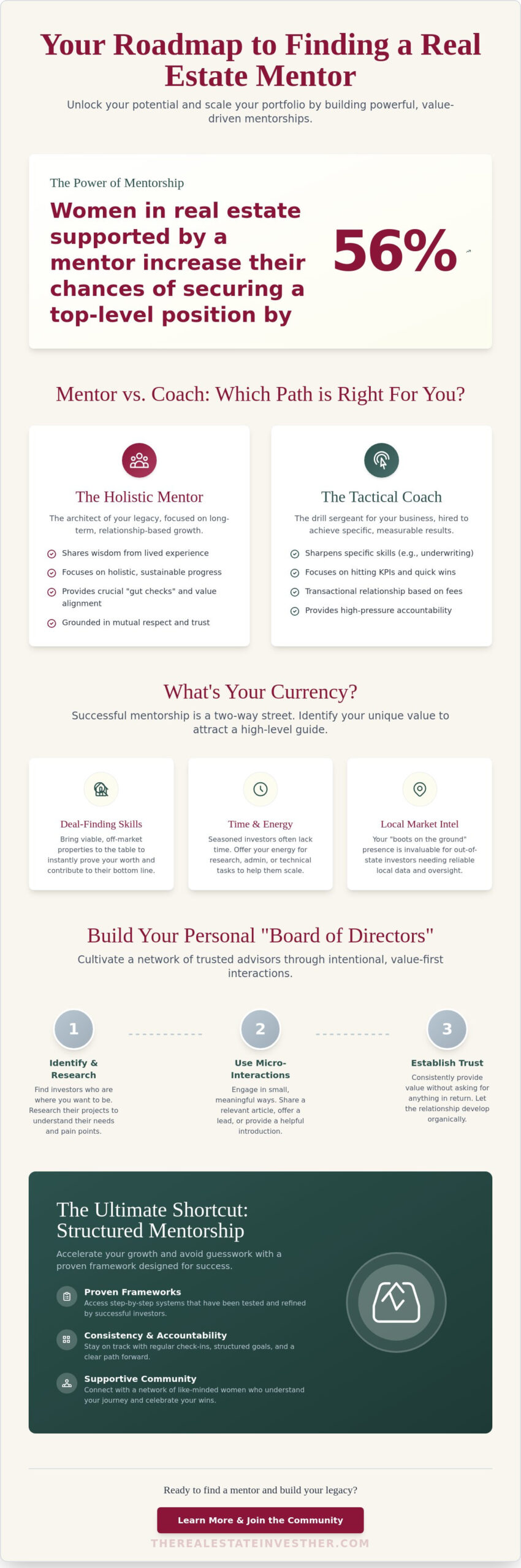
Did you know that women in real estate who are supported by a mentor increase their chances of securing a top-level position by 56% compared to those walking the path alone? Despite this clear advantage, many women still find themselves frozen by the fear of being a burden or the weight of conflicting advice. You might often feel like the only woman in the room, wondering if your questions are too basic or if your goals are too ambitious. The process of finding a real estate mentor doesn’t have to feel like an awkward transaction or a desperate plea for help. It’s about intentional alignment and finding someone who respects your personal well-being as much as your portfolio growth.
We understand that building a legacy requires more than just capital; it requires the collective wisdom of those who have already navigated the hurdles you’re facing. You deserve a partnership that feels like a shared mission rather than a cold exchange. This guide will show you how to master the art of finding a mentor who truly reflects your financial goals and personal values. We’ll provide a clear roadmap to help you approach high-level investors with confidence and clarity. You’re about to learn how to scale your investments while maintaining the balance that makes your journey sustainable.
Key Takeaways
- Understand the distinction between a relational mentor and a tactical coach so you can choose the support that fits your current season of growth.
- Identify your unique “currency,” such as time or deal-finding skills, to ensure your partnership is rooted in mutual value rather than a one-sided request.
- Explore the best local and digital spaces for finding a real estate mentor who aligns with your personal values and long-term vision.
- Learn how to build a personal “Board of Directors” by using micro-interactions to establish trust with investors who are already where you want to be.
- Discover how structured programs provide the consistency and proven framework you need to scale your portfolio without the guesswork of informal advice.
Real Estate Mentor vs. Coach: Choosing the Right Path for 2026
Success in real estate isn’t just about the spread on a spreadsheet. It’s about the people you have in your corner when the market shifts or a deal goes sideways. Many women start their journey by finding a real estate mentor, but they often confuse this role with that of a coach. While both offer guidance, their impact on your portfolio and your peace of mind is vastly different. A mentor is a seasoned investor who shares their wisdom through a long-term, relationship-based lens. They’ve walked the path you’re on and offer insights born from years of shared experience. By understanding mentorship as a holistic partnership, you can better identify which type of support will actually move the needle for you. Conversely, a coach is a paid professional hired to sharpen specific tactical weaknesses or hit specific KPIs. They are the drill sergeants of your business; mentors are the architects of your legacy.
The Holistic Mentor: Beyond the Numbers
For women investors, the journey is rarely just about financial independence. It’s about intentionality and work-life integration. A mentor understands the holistic lifestyle because they live it. They don’t just look at your underwriting; they help you evaluate if a potential out-of-state deal aligns with your family goals or your desire for sustainable progress. When you’re facing your first major acquisition, a mentor provides that essential “gut check” that data alone cannot offer. This relationship relies heavily on emotional intelligence and mutual respect. It’s a connection that grows over time, grounded in collective strength rather than a simple exchange of fees. Finding a real estate mentor who mirrors your values ensures that your growth doesn’t come at the expense of your well-being.
When to Hire a Real Estate Coach Instead
There are seasons where you don’t need a life-long guide; you need a specialist. If your lead conversion rates are plummeting or you’re struggling with complex underwriting for a new asset class, a coach is the right choice. Coaching is transactional by nature. You pay for a result, and they hold you accountable to the numbers. It’s a high-pressure environment designed for quick wins and skill mastery. Before committing to any coaching arrangement, it’s worth understanding the real estate coaching cost landscape in 2026 so you can budget appropriately and avoid overpaying for a program that doesn’t fit your needs. While a coach might help you scale a specific process, they won’t necessarily help you navigate the emotional nuances of being the only woman in a boardroom. Many successful investors start with a coach to fix a bottleneck and eventually transition into a structured mentorship program to find deeper alignment and community support.
Preparing Your Value Proposition: What Do You Offer a Mentor?
The biggest hurdle many women face when finding a real estate mentor isn’t a lack of ambition; it’s the quiet whisper of imposter syndrome. You might look at a seasoned investor with hundreds of units and think, “What could I possibly offer them?” This mindset treats mentorship as a one-way street, but the most successful partnerships are built on a fair exchange of value. To attract a high-level guide, you must identify your personal “currency.” While they have the capital and the track record, they often lack the one thing you likely have in abundance: time. Whether you’re offering technical skills, administrative support, or local market data, your goal is to help them scale their own efficiency. By researching a potential mentor’s current projects, you can identify their specific pain points and present yourself as the solution they didn’t know they needed.
Investors value “deal finders” above almost any other trait. If you can bring a viable, off-market property to their attention, you’ve instantly proven your worth. This demonstrates that you aren’t just looking for a handout; you’re actively contributing to their bottom line. If you’re still learning the ropes, consider how structured mentorship programs emphasize the importance of professional networking and value creation. You don’t need a massive portfolio to be valuable. You just need to be useful. Joining a supportive network like the InvestHER Community Membership can help you refine these skills alongside women who understand exactly where you are starting.
The “Boots on the Ground” Strategy
For an out-of-state mentor, your physical presence in a local market is a goldmine. You can offer to perform drive-bys, take high-quality photos of potential acquisitions, or meet with local contractors to provide real-time updates. If you live in a growing hub like Phoenix or Philadelphia, you can provide market-specific data that a remote investor might miss. Becoming an expert on a specific zip code allows you to offer granular insights that senior investors crave. When you provide “boots on the ground” support, you aren’t just a student; you’re a strategic partner.
Leveraging Your Professional Skills
Don’t discount the skills you’ve built in your 9-to-5. If you have a background in marketing, law, or accounting, your expertise can save a mentor’s firm thousands of dollars in consulting fees. Many senior investors also struggle with the rapid pace of technological change. This creates a perfect opportunity for “reverse mentoring,” where you assist them with social media strategy or new property management software in exchange for their investment wisdom. When you approach them, lead with a 30-second value pitch. Focus entirely on how your skills will solve their problems, rather than what you hope to gain from the relationship.
5 Proven Places to Find a Real Estate Mentor in 2026
Once you’ve identified your value proposition, the next step is putting yourself in the right rooms. Finding a real estate mentor isn’t about casting a wide, anonymous net; it’s about strategic placement. In 2026, the landscape of networking has shifted toward high-trust, niche environments where shared values outweigh transactional gains. While traditional Real Estate Investor Associations (REIAs) remain a staple, many women are finding better alignment in subgroups specifically designed for female investors. These spaces allow for more vulnerable, honest conversations about the intersection of wealth and well-being. Whether you prefer the convenience of digital connections or the high energy of live events, your ideal mentor is likely active in one of these five arenas.
- Niche Online Communities: Platforms like the InvestHER Community Membership provide a global network of women who prioritize collective strength over individual ego.
- Industry-Specific Conferences: Concentrated networking at events like InvestHER CON allows you to secure an InvestHER CON Ticket and meet high-level investors who are actively looking to give back to the community.
- Social Media Ecosystems: LinkedIn and Instagram have evolved into powerful tools for “passive” relationship building. By consistently engaging with a potential mentor’s content, you stay top-of-mind before ever making a formal ask.
- Local REIA Subgroups: Look for chapters that host “women-only” luncheons or masterminds to find a more comfortable entry point into your local market.
- Proprietary Mentorship Programs: If you want to bypass the awkwardness of informal networking, the STRIVE Mentorship Program offers a structured environment designed to accelerate your growth.
Targeting Local Investment Hubs
Geography still plays a massive role in finding a real estate mentor who understands your specific market nuances. Scottsdale and Phoenix currently anchor a powerful Arizona investor circuit where collaborative deal-making is the norm. If you’re tapping into the tech-meets-real-estate crowd, cities like San Diego and Austin offer a unique blend of innovation and traditional asset growth. For those navigating the high-stakes, fast-paced environments of New York or Dallas, having a mentor who knows the local regulatory hurdles and competitive landscape is non-negotiable. These hubs are perfect for finding seasoned pros who have weathered multiple market cycles.
The Power of Women-Only Spaces
Traditional investment groups often leave us feeling like “The Only Woman in the Room.” This dynamic can create an underlying pressure to prove yourself, which often hinders the authentic connection required for a true mentorship. In female-focused spaces, the energy shifts from competition to collaboration. This supportive atmosphere makes it easier to ask the “tough” questions about property management, financing, or scaling a portfolio while raising a family. You can find local InvestHER Meetups in cities like Philadelphia and Orlando, where women gather to share resources and build lasting legacies together.
Building Your “Board of Directors”: A Step-by-Step Approach
Thinking about mentorship as a single, all-knowing relationship often leads to disappointment. Instead, envision your growth as a corporation that requires a “Board of Directors.” This shift in perspective moves you away from the high-pressure search for one perfect person and toward a collective of advisors who offer diverse strengths. Finding a real estate mentor becomes a methodical process of building a network that supports your specific financial and personal evolution. You don’t need a single hero; you need a curated circle of pioneers who have already navigated the obstacles you’re currently facing. By following a structured approach, you can transform awkward introductions into lasting professional alliances.
- Step 1: Identify your rungs. Look for 3 to 5 investors who are exactly 2 to 3 steps ahead of you. If you’re closing your first deal, someone with ten units is more relatable and accessible than a mogul with a thousand.
- Step 2: Lead with micro-interactions. Before making an ask, engage with their work. Share their latest project on social media or send a brief email mentioning a specific insight you gained from their recent interview.
- Step 3: The specific ask. Request a 15-minute “advice session” focused on one singular problem. Avoid the vague “coffee date.” Respect their time by being surgically precise with your questions.
- Step 4: Close the loop. After the meeting, execute their advice immediately. This is the most critical step in securing a long-term relationship.
- Step 5: Nurture the connection. Consistency breeds trust. Keep them updated on your progress every few months, even if you don’t have a new question.
The Feedback Loop: The Secret to Retaining a Mentor
Successful investors are often driven by the desire to see their wisdom create a tangible impact. They love seeing their advice put into action. To retain a high-level mentor, you must prove you’re a worthy investment of their time. Send a “results email” within two weeks of your meeting. Detail exactly what steps you took based on their guidance and what the outcome was. This creates a psychological win for the mentor and makes them significantly more likely to say yes to your next request. If you’re ready to move beyond informal chats and into a proven framework for growth, consider joining the STRIVE Mentorship Program to find your path.
Diversifying Your Board
A well-rounded board requires different types of expertise. You need a “technical” mentor who can tear apart a pro forma; a “mindset” mentor who helps you push through the fear of scaling; and a “connector” mentor who introduces you to the right lenders and contractors. Managing multiple advisors isn’t about playing them against each other. It’s about gathering a 360-degree view of your business. As you scale, you’ll find yourself naturally transitioning from mentee to mentor, completing the cycle of collective strength and ensuring the next generation of women investors has the support they need to build their own legacies.
Why Structured Mentorship (Like STRIVE) is the Ultimate Shortcut
While the organic approach to building a “Board of Directors” is invaluable, it often comes with a hidden cost: time. Informal relationships can be inconsistent. Life gets in the way; meetings get canceled; and without a clear roadmap, your progress can stall. Finding a real estate mentor through traditional networking often feels like a series of “awkward asks” that may or may not lead to a breakthrough. A structured environment removes this friction. It replaces the guesswork with a proven framework designed specifically for the challenges women face in this industry. By choosing a formal path, you aren’t just getting advice; you’re gaining a strategic partner dedicated to your long-term success.
The STRIVE Mentorship Program provides the ultimate shortcut by connecting you with a curated network of high-level women investors. These are pioneers who have already built significant legacies and are now ready to give back to the community. Instead of spending months trying to prove your value, you enter a space where mutual support is the default. This 360-degree approach combines community membership with direct mentorship, ensuring you have both the tactical training and the emotional support needed to scale your portfolio with confidence. It’s about moving away from transactional interactions toward a more holistic, community-driven approach to wealth.
The InvestHER Advantage
Real estate can be a lonely journey, especially when you’re the only woman in the room. Moving from a “lonely investor” mindset to being part of a global movement changes everything. Structured programs eliminate the ambiguity of informal mentorship, allowing you to get straight to the strategy. We’ve seen real stories of women who scaled from a single property to portfolios of 50+ units through the accountability and clarity found in STRIVE. They didn’t do it by working harder; they did it by working with the collective wisdom of a tribe that understands their unique hurdles. This is how you build a business that serves your life, rather than a life that serves your business.
Next Steps: InvestHER CON and Beyond
Your journey toward financial independence doesn’t have to be a solo climb. You can use InvestHER CON as a powerful springboard to find your next mentor and connect with hundreds of like-minded women. Whether you’re just starting or looking to optimize a growing portfolio, joining the membership keeps you accountable to your wealth-building goals. It’s time to stop second-guessing your potential and start building your legacy with a team that has your back. Apply for STRIVE or Join our Community today to take the next step in your real estate journey.
Step Into Your Power and Build Your Legacy
Your journey toward financial independence is no longer a path you must walk alone. By identifying your unique value and building a diverse board of directors, you transform the process of finding a real estate mentor from a daunting task into a strategic advantage. You now have the tools to distinguish between tactical coaching and holistic mentorship, ensuring every partnership you form aligns with your deepest values and long-term vision.
Founded by Liz Faircloth and Andresa Guidelli, our community of thousands of women investors globally is dedicated to the idea that collective strength accelerates individual success. If you’ve ever felt the isolation described in “The Only Woman in the Room,” you know how critical it is to find an environment where you’re truly seen and supported. We invite you to move beyond the limitations of inconsistent networking and embrace a proven framework for growth that prioritizes both your portfolio and your personal well-being.
Join the STRIVE Mentorship Program and scale your portfolio today. Your legacy is waiting for you to take the first step with confidence and clarity.
Frequently Asked Questions
Do I have to pay for a real estate mentor in 2026?
You don’t always have to pay a direct fee for a mentor, but you must be prepared to provide significant value in exchange for their time. Informal mentorship is often built on a relationship of mutual respect where you contribute “sweat equity” or specialized skills. However, structured programs often require a professional investment to guarantee a consistent roadmap and high-level accountability that informal relationships might lack.
What is the best way to approach a potential mentor for the first time?
The most effective approach is to lead with a specific value proposition rather than a vague request for help. When you’re focused on finding a real estate mentor, research their current portfolio and identify a gap you can fill. Whether it’s providing local market data or offering administrative support, showing that you’ve done your homework makes you an attractive partner rather than a burden.
How much time should I expect to spend with a mentor each month?
You should generally expect to spend one to four hours of direct interaction with a mentor each month, depending on the intensity of your current projects. Quality always outweighs quantity in these relationships. A focused fifteen-minute “advice session” where you present a specific problem and receive clear guidance is often more valuable than a long, unstructured lunch meeting without a clear agenda.
Can I find a real estate mentor if I am a complete beginner with no deals?
You can absolutely succeed at finding a real estate mentor even if you haven’t closed your first deal yet. Seasoned investors often value the energy, enthusiasm, and time that beginners can offer their business. By positioning yourself as a “boots on the ground” researcher or a technical assistant, you provide the leverage they need to scale while you gain an invaluable education.
What should I do if a potential mentor says no?
Accept a “no” with grace and maintain the relationship by asking if they can recommend a specific resource or another investor who might be a good fit. A rejection is often just a matter of timing and doesn’t reflect your potential as an investor. Use the opportunity to ask for feedback on your value pitch so you can refine your approach for the next person.
Is it better to have a local mentor or an out-of-state mentor for rental properties?
Local mentors are ideal for understanding specific neighborhood nuances and navigating local regulations, while out-of-state mentors are excellent for learning scalable systems and high-level strategy. Your choice should depend on your current bottleneck. If you’re struggling with local contractors, stay local; if you’re trying to build a remote empire, look for someone who has already mastered virtual portfolio management.
How do I know if a real estate mentorship program is a scam?
Authentic programs prioritize sustainable growth and community support over flashy promises of overnight wealth or “get rich quick” schemes. Always check for a transparent track record and verified testimonials from other women in the industry. If a program lacks a clear ethical framework or pressures you into high-interest debt without a solid business plan, it’s a sign to look elsewhere.
What is the difference between a mentor and a mastermind group?
A mentor provides vertical guidance from a senior expert who is several steps ahead of you on the path. A mastermind group offers horizontal, peer-to-peer support where a circle of equals brainstorms solutions and shares resources. Both are vital components of a well-rounded support system, but they serve different needs in your journey toward financial independence and personal well-being. If you’re weighing your options, reviewing a detailed breakdown of real estate coaching costs for women investors in 2026 can help you make a more informed decision about where to invest your time and money.

Article by
Andresa Guidelli
Real estate investor, operator, and founder of The Real Estate InvestHER, a national platform supporting women real estate investors. With 15+ years of experience in real estate investing and business operations, she focuses on helping investors build stronger businesses behind their portfolios through better systems, clearer decision-making, leadership, and responsible use of AI.
Be the first to comment