


Building a Real Estate Team: The Ultimate Scaling Checklist for Women Investors
What if the secret to scaling your portfolio isn’t working more hours, but actually doing less? You’ve likely felt the bone-deep exhaustion of being a solopreneur, where every contractor call in Austin or property manager crisis in Philadelphia lands squarely on your shoulders. It’s natural to worry that building a real estate team might mean losing control over deal quality, especially when single women now represent 20% of all homebuyers and the stakes for your legacy have never been higher. You want a business that breathes without you, yet the fear of hiring the wrong person often leads to analysis paralysis.
We agree that your time is your most valuable asset, and it’s time you started protecting it. This guide provides a comprehensive, 5-part checklist for transitioning from a solo operator to a strategic leader. We’ll walk through how to curate a circle of trusted partners who treat your business with the same care you do, ensuring you gain more time for family and high-level planning. By the end of this read, you’ll have a clear roadmap to build a scalable model that supports your life rather than consuming it.
Key Takeaways
- Identify your “Zone of Genius” to shift from a task-oriented solopreneur to a strategic CEO who focuses only on high-impact growth.
- Define the “Big Four” essential partners and specialized support roles required to scale your portfolio with confidence and professional precision.
- Implement an “Alignment Interview” strategy when building a real estate team to ensure every new partner treats your business with the same intentionality you do.
- Build a frictionless operation by documenting your unique processes and adopting simple tech tools that keep your team connected and your deals moving.
- Foster a sustainable culture of excellence by balancing firm accountability with the empathetic leadership that turns contractors into long-term strategic allies.
Phase 1: Assessing Your Readiness to Scale (The “CEO Mindset” Checklist)
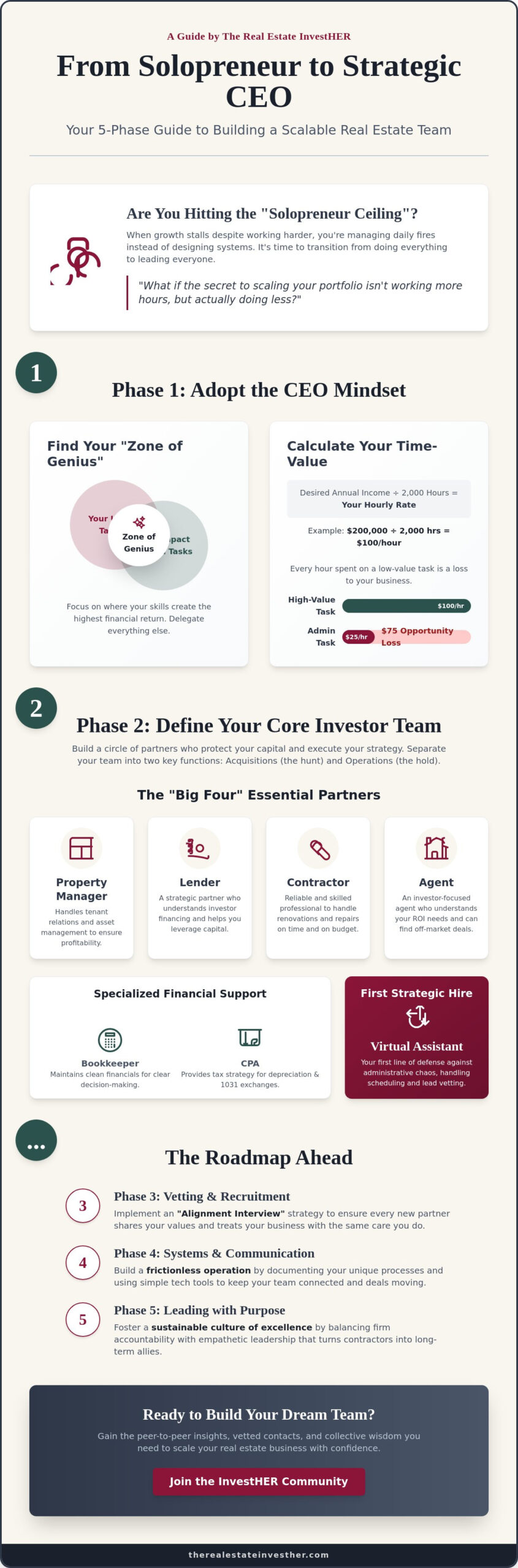
Transitioning from a solo investor to a strategic leader requires more than just capital. It demands a psychological evolution. Many women start by doing everything because they believe no one else can match their standards or attention to detail. This mindset acts as a safety net that eventually becomes a cage. When you begin building a real estate team, you aren’t just hiring help; you’re reclaiming your time to focus on your “Zone of Genius.” This is the intersection where your unique talents, like complex deal structuring or high-level networking, meet the highest financial returns. Everything else is an administrative energy drain that pulls you away from your legacy.
Audit your current portfolio to see where momentum is dying. Are your flips in San Diego or Phoenix stalling because you’re the one coordinating every minor repair or chasing down permits? Calculate your time-value to gain clarity. Divide your desired annual income by 2,000 working hours. If your goal is $200,000, your hour is worth $100. Every hour spent on a $25 task is a $75 loss to your business. This simple math justifies the cost of your first hire and shifts your perspective from expense to investment. You must decide if you are building a lifestyle business that offers freedom or a massive empire that requires heavy infrastructure.
Recognizing the “Solopreneur Ceiling”
You’ve hit the ceiling when growth stops despite you working harder than ever. This usually happens because you’re working in the business, managing daily fires, instead of on it, designing the systems that prevent those fires from starting. Signs of this bottleneck include missed follow-ups, delayed closings, or a general sense of resentment toward your portfolio. To guide your hiring needs, write a single sentence defining your “Ideal Day.” For example: “My ideal day involves reviewing three high-yield deal packages before noon and spending the afternoon with my family, knowing my operations are handled by a trusted partner.”
Financial Benchmarking for Your First Hire
Before bringing on a Virtual Assistant or a specialized real estate agent to help source leads, ensure your cash flow is consistent. You don’t need a massive surplus, but you do need enough to cover at least three months of a new hire’s compensation. The real risk isn’t the cost of the hire. It’s the opportunity cost of staying small. Consider the deals you missed last month because you were too busy reconciling bank statements to answer a motivated seller’s call. Building a real estate team is about closing that gap between where you are and the visionary leader you are meant to be.
Phase 2: Defining Your Core Investor Team Roles
Building a real estate team as an investor requires a significant shift in how you view professional partnerships. Unlike a brokerage focused on high-volume listings, your team must be built around the “Big Four” pillars: the Property Manager, the Lender, the Contractor, and the Agent. These individuals don’t just work for you; they protect your capital and ensure your strategy remains profitable. Principles of Effective Team Management suggest that clear role definition is the first step toward collective success. You also need specialized support from an investor-focused bookkeeper and a CPA who understands the intricacies of depreciation and 1031 exchanges to ensure your growth is sustainable and tax-efficient.
Your structure should clearly distinguish between acquisitions and operations. Acquisitions handle the hunt, focusing on lead generation, market analysis, and deal structuring. Operations handle the hold, focusing on asset management, tenant relations, and long-term value creation. For many women, a Virtual Assistant serves as the first line of defense against administrative chaos, handling everything from scheduling to initial lead vetting. This allows you to focus on high-level negotiations and strategic planning. As your portfolio grows and you begin raising capital for real estate deals to fund larger acquisitions, having a clearly defined team structure becomes essential to inspiring investor confidence. If you’re looking for a network of women who have already navigated these hiring hurdles, joining the InvestHER Community Membership can provide the peer-to-peer insights and collective wisdom you need to scale.
The Investor-Focused Real Estate Agent
A standard retail agent in Scottsdale might find a beautiful home, but they often won’t understand your specific ROI requirements or the nuances of a BRRRR strategy. During the agent vetting process, ask if they own investment properties themselves. You need someone who can spot a deal’s potential beyond the paint color and who understands how the mid-2024 NAR settlement changes impact your negotiation leverage. They should be able to provide data-driven insights rather than just emotional sales pitches.
Property Management: The Gatekeeper of Your Passive Income
In high-regulation markets like New York or Philadelphia, your property manager is your most critical legal and financial shield. They must be experts in local tenant laws to prevent costly litigation and ensure your cash flow remains steady. During interviews, dig into their communication style and maintenance markups. Do they treat your business with intentionality, or are you just another door in their portfolio? Finding a partner who values transparency and alignment is non-negotiable for long-term sustainability.
Phase 3: The Vetting and Recruitment Checklist
Sourcing the right talent is where your vision meets reality. Instead of relying on generic job boards, tap into networks where the “investor mindset” is already a shared language. Members of the InvestHER community in Dallas or Orlando often share vetted referrals for partners who understand creative financing and long-term hold strategies. This peer-to-peer verification reduces the friction of cold-calling. While building a real estate team, your goal is to find individuals who view your success as a catalyst for their own growth. Collective wisdom is a much faster path to scaling than trial and error.
Once you have a shortlist, move into the verification phase. This is non-negotiable. Check for active licenses and confirm that their Errors & Omissions (E&O) insurance is current. In the industry, E&O coverage typically ranges from $40 to $150 per month per employee; if a professional cannot provide proof of this basic protection, they aren’t ready to handle your portfolio. Call at least three past investor references. Ask specifically how the partner handled a deal that went sideways. Their response to failure tells you more than any polished testimonial ever could.
Always implement a “Trial Project” before signing a long-term contract or a massive renovation. Assign a small repair or a single-unit lease-up. This allows you to observe their communication rhythm and attention to detail without risking your entire capital stack. It’s a low-stakes way to see if their operational style aligns with your standards.
Finding Quality Contractors in Competitive Markets
In high-demand hubs like Austin, the best contractors are often booked months in advance. To stand out as a “Preferred Investor,” show them that you have your systems in place. Provide clear, documented scopes of work and demonstrate that your funding is ready. Red flags in the bidding process, such as vague estimates or slow response times, are early indicators of future team friction. If they don’t value your time during the honeymoon phase, they won’t prioritize your project when challenges arise.
Interviewing for Cultural Alignment
Many women experience “The Only Woman in the Room” syndrome, where their authority is subtly challenged by vendors or peers. Your team must respect your leadership and your vision. During the “Alignment Interview,” ask questions that reveal their views on collaborative wealth building. Do they see you as a temporary transaction or a long-term strategic partner? You aren’t just looking for a vendor. You are curating a circle of allies who value your autonomy and share your commitment to excellence.
Phase 4: Systems and Communication for a Frictionless Team
Systems are the silent engine of your investment business. Without them, building a real estate team just creates a group of people waiting for you to tell them what to do. Your goal is to document your “Secret Sauce” through Standard Operating Procedures (SOPs), ensuring that every deal moves from offer to closing with surgical precision. This level of intentionality allows you to step back from the daily grind while maintaining the high standards that built your portfolio. When your team knows exactly how you evaluate a property or handle a tenant dispute, you stop being the bottleneck and start being the visionary leader you were meant to be.
Your tech stack should simplify your life, not complicate it. For individual agents in 2026, CRM costs typically range from $49 to $150 per month, while team plans like Follow Up Boss start at $69 per user per month. These tools, paired with project management software like Asana or communication hubs like Slack, provide a centralized source of truth. They eliminate the need for endless email chains and ensure that no lead or maintenance request falls through the cracks. If you are ready to master these systems alongside other high-achieving women, joining the STRIVE Mentorship Program can provide the hands-on guidance you need to scale your operations.
Consistency is the antidote to micromanagement. A Weekly Pulse Meeting keeps everyone aligned on goals and current projects without requiring daily check-ins. Use this time to review financial transparency reports, so you always know your debt-to-equity ratios and cash flow numbers. When everyone has access to the right data, they can make informed decisions that treat your business like their own. This creates a culture of autonomy where your partners feel empowered rather than hovered over. It’s about building a sustainable rhythm that supports long-term growth.
Building Your Investor SOP Library
Your SOP library should be a living document that covers every phase of the investment lifecycle. Start with a “Deal Deep Dive” SOP that outlines your specific criteria for inspections, appraisals, and title work. You must also document your property management expectations to avoid “Scope Creep.” Clearly defining who handles utility transfers or minor repairs prevents costly misunderstandings and ensures your passive income remains truly passive. This clarity protects your time and your profit margins.
Communication Protocols
Set firm boundaries to protect your personal well-being and maintain professional focus. Define exactly when and how your team should contact you, and establish an “Emergency Matrix” for your Philadelphia rental portfolio. For example, a burst pipe at 2:00 AM is a 911 that requires immediate action, while a question about a paint color can wait for the weekly meeting. These protocols ensure that your team only interrupts your strategic planning or family time when it’s absolutely necessary.
Phase 5: Leading with Purpose: Sustaining Your Team Culture
The final stage of building a real estate team is the most profound. It requires you to stop being a manager of tasks and start being a leader of people. Many traditional coaching models focus solely on cold accountability and rigid sales quotas, but sustainable growth for women investors thrives on a culture of alignment. Your team is a living ecosystem. When you prioritize shared values over mere compliance, you create a circle of partners who treat your portfolio with the same reverence you do. This shift ensures that your business doesn’t just survive your absence; it flourishes because of the foundation you’ve built.
Leadership requires a sophisticated balance of accountability and empathy. Mistakes will happen. A contractor might underestimate a repair in Austin, or a property manager in Philadelphia might miss a lease renewal. Handling these moments without burning bridges is what separates a transactional operator from a legacy builder. Approach these hurdles as opportunities for system refinement rather than personal failure. By maintaining a steady, confident cadence in your communication, you foster a sense of psychological safety that encourages your team to be honest, proactive, and deeply committed to your collective success.
Never underestimate the power of recognition. While financial incentives are necessary, a sincere “thank you” or public acknowledgment often does more for long-term retention than a standard bonus. People want to feel seen and valued for their specific contributions to your mission. As your portfolio grows, provide your partners with opportunities to elevate their own professional standing. When you reach the point where your team handles the daily operations, it may be time to scale your own leadership by joining the STRIVE Mentorship Program to refine your high-level strategy.
The InvestHER Leadership Philosophy
Leading as an authoritative yet empathetic guide means you set the standard while remaining deeply human. You aren’t just looking for someone to fill a role; you are curating a legacy team. Think 5 to 10 years ahead. Ask yourself if your current partners are the ones you want by your side when your portfolio triples in size. This long-term intentionality prevents the high turnover that plagues many investor teams and ensures that your business remains a source of personal well-being rather than stress.
Next Steps for the Scaling Investor
Your transition from Team Leader to Portfolio Visionary is a journey of letting go. As you step into this higher frequency, the InvestHER Community provides the ongoing support and collective wisdom needed to lead with confidence. You’ve built the engine. Now, your job is to point it toward the horizon. By focusing on your core purpose and empowering your team to handle the rest, you achieve the ultimate goal: a scalable business that creates both financial independence and a lasting impact.
Stepping Into Your Power as a Portfolio Visionary
You’ve moved beyond the exhaustion of doing it all alone. By reclaiming your “Zone of Genius” and defining your core pillars, you’ve laid the groundwork for a business that serves your life rather than consuming it. Building a real estate team isn’t just about delegating tasks; it’s about curating a circle of strategic partners who share your vision for financial independence and personal well-being. You’ve seen how intentional SOPs and empathetic leadership turn administrative chaos into a frictionless operation that sustains itself.
Now it’s time to accelerate that growth with a community that understands your journey. Join the STRIVE Mentorship Program to scale your team and portfolio with expert guidance. Led by industry pioneers Liz Faircloth and Andresa Guidelli, this program provides a proven framework for scaling from 1 to 100+ doors. You’ll also gain access to a network of 50+ local InvestHER meetups to find the collective wisdom you need to lead with confidence.
Your legacy is waiting for you to take the lead. Step forward with the knowledge that you have the systems, the team, and a powerful community of women standing with you every step of the way.
Frequently Asked Questions
When is the right time to start building a real estate team?
The right time to start building a real estate team is when your administrative tasks prevent you from evaluating new deals or managing high-level strategy. If you find yourself working more than 50 hours a week but your portfolio growth has plateaued, you’ve likely hit your solopreneur ceiling. Scaling before you’re completely overwhelmed allows you to train partners with intentionality rather than hiring out of desperation. Reclaiming your time is the first step toward true financial independence.
Who should be my first hire as a real estate investor?
Most investors find that a Virtual Assistant or a specialized bookkeeper is the most impactful first hire. These roles remove the burden of data entry and scheduling, which are often the biggest energy drains for a growing business. By offloading these tasks, you reclaim the mental bandwidth needed to negotiate with lenders or vet contractors. Focus on the specific role that currently causes the most friction in your daily workflow to see the fastest return on investment.
How do I find investor-friendly real estate agents in my local market?
You can identify investor-friendly agents by asking for their personal investment history and their understanding of local cap rates. A retail-focused agent might prioritize aesthetics, while an investor-focused partner prioritizes cash-on-cash return and long-term equity. Attend local meetups or join digital communities where active investors share vetted referrals. This peer-to-peer approach ensures you find a partner who understands the nuances of the post-2024 NAR settlement landscape and can articulate their value clearly.
What is the average cost of building a real estate team?
The cost of building a real estate team varies based on your needs, but you should budget for both software and professional protection. Real estate CRM software typically ranges from $49 to $150 per month for individuals, while team plans can exceed $499. Additionally, Errors & Omissions (E&O) insurance often costs between $40 and $150 per month per employee. Always factor in these operational overheads and local licensing fees before committing to a new long-term partnership.
Do I need a formal business plan before hiring a team?
You don’t need a hundred-page document, but a clear vision for your “Ideal Day” and financial targets is essential. This plan acts as a compass for your hiring decisions, ensuring every new partner aligns with your long-term legacy and investment style. Without a defined roadmap, you risk hiring for temporary fixes rather than strategic growth. A simple one-page summary of your goals and core values is often enough to begin your transition to a CEO mindset.
How do I manage a real estate team while working a full-time job?
Managing a team alongside a 9-to-5 requires robust systems and asynchronous communication tools like Slack or Asana. Documenting your processes through SOPs ensures your team can function without your constant supervision during work hours. Set clear boundaries for when you are available for “Emergency Matrix” issues versus routine updates. This structure allows your business to grow in the background while you maintain your primary income stream and protect your personal well-being.
What are the most common mistakes when building a real estate team?
One common pitfall is hiring out of desperation without conducting an “Alignment Interview” to check for shared values. Another mistake is failing to verify a partner’s insurance or professional licenses before starting a trial project. In 2026, the total cost for a real estate license in states like California can reach $1,210; ensure your partners have invested in their own professional standing. Skipping these basic vetting steps often leads to costly friction and misaligned expectations later on.
How can I ensure my team aligns with my investment values?
You can ensure alignment by integrating your core values into the interview process and your daily operational rhythm. Ask potential partners how they handle mistakes and what long-term sustainability means to them in a competitive market. A culture of alignment is built on mutual respect and transparent communication rather than just transactional quotas. When your team understands your “why,” they are more likely to treat your building a real estate team efforts as a shared journey toward excellence. As you scale, learning the strategies behind raising capital for real estate deals will further empower you to grow your portfolio with confidence and attract partners who share your long-term vision.

Article by
Andresa Guidelli
Real estate investor, operator, and founder of The Real Estate InvestHER, a national platform supporting women real estate investors. With 15+ years of experience in real estate investing and business operations, she focuses on helping investors build stronger businesses behind their portfolios through better systems, clearer decision-making, leadership, and responsible use of AI.
Be the first to comment