


Real Estate Investing for Moms: A Step-by-Step Guide to Building Generational Wealth
What if the daily chaos of managing a household isn’t a distraction from your investment goals, but the ultimate training ground for them? You already possess the negotiation skills, the multitasking prowess, and the resilience needed to dominate the market. Yet, many women feel stuck in analysis paralysis or carry a heavy sense of guilt over financial risks. Real estate investing for moms should be a vehicle for freedom; it shouldn’t be another source of stress that depletes your precious “me” time. You deserve a seat at the table where your role as a mother is seen as a strategic advantage rather than a hurdle.
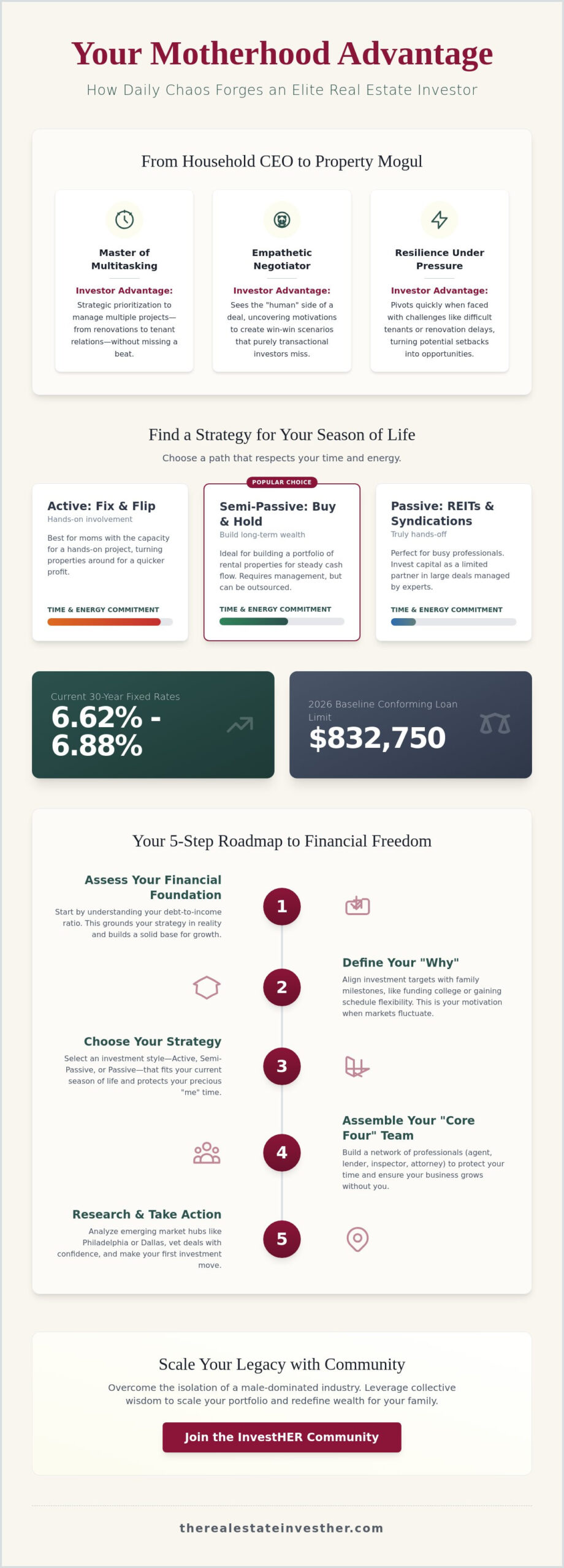
We understand the unique pressure of building a college fund while navigating an industry that often feels like a boys’ club. This article provides a clear, strategic roadmap designed to help you balance motherhood with multi-family deals. We’ll examine how to leverage current market shifts, including the 2026 baseline conforming loan limit of $832,750, to create sustainable passive income. You’ll discover how to navigate a market where 30-year fixed rates currently average between 6.62% and 6.88% while staying focused on your long-term vision. This guide offers the clarity to move past fear and the confidence to join a community of women redefining wealth for their families.
Key Takeaways
- Learn how your existing household management skills translate into professional property management and high-level negotiation advantages.
- Identify the most sustainable real estate investing for moms strategy by aligning your financial goals with your family’s current season of life.
- Discover how to assemble your “Core Four” team of professionals to protect your time and ensure your business grows without your constant presence.
- Follow a practical five-step roadmap to move from assessing your debt-to-income ratio to researching emerging market hubs like Philadelphia or Dallas.
- Explore how collective wisdom and a supportive community can help you scale your portfolio while overcoming the isolation of a male-dominated industry.
Why Motherhood is Your Secret Weapon in Real Estate
Society often frames motherhood as a series of sacrifices, yet in the world of property acquisition, your role as a mother is your greatest asset. You are already a Chief Operating Officer. Every day, you manage complex schedules, resolve high-stakes conflicts, and oversee a budget that keeps a small organization running. These aren’t just “mom skills”; they are the exact professional competencies required to excel in real estate investing. When you pivot from simply saving for the future to investing for generational wealth, you aren’t just changing your bank balance. You’re changing your family’s trajectory for decades to come.
Success in this industry requires a specific brand of resilience that moms possess in abundance. While others might see a difficult tenant or a delayed renovation as a reason to quit, you understand how to pivot under pressure. Your ability to multi-task isn’t just about doing more; it’s about strategic prioritization. In negotiations, your natural empathy allows you to see the “human” side of a deal, often uncovering motivations that a purely transactional investor would miss. This “Mom Edge” turns real estate investing for moms into a sophisticated masterclass in leadership and legacy building.
The Psychology of the Mom Investor
Many women face a “guilt gap” when they consider moving family capital into an investment property. You might worry that you’re risking your children’s stability, but the reality is that stagnant savings often lose value to inflation. Shifting from a scarcity mindset to an abundance mindset allows you to see that financial risk, when calculated and strategic, is actually a form of protection. The InvestHER Mindset is the intentional fusion of radical empathy for others and a relentless focus on ROI for your family. It’s about recognizing that your growth as an investor directly fuels the opportunities available to your children.
Strategic Goal Setting for Your Family
Effective investing begins with a clear “Why” that goes beyond a monthly cash flow number. Perhaps your goal is to fully fund a college account by the time your toddler reaches eighteen, or maybe you want the schedule flexibility to never miss a mid-day school play. By aligning your investment targets with these family milestones, you create a source of motivation that remains steady even when the market fluctuates. It’s vital to set realistic time boundaries for your new business to prevent burnout. You aren’t building a job; you’re building a legacy that should eventually run without you. Consider these steps for your initial strategy:
- Define your “Season of Life”: Determine if you have the capacity for a hands-on “fix and flip” or if a passive “buy and hold” approach fits your current schedule better.
- Map milestones to assets: Calculate how many doors are required to cover specific family expenses, like private school tuition or annual vacations.
- Protect your “Me” time: Establish “business hours” for your real estate activities so your investment goals don’t encroach on your presence with your children.
Choosing a Mom-Friendly Investment Strategy
Success in real estate investing for moms isn’t about working harder; it’s about choosing a path that respects your time and energy. Every mother’s season of life is different. If you’re currently managing the needs of young children, an active “fix and flip” project might feel overwhelming. Conversely, if you’re a professional looking to diversify your income, passive strategies offer a way to grow wealth without adding to your daily to-do list. The goal is to find a strategy that generates cash flow while allowing you to remain present for the moments that matter most.
For those seeking a truly hands-off experience, Real Estate Investment Trusts (REITs) and syndications are excellent options. Syndications allow you to act as a limited partner in large-scale multi-family deals. You provide the capital, and a professional team handles the operations. It’s an empowering way to own a piece of a 200-unit apartment complex without ever taking a tenant call. If you’re looking for a supportive network to help you vet these deals, joining the InvestHER Community Membership can provide the collective wisdom you need to invest with confidence.
House hacking remains a powerful tool for growing families. By utilizing an FHA loan, you can purchase a multi-family property with a minimal down payment. In 2026, the FHA loan limits range from $541,287 in low-cost areas to $1,249,125 in high-cost regions. Living in one unit while renting out the others can effectively eliminate your housing expense, allowing you to redirect those savings into your next investment or a college fund. It is a strategic move that turns your home into an asset rather than a liability while you build your portfolio.
Short-Term vs. Long-Term Rentals
Choosing between Airbnb and traditional leases is a question of time versus yield. Short-term rentals in hubs like Scottsdale or Orlando often command higher rates but require intense management. Long-term rentals provide a steady, predictable income stream that fits a busy schedule. To decide, calculate your Cash-on-Cash return. With national median listing prices down 2.3% year-over-year as of May 2026, you may find attractive entry points for long-term stability.
The Power of the BRRRR Method
The BRRRR method is a favorite in the world of real estate investing for moms because it allows you to scale quickly by buying, rehabbing, renting, refinancing, and repeating. You buy a distressed property, add value through renovation, and refinance to pull your initial capital back out. You don’t need to be on-site daily to manage a rehab. By hiring a trusted contractor, you can oversee progress remotely. With 30-year fixed mortgage rates between 6.62% and 6.88%, this strategy remains a proven engine for building wealth.
Building Your ‘InvestHER’ Team to Protect Your Time
The myth of the “self-made” investor is a dangerous fairy tale that often leads busy women straight toward burnout. You don’t need to be the person swinging a hammer or chasing down rent checks to build a massive portfolio. True success in real estate investing for moms is found in the strength of your network, not the length of your to-do list. By surrounding yourself with a “Core Four”—an investor-friendly agent, a creative lender, a licensed contractor, and an experienced property manager—you shift your role from a harried landlord to a visionary CEO. This infrastructure protects your most valuable asset: your time.
Vetting these partners requires a different set of questions than a typical investor might ask. You aren’t just looking for the lowest rate or the fastest turnaround. You need a team that respects your boundaries and understands that your business must coexist with your family life. When you review a Beginner’s Guide to Real Estate Investing, you’ll see the technical requirements for these roles, but don’t ignore the cultural fit. If a contractor won’t use a project management app or insists on only calling during your children’s bedtime, they will eventually become a source of friction. Look for professionals who value your time as much as you do.
Finding Local Experts in Key Markets
Local knowledge is your shield against costly mistakes. Markets in Austin or Phoenix have specific rental regulations and neighborhood dynamics that change block by block. If you are investing out-of-state from San Diego or New York, your local agent is your eyes and ears on the ground. They should understand the “InvestHER” mindset and look for properties that meet your specific ROI goals. Interview property managers with a focus on their emergency protocols. You are paying them to ensure that a broken water heater at 2 AM never becomes your problem to solve.
Delegation as a Form of Scaling
Scaling requires you to let go of the “if I want it done right, I have to do it myself” mentality. True wealth is built through systems, not individual effort. You must move from “doing the work” to “owning the business” to see true growth. Use technology to your advantage by leveraging cloud-based portals that allow you to approve repairs and view financial statements with a few taps on your phone. This level of digital oversight ensures you stay informed without being entangled in the minutiae. A high-quality property manager is a mom’s best friend because they provide the freedom to scale your legacy without sacrificing your presence at the dinner table.
A 5-Step Roadmap to Your First Investment Property
Moving from the sidelines to your first closing requires more than just ambition; it demands a repeatable system. Real estate investing for moms is most effective when you follow a structured process that respects your limited bandwidth. Your first step is financial housekeeping. This involves a deep dive into your debt-to-income (DTI) ratio and securing a pre-approval. With 30-year fixed mortgage rates currently averaging between 6.62% and 6.88% as of May 2026, knowing your exact buying power is the only way to move with speed when a deal surfaces.
Once your finances are in order, pivot to market research. Focus on emerging hubs like Philadelphia or Dallas, where local economic drivers support long-term growth. National median listing prices have dipped 2.3% year-over-year as of May 2026, and active inventory is up 2.2%. This shift provides a window of opportunity for buyers to negotiate. When you find a potential property, apply the 1% rule as a quick filter; if the monthly rent doesn’t approach 1% of the purchase price, it may not be the right fit for your cash flow goals. After vetting the numbers, you’ll move to making the offer. Use your natural negotiation skills to find a win-win scenario, then transition through the closing process with your “Core Four” team to ensure a seamless handoff to management.
Mastering the Numbers
To avoid analysis paralysis, you must become comfortable with three core metrics: Capitalization Rate (Cap Rate), Net Operating Income (NOI), and Cash Flow. Cap Rate is your NOI divided by the purchase price, providing a snapshot of the property’s potential return. You don’t need complex software to track these; a simple spreadsheet is often more effective for maintaining clarity. Always look for red flags in property disclosures, such as recurring water issues or structural shifts. Identifying these early prevents a “good deal” from becoming a financial drain on your family’s resources.
Financing Your Future
Choosing the right loan product is a strategic decision that impacts your long-term scaling ability. FHA loans are excellent for your first deal because they offer a lower down payment, with 2026 limits starting at $541,287 for single-family homes. If you have more capital, a conventional loan with the 2026 baseline limit of $832,750 might be preferable for its flexibility. You can also explore creative avenues like using a Home Equity Line of Credit (HELOC) on your primary residence to fund your down payment. This allows you to put your existing equity to work without draining your liquid savings. If you want a comprehensive, step-by-step breakdown of loan products and market essentials tailored specifically for women, the 2026 strategic guide on how to start investing in real estate is an essential resource. If you’re ready to move beyond the basics and want high-level guidance on these strategies, consider applying for the STRIVE Mentorship Program to accelerate your journey.
Scaling Your Legacy with the InvestHER Community
Isolation is often the greatest hurdle on the path to financial independence. You might be the only person in your social circle discussing cap rates while others talk about school lunches, and this disconnect can lead to hesitation. Real estate investing for moms thrives when it’s rooted in a supportive network that understands your specific challenges. By joining a community of like-minded women, you replace uncertainty with collective wisdom. You move from a place of isolation to one of shared strength, ensuring that your investment journey is sustainable for the long haul.
Many of us have experienced being The Only Woman in the Room during high-level negotiations or at industry events. Instead of seeing this as a disadvantage, we embrace it as a position of unique influence and perspective. This mindset shift is central to scaling your legacy. It’s the difference between tentatively asking for a seat at the table and confidently building your own. Accountability within a dedicated community ensures that your goals don’t just stay on paper. It provides the push you need to move from owning a single property to managing a diverse portfolio of assets that fund your family’s future.
Mentorship and Education
The STRIVE Mentorship Program is designed specifically for the high-achieving mom who is ready to bridge the gap between education and execution. It isn’t enough to simply know the theory; you need a roadmap that accounts for your busy schedule and high-level ambitions. Learning from women who have already achieved the harmony you crave provides a shortcut to success. This mentorship focuses on strategic, sustainable growth. It helps you scale your business without sacrificing the personal well-being that makes your success meaningful.
Connecting at InvestHER CON
There is an undeniable energy that comes from meeting women who share your drive and your values. Attending events like InvestHER CON allows you to build strategic partnerships that can last a lifetime. These in-person connections often lead to joint ventures, referrals, and deep friendships that sustain you through the inevitable shifts in the market. You don’t have to navigate this path alone. It is time to stop building in silence and start growing with intention. Join the InvestHER Community and start your journey today to ensure your legacy is built on a foundation of support and professional excellence.
Build Your Legacy with Intention
Your journey into real estate investing for moms is no longer a solitary pursuit. You now possess the strategic roadmap to move from initial financial housekeeping to closing your first multi-family deal with confidence. By leveraging your innate skills as a mother and surrounding yourself with a trusted “Core Four” team, you can protect your time while building a lasting legacy for your children. Liz Faircloth and Andresa Guidelli founded this community to bridge the gap between high-level professional ambition and the reality of family life. Whether you are seeking the targeted guidance of the STRIVE Mentorship Program or the transformative power of collective wisdom, the path forward is clear. It is time to stop dreaming about financial freedom and start architecting it with the support of women who truly understand your “Why.” Secure your InvestHER CON 2026 ticket and meet your future partners. Your family’s future is waiting for you to take the lead, and you don’t have to do it alone.
Frequently Asked Questions
Is real estate investing for moms actually realistic with a full-time job?
Yes, real estate investing for moms is highly realistic when you prioritize systems over manual labor. By focusing on passive income streams or delegating tasks to a professional property manager, you can grow your portfolio without sacrificing your primary career. Success lies in shifting from a “do-it-yourself” approach to a CEO mindset. This allows you to oversee operations during small windows of time rather than being on call for every minor repair.
How much money do I need to start investing in real estate as a mom?
Your initial capital requirement depends entirely on your chosen financing strategy and the local market. For example, house hacking with an FHA loan may only require a 3.5% down payment, with 2026 floor limits starting at $541,287. If you aren’t living in the property, you should typically prepare for a 20% to 25% down payment. In 2026, the baseline conforming loan limit for a single-family home is $832,750, which provides a clear target for your savings goals.
What is the best type of real estate for a beginner mom investor?
Long-term residential rentals are often the best entry point for beginners because they provide predictable stability and simpler management. Unlike short-term rentals, which require constant guest communication and cleaning schedules, long-term leases offer a steady rhythm. This strategy allows you to build equity and benefit from tax advantages while keeping your daily involvement to a minimum. It’s an excellent way to learn the fundamentals of asset management without overwhelming your family schedule.
How do I find a real estate mentor who understands the challenges of motherhood?
Finding a mentor who understands the nuances of motherhood requires looking beyond traditional, male-dominated investment circles. You need a guide who recognizes that your time is a finite resource and that your “Why” is rooted in family legacy. Programs like the STRIVE Mentorship provide access to successful women pioneers who have already navigated these hurdles. These mentors offer both strategic wisdom and the emotional intelligence needed to balance high-level growth with personal fulfillment.
Is now a good time to invest in real estate in markets like Phoenix or Austin?
The current market shows signs of normalization, making it a strategic time for those with a long-term outlook. As of May 2026, national active housing inventory is up 2.2% year-over-year, while median listing prices have decreased by 2.3%. This environment offers more negotiating power than in previous years. While 30-year fixed rates are averaging between 6.62% and 6.88%, a well-analyzed deal in high-growth hubs like Phoenix or Austin can still yield strong generational wealth.
Can I invest in real estate out-of-state if I’m a busy mom?
Investing out-of-state is entirely possible and often necessary if your local market doesn’t align with your financial goals. The key is building a “Core Four” team on the ground in your target city to act as your eyes and ears. With modern property management software and a trusted local agent, you can review inspections and approve repairs from your phone. This approach allows you to diversify your portfolio across different geographic regions without ever leaving your home.
What are the tax benefits of real estate investing for families?
Real estate offers unique tax advantages that help families accelerate their wealth-building efforts. You can utilize depreciation to offset rental income and participate in 1031 exchanges to defer capital gains taxes. For married couples filing jointly in 2026, the 0% capital gains rate applies to income up to $98,900, and the primary residence exclusion is up to $500,000. These incentives are designed to reward long-term property ownership and help you keep more of your hard-earned profits.
How do I manage rental properties without them becoming a second full-time job?
To prevent your investments from becoming a second job, you must outsource the day-to-day operations to professional property management companies. They handle tenant screening, rent collection, and maintenance requests so you don’t have to. While this service typically costs a percentage of the monthly rent, the time it buys back for your family is invaluable. Automation tools for bookkeeping and communication also help streamline your oversight responsibilities, ensuring you remain the owner rather than the employee.

Article by
Andresa Guidelli
Real estate investor, operator, and founder of The Real Estate InvestHER, a national platform supporting women real estate investors. With 15+ years of experience in real estate investing and business operations, she focuses on helping investors build stronger businesses behind their portfolios through better systems, clearer decision-making, leadership, and responsible use of AI.
Be the first to comment