


Orlando Multifamily Investing for Women: A Strategic Guide to Scaling in 2026
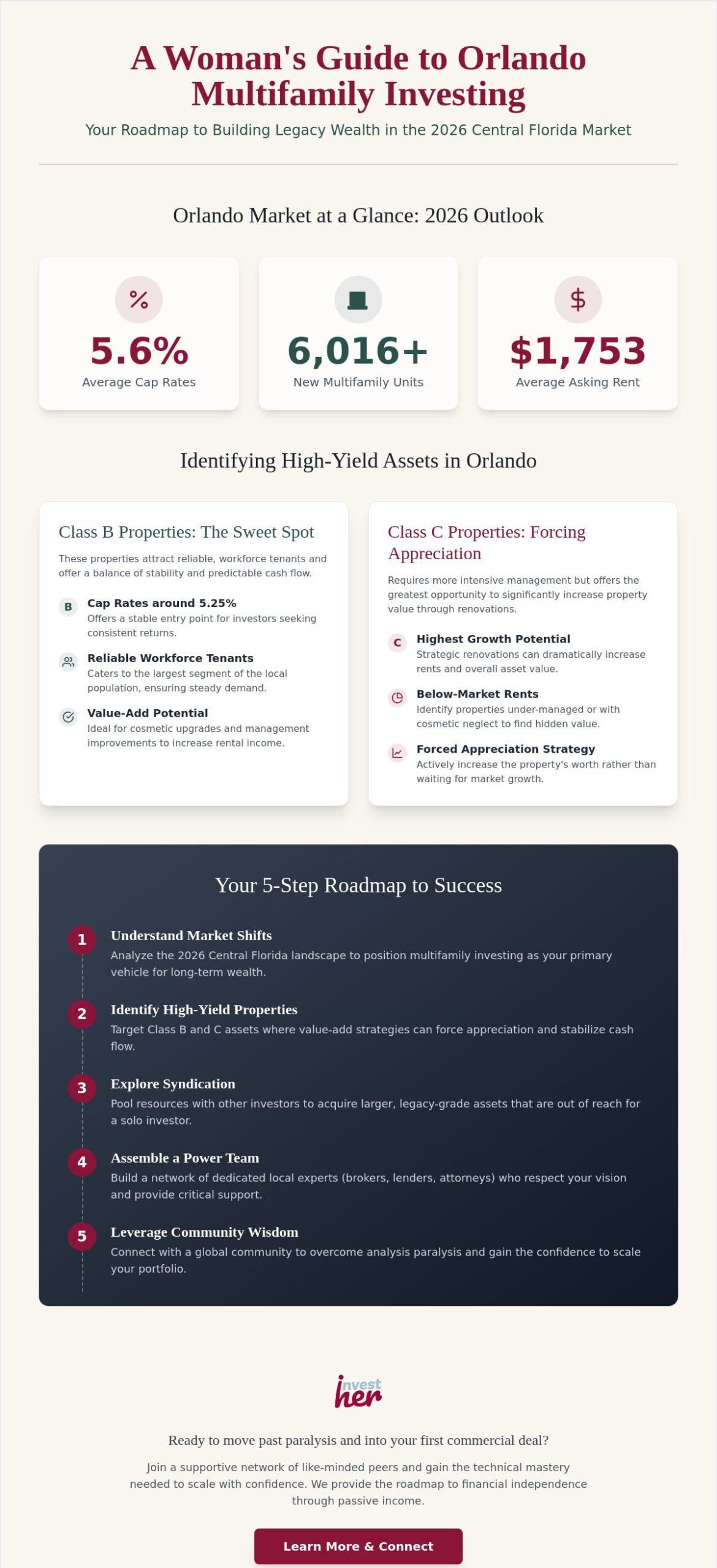
What if the most powerful seat at the commercial real estate table isn’t the one you’re fighting for, but the one you’re building for yourself? You’ve likely felt that familiar chill of being the only woman in a room full of suits, wondering if your move from single-family rentals to larger assets is a leap or a ledge. In 2026, Orlando multifamily investing for women is no longer just a niche interest. It’s a strategic frontier for those ready to claim their space in a market showing 5.6% average cap rates. We understand that scaling feels daunting when you lack a local circle you can trust. It’s natural to hesitate when the underwriting feels like a foreign language and the stakes involve your family’s future legacy.
You can master the technical nuances of this market and build a high-performing portfolio without sacrificing your peace of mind. This guide provides the roadmap to financial independence through passive income while surrounding you with a supportive network of like-minded peers. We’ll explore the 2026 Orlando landscape, from the July 1st Live Local Act updates to the specific underwriting mastery needed to move past paralysis and into your first major commercial deal.
Key Takeaways
- Understand the 2026 market shifts in Central Florida to position Orlando multifamily investing for women as your primary vehicle for long-term wealth.
- Identify high-yield Class B and C properties where value-add strategies can force appreciation and stabilize your portfolio’s cash flow.
- Explore the power of syndication to pool resources and acquire larger, legacy-grade assets that might feel out of reach as a solo investor.
- Assemble a dedicated power team of local experts who respect your vision and provide the technical support necessary for complex commercial success.
- Leverage the collective wisdom of a global community to overcome analysis paralysis and gain the technical mastery required to scale with confidence.
The 2026 Orlando Multifamily Outlook: Why Central Florida for Women?
Orlando isn’t just a vacation destination; it’s a maturing economic powerhouse. For those looking at Orlando multifamily investing for women, the 2026 landscape offers a unique moment of stabilization. While the headlines often focus on the theme parks, the real story lies in the steady influx of new residents into Orange and Seminole counties. These aren’t just seasonal visitors. They are professionals seeking a balanced lifestyle in a city that’s diversifying at a rapid pace. This population growth, paired with a projected 6,016 multifamily units completed this year, creates a market that is both active and accessible for strategic scaling.
While rent growth in Orlando has stabilized after the frantic spikes of previous years, the market remains more predictable than the volatile swings seen in Miami or Tampa. This predictability is a gift. It allows for precise underwriting and safer entry points, especially within the “Class B” garden-style apartment sector. These properties represent the sweet spot for investors because they cater to the largest segment of the local workforce. Investing here isn’t just about the numbers on a spreadsheet; it’s about anchoring your capital in a community with deep, resilient roots.
Economic Drivers in the City Beautiful
Job growth is the primary engine of any real estate investing strategy. In Orlando, that engine now runs on high-tech manufacturing and world-class healthcare. The expansion of the Lake Nona Medical City and the NeoCity tech hub has created a “renter by necessity” demographic that values proximity to high-wage employment. Infrastructure projects completed in early 2026 have finally begun to ease congestion, shifting property values in previously overlooked pockets of the metro area. Demand is no longer concentrated solely around the tourism corridor. It’s spreading into suburban submarkets where families seek stability and quality of life.
Market Resilience and Legacy Wealth
Multifamily assets provide a level of downside protection that single-family homes simply cannot match. When you own a 20-unit complex, one vacancy is a minor ripple; in a single-family rental, it’s a total loss of income. This resilience is why so many women are pivoting toward larger assets to build generational wealth. It’s about more than just monthly cash flow. It’s about creating a legacy that stands firm even when the broader economy fluctuates. By focusing on Orlando multifamily investing for women, you’re choosing a path that prioritizes long-term sustainability over quick, risky wins. You’re building a portfolio that rewards patience, technical mastery, and a commitment to providing quality housing for the people who make this city thrive.
Identifying High-Yield Multifamily Assets in Orlando
Finding the right asset in 2026 requires a blend of sharp data and intuitive local knowledge. As more women in the real estate industry move into the commercial space, the focus has shifted from high-risk speculation to sustainable, high-yield assets. In the Orlando context, Class B properties are often the sweet spot. These assets, frequently found in suburban pockets, saw cap rates of approximately 5.25% in early 2026. They attract reliable, workforce tenants who value stability. Class C properties, while requiring more intensive management, offer the greatest opportunity for Orlando multifamily investing for women looking to force appreciation through strategic renovations.
Success in this market often comes down to the “20-minute commute” rule. Even with the rise of remote work, proximity to major employment hubs like the tourism corridor, Lake Nona Medical City, or the downtown business district remains a primary driver for tenant retention. With average asking rents hovering around $1,753, investors must be precise. You’re looking for properties where the current rent sits below market value due to cosmetic neglect rather than structural failure. If you’re feeling stuck on the underwriting, connecting with a supportive network of peers can help you gain the clarity needed to pull the trigger on your first large deal.
The Value-Add Framework for Women
Value-add multifamily investing in Orlando is the strategic process of upgrading under-managed Class B or C properties to drive rental growth and long-term asset appreciation. Focus your budget on high-impact cosmetic changes like modern flooring, updated cabinetry, and improved lighting. These shifts allow you to command higher rents without the massive risk of deep structural overhauls. Beyond the units, consider “lifestyle” amenities that foster community, such as secure package lockers, upgraded fitness corners, or designated co-working spaces. These touches resonate deeply with the 2026 renter who views their home as a sanctuary and a workspace.
Central Florida Neighborhood Spotlights
The geography of Orlando is shifting. Emerging pockets like Lake Nona and Winter Garden are attracting significant capital due to their tech-centric job growth and family-friendly infrastructure. If you prefer established stability, areas like Winter Park and College Park continue to offer high demand, though entry prices are steeper. It’s vital to avoid the “D” class pitfalls in neighborhoods where crime rates or declining infrastructure might stall your growth. Stick to transitioning areas where the “path of progress” is clearly visible through new grocery stores, improved schools, and recent city infrastructure investments. Building a legacy-grade portfolio starts with seeing value where others see a maintenance list.
Overcoming the Capital Barrier: Funding Your Orlando Deal
Capital is often the final hurdle that keeps talented women from moving into the commercial space. You might have the technical underwriting skills and a deep understanding of the Central Florida market, yet the sheer size of a multifamily down payment feels like a wall. In June 2026, commercial loan rates in Orlando for multifamily properties typically range from 5.08% to 11.75%. For those looking at larger acquisitions over $6 million, Fannie Mae and Freddie Mac rates are currently hovering between 5.3% and 6.0%. Understanding these numbers is the first step, but the real breakthrough happens when you stop trying to fund every deal alone. Scaling Orlando multifamily investing for women requires a shift from a solo-investor mindset to a collaborative one.
Creative financing and strategic partnerships are the tools that turn a “no” into a “how.” Many successful women in our network leverage HUD 223(f) loans, which currently offer rates around 5.25% to 5.85% before MIP, providing a more accessible entry point for acquisitions. Beyond traditional debt, syndication has become a primary vehicle for growth. By pooling resources with other like-minded investors, you can take down 50 or 100-unit complexes that would be impossible to manage solo. This isn’t just about the money. It’s about finding a partner whose strengths fill your gaps, whether that’s local operational experience or a deep bench of private lending contacts.
Raising Capital with Confidence
Pitching your first deal to private lenders can feel intimidating, but it’s really about offering a high-value return on their capital. You aren’t asking for a favor; you’re providing a professional opportunity. A polished “Investor Deck” is your most important tool here. It should clearly outline the Orlando market’s resilience, your specific value-add strategy, and the projected cash-on-cash returns. When you lead with data and a clear vision for the property’s legacy, the fear of “asking for money” dissolves. You’re inviting others to participate in a wealth-building journey that you have already de-risked through rigorous analysis.
Leveraging Community for Scale
The power of shared wisdom cannot be overstated when you’re navigating your first commercial loan. Within our InvestHER Community Membership, women are constantly sharing their experiences with local Orlando lenders who actually understand the nuances of the Central Florida market. We’ve seen groups of our members successfully navigate the complexities of their first group acquisition by leaning on the collective expertise of the network. If you’re feeling the weight of analysis paralysis, the STRIVE Mentorship Program offers the technical guidance and emotional support needed to move from single-family rentals to legacy-grade multifamily assets. You don’t have to figure out the capital stack in a vacuum when you have a global community standing behind you.
Building Your Orlando Power Team: A Woman-to-Woman Guide
Real estate is often described as a solo journey, but scaling into large assets requires a collective. Your team isn’t just a support system; it’s the most valuable asset in your entire portfolio. In a city where the multifamily vacancy rate was 7.3% in early 2026, having the right eyes on your property is the difference between stagnation and growth. For those pursuing Orlando multifamily investing for women, building this circle requires intentionality. You need partners who don’t just see a transaction, but understand the long-term legacy you’re building. When your team aligns with your values, every challenge becomes a shared stepping stone rather than an individual burden.
The Broker-Investor Relationship
Navigating the male-dominated brokerage culture in Central Florida can feel like an uphill battle. Brokers are the gatekeepers to “pocket listings,” those lucrative deals that never hit the open market. To get on their short list, you must communicate with absolute precision. Know your strike zone. Define your cap rate requirements, preferred unit count, and geographical boundaries. When you show up with a clear criteria and proof of funds, you command a level of authority that cuts through industry bias. A broker who takes your vision seriously is worth their weight in gold, but that respect is earned through the clarity of your professional pitch.
Property Management as a Profit Center
Self-management is the primary enemy of scaling. While it’s tempting to save on the 8% to 12% monthly management fees typical in Orlando, doing so often traps you in the “landlord” role rather than the “investor” role. A specialized property manager is a profit center, not an expense. They handle the leasing fees, which often range from 50% to 100% of one month’s rent, and lease renewal fees that commonly sit between $150 and $500. Ask them how they handle the 2026 “Live Local Act” compliance or how they’ve managed the recent influx of new inventory in Orange County. Your team must share your values of community and tenant care; otherwise, the asset’s soul is lost.
Vetting contractors and attorneys who specialize in commercial real estate is equally vital. You need a legal team that understands the nuances of Florida’s 19.0878 millage rate in Orlando city limits and how to navigate the removal of assessment caps upon sale. A local mentor acts as the ultimate shortcut, helping you avoid the expensive mistakes that others have already paid for. If you’re ready to find those partners and stop being the only woman in the room, join the InvestHER Community Membership to connect with women who are already doing the work on the ground. Together, we move faster, smarter, and with a shared sense of purpose.
Scaling with The Real Estate InvestHER: Mentorship and Community
Investing in a vacuum is a recipe for burnout. While the technical side of Orlando multifamily investing for women can be learned through books, the nuance of the Central Florida market is best understood through shared wisdom. You don’t have to face the complexities of the 2026 stabilization alone. A community provides the emotional safety net required to take calculated risks. When you surround yourself with women who’ve already navigated the July 1st Live Local Act updates, your path to scaling becomes clearer and significantly less lonely. It is through these connections that we move from individual ambition to collective legacy.
The 2026 market rewards those who are prepared to move with speed and certainty. With over 6,000 units coming online this year, competition for quality tenants is real. However, the women who thrive in Orlando multifamily investing for women are those who have refined their strategies within a supportive network. Collective wisdom allows you to spot red flags in a pro forma that you might miss while working late at your kitchen table. It’s about moving from a place of hope to a place of conviction because your peers have verified the data. This shared strength is what transforms a simple real estate deal into a sustainable business.
The STRIVE Mentorship Advantage
Execution is the bridge between a dream and a portfolio. The STRIVE Mentorship Program is designed to help you cross that bridge by pairing high-level strategy with granular underwriting support. You’ll move beyond the theoretical and into the practical; analyzing real Orlando deals with mentors who ensure your numbers are bulletproof. This isn’t just about learning. It is about doing. Having an expert eye on your first multifamily deal in Orange County provides the confidence needed to sign on the dotted line. You gain access to a network of women who have already scaled in the Florida market, offering you a blueprint for sustainable growth that respects your personal well-being.
Your Next Steps in Orlando
Start by showing up in the spaces where growth happens. Attending local meetups allows you to find future partners who share your vision for community-centric housing. These rooms are where the syndications we discussed earlier are born. If you’re ready to immerse yourself in the highest level of real estate education, securing your InvestHER CON Ticket is an essential step for your 2026 planning. This is where high-level professional ambition meets deep human connection. The journey to financial independence is better when shared with those who understand the weight of your goals. Join the InvestHER Community and start your Orlando journey today!
Your Legacy in the City Beautiful Starts Now
The landscape of 2026 presents a rare window for those ready to move from the sidelines into strategic ownership. Orlando multifamily investing for women is about more than just analyzing cap rates or navigating the Live Local Act; it’s about seizing a moment of market stabilization to anchor your financial future in a resilient region. You’ve seen how job diversification and a robust power team can de-risk your journey. Now, the only question remains: will you scale alone, or will you leverage the power of a global collective?
With over 50,000 women in our global community, we’ve seen that success is a team sport. Whether you’re networking with industry leaders at our annual InvestHER CON or refining your underwriting skills, you deserve a path that honors both your ambition and your well-being. Don’t let analysis paralysis hold your legacy captive. You have the tools and the support system needed to build something that lasts for generations.
Scale your portfolio with the STRIVE Mentorship Program, where experienced multifamily investors guide you through every complex deal. Your seat at the table is ready. It’s time to claim it.
Frequently Asked Questions
Is Orlando a good market for multifamily investing in 2026?
Orlando is showing clear signs of stabilization in 2026 with a projected occupancy rate of 91.3% by the end of the fourth quarter. Although rent growth has slowed since the 2023 peaks, a contracting construction pipeline is helping to alleviate supply pressures. This shift creates a more balanced environment for long-term wealth builders who prioritize stability over speculative gains.
How much capital do I need to start investing in multifamily in Orlando?
Capital requirements vary by asset size, but you should generally prepare for a down payment of 20% to 30% for commercial multifamily loans. With rates for loans under $6 million starting around 6.02% in June 2026, many investors choose syndication to manage these costs. This strategy allows you to acquire larger buildings by pooling resources with partners rather than relying solely on personal savings.
What are the best neighborhoods in Orlando for Class B multifamily?
Suburban submarkets like Winter Garden and Lake Nona are currently the premier choices for Class B assets due to their high-growth employment hubs. These neighborhoods attract stable, workforce tenants who value proximity to tech and healthcare centers. Investors also find consistent demand in established areas like Maitland, where infrastructure supports steady property values and reliable tenant retention.
How can women investors find mentors in the Orlando real estate market?
Finding a mentor is most effective through dedicated networks like the InvestHER Community Membership or local investment meetups focused on commercial assets. These platforms offer a “mentor-to-peer” register that moves away from cold networking toward genuine, shared growth. Attending the annual InvestHER CON provides a unique opportunity to connect with high-level pioneers who’ve already navigated the Central Florida market.
What is the difference between residential and commercial multifamily in Florida?
In Florida, residential multifamily refers to properties with 2 to 4 units, while commercial multifamily involves buildings with 5 or more units. The primary difference lies in valuation; commercial assets are valued based on the income they generate rather than just neighborhood comparables. This distinction is vital for Orlando multifamily investing for women because it allows for forced appreciation through operational improvements.
Can I invest in Orlando multifamily if I live out of state?
You can successfully invest in Orlando from anywhere if you have a trusted local power team managing the daily operations. This “boots on the ground” approach requires a specialized property manager and a broker who understands your specific investment criteria. Many out-of-state investors find that Orlando’s tourism-driven economy and job diversification make it a resilient choice for remote portfolio scaling.
How does the InvestHER community help women scale their portfolios?
The InvestHER community facilitates Orlando multifamily investing for women by providing the technical mastery and supportive network needed to overcome analysis paralysis. Programs like the STRIVE Mentorship Program offer direct guidance on underwriting complex deals and structuring creative financing. It’s a space where collective wisdom replaces individual ego, ensuring every member feels supported as they move toward financial independence.
What are the current cap rates for multifamily properties in Central Florida?
As of June 13, 2026, multifamily cap rates in Orlando are approximately 5.25% for Suburban A Class properties and 5.18% for Luxury Metro A Class assets. The average across all property classes in the first quarter of 2026 was 5.6%. These figures reflect a market that has moved past the volatility of previous years into a period of sustainable, predictable returns.

Article by
Andresa Guidelli
Real estate investor, operator, and founder of The Real Estate InvestHER, a national platform supporting women real estate investors. With 15+ years of experience in real estate investing and business operations, she focuses on helping investors build stronger businesses behind their portfolios through better systems, clearer decision-making, leadership, and responsible use of AI.
Be the first to comment