


New York City Real Estate Investment Strategies for Women: A 2026 Roadmap
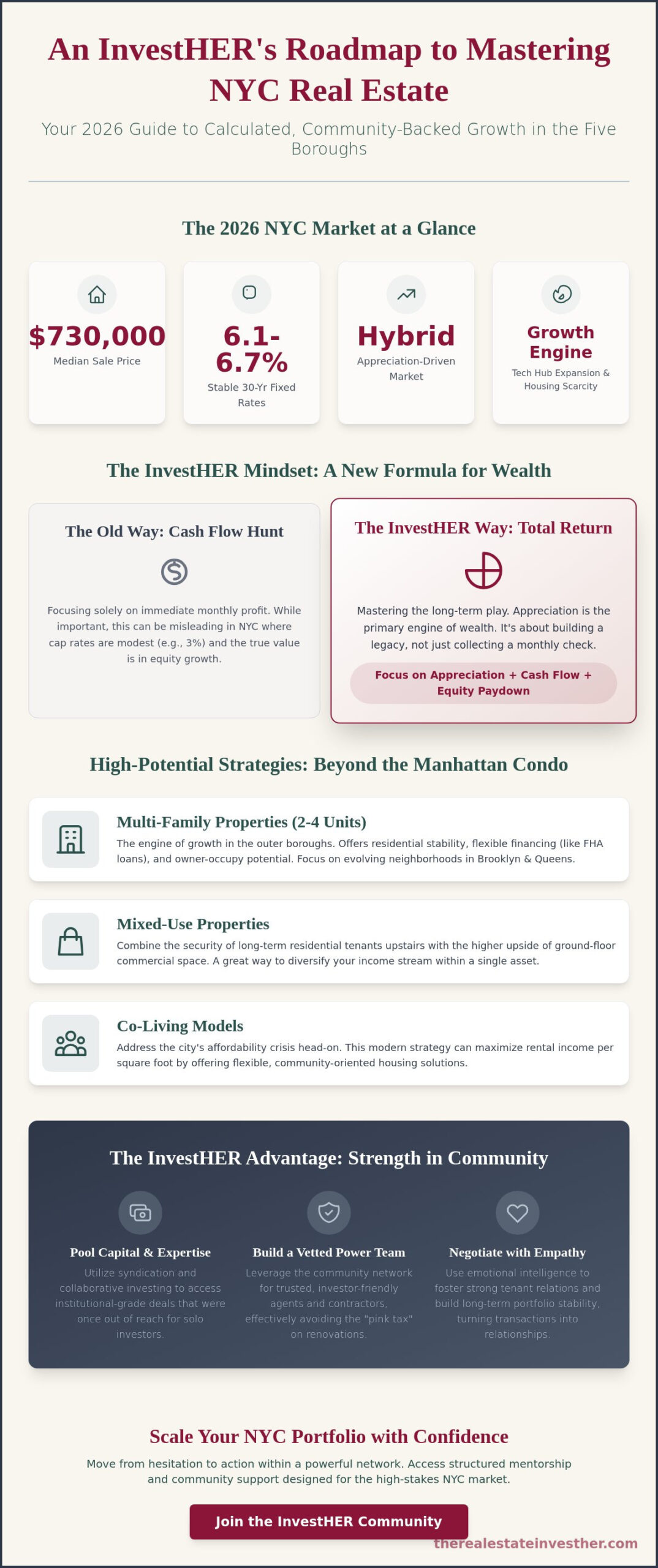
What if the most lucrative path through the 2026 New York market isn’t a solo climb up a Manhattan skyscraper, but a shared journey through the vibrant streets of the outer boroughs? You likely feel the weight of this high-stakes environment, where the median sale price sits at $730,000 and the fear of a million-dollar mistake is very real. It’s daunting to navigate the new LLC Transparency Act disclosures and the complexities of the 2026 pied-à-terre tax while trying to find a deal that actually pencils out. You want more than just a transaction; you want a legacy built on intentionality and financial autonomy. This roadmap will empower you to master New York City real estate investment strategies for women by shifting the focus from high-risk gambles to calculated, community-backed growth. We’ll analyze the math behind appreciation versus cash flow in today’s 6.5 percent mortgage rate environment, identify neighborhoods with untapped potential, and show you how to leverage the 90-day rule for institutional investors to your advantage. We’re breaking down the barriers to entry so you can move from hesitation to action within a powerful network of peers.
Key Takeaways
- Learn how to shift your perspective from immediate cash flow to long-term wealth by mastering the total return formula in NYC’s unique appreciation-heavy market.
- Discover high-potential New York City real estate investment strategies for women that focus on multi-family and mixed-use properties within the evolving outer-borough neighborhoods.
- Build a resilient power team by identifying investor-friendly agents and vetting contractors using specialized methods to avoid the “pink tax” on your renovations.
- Scale your portfolio with confidence by connecting with a powerful community of women investors and accessing structured mentorship designed for the high-stakes NYC market.
Understanding the NYC Real Estate Landscape in 2026
New York City isn’t just a place to own property; it’s a global financial ecosystem that rewards patience and intentionality. In 2026, we define this as a “hybrid” market. Most investors are trained to hunt for immediate cash flow, but in the five boroughs, appreciation is the engine that builds true wealth. New York City real estate investment strategies for women focus on this long-term equity play. While a 3 percent cap rate might seem modest compared to the Midwest, the compounding value of a Brooklyn brownstone or a Queens multi-family often outpaces higher-yield markets over a decade. It’s about shifting your gaze from the monthly check to the legacy you’re building.
The current climate is defined by a welcome sense of stabilization. Mortgage rates for 30-year fixed loans are currently holding between 6.125 percent and 6.65 percent, providing a predictable foundation for your financial modeling. This stability, combined with the city’s evolution into the “Silicon Valley of the East,” has created a unique window of opportunity. Manhattan is no longer just about finance. The massive footprints of Meta and Google have anchored a tech workforce that demands high-quality housing. The InvestHER mindset allows us to look past the daunting entry price to see the intrinsic value of the land and the location.
The 2026 Market Pulse: Tech, Finance, and Migration
People are moving back to the urban core with renewed vigor. This isn’t just a trend; it’s a structural shift as hybrid work evolves into a desire for urban connectivity. The expansion of tech hubs in Manhattan has created a ripple effect, driving residential demand in neighboring districts. In 2026, the acute supply-demand imbalance in New York City is defined by a persistent housing shortage that keeps vacancy rates near historic lows while the influx of high-earning tech and finance professionals continues to swell. This scarcity creates a natural floor for property values, protecting your investment from the volatility seen in overbuilt markets.
Why Women Investors are Thriving in the NYC Market
Women are uniquely positioned to win in this high-stakes environment because we prioritize collective strength over individual ego. We’re seeing a significant rise in syndication and collaborative investing. By pooling capital and expertise, women are accessing institutional-grade deals that were once out of reach. This community-driven approach is a hallmark of modern New York City real estate investment strategies for women.
Navigating this landscape requires staying connected to the pulse of the industry. While the Real Estate Board of New York (REBNY) provides the regulatory and professional framework for the city’s agents and owners, our strength comes from our personal networks. Local InvestHER meetups across the boroughs have become vital hubs for deal flow and contractor recommendations. We use our emotional intelligence to manage tenant relations and negotiate with a level of empathy that builds long-term stability. It’s about seeing the human element behind the high-rise and understanding that a successful portfolio is built on strong relationships.
NYC Investment Strategies: Beyond the Manhattan Condo
While many beginners look toward Manhattan glass towers, veteran investors know that the real engine of growth lies in the multi-family units of the outer boroughs. Effective New York City real estate investment strategies for women often prioritize these 2-4 unit buildings because they offer a unique blend of residential stability and financing flexibility. For instance, you can utilize FHA loans to enter the market with a lower down payment, provided you occupy one of the units. To support this path, programs like NYC’s Economically Targeted Investments are instrumental in providing mortgage capital to purchasers who have historically faced barriers. This is how we move from being “the only woman in the room” to owning the building. Beyond simple residential plays, mixed-use properties combine the safety of long-term tenants with the higher upside of ground-floor commercial space, while co-living models address the city’s persistent affordability crisis.
The Multi-Family Advantage in Brooklyn and Queens
Brooklyn and Queens are the heartbeat of the 2026 market. In areas like Sunset Park, we see a surge in demand driven by proximity to industrial tech hubs and waterfront redevelopment. A Brooklyn townhome often has lower carry costs than a Manhattan condo because you aren’t paying high monthly common charges to a board; you’re the board. This control allows you to manage expenses directly and reinvest those savings into your property. If you’re looking for a community to vet these deals with, joining an InvestHER Community Membership provides the collective wisdom needed to avoid common pitfalls. Value-add renovations in Astoria or Ridgewood allow you to force appreciation, creating equity in a market where inventory remains incredibly tight.
Niche Markets: Executive Stays and Mid-Term Rentals
The short-term rental market changed forever with Local Law 18. In 2026, the strategy has shifted entirely to mid-term “Executive Stays.” This niche targets traveling nurses, tech contractors, and digital nomads who need stays of 30 days or longer. It’s a professional approach that yields higher returns without the regulatory headaches of weekend tourism. To ensure your property is regulation-proof, follow this checklist:
- Verify the property is not on the prohibited buildings list.
- Ensure the certificate of occupancy matches the current usage.
- Target neighborhoods near major hospitals or tech campuses.
- Focus on units with high-speed internet and dedicated workspaces.
This mid-term model bypasses the volatility of the hospitality sector while securing significantly higher rents than traditional long-term leases. It’s a strategy rooted in the reality of 2026 workforce trends.
The Math of the Metropolis: Cash Flow vs. Appreciation
Numbers tell a story. In New York, you must know how to read between the lines. Many investors are scared away by a 3 percent cap rate. They compare it to the double-digit yields of the Midwest and walk away. That’s a mistake. Effective New York City real estate investment strategies for women recognize that a low cap rate in a supply-constrained environment is a signal of safety and massive upside. We look at the Total Return. This is the sum of your monthly cash flow, annual appreciation, principal paydown, and tax benefits. When you add these up, that 3 percent cap rate often transforms into a 15 percent internal rate of return.
If you can’t find immediate cash flow, manufacture it. This is where the InvestHER mindset thrives. By taking a tired multi-family building and executing a strategic value-add renovation, you force the appreciation. You aren’t waiting for the market to lift you. You’re doing the lifting yourself. This proactive approach turns a break-even property into a wealth-generating asset. We prioritize conservative underwriting, especially with mortgage rates holding between 6.125 percent and 6.65 percent. It’s about building a portfolio that survives the lean years and thrives during the booms.
Navigating Rent Stabilization and Local Law 97
Local Law 97 is often viewed as a burden, but it’s actually a powerful negotiation tool. Buildings with high carbon emissions face steep fines, which directly impacts their 2026 valuations. Use these looming costs to justify a lower offer price. During your due diligence, you must distinguish between “Free Market” units and “Rent Stabilized” units. Buying a building with energy retrofits in mind allows you to modernize the asset while potentially accessing green financing. It’s a strategic way to apply New York City real estate investment strategies for women to the evolving regulatory environment.
Tax Strategies for the New York Investor
Tax efficiency is the silent partner in your portfolio. Cost segregation studies allow you to accelerate depreciation on components like flooring or lighting. This shields your income from the IRS. When you’re ready to scale, a 1031 exchange lets you sell your initial property and roll the gains into a larger asset without an immediate tax hit. In 2026, the 421-a successor status is defined by the 485-x program, which provides essential property tax exemptions for residential projects that commit to specific affordable housing requirements. These tools ensure your growth is sustainable and your tax burden remains manageable.
Building Your NYC Power Team: A How-To for Women
In a market as intricate as New York, your success is a direct reflection of the people you trust. Attempting to go it alone is a recipe for expensive delays. Building a “Power Team” is the most critical of all New York City real estate investment strategies for women. This isn’t just about hiring professionals; it’s about curated partnerships with experts who respect your vision and understand the specific math of the five boroughs. Your team must be able to translate complex zoning laws and pro-forma projections into actionable steps for your portfolio.
Your first hire should be an investor-friendly agent who understands “house hacking” and the nuances of NYC’s R-class zoning. They should provide data, not just descriptions. Next, you need a specialized real estate attorney. Closing customs in New York are unique, and a generalist will struggle with the specific requirements of multi-family title transfers. For renovations, use the “InvestHER method” to vet contractors. This involves technical questioning and peer review to ensure you aren’t being charged a “pink tax” simply because of your gender. Finally, a property manager who understands the 2024 Good Cause Eviction law is non-negotiable for long-term stability. To find these vetted professionals, join the InvestHER Community Membership and tap into our local New York network.
Avoiding the Lone Wolf Trap
Managing an NYC renovation from afar or without local oversight is one of the highest risks you can take. The “Lone Wolf” trap leads to budget overruns and missed compliance deadlines. Mastermind groups are essential for troubleshooting local landlord issues, such as navigating the new LLC Transparency Act requirements. These groups offer a space to share collective wisdom, ensuring that when one woman solves a problem with a difficult boiler or a complex permit, the whole community learns. Collective strength is your greatest asset in this high-stakes environment.
Financing Your NYC Deal
Traditional big banks aren’t always the best fit for New York City real estate investment strategies for women. Local credit unions often offer more flexible terms for 2-4 unit buildings and have a deeper understanding of specific neighborhood valuations. If you are pursuing a value-add project in the outer boroughs, “Hard Money” lenders can provide the speed needed to secure a deal, even if the interest rates are higher than the standard 6.125 percent to 6.65 percent. In a high-interest market, don’t overlook seller financing. It’s a creative tool that allows you to negotiate terms directly with the owner, often bypassing the rigid requirements of institutional lenders while creating a win-win for both parties.
Scaling Your NYC Portfolio with the InvestHER Community
Scaling a portfolio in the five boroughs isn’t about doing more of the same; it’s about doing things differently. As you move from your first multi-family in Queens to a diversified portfolio across the city, the complexity grows. New York City real estate investment strategies for women must evolve from simple acquisition to sophisticated portfolio architecture. This is where the power of a dedicated community becomes your competitive advantage. You don’t have to carry the weight of every million-dollar decision alone. Community is the catalyst. By leveraging the “Only Woman in the Room” mindset, you transform from an outlier into a formidable negotiator who sees opportunities others miss. It’s about leading with intention and trusting the strength of your network.
The Power of Mentorship in a High-Stakes Market
In a market where a single misstep can cost six figures, having an experienced guide is essential. Mentorship provides the perspective needed to navigate the 2026 landscape of interest rate stabilization and the tech-driven demand we analyzed earlier. A mentor helps you filter out the noise. They ensure you focus on the math that actually builds wealth. The STRIVE program is specifically designed to help you build a sustainable roadmap for growth, moving beyond a “one-and-done” mentality toward a legacy-driven approach. You can join the STRIVE Mentorship Program to scale your NYC investments and gain the clarity needed to lead with confidence. Avoid the common newbie mistakes that stall progress in this high-velocity environment.
Legacy Building: The InvestHER Mission
New York City real estate remains one of the most powerful generational wealth-building tools on the planet. We aren’t just buying buildings. We’re securing the future for our families and our communities. This mission requires a network that extends beyond the city limits. InvestHER CON serves as a bridge, connecting NYC-based investors with national partners and resources that can help diversify and strengthen your holdings. It’s a space where shared understanding meets strategic growth. You are invited to step into this collective strength and secure your InvestHER CON 2026 Ticket today to meet the women who are redefining what’s possible in this industry. Legacy is built daily.
Your journey toward financial autonomy doesn’t end with this roadmap. The next step is to ground these strategies in real-world connections. Whether you attend a local NYC meetup in Brooklyn or join our virtual community, the goal is to stay engaged and informed. The 2026 market rewards those who are both bold and backed by a network of peers. Start today by reaching out to a fellow investor or joining a discussion on our platform. Your legacy is waiting to be built, one intentional brick at a time.
Step Into Your Power as a New York Investor
The high-stakes landscape of the five boroughs doesn’t have to be a solo journey. You now have the roadmap to move from capital-intensive Manhattan condos to the high-growth multi-family units of the outer boroughs. By mastering the total return formula and building a power team that respects your vision, you’re doing more than just buying property; you’re securing your financial autonomy. New York City real estate investment strategies for women are most effective when they’re rooted in collective wisdom and strategic intentionality. Founded by Liz Faircloth and Andresa Guidelli, our community was built on the belief that you shouldn’t have to navigate these complexities alone. With over 50 local meetups across the US, the support you need is already within reach. It’s time to transition from learning to leading. Your legacy in this city is waiting to be built. Scale your NYC portfolio with the STRIVE Mentorship Program and join a network of women who are redefining the market. You’ve got the vision, and now you have the community to match it.
Frequently Asked Questions
Is it still worth investing in NYC real estate in 2026?
Yes, New York City remains a premier market for long term wealth building because its supply constrained nature creates a natural floor for property values. While the entry price is higher than other regions, the combination of global demand and the city’s evolution into a major tech hub ensures that appreciation continues to outpace many high yield but declining markets. It is a strategic play for those focused on total return rather than just monthly cash flow.
What is the best NYC borough for real estate investment right now?
Brooklyn and Queens are currently the strongest contenders for investors seeking a balance of rental demand and appreciation potential. Neighborhoods like Sunset Park and Astoria are particularly attractive due to their proximity to tech hubs and updated transportation links. These areas offer a diverse inventory of multi family homes that allow for more flexible New York City real estate investment strategies for women compared to the high cost condo market in Manhattan.
How much money do I need for a down payment in New York City?
You generally need a 20 to 25 percent down payment for an investment property, which would be approximately $146,000 based on the April 2026 median sale price of $730,000. However, if you choose to “house hack” by living in one unit of a 2-4 unit building, you may qualify for FHA financing with as little as 3.5 percent down. This lower barrier to entry is a powerful tool for those starting their portfolio in the outer boroughs.
What is Local Law 97 and how does it affect real estate investors?
Local Law 97 is a carbon emissions mandate that requires buildings over 25,000 square feet to meet strict energy efficiency limits or face significant annual fines. For investors, this law makes energy retrofits a critical part of the due diligence process. Understanding these requirements allows you to negotiate better purchase prices on older buildings that need modernization, effectively turning a regulatory hurdle into a value add opportunity.
Can I invest in NYC real estate if I don’t live in New York?
You can absolutely invest in the NYC market from anywhere if you have a robust local power team in place. Success as a remote investor depends on your partnerships with an investor friendly agent and a property manager who understands the specific nuances of the 2024 Good Cause Eviction law. These local experts act as your eyes and ears, ensuring your asset is maintained and your tenant relations remain professional and compliant.
How do I find rent-stabilized building information for a property?
You can verify the rent stabilization status of a property by checking records with the New York State Division of Housing and Community Renewal (DHCR). It is essential to request a certified rent history during your due diligence period to ensure the current rents are legal and documented. This step protects you from future overcharge claims and provides a clear picture of the building’s actual income potential before you close the deal.
What are the benefits of joining a women’s real estate investing group in NYC?
Joining a dedicated group provides you with a “mentor to peer” network that offers vetted local referrals and emotional support in a high stakes market. These communities are vital for sharing New York City real estate investment strategies for women, such as navigating the LLC Transparency Act or avoiding the “pink tax” from contractors. You gain the collective strength of a tribe that has already navigated the hurdles you are currently facing.
How does the STRIVE Mentorship Program help with NYC-specific deals?
The STRIVE Mentorship Program provides the high level strategic roadmap needed to underwrite complex NYC deals with confidence. It helps you move past the “lone wolf” trap by connecting you with mentors who understand how to model for NYC property taxes and rent regulations. This structured guidance ensures that your portfolio architecture is built for long term sustainability and generational wealth rather than just a single transaction.

Article by
Andresa Guidelli
Real estate investor, operator, and founder of The Real Estate InvestHER, a national platform supporting women real estate investors. With 15+ years of experience in real estate investing and business operations, she focuses on helping investors build stronger businesses behind their portfolios through better systems, clearer decision-making, leadership, and responsible use of AI.
Be the first to comment