


How to Scale Real Estate Investments: The Strategic Guide for Women Investors
What if your real estate portfolio wasn’t a second job, but a self-sustaining engine that actually gave you your time back? Many women find themselves caught in the “Self-Employed Trap,” where they manage every detail and feel limited by their own personal capital. It’s a common hurdle to feel like you’ve hit a ceiling because you lack the systems to handle more than a few doors. You’ve worked hard to build what you have, and you deserve a business that offers true autonomy rather than another exhausting item on your to-do list.
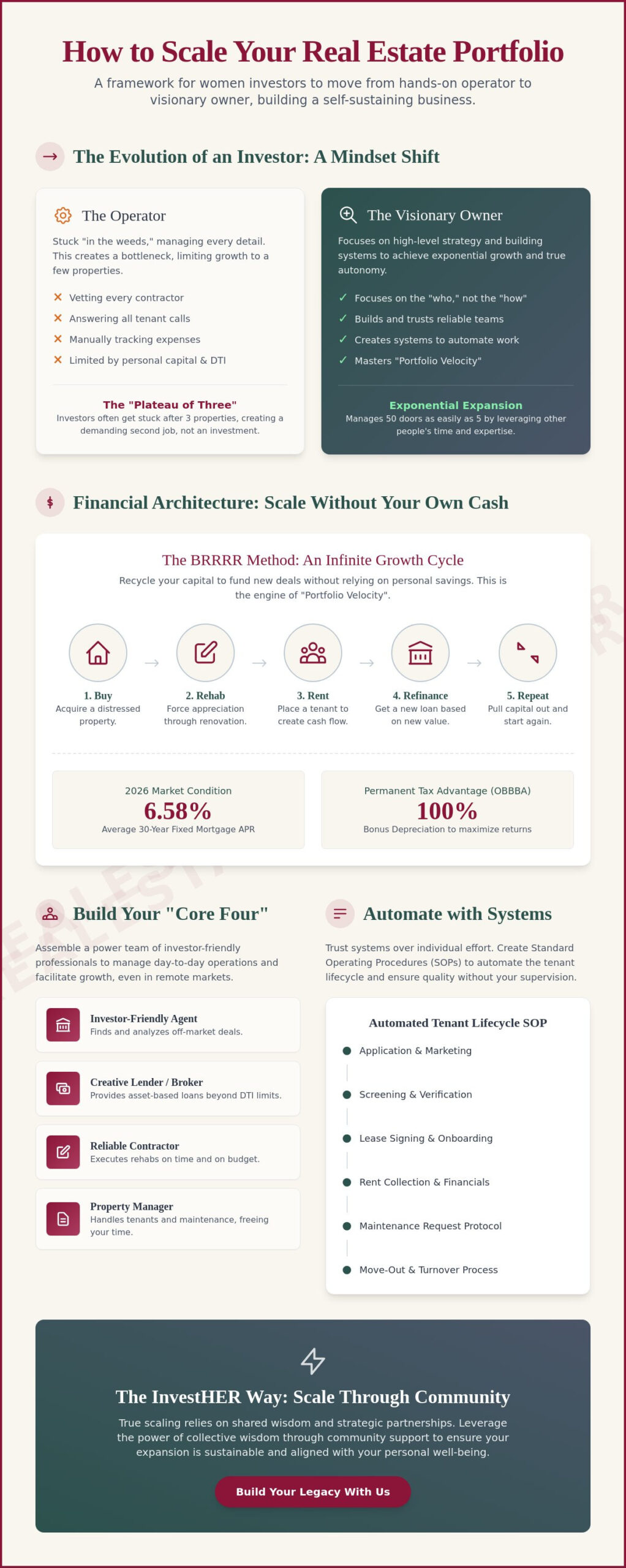
This guide will teach you how to scale real estate investments by shifting your mindset from a hands-on operator to a visionary owner. You’ll learn how to grow in a 2026 market where the average 30-year fixed mortgage APR is 6.58%, all while leveraging permanent tax advantages like the 100% bonus depreciation established by the OBBBA. We’re providing a proven framework to help you move from individual effort to strategic partnerships and reliable teams. By the end of this article, you’ll have a clear roadmap to build a legacy that thrives without your constant supervision.
Key Takeaways
- Shift your perspective from a hands-on operator to a visionary owner to break past the common plateau that stalls growth after your first few properties.
- Discover how to scale real estate investments using the BRRRR method to recycle capital and move beyond the limitations of personal debt-to-income ratios.
- Form a “core four” power team of investor-friendly professionals to manage the day-to-day operations and facilitate growth in remote markets.
- Design Standard Operating Procedures that automate the tenant lifecycle and create a self-sustaining portfolio that respects your boundaries.
- Leverage the power of collective wisdom through community support to ensure your expansion is sustainable and aligned with your personal well-being.
The Evolution of an Investor: Why Scaling is a Mindset Shift
Scaling is often misunderstood as simply doing more of the same. In reality, it represents a fundamental shift from linear growth, where each new property adds an equal amount of work, to exponential expansion, where your portfolio grows while your personal labor decreases. Many investors hit what we call the “Plateau of Three.” They successfully acquire their first few rentals but suddenly find themselves exhausted. Their personal capital is tied up, their debt-to-income ratios are stretched, and they are personally managing every tenant request. At this stage, you don’t own an investment; you own a demanding second job. Learning how to scale real estate investments requires moving beyond this individualistic approach.
Women are uniquely positioned to break through this plateau because of a natural inclination toward collaboration and collective strength. While traditional models of real estate investing often emphasize a “lone wolf” mentality, true scaling relies on shared wisdom and strategic partnerships. It’s about moving from “I do it all” to “We grow together.” This shift allows you to leverage other people’s time and expertise, which is the only way to achieve true financial autonomy and a lasting legacy.
The Operator vs. The Visionary Owner
The operator is stuck in the weeds. She’s the one vetting every contractor, responding to maintenance calls, and manually tracking every expense. This role is a bottleneck for growth. If you are the only person who can solve a problem in your business, you’ve created a ceiling for yourself. The visionary owner focuses on high-level strategy, capital acquisition, and building the right team. She understands Portfolio Velocity. Portfolio Velocity is the speed at which equity is recycled from one project into the next to keep growth moving without needing fresh infusions of personal cash. By focusing on the “who” instead of the “how,” she unlocks the ability to manage fifty doors as easily as five.
Overcoming the Fear of Letting Go
The biggest hurdle to scaling is often the fear that no one will care for your properties as well as you do. It’s a valid concern, but it’s also a growth killer. To master how to scale real estate investments, you must trust systems over individual effort. This means creating clear standards that a property manager or virtual assistant can follow without your direct supervision. You maintain quality not by doing the work, but by auditing the systems that govern the work. Letting go isn’t about losing control. It’s about gaining the freedom to focus on the deals that will actually change your life and your financial future. If self-doubt is making it harder to delegate and trust your own judgment, understanding how imposter syndrome in real estate investing holds women back can help you move past the hesitation that keeps your portfolio stagnant.
Financial Architecture: How to Scale Without Using Your Own Cash
Scaling requires a departure from the traditional mortgage application process. Most investors eventually hit a wall where their Debt-to-Income (DTI) ratio prevents further conventional borrowing. This is where you pivot from personal-based lending to asset-based lending. In June 2026, with the average 30-year fixed mortgage rate sitting at 6.52%, traditional loans carry a higher cost of entry. To keep growing, you need a financial architecture that doesn’t rely solely on your paycheck or your personal savings. Raising private capital is the ultimate skill for those who want to master how to scale real estate investments while maintaining their own liquidity.
The BRRRR method (Buy, Rehab, Rent, Refinance, Repeat) remains the gold standard for infinite growth. By buying distressed properties, adding value, and refinancing based on the new appraised value, you can pull your initial capital back out to fund the next deal. This strategy is even more powerful now that the One Big Beautiful Bill Act (OBBBA) has made 100% bonus depreciation permanent. You aren’t just building equity; you’re creating a tax-efficient wealth machine that sustains itself. It’s a rhythmic cycle that turns a single deposit into a multi-property portfolio over time.
Portfolio lenders are your best allies in this journey. Unlike big national banks, local institutions in cities like Philadelphia or Orlando often keep loans on their own books. They care more about the property’s cash flow and your track record than your personal debt. Building these relationships is essential for anyone learning how to scale real estate investments without hitting a ceiling. It’s about finding partners who see the vision of your entire portfolio rather than just a single transaction.
Creative Financing Strategies for 2026
In a high-interest environment, creative strategies like Seller Financing and Subject-To deals allow you to acquire property without a new bank loan. You can often negotiate better terms directly with a seller than you’d find on the open market. Debt Service Coverage Ratio (DSCR) loans are also vital; they qualify you based on the property’s rental income rather than your personal tax returns. If a property’s income covers the debt, the loan is yours. You might also use a Home Equity Line of Credit (HELOC) on an existing asset as a temporary bridge to secure your next high-potential deal.
Strategic Partnerships and Joint Ventures
You don’t have to be the one with the cash and the expertise. Many successful women scale by forming joint ventures where one partner provides the capital while the other manages the project and the strategy. This “Win-Win” structure allows you to take on larger multifamily projects that would be impossible alone. Ensuring your legal asset protection is in place through well-structured LLCs is non-negotiable here. As you grow, you’ll find that being The Only Woman in the Room is easier when you have a network of trusted female partners who share your values and your drive for excellence.
Building Your Power Team Across Different Markets
You’ve mastered the mindset and designed your financial architecture; now you need the boots on the ground to execute your vision. True scaling is impossible if you’re the only one who can identify a good deal or supervise a kitchen renovation. To successfully manage a growing portfolio, you must assemble a “Core Four” in every market where you operate. This team includes an investor-friendly agent, a reliable lender, a skilled contractor, and a proactive property manager. These individuals are the pillars of your business, allowing you to focus on high-level strategy while they handle the tactical execution. When you understand how to scale real estate investments, you realize that your net worth is directly tied to the strength of your network.
Local expertise is non-negotiable, especially in nuanced markets like San Diego or Scottsdale. A local agent understands which streets are seeing the most revitalization, while a local lender knows which neighborhood banks are currently aggressive with portfolio lending. Beyond the core four, a specialized real estate CPA is your most valuable asset for long-term tax strategy. They ensure you’re maximizing the 100% bonus depreciation benefits provided by the One Big Beautiful Bill Act (OBBBA) and navigating the $40,400 SALT deduction cap for 2026. Without this specialized guidance, you’re likely leaving significant wealth on the table.
Market-Specific Team Building
Different markets require different team strengths. In high-appreciation areas like New York or San Diego, your team must be agile enough to secure deals in a competitive environment where Class A multifamily cap rates sit around 5.10%. Conversely, in cash-flow hubs like Dallas, Philadelphia, or Orlando, your contractor and property manager are your most critical hires to ensure your margins remain healthy. Finding these vetted professionals doesn’t have to be a solo mission. Leveraging local InvestHER meetups or the InvestHER Community Membership allows you to tap into a collective database of trusted partners who have already been tested by other successful women investors.
The Role of Technology in Team Management
Scaling across state lines, such as investing in Phoenix while living in New York, is only possible through digital systems. Use project management tools to track renovation milestones and maintain a shared document for every property’s Standard Operating Procedures (SOPs). Clear communication protocols with out-of-state property managers ensure that you aren’t surprised by unexpected vacancies or maintenance costs. Effective remote scaling requires a “trust but verify” approach, where digital documentation and third-party inspections provide the transparency needed to manage assets from thousands of miles away. By using technology to bridge the physical gap, you can maintain high standards across your entire portfolio without ever leaving your home office.
Operational Excellence: Systems to Automate Your Growth
Effort alone is a finite resource. If your growth depends entirely on your personal bandwidth, you haven’t built a business; you’ve built a cage. To truly master how to scale real estate investments, you must transition from being the engine of your business to being its architect. This requires a shift toward operational excellence through Standard Operating Procedures (SOPs). These documents are the secret sauce of the wealthy. They ensure that every task, from tenant screening to emergency maintenance, is handled with consistent quality regardless of your direct involvement. Systems provide the freedom to step away without the fear that everything will crumble in your absence.
Automating the tenant lifecycle is the first step toward reclaiming your time. In a 2026 market where multifamily Class B cap rates average 5.25%, your margins depend on efficiency. By using specialized software to handle leads, digital lease signings, and automated rent collection, you eliminate the friction of manual management. This doesn’t mean removing the human element. It means using technology to handle the repetitive tasks so your team can focus on building community and maintaining the asset’s value. When your systems are robust, scaling becomes a matter of replication rather than additional stress.
The 5-Step Automation Framework
Building a self-sustaining portfolio requires a methodical approach to your workflow. Follow these steps to streamline your operations:
- Step 1: Document. Write down every repetitive task you currently perform.
- Step 2: Eliminate. Remove any steps that don’t directly add value to your bottom line or tenant experience.
- Step 3: Delegate. Hand off tasks to your power team or a virtual assistant.
- Step 4: Automate. Implement real estate software to handle data entry and scheduling.
- Step 5: Audit. Review your systems quarterly to ensure they remain efficient as you grow.
Risk Management and Asset Protection
As your portfolio expands, your exposure to risk increases. Moving properties from your personal name into LLCs is a vital step for asset protection. This is especially important as the estate tax exemption has increased to $15 million per person in 2026, making long-term legacy planning more accessible. Your systems must also account for fair housing laws and local regulations to avoid costly legal hurdles. A “Friday Review” is a 30-minute system where you audit your KPIs, check your insurance requirements, and ensure your team is meeting your standards. If you’re ready to implement these systems alongside other high-level investors, consider joining the InvestHER Community Membership to share vetted SOPs and strategies. Staying in control doesn’t mean doing the work; it means having the right metrics to ensure the work is done correctly.
The InvestHER Way: Scaling Through Community and Mentorship
Scaling isn’t a solo mountain climb. If you try to carry the weight of every decision, every negotiation, and every operational hurdle alone, you’ll eventually reach a breaking point. Burnout isn’t just about working long hours; it’s the result of isolation in high-stakes environments. Many women experiencing “The Only Woman in the Room” syndrome find that the pressure increases as they move into commercial assets or larger multifamily syndications. Understanding how to scale real estate investments means recognizing that your greatest asset isn’t your capital or your properties. It’s the community you surround yourself with.
Collective wisdom allows you to bypass the expensive mistakes others have already made. When you connect with women who are ten steps ahead of you, your perspective shifts from “Is this possible?” to “How do we execute this?” This collaborative environment is where true legacy is built. It’s about finding a space where your ambition is celebrated rather than questioned. By sharing resources and strategies, we move away from a scarcity mindset and toward a model of sustainable, collective growth. Part of that growth means confronting the internal barriers that slow you down, and learning to dismantle the myths of imposter syndrome in real estate investing that cause so many talented women to discount their own strategic brilliance.
Mentorship: Your Shortcut to Success
Professional coaching is the most effective way to eliminate the “analysis paralysis” that often accompanies larger deals. A mentor provides the objective clarity needed to see through the noise of market fluctuations and complex financing structures. They help you align your portfolio growth with your “Life on Your Own Terms” goals, ensuring that your business serves your life rather than consuming it. Discover how the STRIVE Mentorship Program can accelerate your portfolio by providing the strategic roadmap and accountability you need to reach the next level.
Building Your Local and National Network
Your local network provides the immediate support needed for day-to-day operations, while your national network opens doors to high-level deal flow and diverse market insights. Leveraging local InvestHER chapters in cities like Dallas and Phoenix allows you to find vetted professionals who understand your specific market’s nuances. On a larger scale, attending InvestHER CON in cities like Scottsdale and Austin offers a purposeful networking environment designed for women who are ready to scale with intention. These gatherings are more than just conferences; they are the starting point for strategic partnerships that can redefine your investment trajectory. Scaling is a team sport. Make sure you’re playing with the best.
Your Path to Sustainable Portfolio Growth
Scaling is a deliberate choice to prioritize your freedom over your current comfort zone. You’ve learned that mastering how to scale real estate investments requires more than just capital; it demands a fundamental shift in identity from a hands-on operator to a strategic visionary. By implementing robust SOPs and building a “Core Four” power team in every market, you create a portfolio that grows without demanding more of your personal time. You don’t have to navigate this complex path in isolation.
The transition from a single property to a self-sustaining empire is easier when you’re backed by collective wisdom. We offer over 50 local chapters across the US and our annual InvestHER CON event featuring top-tier investors to ensure you have the connections you need. Whether you’re seeking the structured guidance of our STRIVE Mentorship led by industry pioneers or the daily support of a global network, your next level of success is within reach. It’s time to build a legacy that honors both your financial ambition and your personal well-being.
Join the InvestHER Community and Scale Your Wealth Today
Your future as a strategic mogul is waiting. We’re here to help you build it.
Frequently Asked Questions
How many properties do I need before I should consider scaling?
You don’t need a specific number of properties; you need a repeatable system that works. Most investors feel the need to scale after their third property, often called the “Plateau of Three,” because they hit a wall with personal time and capital. If you have one successful rental and a clear set of Standard Operating Procedures, you’re ready to look at how to scale real estate investments through strategic partnerships and delegation.
Can I scale my real estate portfolio while working a full-time job?
Yes, scaling is actually the most sustainable way to manage a portfolio while working full-time because it focuses on automation. By hiring a dedicated property manager and using software to track the tenant lifecycle, you remove yourself from the daily operator role. This allows you to focus your limited time on high-level decisions and capital acquisition rather than answering maintenance calls or chasing rent payments.
What is the best way to find private money lenders for my deals?
Networking within specialized communities is the most effective way to identify private capital partners. Building genuine relationships with other investors through the InvestHER Community Membership provides access to peers who understand your track record and values. Private lending is built on mutual trust. When you present a deal with a clear exit strategy and professional underwriting, you create a win-win opportunity for your partners.
Do I need to live in the city where I am scaling my investments?
You don’t need to live near your assets if you have a reliable “Core Four” team on the ground. Scaling in remote markets like Orlando or Phoenix is common for investors living in high-cost areas like New York. With project management tools and digital communication, you can oversee renovations and property management from anywhere while leveraging local expertise to ensure your assets continue to perform well.
How do I know if my current team is capable of handling a larger portfolio?
Your team’s capability is measured by their responsiveness and their ability to follow your established systems without constant supervision. If your contractor is missing deadlines or your property manager isn’t providing clear monthly reports, they may not be ready for a larger workload. Scaling requires partners who have the infrastructure to grow with you and a professional mindset that is aligned with your long-term legacy goals.
Is the BRRRR method still viable for scaling in 2026?
The BRRRR method remains a powerful strategy in 2026, especially with the permanent tax benefits of the One Big Beautiful Bill Act. While interest rates for investment properties are higher than in previous years, the ability to recycle capital is the key to how to scale real estate investments indefinitely. Success requires finding distressed properties with enough margin to cover the current average mortgage APR during the refinance phase.
What are the biggest mistakes women make when trying to scale?
The most common mistake is falling into the “Self-Employed Trap” by trying to handle every operational detail personally. Many women feel they must be the primary contact for every issue to maintain quality, but this limits growth to their own physical bandwidth. Another hurdle is neglecting asset protection. As you scale, moving properties into LLCs is essential to safeguard your personal wealth and ensure your family’s long-term financial security.
How does the STRIVE Mentorship program help with scaling?
The STRIVE Mentorship Program provides a structured roadmap and direct access to industry pioneers who have already navigated the scaling journey. It helps you move past analysis paralysis by offering professional accountability and proven frameworks for deal structuring and team building. This environment allows you to learn from the collective wisdom of others, ensuring your expansion is both strategic and sustainable as you build wealth.

Article by
Andresa Guidelli
Real estate investor, operator, and founder of The Real Estate InvestHER, a national platform supporting women real estate investors. With 15+ years of experience in real estate investing and business operations, she focuses on helping investors build stronger businesses behind their portfolios through better systems, clearer decision-making, leadership, and responsible use of AI.
Be the first to comment