


Raising Capital for Real Estate Deals: A Strategic Guide for Women Investors
Raising capital is not a transactional request for a favor; it’s a relationship-driven exchange of value that honors your expertise as much as the investor’s capital. If you’ve ever felt like the only woman in the room during a high-stakes pitch, you know that the technical hurdles of raising capital for real estate deals are often secondary to the mindset shift required to lead them. It’s natural to wonder how to move from using your own savings to attracting private money without losing control of your vision or your credibility.
You deserve a strategy that feels as intentional as the legacy you’re building. This guide will show you how to master the art of attracting partners and structuring funding with absolute confidence. We’ll preview a repeatable system for scaling your portfolio, navigate the complexities of 2026 regulations like Rule 506(c) and the current 3.75% interest rate environment, and help you secure the financial independence you’ve worked so hard to achieve. Whether you’re weighing a joint venture or a syndication, you’ll find the clarity needed to grow with purpose.
Key Takeaways
- Break through your personal capital ceiling by leveraging Other People’s Money to build a lasting legacy beyond your own savings.
- Learn to distinguish between debt and equity structures so you can choose the most profitable funding model for your specific asset class.
- Build a professional credibility kit that streamlines raising capital for real estate deals, even if you’re just starting to scale your portfolio.
- Master a five-step framework to move confidently from building an investor list to securing interest through a strategic soft circle.
- Discover why scaling is a team sport and how mentorship provides the guidance needed to avoid expensive legal or financial mistakes.
The Power of OPM: Why Raising Capital is Essential for Scaling
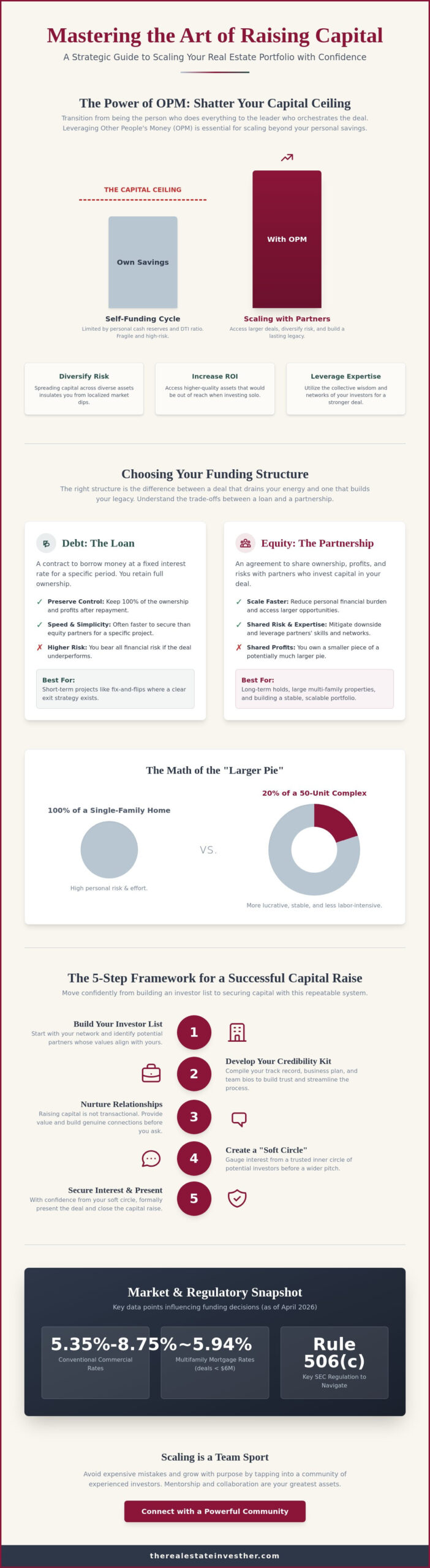
Many investors begin their journey by tapping into their own savings or utilizing creative financing techniques to get their first few properties under contract. This is a vital phase of proof-of-concept. However, relying solely on your own liquidity eventually leads to the “Capital Ceiling,” a point where your personal debt-to-income ratio or cash reserves stop your progress cold. Transitioning into raising capital for real estate deals allows you to shatter that ceiling. You move from being the person who does everything to the leader who orchestrates the deal. This shift requires deep intentionality. It’s about choosing partners whose values align with yours, ensuring that every dollar raised supports a legacy you’re proud to own. You are no longer just buying a building; you’re curating a community of investors who believe in your vision.
Breaking the Self-Funding Cycle
Relying on personal credit or home equity lines can feel safe, but it often creates a fragile foundation. If one deal sours, your entire personal financial life is at risk. Raising capital for real estate deals facilitates risk diversification. By spreading capital across diverse assets, you insulate yourself from localized market dips. You aren’t just a borrower; you’re a visionary who understands that true wealth is built through leverage, not just hard work. This evolution protects your peace of mind while opening doors to institutional-sized opportunities. Raising capital is an act of leadership.
The ROI of Partnership
In the current market, where multifamily mortgage rates for deals under $6 million start around 5.94%, the cost of debt is a significant factor in your pro forma. Bringing in equity partners can mitigate the pressure of high-interest payments while adding layers of expertise to your team. Think of it as the math of the “larger pie.” This collaborative approach is the cornerstone of building wealth on your terms. Partnering allows you to:
- Access higher-quality assets that would be out of reach solo.
- Leverage the collective wisdom and networks of your investors.
- Reduce personal liability while scaling your portfolio faster.
Owning 20% of a high-performing 50-unit complex is often more lucrative, more stable, and far less labor-intensive than owning 100% of a single-family house that demands your constant attention. It moves you away from transactional stress and toward a holistic, community-driven investment model where everyone wins together.
Equity vs. Debt: Choosing the Right Funding Structure
Choosing the right structure is the difference between a deal that drains your energy and one that builds your legacy. When you’re raising capital for real estate deals, you’ll primarily choose between debt and equity. Debt is a loan; it’s a contract where you pay a fixed interest rate over a specific period. Equity is a partnership; it’s an agreement where you share ownership and profits. Each path offers distinct advantages depending on your project. For short-term fixes and flips, debt is often the preferred tool because it allows you to keep 100% of the profit once the lender is paid. Long-term rentals, however, often benefit from equity partners who provide stability and share the ongoing risks of ownership. Understanding the various real estate financing options available today helps you align your funding with your specific exit strategy.
The cost of capital is your most critical metric. With the Federal Reserve holding the funds rate between 3.50% and 3.75% as of April 2026, conventional commercial rates now range from 5.35% to 8.75%. High interest rates can squeeze your bottom line, making equity partnerships more attractive when cash flow is tight. While debt offers speed and preserves your control, equity allows for faster scaling by reducing your personal financial burden. It’s a trade-off between owning the whole pie or growing a much larger one with a trusted inner circle. If you’re seeking a community of peers who have successfully navigated these choices, connecting with other women investors can provide the perspective you need to move forward with confidence.
Private Money Lenders vs. Equity Partners
Private money lenders act like a bank but with more flexibility. They provide short-term liquidity for a fixed return, usually without taking any ownership in your deal. Equity partners are different. They’re in it for the long haul, participating in the tax benefits, cash flow, and eventual appreciation. For smaller projects with one or two partners, a Joint Venture (JV) is often sufficient. Once you scale to larger multifamily assets, a formal syndication structure becomes necessary to manage multiple investors while maintaining clear operational boundaries.
Legal Compliance and SEC Basics
Taking money from others isn’t just a handshake; it’s a regulated activity. You’ll likely use SEC Regulation D to stay compliant. Rule 506(b) is a common choice, allowing you to raise unlimited capital from unlimited accredited investors and up to 35 non-accredited investors, provided you don’t use general solicitation. If you want to advertise your deal publicly, Rule 506(c) allows for general solicitation, but every investor must be a verified accredited investor. Before you accept a single dollar, you must consult a real estate attorney to draft a Private Placement Memorandum (PPM). This document protects both you and your investors, ensuring that your raising capital for real estate deals remains professional, legal, and grounded in transparency.
Building Your Credibility: Overcoming the ‘Ask’ Anxiety
The most significant barrier to raising capital for real estate deals is often the internal narrative that you are asking for a favor. This mindset creates a power imbalance that can make even the most seasoned professional feel small. It is time to reframe “the ask” as “the offer.” You aren’t taking money from someone; you are providing them with an opportunity to grow their wealth through a vetted, high-quality asset. When you approach a potential partner with this level of conviction, the energy of the conversation shifts from desperation to collaboration. You are the architect of a deal that could secure their financial future.
If you don’t have a portfolio of 100 deals yet, building a “Credibility Kit” is essential. This document isn’t just about your real estate history. It’s about your professional integrity, your attention to detail, and the strength of the team you’ve assembled. Leverage your background in project management, nursing, or education as an asset. These roles require high-level organization and risk assessment, which are the same skills needed to manage a successful investment. Transparency is your greatest tool. Being honest about what you know, and showing exactly who you turn to when you don’t have the answer, builds deeper trust than a polished, perfect facade ever could.
The ‘Only Woman in the Room’ Strategy
Being the only woman in a room full of investors isn’t a hurdle; it’s a unique competitive advantage. Data from 2024 indicates that women investors often see 1.2% higher returns than their male counterparts, according to studies by Roofstock. Use this to your benefit. Finding “Aligned Investors” means seeking people who value your perspective and share your long-term vision for community impact. This alignment eliminates the pressure to conform to traditional, aggressive pitching styles. When you focus on the strength of the deal and the intentionality of your strategy, analysis paralysis fades away. You can find more about navigating these spaces in our resource, The Only Woman in the Room.
Developing Your Investor Pitch Deck
Your pitch deck is the visual representation of your professionalism. It needs to be concise, clear, and focused on the three pillars: The Team, The Market, and The Exit. Even if you aren’t a “math person,” you can present numbers with confidence by focusing on the logic behind the projections. If you’re new, your “Track Record” slide should highlight the experience of your mentors, your property managers, and your contractors. This shows investors that while you may be the deal sponsor, the project is backed by decades of collective wisdom. This collaborative approach is exactly what we cultivate within the STRIVE Mentorship Program, where we help you refine your presentation to attract the right partners.
The 5-Step Framework for a Successful Capital Raise
Success in raising capital for real estate deals isn’t a matter of luck; it’s the result of a disciplined, repeatable process. Many investors wait until they have a signed contract to start looking for money. This creates unnecessary pressure and often leads to unfavorable terms. Instead, you should operate with a “capital-first” mindset. This means building your investor base while you’re still hunting for the right asset. By the time you find a property that meets your criteria, your funding should feel like a foregone conclusion rather than a desperate scramble.
- Step 1: The Pre-Raise: This is the constant work of building your list. You’re identifying potential partners who share your values before you ever need their checkbooks.
- Step 2: The Soft Circle: Once a deal is in sight, you gauge interest without a formal commitment. The soft circle is a vital risk-mitigation step that ensures you don’t overextend yourself on a deal that lacks back-end support.
- Step 3: The Deal Presentation: This is where you move from conversation to conversion. Whether through webinars, intimate 1-on-1s, or site visits, you present the opportunity with the confidence of a deal sponsor.
- Step 4: The Commitment and Funding: This technical phase involves handling the escrow process and ensuring all legal documents, like the PPM discussed earlier, are signed and verified.
- Step 5: Post-Closing Communication: The work doesn’t end when the wires clear. Consistent updates are the secret to raising capital for your next deal.
Step 1 & 2: Building the Foundation
Global real estate capital raising improved by approximately 16% year-over-year in 2025, showing that liquidity is returning to the market for those prepared to capture it. Networking remains the heartbeat of this industry. High-net-worth hubs like Austin or San Diego offer fertile ground for finding partners who are looking for passive opportunities. Don’t underestimate the power of your digital presence either. Using social media to document your property tours or your due diligence process creates a window into your expertise. It allows potential investors to observe your intentionality from a distance before they ever jump on a call. This organic attraction builds a warm list that’s much easier to convert when the right deal arrives.
Step 5: Investor Relations as a Scaling Tool
Your reputation is built during the hold period, not just at the acquisition. Monthly or quarterly updates keep your partners feeling like valued members of a team rather than just a source of funds. If a project hits a snag, such as a shift in market demand or a construction delay, lean into transparency. Handling bad news with honesty builds significantly more trust than projecting a false sense of perfection. When investors see that you can navigate challenges with integrity, they become life-long legacy partners. If you’re ready to refine your investor outreach and join a network of high-level peers, consider joining the InvestHER Community Membership to share strategies and scale together with other ambitious women.
Scaling Together: The Role of Community and Mentorship
Real estate is often painted as a solo hustle, but raising capital for real estate deals is fundamentally a team sport. You need teammates who complement your skills. While you might excel at underwriting and identifying market trends, another woman in your network might be a master of investor relations or legal compliance. Finding your “who” is more important than knowing every “how.” Community provides the social proof that institutional lenders and private investors look for. It demonstrates that you aren’t a lone wolf; you’re part of an ecosystem of excellence that values collective strength over individual ego.
Mentorship is the ultimate shortcut to avoiding expensive legal and financial pitfalls. As noted earlier, the market is highly competitive. Capital often flows to established managers, which can make it difficult for emerging investors to break through. A mentor allows you to borrow their track record and systems while you build your own. This guidance is crucial for navigating the current environment where investors are increasingly risk-averse and discerning. By standing on the shoulders of those who have paved the way, you move with a level of confidence that is palpable to potential partners. If you’re building your portfolio in the Northeast, exploring a women’s real estate mentorship Philadelphia program can connect you with guides who understand both the local market dynamics and the unique challenges women investors face.
The STRIVE Mentorship Advantage
The STRIVE Mentorship Program is designed to move you from isolation to collective wisdom. High-level investing can feel lonely, especially when you’re the only woman at the closing table. Within this program, you gain access to off-market deals and shared expertise that isn’t available in public forums. You aren’t just learning a strategy; you’re gaining the credibility needed to lead your first seven-figure raise. This environment fosters a “growth mindset,” where you’re constantly challenged to improve, pivot, and scale alongside a tight-knit network of high-achievers.
Your Next Steps: Community and Connection
Moving from local Scottsdale meetups to national stages is a pivotal moment in an investor’s journey. Events like InvestHER CON are where potential partners become lifelong collaborators. These gatherings provide the physical space to build the trust that digital communication can’t always capture. If you’re ready to find your accountability partners and scale your portfolio with intentionality, joining the InvestHER Community Membership is your next logical step. This isn’t just about business; it’s about the intersection of your financial independence and your personal well-being. Surround yourself with women who understand the nuances of your journey and are committed to your long-term success.
Build Your Legacy Through Strategic Partnerships
Building a real estate empire is a journey that requires both strategic precision and a supportive inner circle. You’ve learned that mastering the art of raising capital for real estate deals is about more than just numbers; it’s about shifting your mindset from a solo doer to a visionary leader. By utilizing a disciplined five-step framework and choosing the right equity or debt structures, you move closer to financial independence on your own terms.
True growth happens when you stop trying to navigate these complexities alone. With over 50 local meetups across the US and our annual InvestHER CON gathering over 500 high-level women investors, the support you need is already within reach. If you’re ready to bridge the gap between your current portfolio and your ultimate legacy, take the next step. You can scale your portfolio and master the art of raising capital with the STRIVE Mentorship Program, led by industry pioneers Liz Faircloth and Andresa Guidelli. The world of high-level investing is waiting for your unique perspective. It’s time to lead with intentionality and collective strength.
Frequently Asked Questions
Do I need to be an accredited investor to raise capital for my real estate deals?
You don’t need to be an accredited investor to act as a deal sponsor or general partner. Your personal financial status doesn’t dictate your ability to lead a raise; your expertise and the quality of the deal do. However, the status of your investors matters significantly for SEC compliance. If you use Rule 506(b), you can accept funds from up to 35 non-accredited investors, provided they are sophisticated and you have a pre-existing relationship with them.
How much should I pay a private money lender for a real estate deal in 2026?
Private money rates typically sit several points above conventional commercial loans, which ranged from 5.35% to 8.75% in May 2026. You should expect to offer between 8% and 12% interest depending on the project’s risk profile and the lender’s relationship with you. It’s also standard to pay 1 to 2 points at closing. These rates reflect the speed and flexibility that private lenders provide compared to traditional institutions.
What is the difference between a Joint Venture and a Syndication?
The primary difference lies in the level of participation and the number of partners involved. In a Joint Venture, every partner typically has an active, decision-making role in the project’s management. A syndication is a more complex structure where you, as the sponsor, manage all operations while passive investors provide the bulk of the capital. Because syndications involve passive investment, they are subject to stricter SEC oversight and require more robust legal disclosures.
Can I raise capital for my first real estate deal without a track record?
Yes, you can successfully secure funding by leveraging the collective experience of your team. If you lack a personal history of 100 deals, highlight the track records of your mentors, specialized contractors, and property managers in your pitch. Investors aren’t just betting on you; they’re betting on the ecosystem of experts you’ve assembled. Focus on the data of the deal and the professional skills you’ve honed in other industries to build trust.
What legal documents are required when raising money from private investors?
You’ll need a comprehensive legal package that usually includes a Private Placement Memorandum (PPM), an Operating Agreement, and a Subscription Agreement. These documents clearly define the risks, the split of profits, and the exit strategy for the project. These aren’t templates you should download from the internet. You must work with a qualified securities attorney to ensure your raising capital for real estate deals remains fully compliant with current 2026 federal and state regulations.
Is it better to raise debt or equity for a long-term rental property?
Equity is often the superior choice for long-term rentals because it protects your monthly cash flow from high interest payments. Debt requires fixed monthly servicing regardless of vacancy rates or unexpected repairs, which can create financial strain. Equity partners share in both the cash flow and the long-term appreciation. This structure aligns everyone’s interests toward the sustainable health of the asset rather than just a quick return on a loan.
How do I find private investors in my local market, like Phoenix or Dallas?
Start by showing up where high-net-worth individuals gather, such as local real estate meetups, charity events, or professional networking groups. Markets like Phoenix and Dallas have dense populations of investors looking for passive ways to grow their wealth. Share your journey and your “why” consistently. When you lead with value and transparency, you attract partners who are looking for the exact level of intentionality you bring to your projects.
What happens if a real estate deal goes south and I’ve raised outside capital?
The strength of your reputation is forged in how you handle a deal that underperforms. If a project faces challenges, lean into radical transparency by communicating with your investors early and often. Your legal documents, like the PPM, are designed to protect you from personal liability if the market shifts. However, your ability to raise money in the future depends on your integrity during a crisis. Present a clear mitigation plan and show your partners that you’re working tirelessly to protect their principal.

Article by
Andresa Guidelli
Real estate investor, operator, and founder of The Real Estate InvestHER, a national platform supporting women real estate investors. With 15+ years of experience in real estate investing and business operations, she focuses on helping investors build stronger businesses behind their portfolios through better systems, clearer decision-making, leadership, and responsible use of AI.
Be the first to comment