


Goal Setting for Real Estate Investors: The 2026 Holistic Success Template
Chasing a high property count is often the fastest way to lose your sense of self. In a market where 30-year fixed mortgage rates sit at 6.53% and new FinCEN reporting rules add layers of complexity to every LLC, the old “hustle harder” mantra is no longer sustainable. Effective goal setting for real estate investors in 2026 requires more than just spreadsheets; it demands a soul-level alignment with the life you actually want to live. You’ve likely felt the weight of industry metrics that prioritize volume over your personal well-being, leaving you wondering how to scale without losing your peace.
We believe that true wealth isn’t just about the numbers on a closing statement. It’s about the autonomy to choose your schedule and the strength of the community standing behind you. This article promises to help you master a holistic framework that aligns your financial ambitions with intentional lifestyle design. You’ll gain a clear 2026 investment roadmap that uses the “SMART+” method to move from owning a few properties to leading a scalable, purpose-driven business.
Key Takeaways
- Move beyond the “unit-count” obsession by adopting a holistic framework that prioritizes “Wealth on Your Own Terms” over mere portfolio size.
- Master the SMART+ framework to ensure your goal setting for real estate investors includes the vital pillars of personal alignment and community support.
- Learn to tailor your 2026 milestones to specific market geographies, choosing the right mix of cash flow and appreciation for your unique roadmap.
- Use our step-by-step blueprint to conduct an Annual Vision Audit, setting clear targets for passive income and net worth growth.
- Discover how to scale your business without burnout by transitioning from a solo operator to a supported leader through mentorship and collective wisdom.
Beyond the Numbers: Why Holistic Goal Setting Matters for Women Investors
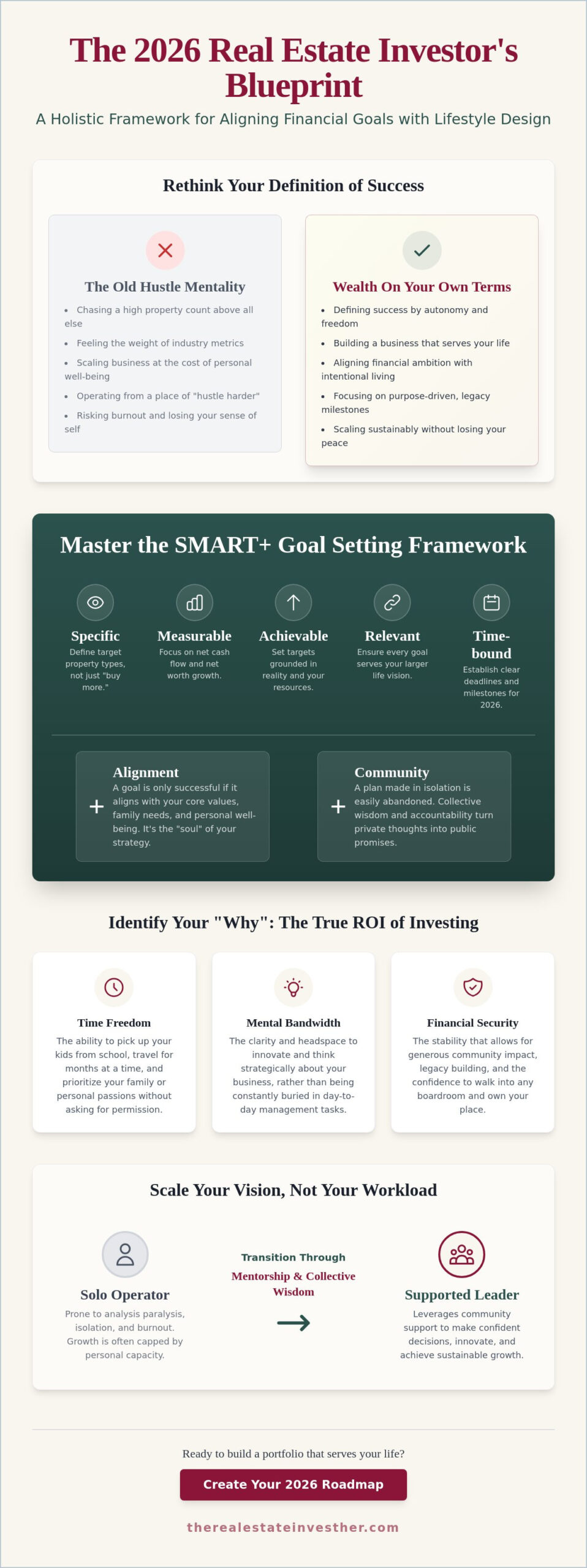
Success in real estate is often measured by the size of a portfolio or the total number of units under management. While these metrics provide a snapshot of growth, they don’t tell the whole story. For many women, a massive portfolio that requires sixty hours of weekly maintenance isn’t freedom; it’s just another job. True goal setting for real estate investors begins by defining “Wealth on Your Own Terms.” This means building a business that serves your life, rather than a life that serves your business. It’s about finding the precise intersection where financial independence meets personal well-being.
When we focus solely on “unit-count” obsession, we risk total burnout. More properties do not always equal more freedom. In fact, scaling without a holistic plan can lead to increased stress and decreased autonomy. By rooting your strategy in goal setting theory, you can move away from transactional targets. You’ll start focusing on legacy-building milestones that actually improve your daily experience. This shift allows you to view your portfolio as a tool for empowerment rather than a source of exhaustion.
The “Invisible” Drivers of Investor Success
Before you calculate “how many” properties you need, you must identify your “Why.” Is it the ability to pick up your children from school every day? Is it the security to travel for months at a time? Autonomy is the ultimate ROI for the modern woman investor. Shifting your focus to these invisible drivers ensures that every deal you close brings you closer to your ideal lifestyle. It’s about intentionality. When your goals align with your core values, your growth becomes sustainable. Consider these drivers:
- Time freedom to prioritize family or personal passions.
- Mental bandwidth to innovate rather than just manage.
- Financial security that allows for generous community impact.
Overcoming Analysis Paralysis in 2026
The real estate market moves fast. With 2026 bringing new regulations like the FinCEN reporting rules for LLCs, it’s easy to feel overwhelmed by the sheer volume of information. Clear goals act as a vital filter for “shiny object syndrome.” They allow you to say “no” to a good deal so you can say “yes” to a great one. This clarity reduces the fear of the next deal. It builds the confidence needed to walk into a boardroom and own your place, even if you are The Only Woman in the Room. A growth mindset replaces intimidation with curiosity. You aren’t just competing; you’re innovating. You’re building a roadmap that is uniquely yours, grounded in both strategic wisdom and emotional intelligence. Understanding the real estate investing mindset shifts required to move from consumer to wealth architect is often the missing piece that transforms hesitation into decisive, legacy-driven action.
The SMART+ Framework: Aligning Portfolio Growth with Personal Lifestyle
Business planning shouldn’t feel like a cold transaction with your future self. It should feel like an invitation to a better life. Traditional goal setting for real estate investors often relies on the classic SMART criteria: Specific, Measurable, Achievable, Relevant, and Time-bound. While these pillars are essential for tracking progress, they often fail to account for the human element. We believe in the SMART+ framework. This adds two critical “Plus” factors: Alignment and Community. Without these, even the most profitable portfolio can become a source of resentment rather than a path to freedom.
A goal that isn’t aligned with your family’s needs or your physical health is a failing goal. Similarly, a plan made in isolation is a plan that is easily abandoned when the market gets tough. Utilizing a SMART goal system for investors ensures your targets are grounded in reality, but the “Plus” factors ensure they are grounded in your soul. Community accountability increases success rates because it replaces the “lone wolf” mentality with collective strength. When you share your 2026 vision with a group of like-minded women, your commitment moves from a private thought to a public promise.
Applying SMART to Real Estate Metrics
In the 2026 market, specificity is your best defense against economic volatility. Instead of a vague desire to “buy more,” define your target property types. Are you looking for small multi-family units or short-term rentals? Make your goals measurable by focusing on net cash flow rather than gross revenue. With 30-year fixed mortgage rates at 6.53%, your borrowing capacity must be evaluated with a clear eye on current capital. Ensure your timeline is realistic, giving you the space to navigate the slow normalization of housing inventory without feeling rushed.
The Alignment Check: Does This Goal Serve Your Life?
Every investment requires a trade-off of time, energy, or capital. The “Time-Freedom” Test asks a simple question: will this investment require more of your daily hours than you are willing to give? If you’re in a season of career peak or intensive motherhood, a heavy-lift renovation might not be the right choice. Your 2026 goals must support your 10-year vision for legacy and autonomy. If a deal doesn’t fit your current season of life, it’s okay to pass. Joining a community focused on holistic growth can help you vet these decisions with women who understand the delicate balance you’re trying to strike.
Setting Market-Specific Milestones: From Scottsdale to New York
Geography isn’t just a coordinate on a map; it’s the primary boundary for your strategy. Effective goal setting for real estate investors in 2026 requires a deep understanding of how local market dynamics shift your objectives. A goal that focuses on high equity growth in Scottsdale looks nothing like a cash-flow-heavy plan for Philadelphia. With the National Association of Realtors predicting a 14% increase in nationwide home sales this year, your milestones must be agile enough to capture momentum while respecting local constraints. You cannot apply a blanket strategy to a country experiencing such varied normalization speeds.
Choosing your primary driver is the first step in this process. Are you chasing appreciation to build long-term wealth, or do you need immediate cash flow to support your lifestyle design? In 2026, the mid-6% mortgage rates make this choice even more critical. You must also account for regional regulations, such as California’s new mandatory disclosures for digitally altered photos and zoning changes. Building a reliable “boots on the ground” team should be a non-negotiable strategic objective. Without local partners who understand the nuances of their specific blocks, your goals remain theoretical rather than actionable.
High-Growth Market Goals: Phoenix and Austin
In competitive hubs like Phoenix, Austin, and San Diego, the focus shifts toward equity growth and portfolio scaling. Because NAR forecasts a 4% rise in home prices for 2026, your goals should prioritize finding value in appreciating corridors. Success here often depends on your ability to source deals before they hit the open market. To stay ahead, set a specific lead generation goal: “I will connect with three new local wholesalers each month to identify off-market opportunities in Scottsdale.” This proactive approach ensures you aren’t just reacting to the MLS, but actively shaping your acquisition pipeline.
Stable Cash Flow Market Goals: Philadelphia and Orlando
If your 2026 vision prioritizes stability, markets like Philadelphia and Orlando offer a different set of opportunities. Here, the core objectives are occupancy rates and tenant retention. While U.S. multifamily demand remains above historical norms, the national vacancy rate sits at 8.5%, making property management efficiency a top priority. When analyzing these deals, it’s helpful to follow a step-by-step guide to ensure your rehab milestones are realistic. For those using the BRRRR strategy, your 2026 roadmap must include strict timelines for construction phases to mitigate the impact of fluctuating material costs and labor availability.
Your 2026 Real Estate Investor Goal Template: A Step-by-Step Blueprint
A vision without a structure is simply a daydream. To move from a handful of properties to a thriving, scalable business, you need a repeatable system. Goal setting for real estate investors should be a methodical practice that bridges the gap between where you are and where you intend to be. This blueprint serves as your tactical guide for the coming year, ensuring that every action you take is rooted in intentionality rather than reaction. By following these five steps, you’ll build a portfolio that reflects your values and your financial needs.
- Step 1: The Annual Vision Audit. Close your eyes and imagine December 31, 2026. What does your life look like? Define your success not just by your bank balance, but by your level of peace and autonomy.
- Step 2: Financial Target Setting. Be precise with your numbers. Set targets for monthly passive income, total net worth, and strategic debt reduction. With the 2026 standard deduction at $32,200 for married couples filing jointly, ensure your tax strategy is as robust as your acquisition plan.
- Step 3: Acquisition & Portfolio Milestones. Decide on the number of doors or the total Assets Under Management (AUM) you want to control. In a market seeing a 4% rise in home prices, quality often outweighs quantity.
- Step 4: The Personal Development Goal. Identify the specific skill you need to master this year. Whether it’s advanced underwriting or negotiating with private lenders, choose a focus that elevates your professional authority.
- Step 5: The Community Connection. No one reaches the summit alone. Identify the network that will provide the collective wisdom you need to scale your business without losing your mind.
The 90-Day Sprint Breakdown
Annual goals often feel overwhelming, which leads to procrastination. Breaking your year into 90-day sprints creates a sense of urgency and focus. For the first quarter of 2026, identify three core “rocks,” the most important tasks that must be completed to move the needle. This allows you to measure progress based on your actions rather than getting discouraged by temporary market fluctuations or shifting mortgage rates that currently hover around 6.53%.
The “InvestHER” Accountability Checklist
Consistency is the quiet engine of success. Your daily habits should reflect your high-level real estate goals. Ask yourself every month: “Am I still aligned with my 10-year vision?” To stay on track, share an accountability statement with your peers, such as: “I am committed to analyzing five deals a week to secure my next multi-family property by June.” If you’re ready to move from planning to execution, consider joining the STRIVE Mentorship Program to surround yourself with experts who will hold you to your highest standard.
Scaling Your Vision: How Mentorship and Community Turn Goals into Reality
Building a real estate empire in a vacuum is a dangerous game. Many investors believe they must solve every problem alone, but this “Lone Wolf” mentality often leads to a plateau. Strategic goal setting for real estate investors shouldn’t be a solitary activity. It requires the perspective of those who have already walked the path. When you isolate your planning, you risk developing blind spots that can lead to burnout or costly mistakes in a market where 30-year fixed mortgage rates sit at 6.53%. Real growth happens when you trade isolation for collective wisdom. Part of that growth begins internally — making the critical real estate investing mindset shifts that separate passive consumers from active wealth architects.
The STRIVE Mentorship Program serves as a bridge between your current capacity and your future potential. It provides the high-level guidance necessary to navigate complex 2026 regulations, such as the new FinCEN reporting rules for LLCs. While mentorship offers the roadmap, the InvestHER Community Membership provides the essential “Alignment” check. This community acts as a mirror, helping you see if your financial targets truly support your personal well-being. It’s the difference between building a business that owns you and building one that sets you free.
Finding Your Real Estate Mentor
A great mentor does more than just look at your spreadsheets. They understand the unique hurdles women face in this industry. When seeking guidance to scale your New York or Austin portfolio, look for a mentor who has successfully navigated market normalization and shifting inventory levels. There is a fundamental difference between a coach and a community; you need both to thrive. A coach provides the tactical “how-to,” while the community provides the emotional “me-too.” This dual support system ensures you remain resilient when challenges arise.
Next Steps: From Planning to Action
Execution is the final step in the goal setting for real estate investors framework. Moving from a written plan to a physical reality often requires a catalyst that shifts your mindset from “Set” to “Execute.” Attending a professional development event, such as InvestHER CON, offers the immersive experience and professional networking required to turn a roadmap into a series of closed deals. These gatherings are where partnerships are forged and legacy-building strategies are refined. Your 2026 legacy isn’t built in a single day, but it starts with the intentionality you bring to your network and your personal development right now.
Ready to turn your vision into a scalable reality? Join the InvestHER Community and scale your portfolio with us.
Your 2026 Legacy Starts Today
The transition from a property owner to a business leader requires more than just a spreadsheet. It demands a shift toward intentionality and collective strength. By embracing the SMART+ framework and market-specific milestones, you’ve already begun the work of aligning your financial ambitions with your personal well-being. This holistic approach to goal setting for real estate investors ensures that your growth is sustainable and your success is shared.
Whether you find inspiration in our STRIVE Mentorship Program success stories or through one of our 50 local meetups across the US, you don’t have to walk this path alone. The roadmap is clear and the support is waiting. Secure your future by surrounding yourself with women who challenge and elevate you. Grab your InvestHER CON 2026 tickets now to experience the power of this network in person. Each connection you make serves as a pillar for your future business.
Download Your Strategic 2026 Goal Setting Template & Join Our Community
Your vision for a life of autonomy and impact is within reach. Take the first step today and build the legacy you’ve always imagined.
Frequently Asked Questions
How many properties should a beginner real estate investor aim for in their first year?
Aim for one or two high-quality acquisitions rather than a high volume of properties. Your first year is about mastering the fundamentals of underwriting and property management. Focusing on a single successful deal allows you to build a solid foundation without the overwhelm that leads to burnout. It’s better to have one profitable asset that aligns with your lifestyle than three properties that drain your energy and capital.
What are the best financial goals for real estate investors in 2026?
Focus on net cash flow and strategic tax planning. With 30-year fixed mortgage rates at 6.53%, prioritizing properties with strong yields is essential. You should also set a goal to maximize your tax efficiency. For example, single filers should account for the 2026 standard deduction of $16,100 while planning their deductions. Effective goal setting for real estate investors this year involves balancing portfolio growth with debt reduction to maintain a healthy debt-to-equity ratio.
How do I balance real estate goal setting with a full-time career?
Utilize the 90-day sprint method to break large objectives into manageable tasks. You don’t need forty hours a week to be a successful investor; you need consistent, high-impact hours. Dedicate specific blocks of time each week to lead generation or deal analysis. This focused approach allows you to move toward financial independence while maintaining your current professional responsibilities. Consistency over time will always outperform occasional bursts of frantic activity.
Should my real estate goals focus on cash flow or appreciation?
Your choice depends on your immediate needs versus your long-term legacy. If you’re seeking autonomy to leave a career, prioritize cash flow to replace your active income. If you’re focused on building generational wealth, appreciation might be your primary driver. National Association of Realtors data predicts a 4% rise in home prices for 2026. This suggests that while appreciation is likely, your strategy must remain grounded in the reality of your specific market’s performance.
How often should I review and adjust my investment goals?
Conduct a deep dive into your progress every quarter and a full vision audit once a year. A quarterly review allows you to adjust your tactics based on market shifts, such as changes in housing inventory or interest rates. Your annual audit is the time to ensure your portfolio still serves your personal well-being. Regular check-ins prevent you from drifting off course and help you stay aligned with your 10-year roadmap for success.
What is a realistic passive income goal for a new investor?
Start with a “bridge goal” that covers one specific personal expense, like a car payment or a utility bill. Setting an arbitrary goal of $10,000 a month often feels unattainable and leads to frustration. Instead, aim to replace small portions of your lifestyle costs one by one. This incremental approach builds the confidence and momentum you need to eventually scale into larger, more complex multifamily or commercial deals.
How can a real estate mentor help me reach my goals faster?
A mentor provides a proven path that helps you avoid the expensive mistakes common in a shifting market. They offer a “second set of eyes” on your underwriting and help you navigate new regulations like the FinCEN reporting rules. Through programs like the STRIVE Mentorship Program, you gain access to collective wisdom and professional networks. This support accelerates your growth by replacing trial and error with strategic, guided action.
What are the most common mistakes in goal setting for real estate investors?
The biggest mistake is obsessing over “unit count” while ignoring net profit and personal happiness. Many investors fall into the trap of “hustle culture” metrics that don’t actually lead to freedom. Another common error is setting goals in isolation without a supportive community to offer accountability. Without a holistic view, you might build a portfolio that creates more stress than wealth. Always ensure your financial targets are balanced with your need for time and autonomy.

Article by
Andresa Guidelli
Real estate investor, operator, and founder of The Real Estate InvestHER, a national platform supporting women real estate investors. With 15+ years of experience in real estate investing and business operations, she focuses on helping investors build stronger businesses behind their portfolios through better systems, clearer decision-making, leadership, and responsible use of AI.
Be the first to comment