


Imposter Syndrome in Real Estate Investing: Busting the 5 Myths Holding Women Back
What if the persistent fear of being “found out” isn’t a sign of incompetence, but the biological tax you pay for entering a new level of growth? You’ve likely sat in a high-stakes negotiation, perhaps as the only woman in the room, and felt the familiar sting of analysis paralysis. It’s easy to look at a 6.53% mortgage rate or new FinCEN reporting requirements and convince yourself that every other investor has a secret manual you somehow missed. You might even find yourself discounting your latest closing as mere luck rather than a result of your own strategic brilliance.
We recognize that the journey to financial independence is as much about mindset as it is about the numbers. You deserve to move past the hesitation that keeps your portfolio stagnant. This guide will teach you how to identify, dismantle, and leverage imposter syndrome real estate investing to scale your assets with absolute confidence. We will explore the five pervasive myths currently holding women back and provide the tools you need to silence your inner critic for good.
Key Takeaways
- Learn to distinguish between the paralyzing “fraud” feeling and the constructive doubt that actually keeps your capital safe during high-stakes deals.
- Identify the five dangerous myths about investor confidence that prevent women from taking action on viable properties.
- Understand how high-barrier markets like New York and Austin can trigger imposter syndrome real estate investing and how to reclaim your seat at the table.
- Master the InvestHER Framework to externalize your inner critic and replace emotional narratives with cold, hard data.
- Discover why professional mentorship is the ultimate antidote to the isolation and fear that often accompany scaling your portfolio.
Beyond the “Fraud” Feeling: Why Real Estate Triggers Imposter Syndrome
Investing in property isn’t like buying stocks or starting a small side hustle; it’s a high-stakes arena where the numbers have more zeros and the assets are made of brick and mortar. For many women, this scale triggers a psychological pattern of doubting one’s accomplishments that we commonly call imposter syndrome. In the context of imposter syndrome real estate investing, this isn’t just a vague feeling of inadequacy. It’s the specific fear that your first multi-family deal or your expansion into a new market was a fluke that will soon be exposed by a market correction or a failed inspection.
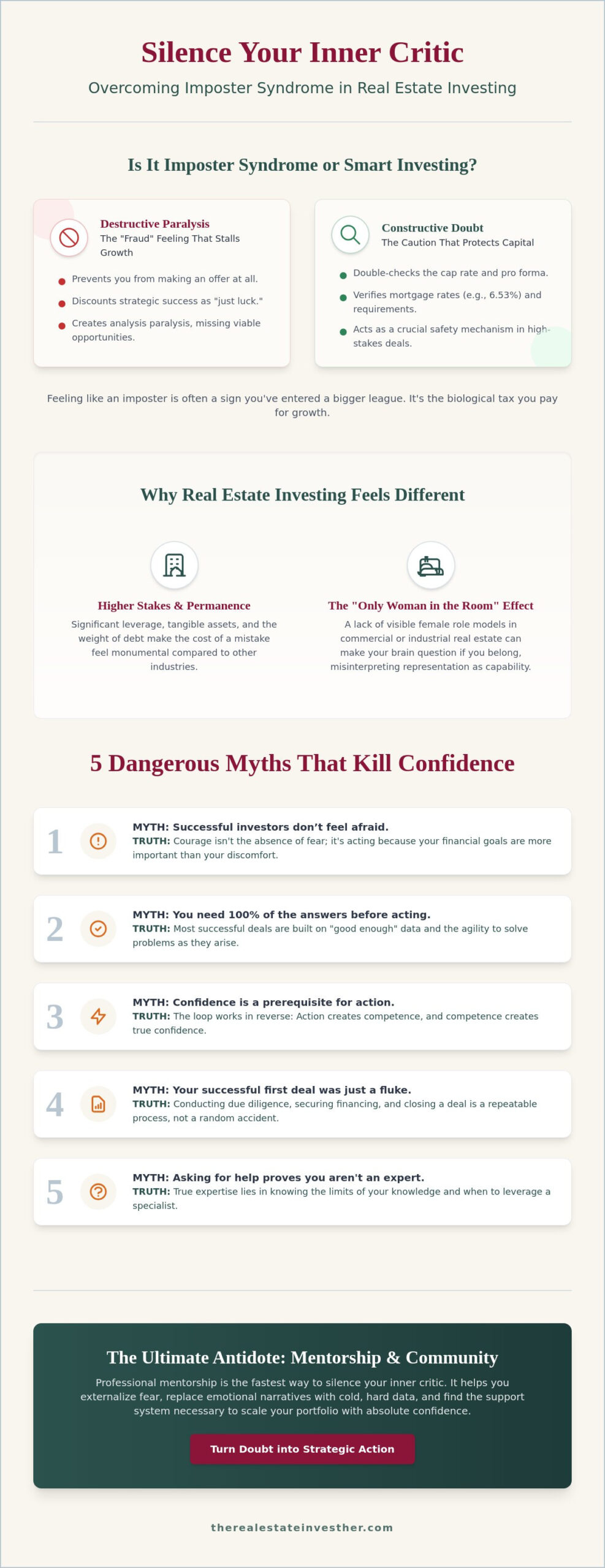
It’s vital to distinguish between constructive doubt and destructive paralysis. Healthy doubt acts as a safety mechanism; it’s the voice that tells you to double-check the cap rate or verify the 6.53% mortgage rate on your pro forma. Destructive imposterism, however, is the wall that prevents you from making the offer at all. Paradoxically, the most competent investors often suffer the most. This is often a reverse Dunning-Kruger effect, where your deep understanding of market complexities makes you more aware of what you don’t know, leading to a dip in confidence. At InvestHER, we view this discomfort as a signal. If you feel like an imposter, it’s usually because you’ve stopped playing small and have entered a bigger league.
The “Only Woman in the Room” Phenomenon
Lacking visible role models in sectors like commercial real estate in Dallas or industrial hubs in Phoenix creates a unique psychological burden. When you don’t see yourself reflected in the leadership at a local meetup, your brain naturally questions if you belong there. This creates identity-based imposter syndrome, where the lack of representation is misinterpreted as a lack of personal capability. It’s hard to feel like an expert when the environment subtly suggests you’re an outsider.
Real Estate vs. Other Industries: Why the Stakes Feel Higher
Real estate involves significant leverage and tangible assets, which differentiates it from digital businesses. The weight of debt and the permanence of a physical building make the cost of a mistake feel monumental. While other industries might encourage you to “fake it until you make it,” that’s dangerous advice when dealing with legal contracts and structural integrity. The transition from being an “accidental landlord” with one inherited rental to a “strategic investor” scaling a portfolio is often the primary trigger for imposter syndrome real estate investing. You are no longer just managing a house; you are building a legacy, and that responsibility carries emotional weight. Making this leap successfully requires embracing the real estate investing mindset shifts that transform you from a consumer into a true wealth architect.
5 Dangerous Myths About Investor Confidence You Need to Stop Believing
The internal narrative of imposter syndrome real estate investing often relies on a set of culturally reinforced myths. These lies act as invisible anchors, keeping you tethered to small, safe deals while your peers scale their portfolios. To move forward, we must dismantle these false standards and replace them with the reality of high-level property acquisition. Believing you need to be fearless to be successful is a trap that keeps many talented women on the sidelines.
- Myth 1: Successful investors don’t feel afraid before a closing. The truth is that fear is a constant companion for anyone pushing their boundaries. Courage isn’t the absence of fear; it’s the decision that your financial goals are more important than your discomfort.
- Myth 2: You must have 100% of the answers before making an offer. Waiting for perfect certainty is a recipe for analysis paralysis. Most successful deals are built on “good enough” data and the agility to solve problems as they arise.
- Myth 3: Confidence is a prerequisite for action. In reality, the loop works in reverse. Action creates competence, and competence creates confidence. You’ll never feel “ready” until you’ve already done the work.
- Myth 4: Your first deal was just a fluke or lucky timing. This is the “luck vs. skill” trap. If you conducted due diligence, secured financing, and managed a closing, that is a repeatable process, not a random accident.
- Myth 5: Asking for help proves you aren’t a real expert. True expertise lies in knowing where your knowledge ends and where a specialist’s begins.
Dismantling the “Expert” Illusion
The “guru” culture in the property world often projects an impossible standard of solo perfection. This creates a false expectation that you should know everything from plumbing codes to complex tax laws. True growth happens when you shift from trying to “know everything” to “knowing how to find the answer.” Even top-tier investors in San Diego don’t operate as solo geniuses; they rely on specialized teams to navigate complex acquisitions and market shifts. If you’re feeling isolated in your journey, joining a supportive community of women investors can help normalize these challenges.
The “Luck vs. Skill” Debate in a Bull Market
It’s easy to attribute your success to a rising market, but you must audit your past deals to find your “Paper Trail of Success.” Market appreciation is a tide that lifts all boats, but forced appreciation through strategic renovations or better management is your personal skill at work. By documenting the specific actions you took to increase a property’s value, you can stop imposter syndrome real estate investing from stealing credit for your hard work. Taking ownership of your wins is a vital skill for scaling to larger, more complex properties.
From New York to Austin: How Local Markets Fuel Investor Anxiety
Local market dynamics often act as a megaphone for imposter syndrome real estate investing. If you’re looking at the Manhattan market, where the median sales price hit $1.3 million in April 2026, the barrier to entry feels less like a hurdle and more like a fortress. High-barrier markets like New York City or San Diego naturally trigger deeper feelings of inadequacy because the financial stakes are so high. You aren’t just buying a property; you’re navigating a complex ecosystem of 7.9% year-over-year price increases and intense regulatory scrutiny. It’s easy to feel like an outsider when every transaction feels like a masterclass you haven’t yet attended.
In contrast, rapidly growing hubs like Austin or Scottsdale create a “Small Fish, Big Pond” syndrome. Even though Austin’s median home price was a more accessible $460,000 in May 2026, the 3.8% year-over-year increase and the influx of institutional capital can make individual investors feel irrelevant. New federal regulations, such as the FinCEN reporting requirements for LLCs that began on March 1, 2026, add another layer of “insider knowledge” that newcomers often fear they lack. Local networking groups in cities like Philadelphia or Orlando serve as the vital antidote to this isolation. They provide a space to realize that even seasoned pros are still learning the nuances of the 23% QBI deduction or permanent bonus depreciation rules.
Navigating Competitive Hotspots
Markets like Phoenix often feel like a battlefield of aggressive bidding wars. It’s easy to feel like an imposter when you see peers on social media posting about “massive wins” while you’re struggling to avoid overpaying in a mid-6% mortgage rate environment. Staying grounded requires a local “Truth-Teller” community rather than a generic networking group. You need people who will speak openly about the deals they lost and the mistakes they made. This transparency strips away the illusion of perfection and lets you focus on your own strategic execution.
The Power of Localized Mentorship
General advice rarely suffices when you’re dealing with city-specific challenges like Scottsdale short-term rental ordinances or New York’s segmented pricing. A mentor who understands your specific geography can reduce anxiety by providing a “calibrated mirror” of your progress. Our STRIVE Mentorship Program bridges the gap between local fear and global strategy, ensuring you have the support needed to scale. Whether you’re seeking a mentor who understands the New York market or a partner in Austin, having an experienced guide makes the unknown feel manageable. You don’t have to carry the weight of every decision alone.
The InvestHER Framework: 4 Steps to Turning Self-Doubt into Strategic Action
Transforming internal resistance into external momentum requires a repeatable system. While the myths we’ve discussed can feel overwhelming, the InvestHER Framework provides a tactical roadmap to dismantle the psychological barriers of imposter syndrome real estate investing. This process isn’t about eliminating fear entirely; it’s about building a structure that allows you to act in spite of it. By moving from emotional reaction to strategic execution, you reclaim your autonomy.
- Step 1: Externalize the Voice. Give your inner critic a specific name. By personifying the doubt, you create a psychological distance that allows you to observe the thought without identifying with it. It’s a passenger in the car, but it doesn’t get to touch the steering wheel.
- Step 2: Fact-Check the Fear. Replace emotional narratives with cold, hard data. If you’re terrified of a “bad” market, look at the verified facts: national house prices rose 1.7% between Q1 2025 and Q1 2026. Run your pro forma using the current 6.53% mortgage rate. Spreadsheets don’t have feelings; they have answers.
- Step 3: The “Five-Minute” Action Rule. Analysis paralysis thrives on big, vague goals. Break the freeze by committing to a micro-action that takes five minutes or less. Send one follow-up email to a broker or analyze just one line item on an inspection report. Small wins build the momentum needed for big deals.
- Step 4: Curate Your “Board of Advisors.” You aren’t meant to scale in a vacuum. Surround yourself with people who recognize your potential even when you don’t. This group should include mentors, peers, and specialists who offer objective feedback rather than just emotional validation.
Building Your “Evidence Folder”
Create a dedicated digital or physical file to house every win, no matter how small. Include successful inspection reports, thank you notes from tenants, and closing statements. During “The Dip”; that high-anxiety moment right before you submit a multi-million dollar offer; review this folder to remind yourself of your track record. To start your folder today, list three skills you’ve mastered in your previous career, such as budget management, complex negotiation, or team leadership, and identify how they translate directly to your property deals.
Strategic Vulnerability in Networking
Admitting you don’t have all the answers is a genuine power move. In a room full of egos, saying “I don’t know” invites collaboration rather than competition. This shift allows you to use the InvestHER Community Membership to ask the “dumb” questions that often save thousands of dollars in the long run. When you stop trying to prove you belong, you finally have the energy to actually build. True expertise is found in the willingness to learn alongside others who share your vision for a legacy of financial independence.
Scaling Your Portfolio: Why Mentorship is the Ultimate Antidote
Mentorship isn’t just about learning the mechanics of a 1031 exchange or understanding the nuances of the 23% QBI deduction for 2026. It’s about perception. A mentor serves as a “calibrated mirror,” reflecting your actual progress rather than the distorted image created by imposter syndrome real estate investing. When you’re in the thick of a high-stakes deal, your inner critic might scream that you’re failing. An experienced guide looks at the same data and sees a strategic pivot. They provide the objective clarity you need to stop discounting your successes as mere luck.
The STRIVE Mentorship Program was designed specifically to normalize the fears that accompany scaling. Moving from single-family rentals to larger multi-family assets or commercial properties requires a fundamental shift in identity. You’re transitioning from a “solo investor” mindset to a “wealth builder” perspective. This evolution is less about technical skill and more about the collective wisdom of those who have paved the path before you. By learning from someone who has already navigated market corrections and regulatory shifts, the unknown becomes manageable. Confidence isn’t found in isolation; it’s built through partnership.
The Power of the InvestHER Community
Isolation is the fuel that keeps imposter syndrome alive. When you are part of a local group in Philadelphia or Dallas, you realize that your challenges are not unique. Shared vulnerability is the fastest way to build professional confidence because it strips away the “expert illusion.” By seeing other successful women manage the same market fluctuations and 6.5% mortgage rates, you find a safety net for your own growth. Join the InvestHER Community: Women Building Wealth and stop navigating the complexities of the market alone. Community transforms your self-doubt into a shared strategic advantage.
Taking the Next Step: InvestHER CON 2026
There is a specific energy that comes from being in a room with hundreds of women who share your ambition. At InvestHER CON 2026, the feeling of being the “only woman in the room” finally disappears. You find your tribe. This isn’t just a networking event; it’s a realization that the “fraud” feeling is a universal experience among high achievers. Surrounding yourself with pioneers who have conquered the same fears allows you to see your own potential more clearly. You’ll leave with more than just strategies; you’ll leave with the conviction that you belong in every room where deals are made.
Secure your InvestHER CON 2026 ticket and start building your legacy today.
Own Your Power and Scale Your Legacy
You now have the tools to identify the myths that have quieted your ambition. By applying the InvestHER framework, you can move from analysis paralysis to strategic execution, even when the market feels uncertain. Remember that feeling like an outsider is often just a sign that you’re entering a higher tier of growth. Imposter syndrome real estate investing doesn’t have to be a barrier; it can be the catalyst that drives you toward deeper due diligence and stronger partnerships.
Founded by industry leaders Liz Faircloth and Andresa Guidelli, our community of over 50,000 women investors is here to ensure you never walk this path alone. From our annual InvestHER CON, which has been featured in major real estate publications, to the daily support found in our network, we provide the collective strength needed to build lasting wealth. It’s time to stop playing small and start trusting the evidence of your own expertise. Join the STRIVE Mentorship and scale your portfolio with confidence. Your future self is waiting for you to take this next step. You’ve earned your place at the table, and it’s time to claim it.
Frequently Asked Questions
Is it normal to feel like an imposter even after my first successful deal?
Yes, it is entirely normal to feel this way. Many investors attribute their first closing to “lucky timing” or a favorable market rather than their own strategic work. This is a hallmark of imposter syndrome real estate investing, where you discount your personal agency. To counter this, review your closing documents and identify every specific decision you made that led to that success. You earned that win.
How do I know if I have imposter syndrome or if I actually lack the necessary skills?
Distinguish between a skill gap and a psychological barrier by auditing your results. If your properties are performing and your underwriting is sound, you are likely dealing with imposter syndrome. If you genuinely don’t understand the new 2026 tax regulations, that is simply a technical gap. Address the former with mindset work and the latter with targeted education or professional mentorship through the STRIVE program.
What are the most common triggers for imposter syndrome in real estate investing?
Triggers usually involve “newness” or a lack of representation. You might feel it when entering a competitive market like Austin or when navigating the mid-6% mortgage rate environment of May 2026. Being the only woman in a room of commercial brokers is another common catalyst. These situations highlight the distance between your current comfort zone and your next level of professional growth.
Can imposter syndrome actually be a good thing for an investor?
It can be beneficial if you use it as a prompt for extreme diligence. That “fraud” feeling can push you to verify every line item in an inspection or double-check the 23% QBI deduction requirements. While paralysis is destructive, a healthy dose of doubt ensures you don’t become overconfident or reckless in your acquisitions. It keeps your capital safe while you learn.
How can I explain my real estate goals to others without feeling like a fraud?
Lead with your vision and the facts of your journey. You don’t need to own 100 doors to call yourself an investor; you just need to be actively pursuing the path. Use neutral, professional language to describe your strategy. When you focus on the legacy you’re building rather than seeking external validation, your confidence naturally becomes more grounded and authentic to your mission.
Does imposter syndrome ever go away as you scale your portfolio?
It doesn’t necessarily disappear, but your relationship with it changes. As you scale to larger properties, the stakes increase, which can reignite old fears. However, as you build a track record, you gain the “evidence” needed to silence the critic faster. You learn that the feeling is just a temporary side effect of pushing into territory you haven’t mastered yet. It’s a sign of progress.
How do I stop analysis paralysis caused by self-doubt?
Break your decision-making process into micro-commitments to bypass the freeze response. Analysis paralysis often stems from trying to solve the entire deal at once. Instead, focus on the next five minutes. Analyze one specific expense or make one phone call to a property manager. By taking small, manageable steps, you prove to your brain that you are capable of handling the project.
What is the best way to find a supportive community of female investors?
Look for environments that value collective strength and professional ambition. The InvestHER Community Membership provides a dedicated space for women to share strategies and normalize the emotional hurdles of the industry. Connecting with a network that understands the unique challenges of being a female investor helps you realize you aren’t alone. This shared understanding is the ultimate cure for the isolation that fuels self-doubt. To fully overcome that self-doubt, explore the essential real estate investing mindset shifts needed to transition from consumer thinking to building lasting wealth.

Article by
Andresa Guidelli
Real estate investor, operator, and founder of The Real Estate InvestHER, a national platform supporting women real estate investors. With 15+ years of experience in real estate investing and business operations, she focuses on helping investors build stronger businesses behind their portfolios through better systems, clearer decision-making, leadership, and responsible use of AI.
Be the first to comment