


Creating a Real Estate Business Plan: The Holistic Guide for Women Investors in 2026
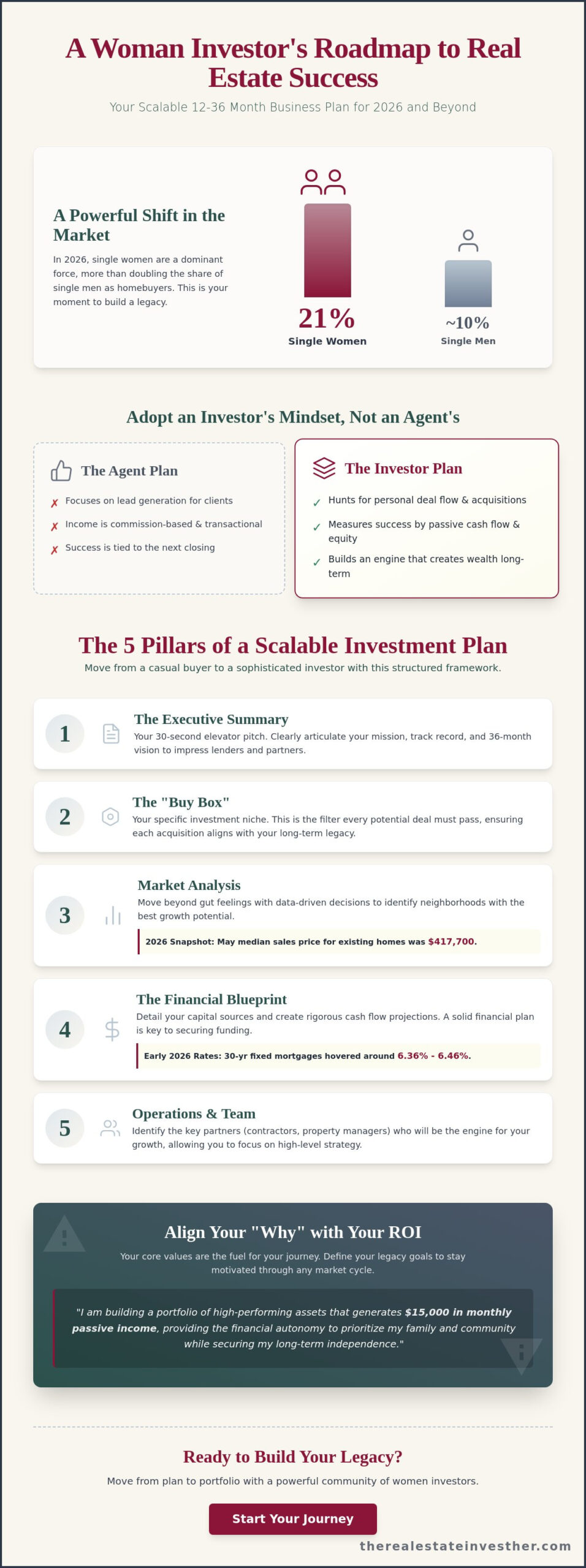
Did you know that single women now account for 21% of all homebuyers, more than doubling the share of single men in this 2026 market? It’s a powerful shift, yet many of us still struggle with analysis paralysis when creating a real estate business plan that actually works for our busy lives. You’re likely juggling the demands of a career or family while trying to figure out how to scale your portfolio without losing your sanity or your seat at the table.
We believe your investment strategy should be a reflection of your values, not just a list of properties. This guide provides a strategic roadmap for the next 12 to 36 months, helping you leverage the latest tax changes from the One Big Beautiful Bill Act and gain the confidence to present your vision to any lender. We’ll walk through a holistic framework designed to help you reclaim your time and build a sustainable path to financial independence. It’s time to stop feeling like the only woman in the room and start building a legacy that supports the life you’ve worked so hard to create.
Key Takeaways
- Move past rigid spreadsheets by treating your plan as a living document that aligns your financial growth with your personal well-being.
- Master the art of creating a real estate business plan by defining your “Buy Box” to ensure every acquisition serves your long-term legacy.
- Learn to adapt your strategy for high-growth hubs while mitigating risks through a thorough analysis of local regulations and landlord-tenant laws.
- Establish clarity through a personalized SWOT analysis and SMART investment goals that span from your first year to your first decade.
- Shift from solo planning to collective strength by leveraging accountability partners to ensure your strategic vision leads to consistent action.
Beyond the Spreadsheet: Why Women Investors Need a Holistic Business Plan
A business plan should never feel like a static document destined to gather dust on a shelf. For the modern woman investor, it’s a living, breathing tool that guides every acquisition and every exit. While many people view financial planning as a cold exercise in number-crunching, we know that true wealth is about more than just your bank balance. It’s about intentionality. Creating a real estate business plan allows you to bridge the gap between your current financial reality and the legacy you want to leave behind. It transforms overwhelming data into a clear, actionable path, effectively silencing the analysis paralysis that often stalls even the most ambitious portfolios.
The psychological benefits of this clarity are profound. When you have a roadmap, fear loses its grip. You’re no longer guessing if a deal fits; you’re measuring it against a pre-defined standard of success. By following a comprehensive business plan, you move from a place of uncertainty to a position of authority. This isn’t just about money. It’s about reclaiming your time and ensuring your business serves your life, rather than the other way around.
The Difference Between an Agent Plan and an Investor Plan
Traditional real estate advice is often skewed toward the “agent” mindset, which focuses heavily on lead generation for clients and commission-based income. As an investor, your focus is fundamentally different. You aren’t looking for clients; you’re hunting for deal flow for personal acquisition. While an agent’s success is tied to the next transaction, your success is measured by passive cash flow and equity growth. This shift in perspective is essential when creating a real estate business plan that scales. You must prioritize exit strategies, such as 1031 exchanges or long-term holds, which are rarely the focus of a standard brokerage plan. Your goal is to build an engine that works while you sleep.
Aligning Your ‘Why’ with Your ROI
Before you set a single financial target, you must identify the core values that drive you. Are you investing for generational wealth, early retirement, or the ability to fund a passion project? These “legacy goals” are what will keep you motivated during market downturns or challenging renovations. When your ROI is aligned with your personal “why,” every property becomes a stepping stone toward a more fulfilled version of yourself. This alignment ensures that your growth is sustainable and that you don’t burn out in pursuit of a number that doesn’t actually bring you joy.
Your Vision Statement: I am building a portfolio of high-performing assets that generates $15,000 in monthly passive income, providing the financial autonomy to prioritize my family and community while securing my long-term independence.
The 5 Essential Pillars of a Scalable Real Estate Investment Plan
Scaling a portfolio requires more than ambition; it demands a structured framework. When you’re creating a real estate business plan, you’re building the infrastructure that supports your future legacy. This framework consists of five essential pillars that move you from a casual buyer to a sophisticated investor. Many investors start with a property and hope for a profit. A sophisticated investor starts with a plan and ensures the profit through disciplined execution.
- The Executive Summary: This is your 30-second elevator pitch. It must clearly articulate your mission, your track record, and your 36-month vision so that lenders or partners can immediately see your professionalism.
- The Buy Box: This defines your specific niche. It’s the filter through which every potential deal must pass before you spend a minute on due diligence.
- Market Analysis: Move beyond gut feelings. Use current data, such as the May 2026 median sales price of $417,700 for existing homes, to identify neighborhoods with the best growth potential.
- The Financial Blueprint: This section details your capital sources and reserve funds. With 30-year fixed mortgage rates hovering around 6.36% to 6.46% in early 2026, your cash flow projections must be rigorous and conservative.
- Operations and Team: Identify the partners who will help you scale. From contractors to property managers, your team is the engine that allows you to step back from the daily grind and focus on high-level strategy.
Defining Your Buy Box and Investment Niche
Specificity creates speed. By defining exactly what you will not buy, you protect your time and capital for the deals that truly move the needle. Your Buy Box should include strict criteria: the age of the property, its physical condition, and a minimum ROI threshold. For example, you might decide to focus exclusively on mid-term rentals for traveling professionals in specific Austin zip codes. Niching down allows you to become the local expert in that asset class, making it easier to spot undervalued opportunities. Create a “No” list to avoid shiny object syndrome. If a deal doesn’t fit your criteria, it doesn’t deserve your attention.
The Capital Strategy: Funding Your Vision
Your capital strategy is the fuel for your growth. While traditional lending is a staple, scaling often requires a mix of private money and creative financing to bridge “The Gap” between your first few deals and a large portfolio. A diversified capital strategy reduces personal risk by leveraging asset-based lending and private partnerships rather than relying solely on personal credit or primary residence equity. If you’re just getting started and wondering how to invest in real estate with little money through creative entry points like FHA loans and house hacking, there are proven strategies that can help you launch your portfolio without a six-figure down payment. If you’re looking for a supportive environment to discuss these high-level strategies, joining a community of like-minded women can provide the perspective you need to move forward with confidence.
Market-Specific Strategy: Adapting Your Plan for High-Growth Hubs
A strategy that thrives in the high-energy tech corridors of Austin will likely stumble in the historic, stable neighborhoods of Philadelphia. Successful investors understand that markets are unique ecosystems with distinct growth drivers and regulatory hurdles. When you’re creating a real estate business plan, you must tailor your approach to the specific pulse of your chosen hub. Austin, for instance, remains a magnet for corporate relocations and job growth, keeping demand high even as median home prices reached approximately $417,700 in April 2026. Philadelphia, by contrast, offers different opportunities, such as property tax abatements for multi-family deals that can significantly boost your cash-on-cash return.
Analyzing local landlord-tenant laws is not a secondary task; it’s a core business risk assessment. In markets like Phoenix and Scottsdale, identifying “Path of Progress” markers, like new light rail expansions or major employer campuses, allows you to buy ahead of the curve. However, if you don’t account for local regulations, even the best deal can become a liability. Your plan must reflect the reality of the ground you’re standing on, or the ground you’re buying from afar.
Navigating Local Regulations and Incentives
Researching specific neighborhood restrictions is vital for protecting your investment. In Dallas, certain neighborhoods have implemented short-term rental bans that could dismantle an Airbnb-focused strategy overnight. Conversely, Philadelphia offers incentives like tax abatements that reward investors for improving the local housing stock. In Austin, the recent shifts in the tech sector, including hybrid work models, have altered rental demand patterns. You must stay agile. Understanding these nuances ensures your plan remains robust against local volatility and keeps your portfolio aligned with current market demands.
Remote Investing: Scaling Beyond Your Backyard
Scaling your portfolio often means looking beyond your immediate zip code to find better yields. Remote investing requires a “boots on the ground” approach to bridge the physical distance. Whether you’re targeting San Diego or New York, your power team is your most valuable asset. A top-tier property manager in Orlando or a trusted contractor in New York acts as your eyes and ears. Creating a real estate business plan for remote deals requires a digital-first communication strategy. Use project management tools and scheduled video check-ins to maintain momentum. This level of intentionality transforms a distant property into a high-performing asset that supports your freedom rather than draining your energy.
The Step-by-Step Real Estate Business Plan Template for 2026
Clarity is your currency. Without a structured template, your investment goals remain mere wishes. Creating a real estate business plan for 2026 requires a blend of tactical precision and long-term vision. You must establish a quarterly review process to pivot based on shifting trends, such as the new FinCEN reporting requirements for all-cash transactions that took effect in March 2026. This isn’t just about picking properties; it’s about drafting an operational workflow that covers everything from the initial deal find to professional property management. Your plan should also include a dedicated marketing strategy for uncovering off-market deals and attracting private lenders who value your strategic approach.
Phase 1: The Internal Audit (SWOT Analysis)
Before looking outward at the market, look inward at your current capacity. A SWOT analysis helps you identify your unique “InvestHER” strengths, such as a high-level ability to network or a meticulous attention to detail. Acknowledge your current weaknesses, whether that’s a temporary lack of capital or limited hours due to family commitments. Understanding these factors allows you to build a team that complements your skills. My deepest competitive advantage in my local market is my ability to build high-trust relationships with distressed sellers and private lenders through empathetic, transparent communication. By being honest about your starting point, you can leverage the “One Big Beautiful Bill Act” tax benefits, like the permanent 100% bonus depreciation, to maximize your internal resources.
Phase 2: Goal Setting and Financial Projections
Vague desires for wealth won’t satisfy a lender or secure your future. You must translate the concept of “financial freedom” into a specific monthly cash flow number that covers your desired lifestyle. Once you have that target, calculate the exact number of units required to hit it based on current 2026 mortgage rates, which are currently averaging between 6.36% and 6.46% for 30-year fixed loans. Break these targets down into 1-year, 3-year, and 10-year SMART goals. This allows you to build a realistic 12-month acquisition calendar that keeps you moving forward without burning out. If you’re ready to move from theory to execution with a group of women who understand your journey, consider joining our InvestHER Community Membership to gain the tools and support needed to scale your portfolio with confidence.
Your operational workflow is the bridge between your goals and your reality. Document how you will find deals, how you will fund them, and how you will manage them. This level of detail transforms a simple document into a powerful roadmap for the next 36 months of your investment career.
From Plan to Portfolio: Implementation and the Power of Community
The transition from planning to action is where most investors falter. You have done the heavy lifting of creating a real estate business plan, but the real test begins when your strategy meets the reality of the market. A plan that collects dust is a missed opportunity for legacy. To ensure your strategy remains a living document, you must surround yourself with people who hold you to the standards you have set for yourself. Momentum is often a product of the company you keep. When you share your goals with a community, your commitment shifts from a private thought to a public promise.
Moving from a solopreneur mindset to that of a true business owner requires a shift in how you value your time. You are no longer just a person who buys houses; you are a leader who manages a portfolio. This evolution involves trusting your systems and your team to handle the details so you can focus on high-level growth. By treating your plan as a dynamic roadmap rather than a rigid set of rules, you allow yourself the grace to pivot as 2026 market trends evolve while staying anchored in your long-term vision.
The Role of Mentorship in Scaling
Mentorship provides the perspective that spreadsheets simply cannot capture. While your data might look perfect, a mentor who has navigated multiple market cycles can spot the subtle risks you might miss. A mentor acts as a fast pass, helping you avoid the rookie mistakes that drain capital and confidence. Our STRIVE Mentorship program is designed to take your strategic plan and refine it through the lens of experienced investors who have already walked the path you are on. If you are still questioning your next step, you might ask, Is a Real Estate Coach Worth It for Women Investors? The answer often lies in the speed and safety with which you can scale when you are no longer guessing your next move.
Building Your Legacy with the InvestHER Community
Real estate can feel like a lonely pursuit, especially when you are the only woman in the room at local networking events. Tapping into collective wisdom is the most effective way to navigate the complexities of the 2026 economy. Whether you are connecting at a local meetup in San Diego, Phoenix, or Orlando, the power of a supportive network cannot be overstated. These connections provide the emotional and strategic support needed to keep your portfolio growing when challenges arise. You don’t have to build your empire in isolation. Join the InvestHER Community and start building your wealth today to ensure your business plan leads to the life of freedom you deserve.
Your Vision Deserves a Strategic Roadmap
Creating a real estate business plan is the definitive step toward moving from a series of transactions to a sustainable legacy. You’ve learned how to align your core values with your ROI and how to navigate the specific market shifts of 2026 with confidence. By establishing a clear Buy Box and leveraging the support of a power team, you ensure that every property you acquire brings you closer to true time freedom rather than further away from it.
Success in this industry doesn’t have to be a solo journey. Founded by Liz Faircloth and Andresa Guidelli, our dedicated community of thousands of women investors is here to provide the shared wisdom and accountability you need to thrive. Whether you’re adjusting your strategy for new tax laws or scaling into remote markets, you deserve a guide who understands the dual nature of your mission. It’s time to stop over-analyzing and start executing with precision. You can scale your portfolio with the STRIVE Mentorship Program and join a movement focused on holistic wealth and lasting independence. Your future self is waiting for the clarity you create today.
Frequently Asked Questions
Do I really need a formal business plan if I’m just buying my first rental?
Yes, you need one even for your first property because it sets the precedent for how you treat your investments. Treating your first rental as a hobby makes it difficult to transition to a business owner mindset later. A plan ensures your first purchase aligns with your 10-year legacy goals rather than being a random acquisition. It helps you define success early so you don’t overpay.
What is the most important part of a real estate business plan for 2026?
The financial strategy section is paramount in 2026 due to the current interest rate environment and the permanent tax changes under the One Big Beautiful Bill Act. You must account for 30-year fixed rates between 6.36% and 6.46% while maximizing the 100% bonus depreciation benefits. Creating a real estate business plan that prioritizes capital preservation and tax efficiency allows you to remain liquid and ready for new opportunities.
How often should I update my real estate investment plan?
You should review your plan quarterly to ensure your tactics still match the broader economic environment. While your 10-year vision remains steady, your short-term execution might need to pivot if mortgage rates or local regulations change. A quarterly check-in allows you to stay agile without losing sight of your long-term wealth goals. It’s about maintaining a living document that grows alongside your portfolio and your personal life.
Can I use a business plan to get a loan from a private lender?
A professional business plan is your most powerful tool when approaching private lenders or partners. It demonstrates that you are a sophisticated investor with a clear exit strategy and a deep understanding of risk management. Lenders want to see your Buy Box, your financial projections, and your power team before they commit capital. Presenting a polished roadmap builds the trust necessary to secure funding for your deals.
What are the biggest mistakes women make when creating a business plan?
Many women struggle with analysis paralysis by focusing too much on complex spreadsheets while ignoring their personal “why.” Another common hurdle is trying to do everything alone instead of planning for a team from the start. Creating a real estate business plan should be a holistic exercise that balances financial targets with your need for time freedom. Don’t let the fear of being the only woman in the room stop you.
How do I include my ‘Buy Box’ in the business plan template?
Your Buy Box should be a dedicated section in your template that acts as a strict filter for every potential deal. Include specific criteria such as property age, neighborhood zip codes, and minimum cash-on-cash return requirements. This clarity allows you to say “no” to distractions quickly so you can focus on high-performing assets. It transforms your plan from a vague idea into a tactical guide for your daily efforts.
Is it better to have a lean startup plan or a traditional business plan for real estate?
A hybrid approach that combines professional structure with lean agility is often best for modern investors. You need a document that is formal enough to satisfy lenders but flexible enough to adapt to market shifts. While a traditional plan provides the necessary depth, a lean mindset keeps you focused on execution and results. This ensures you are always moving forward without getting bogged down in unnecessary corporate jargon or rigid formatting.
How does a business plan help me scale from 1 to 10 properties?
A business plan helps you scale by moving you away from a solopreneur mindset and toward a systems-based approach. It identifies the gaps in your current team and outlines the operational workflows needed to manage multiple doors. As you grow from one property to ten, your plan serves as the blueprint for your power team to follow. This structure is what allows you to reclaim your time while your portfolio builds wealth.

Article by
Andresa Guidelli
Real estate investor, operator, and founder of The Real Estate InvestHER, a national platform supporting women real estate investors. With 15+ years of experience in real estate investing and business operations, she focuses on helping investors build stronger businesses behind their portfolios through better systems, clearer decision-making, leadership, and responsible use of AI.
Be the first to comment