


15 Warning Signs of a Bad Property Manager: The Investor’s Red Flag Checklist
What if the person you hired to protect your financial freedom is actually the one quietly dismantling it? It is a heavy realization, yet many investors stay in “property manager purgatory” far longer than they should because they fear the transition more than the current friction. You likely know the feeling of scanning an unexpected maintenance bill that lacks a clear explanation or watching a unit sit vacant for weeks while your phone calls go unreturned. These aren’t just minor inconveniences; they are the primary signs of a bad property manager that can derail your path to autonomy and growth.
We understand that real estate is about more than just buildings; it is about the legacy you are building for your future. You deserve a partnership rooted in transparency and shared ambition rather than one that leaves you feeling ignored. In this guide, we provide a clear “stay or go” checklist to help you evaluate your current situation with confidence. You will learn how to hold your team accountable and ensure your management strategy aligns perfectly with your long term wealth goals. It is time to regain your peace of mind and move forward with a team that values your vision as much as you do.
Key Takeaways
- Redefine your professional relationship by viewing your manager as the CEO of your asset while you step into the empowered role of Chairman.
- Identify the subtle communication lapses and unreturned calls that often serve as the earliest signs of a bad property manager.
- Protect your cash flow by learning to spot inconsistent disbursements and maintenance surprises that exceed your pre-authorized limits.
- Recognize operational negligence, such as deferred maintenance or high vacancy rates, before they compromise your portfolio’s long-term growth.
- Develop a clear transition strategy to regain control of your digital assets and move toward a partnership that truly aligns with your vision.
The Strategic Role of a Property Manager in Your Wealth Journey
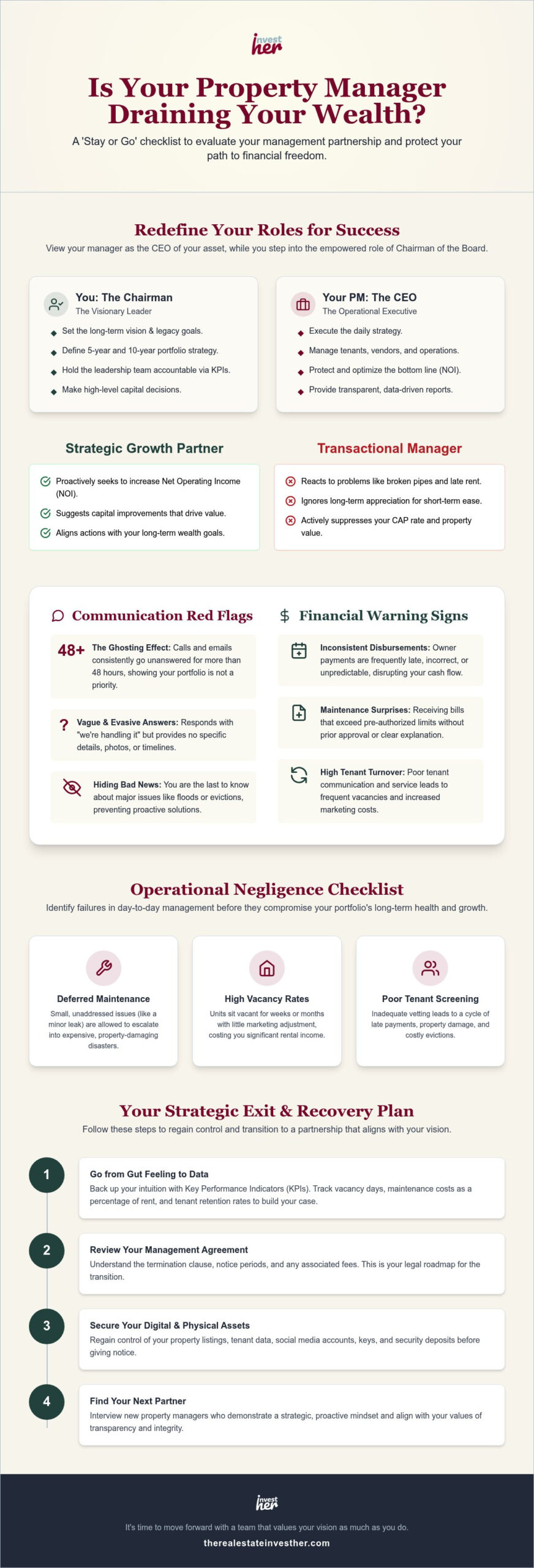
Think of your real estate portfolio as a high performance corporation. In this structure, you are the Chairman of the Board, setting the vision and defining the legacy you want to leave behind. Your property manager is the CEO. They are responsible for the daily execution of your strategy, managing the “people” side of your business, and protecting your bottom line. When this partnership is aligned, your wealth grows with intentionality. However, one of the most damaging signs of a bad property manager is a purely transactional mindset that ignores your long term appreciation.
A transactional manager simply reacts to broken pipes and late rent. A strategic growth partner proactively looks for ways to increase your Net Operating Income (NOI) through better vendor contracts and utility efficiencies. Because property value in commercial and multi-family real estate is directly tied to income, a manager who fails to optimize rent or reduce expenses is actively suppressing your CAP rate. “Good enough” management often costs you thousands in lost equity and missed market opportunities that you could have used to fund your next acquisition. Recognizing the signs of a bad property manager early can save you from a catastrophic loss in property value.
Defining the InvestHER-Level Partnership
Real partnership requires alignment with your five year and ten year portfolio goals. Are you looking to scale rapidly, or are you focused on steady cash flow for retirement? A proactive manager suggests capital improvements that drive value, while a reactive one waits for things to fail. Within the InvestHER Community, we emphasize that shared values like integrity and transparency are non negotiable. Programs like our STRIVE Mentorship help you develop the strategic lens needed to identify whether your PM is a partner or a bottleneck in your journey toward financial independence.
When Gut Feeling Meets Data
Your intuition as a female investor is a powerful tool. If you feel a sense of dread when opening your monthly statements, listen to that signal. To move from feeling to action, back up your concerns with Key Performance Indicators (KPIs) like vacancy days, maintenance costs as a percentage of rent, and tenant retention rates. In this context, fiduciary duty is the legal and ethical obligation of a property manager to act solely in the best financial interest of the property owner. If they are prioritizing their own convenience over your portfolio’s health, they are failing their most fundamental duty.
Communication Red Flags: The #1 Sign of a Bad Manager
Communication is the lifeblood of any strategic partnership. When the person managing your asset stops responding, the foundation of trust begins to crumble. The most obvious of the signs of a bad property manager is the “ghosting” effect. If your emails and phone calls consistently go unanswered for more than 48 hours, your manager is sending a clear signal that your portfolio is not a priority. This silence creates a vacuum where anxiety grows and small issues escalate into expensive disasters.
Vague or evasive answers are equally damaging. If you ask for a specific update on a renovation or a tenant dispute and receive a generic “we’re handling it” without supporting details, transparency is lacking. You deserve clarity. Professional managers provide regular reporting, including monthly financial statements and timestamped inspection photos. Waiting until a major tenant issue has already spiraled before notifying you is a failure of leadership. You should never be the last person to know about a flood or an eviction on your own property.
The Transparency Gap
A bad manager often hides negative news to avoid difficult conversations. Instead of presenting a problem with three potential solutions, they offer silence. In competitive markets like Austin or San Diego, where vacancy marketing requires constant adjustment, inconsistent updates can lead to weeks of lost rent. Without a centralized owner portal for real-time data access, you’re forced to rely on their memory rather than hard facts. If you find yourself struggling to get a straight answer, it might be time to connect with a community of women who can share their experiences with better management standards.
Tenant Communication Breakdown
If your manager isn’t talking to you, they likely aren’t talking to your tenants either. Signs of a breakdown include high turnover rates and a sudden influx of negative online reviews. Tenant unhappiness is your problem because it directly impacts your bottom line through increased marketing costs and repair expenses. When a manager is unresponsive to maintenance requests, tenants feel undervalued and begin looking for their next home. This cycle of turnover destroys your profit margins and damages your property’s reputation in the local market. A strategic partner understands that tenant retention is just as vital as acquisition.
Financial Warning Signs: Auditing Your Monthly Statements
Your monthly statement should be a source of clarity, not a cause for confusion. When you review your financial reports, the numbers ought to tell a story of growth and disciplined management. One of the most distressing signs of a bad property manager is the presence of inconsistent or late owner disbursements. If your funds arrive on a different day every month without a proactive explanation, it suggests a lack of stable internal systems. You are the owner of the asset. You should never have to chase your own cash flow.
Watch for maintenance “surprises” that consistently exceed your pre-authorized spending limits. Most management agreements include a threshold, often between $250 and $500, requiring your approval for larger repairs. If you find charges for $1,000 or more appearing on your ledger without prior notice, your manager is overstepping their authority. Similarly, keep a sharp eye on unusually high “miscellaneous” fees. These small, recurring charges can quietly erode your profit margins and signal that your manager is prioritizing their own revenue over your portfolio’s health.
The Maintenance Markup Trap
Some management firms add a hidden percentage to vendor invoices as a “coordination fee.” While some contracts disclose this, many do not. You can identify this trap by requesting the original vendor receipts rather than accepting the property manager’s itemized statement. In high demand markets like New York or Philadelphia, where repair costs are already elevated, these markups can become a significant financial drain. A strategic partner should negotiate better rates with vendors because of their volume, passing those savings on to you rather than pocketing the difference.
Tenant Ledger Inaccuracies
Review your tenant ledgers to ensure late fees are being collected and credited to your account. If a tenant consistently pays after the grace period but no fee appears on your statement, your manager is failing to enforce the lease. This leniency doesn’t just cost you money; it trains tenants to deprioritize your rent payments. Security deposit mismanagement is another critical red flag that carries heavy legal risks if funds aren’t held in according to state regulations. Accounting sloppiness is often a precursor to larger financial issues, serving as an early warning that the systems protecting your equity are beginning to fail.
Operational Negligence: Maintenance and Vacancy Red Flags
Operational negligence is the silent killer of real estate portfolios. While financial discrepancies are easier to spot on a ledger, the physical degradation of your property often happens out of sight. One of the most critical signs of a bad property manager is a pattern of deferred maintenance that transforms minor repairs into expensive structural failures. If your manager ignores a small roof leak or a dripping faucet, they aren’t saving you money. They are sacrificing your long term equity for short term convenience. Your asset requires proactive care to maintain its value and appeal.
In high demand markets like Phoenix or Orlando, a property sitting vacant for more than thirty days is a glaring red flag. When the market is hot, a long vacancy usually points to a failure in marketing or a disconnect in pricing strategy. Similarly, if you find yourself dealing with frequent evictions, the problem likely lies in a poor tenant screening process. A strategic manager protects your community by selecting residents who value the home as much as you do. Without regular, documented inspections, you have no way of knowing if your asset is being respected or neglected until the damage is already done.
The ‘Band-Aid’ Maintenance Approach
A reactive manager relies on temporary fixes rather than permanent solutions. If you see repeated charges for the same repair on your monthly statement, your manager is likely using a “band-aid” approach. This often happens when they hire unlicensed or low quality vendors to save themselves time rather than saving you money. This practice exposes you to significant liability and often leads to higher costs down the road. A true partner implements a preventative maintenance schedule to catch issues before they become emergencies, ensuring the longevity of your investment.
Marketing and Leasing Failures
Your property’s online listing is its first impression. Using low quality, dark photos or vague descriptions is one of the subtle signs of a bad property manager that suggests they aren’t invested in attracting high caliber tenants. In a digital first world, prospective residents expect quick responses to their inquiries. If your manager takes days to return a message, the best applicants will have already moved on to a competitor. Failure to adjust pricing based on real time market data can leave your unit overpriced and empty, or underpriced and losing revenue. To find vendors who actually care about your results, join the InvestHER Community and connect with women who have already vetted the best in the business.
Taking Back Control: Your Strategic Exit and Recovery Plan
Identifying the signs of a bad property manager is the first step toward reclaiming your peace of mind and protecting your legacy. Once you realize the partnership is no longer serving your vision, staying becomes a liability you cannot afford. The transition to a strategic partner requires a methodical approach that prioritizes the safety of your asset and the stability of your cash flow. Start by reviewing your current management agreement with a sharp focus on notice periods and termination fees. Most contracts require a 30 to 60 day written notice, though you should check for “termination for cause” provisions if the manager has fundamentally failed in their fiduciary duties. Gathering your “Digital Assets” is your next priority. You must secure copies of all active leases, tenant contact logs, maintenance records, and keys before the relationship officially concludes.
Executing the Breakup Professionally
Keep every interaction regarding the termination in writing to ensure a clear paper trail for legal protection. A professional exit prevents the outgoing manager from neglecting the property during their final weeks. Your priority during this shift is managing the tenant’s experience. Change can be unsettling for residents, so a clear, collaborative notification from both the outgoing and incoming managers helps maintain trust. Ensure a seamless transfer of security deposits and prorated rent funds. Handling this phase with grace ensures your tenants feel supported and reduces the risk of turnover during the transition.
Finding Your Next Strategic Partner
Your next manager should be more than a vendor; they must be a strategic growth partner who aligns with your long term scaling goals. We often discuss the STRIVE Mentorship mindset, where every decision is viewed through the lens of intentional growth and legacy. When interviewing candidates, ask five non negotiable questions:
- How do you proactively identify opportunities to increase property value?
- What is your exact process for tenant screening and retention?
- Can you provide a sample of your monthly financial and inspection reports?
- How do you handle maintenance emergencies after hours?
- What is your average response time for owner and tenant inquiries?
Check local references in specific cities like Scottsdale or Dallas to verify their reputation on the ground. Don’t rely solely on online reviews. Instead, leverage the collective wisdom of your network. You can join the InvestHER Community to find vetted partners and scaling strategies from women who have already navigated these challenges. Surround yourself with a network that understands the nuances of the journey and shares your pursuit of excellence.
Reclaim Your Vision and Your Legacy
Your real estate portfolio is the engine of your financial independence, and you deserve a team that respects the effort you’ve invested. Recognizing the signs of a bad property manager is not just about identifying poor service; it’s about protecting the future you’re building for yourself and your family. By shifting your mindset from a passive owner to an empowered Chairman, you can replace friction with flow and uncertainty with strategic clarity. You now have the checklist needed to audit your financials, evaluate communication patterns, and execute a professional transition when necessary.
You don’t have to navigate this transition alone. Our community of over 10,000 women investors is here to offer collective wisdom and support as you refine your management team. If you’re ready to move beyond “good enough” and build a truly scalable business, we invite you to Scale your portfolio with the STRIVE Mentorship Program. Through expert coaching and access to our vetted vendor networks across the US, you will gain the confidence to lead your team with authority. Your legacy is waiting for you to take the next step. You’ve got this.
Frequently Asked Questions
How long should it take for a property manager to respond to my email?
A professional manager should respond to your emails within 24 to 48 business hours for non-emergency matters. In fast moving markets like Scottsdale or Phoenix, timely communication prevents small issues from escalating into costly repairs. If your manager consistently ignores your outreach, it’s a clear indicator that your portfolio is not a priority. Establishing a communication standard in your agreement ensures that both parties stay aligned on the property’s health and your long term goals.
Can I fire my property manager if I have a signed contract?
You can terminate a management contract, but you must follow the specific notice requirements outlined in your agreement. Most contracts in cities like San Diego or Austin require a 30 to 60 day written notice period. While we don’t offer legal advice on specific terminations, we recommend reviewing your contract for “termination for cause” clauses if there are documented signs of a bad property manager, such as gross negligence or financial mismanagement.
What is a typical maintenance markup for a property manager?
Maintenance markups typically range from 0% to 10% of the vendor’s invoice, though some managers charge a flat coordination fee instead. Transparency is more important than the specific percentage. You should always have the right to see the original vendor receipts to ensure you aren’t being overcharged. In competitive markets like Dallas or Orlando, high markups without added value can significantly erode your net operating income and slow your portfolio’s growth.
How do I know if my property manager is actually inspecting the property?
You should receive a detailed inspection report with timestamped photos at least once or twice a year. If your manager only provides verbal updates without visual proof, they may not be visiting the site at all. Regular inspections are vital for catching deferred maintenance before it becomes a structural failure. Consistent lack of documentation is one of the subtle signs of a bad property manager that often leads to expensive surprises during tenant turnover.
What should I do if my property manager isn’t paying me on time?
If disbursements are late, immediately request a copy of the tenant ledger and bank reconciliation statements. Late payments without a proactive explanation are a major red flag for potential commingling of funds or internal accounting failures. In markets with strict rent collection laws like New York or Philadelphia, you need a manager who maintains disciplined financial systems. If the behavior continues, it’s time to begin your strategic exit and recovery plan.
Is a high vacancy rate always the property manager’s fault?
A high vacancy rate isn’t always the manager’s fault, but it’s their responsibility to solve. Market shifts in cities like Austin can impact demand, yet a strategic partner will suggest price adjustments or property upgrades to stay competitive. If your unit stays empty while similar properties nearby are renting quickly, the failure likely lies in poor marketing, low quality listing photos, or slow response times to prospective tenant inquiries.
How do I find a property manager who understands real estate investing strategy?
Finding a strategic partner starts with networking in communities of like minded investors. Joining the InvestHER Community allows you to connect with women who have already vetted vendors in your specific local market. Look for managers who talk about ROI, CAP rates, and long term appreciation rather than just “collecting rent.” Interview candidates by asking how they proactively identify opportunities to increase your property’s value and align with your scaling goals.
What are the most important KPIs to track for my property manager?
Tracking Key Performance Indicators (KPIs) allows you to hold your management team accountable with data rather than emotion. Focus on “Days on Market” for vacancies, the “Maintenance to Rent” ratio, and your “Tenant Retention Rate.” In high growth areas like Phoenix, these metrics tell you if your manager is protecting your cash flow or letting it leak. Sharing these results with a mentor in the STRIVE Mentorship Program can help you identify when it’s time to pivot.

Article by
Andresa Guidelli
Real estate investor, operator, and founder of The Real Estate InvestHER, a national platform supporting women real estate investors. With 15+ years of experience in real estate investing and business operations, she focuses on helping investors build stronger businesses behind their portfolios through better systems, clearer decision-making, leadership, and responsible use of AI.
Be the first to comment