


Scottsdale Women’s RE: Vetting Contractors for Rehab
Imagine walking onto your latest Scottsdale flip only to realize your contractor is treating you like a homeowner picking out kitchen tiles rather than a CEO managing a high-value asset. It’s a frustrating, expensive reality many female investors face when their expertise is overlooked or their margins are treated as optional. You likely already know that the difference between a profitable exit and a budget-draining disaster often comes down to the crew holding the hammers. Finding reliable help in a competitive market is tough, which is why connecting with a dedicated Scottsdale real estate investing network for women is the most strategic move you can make for your portfolio.
It’s exhausting to feel like you’re constantly fighting for respect or clarity on Arizona Registrar of Contractors (ROC) compliance while trying to maintain your speed-to-market. You deserve a renovation process that feels like a partnership, not a battle of wills. This guide will show you how to leverage collective local wisdom to source, vet, and manage contractors who respect both your bottom line and your authority. We’ll explore a repeatable vetting system designed to help you build a trusted power team and finish your projects with your budget and your confidence intact.
Key Takeaways
- Learn how to navigate the high-competition Scottsdale market by leveraging a Scottsdale real estate investing network for women to find referrals that prioritize investor ROI.
- Use the “Rule of Three” bidding system and Arizona ROC verification steps to ensure your project stays compliant and within your projected budget.
- Master the art of the Scope of Work (SOW) to eliminate communication gaps and maintain your authority as the lead investor on every job site.
- Protect your capital by implementing strategic payment schedules that align with project milestones and Arizona’s specific contracting standards.
- Discover how community support and mentorship can help you transition from hands-on rehab management to a scalable, project-managed portfolio.
Navigating the 2026 Scottsdale Construction Landscape for Investors
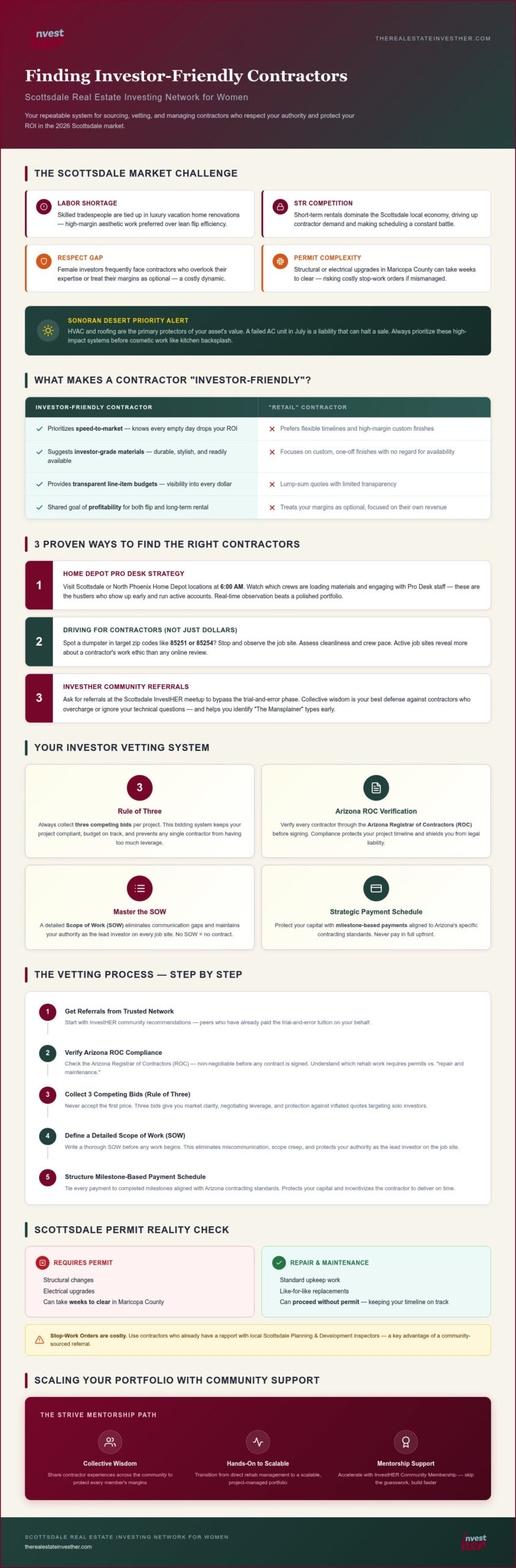
The Scottsdale construction market in 2026 is defined by high demand and a persistent labor shortage. Short-term rentals (STRs) continue to dominate the local economy, which means the most skilled tradespeople are often tied up in luxury vacation home renovations. These projects usually have massive budgets and flexible timelines, making them more attractive to “retail” contractors who prefer high-margin aesthetic work over the lean efficiency required for a flip. As a member of a Scottsdale real estate investing network for women, you’ll quickly learn that competing for these professionals requires a different strategy than a standard homeowner would use.
While the real estate investing fundamentals remain consistent, the Sonoran Desert climate adds a layer of urgency to every project. In Scottsdale, your HVAC and roofing systems are not just functional components; they are the primary protectors of your asset’s value. A failed air conditioning unit in July isn’t just an inconvenience; it’s a liability that can halt a sale or lead to property damage. You need a team that prioritizes these high-impact systems before focusing on the kitchen backsplash.
The Investor-Friendly Contractor Defined
An investor-friendly contractor understands that every day your property sits empty, your ROI drops. They prioritize speed-to-market because they know your holding costs are ticking. Unlike retail contractors who might focus on custom, one-off finishes, an investor-friendly partner suggests “investor-grade” materials that are durable, stylish, and readily available. They provide transparent line-item budgets that allow you to see exactly where your capital is going. This partnership is built on the shared goal of profitability, whether you are preparing a property for a quick flip or a long-term rental.
Scottsdale Zoning and Permit Realities
The City of Scottsdale Planning & Development department maintains strict standards that can impact your 2026 project timelines. Many common rehab projects in Maricopa County, such as structural changes or electrical upgrades, require specific permits that can take weeks to clear. A local Scottsdale real estate investing network for women can be an invaluable resource for finding contractors who already have a rapport with local inspectors. Knowing which projects require a permit and which can proceed under “repair and maintenance” is essential for keeping your timeline on track and avoiding costly stop-work orders.
Leveraging Your Scottsdale Real Estate Investing Network for Women
Finding a reliable contractor in Scottsdale requires moving beyond generic search engines. While popular apps offer convenience, they often feature “retail” pros who lack the speed and margin-consciousness investors need. Instead, tapping into a specialized Scottsdale real estate investing network for women provides access to a “hidden” market of vetted professionals. These are the tradespeople who have already proven their value to your peers and understand the nuances of a local flip or long-term rental.
One effective “boots on the ground” tactic is the Home Depot Pro Desk strategy. Visit the Scottsdale or North Phoenix locations at 6:00 AM. Observe which crews are loading materials and engaging with the Pro Desk staff. These are the hustlers who show up early and have active accounts. Similarly, “Driving for Dollars” isn’t just for finding distressed properties. It is a powerful way to identify active job sites. When you see a dumpster in a target zip code like 85251 or 85254, stop and observe the site’s cleanliness and the crew’s pace. This real-time observation tells you more than a polished portfolio ever could.
Networking Within the InvestHER Community
Asking for referrals in the Scottsdale InvestHER meetup allows you to bypass the trial-and-error phase. Collective wisdom is your best defense against contractors who might try to overcharge or ignore your technical questions. By sharing experiences, you can identify “The Mansplainer” contractors who don’t respect your role as the lead investor. This community-driven approach ensures you build a team that aligns with your professional vision. Connecting with like-minded women through an InvestHER Community Membership can accelerate this process and help you find partners who value your expertise.
Digital vs. Physical Sourcing Strategies
Be wary of contractors with overly polished websites or massive social media followings. Often, the most profitable investor-contractors are too busy on job sites to manage an Instagram feed. They rely on word-of-mouth and repeat business from a Scottsdale real estate investing network for women. While digital platforms have their place, the Arizona Registrar of Contractors (ROC) database is a more reliable discovery tool. Use it to check for active licenses and past complaints. This due diligence, combined with physical sourcing, creates a robust pipeline of talent for your next project.
The Investor’s Vetting Checklist: Arizona ROC and Beyond
Vetting is where you transform a list of names into a reliable power team. It’s a rigorous process that protects your capital and your peace of mind. This is why many members of a Scottsdale real estate investing network for women prioritize thorough screening over quick hires. Start with the “Rule of Three.” You must secure at least three detailed bids for any major rehab project. This isn’t just about finding the lowest price. It’s about establishing a market baseline for labor and materials in Maricopa County. Comparing these bids reveals who truly understands the scope and who might be cutting corners to win the job.
Your first line of defense is the Arizona Registrar of Contractors (ROC). In Arizona, a contractor’s license status is public information. You must verify their standing on the official ROC website. Look for active suspensions, open complaints, or a history of disciplinary actions. A clean record is non-negotiable. Ensure they carry both general liability insurance and workers’ compensation. Without these, a single job site injury could jeopardize your entire investment. Don’t settle for a verbal confirmation; ask for a physical certificate of insurance that names you or your LLC as an additional insured.
Financial and Legal Due Diligence
Professionalism extends beyond the job site. You need to verify that your contractor is financially stable. Check Maricopa County court records for mechanics liens or past litigation. A history of liens often suggests a contractor who fails to pay their own suppliers or subcontractors. Understand the difference between a General Contractor (GC) and a Specialty Subcontractor. A GC manages the entire project, while a specialty pro focuses on one trade like electrical, plumbing, or environmental remediation. For projects that uncover unexpected moisture or hazardous materials during demolition, you can learn more about Dryrite Restoration to understand when a specialized remediation partner is required. Always request a W-9 and current proof of insurance before the first hammer swings. This paper trail is essential for your tax records and your liability protection.
The Interview: Red Flags Every Woman Should Watch For
The interview is your chance to assess the “soft skills” that make or break a project. Pay attention to how they communicate. Do they answer their own phone, or are you stuck behind a gatekeeper? If they struggle to return a call during the bidding phase, they won’t improve when the project is underway. Watch for “The Mansplainer.” If a contractor directs technical answers to your male partner or speaks down to you, they don’t respect your role as the project owner. Ask who is actually swinging the hammer. Many GCs outsource the entire job to subcontractors you haven’t vetted. You deserve to know exactly who is inside your property. Leveraging the collective experience of a Scottsdale real estate investing network for women can help you identify these red flags before you sign a contract.
Master the Job Site: Management and Communication for Women
Managing a rehab site is an exercise in leadership that requires a balance of firm oversight and professional respect. While vetting ensures you have the right people, management ensures you get the right results. Many members of a Scottsdale real estate investing network for women find that the most successful projects are those with a granular Scope of Work (SOW). Your SOW should leave zero room for interpretation. Instead of a vague note to “update the flooring,” your document must specify the exact brand, SKU, and installation pattern. This level of detail protects your margins and prevents the “I thought you meant…” conversations that lead to budget bloat.
Financial leverage is your best tool for maintaining a project’s momentum. In Arizona, it is a strategic best practice to limit upfront deposits. For residential projects, many investors follow a strict rule of paying no more than 10% or a small fixed amount to cover initial mobilization. The remaining capital is released through a milestone-based payment schedule. You should only release funds once a specific phase of work is 100% complete and has passed your personal inspection. This keeps the contractor incentivized to reach the finish line and ensures your capital is always backed by tangible progress.
Setting Boundaries and Communication Cadence
Establishing a professional communication window is essential for your long-term well-being. Define your “office hours” early. Let your team know that while you are available for urgent site issues during the day, you don’t respond to non-emergency texts after 6 PM. To manage your Scottsdale rehab efficiently, use technology to your advantage. A shared digital folder for daily progress photos and videos allows you to monitor the site remotely. This creates a transparent paper trail for every change order, ensuring that any deviation from the original budget is documented and approved in writing before the work begins.
Navigating “The Only Woman in the Room” Dynamics
Asserting your authority on a construction site is about preparation and presence. When you walk onto a job site, you aren’t just a property owner; you are the CEO of the project. By speaking with the technical clarity you’ve gained from your Scottsdale real estate investing network for women, you signal that you understand the mechanics of the build. This professional stance turns a one-time contractor into a long-term strategic partner who respects your expertise. If you want to master the art of assembling a high-performing crew, consider joining the STRIVE Mentorship Program to learn how to lead a power team with confidence.
Scaling Your Scottsdale Portfolio with the STRIVE Mentorship
Scaling your real estate business isn’t about working more hours; it’s about building more resilient systems. For many, a reliable contractor is the “missing link” that transforms a stressful side hustle into a professional, project-managed portfolio. When you stop chasing crews and start leading a power team, your capacity to close deals in Scottsdale expands. This shift requires a fundamental change in your role from the person “doing” the work to the person leading the vision. Finding this balance is significantly easier when you are part of a Scottsdale real estate investing network for women that values strategic growth over individual grind.
The Power of Mentorship in Team Building
The STRIVE Mentorship provides the high-level guidance necessary to master these team dynamics. It’s one thing to vet a single contractor for a kitchen update; it’s another to manage multiple rehabs across Maricopa County simultaneously. By learning from seasoned women who have completed 50 or more rehabs in the Arizona market, you gain access to a blueprint for success. You’ll learn how to structure your business so that the construction process runs like a well-oiled machine, even when you aren’t on-site. This mentorship moves you away from the frantic pace of self-management and toward the steady cadence of a strategic leader who knows how to hold their team accountable to ROI.
Your Scottsdale Success Plan
Your Scottsdale success plan starts with intentional connection. Your first action item is to attend the local Scottsdale InvestHER meetup this month to begin building your referral base. This is where you find the peers who understand the specific pressures of the 2026 market. Being active in a Scottsdale real estate investing network for women ensures you aren’t navigating these challenges alone. As you look toward the horizon, attending InvestHER CON 2026 is a powerful way to find your next strategic partner or mentor. The search for a great contractor should never be a reactive scramble when you’re under contract. Instead, it should be a proactive part of your business development. It’s time to Scale Your Portfolio with the STRIVE Mentorship Program and step into your full potential as an investor.
Build Your Scottsdale Legacy with Confidence
Building a successful real estate portfolio in Arizona requires more than just capital; it requires a circle of trusted professionals who respect your vision. By implementing a rigorous vetting process through the Arizona ROC and securing milestone-based bids, you protect your assets from the common pitfalls of the local market. You’ve learned that your authority on the job site is non-negotiable and that a detailed Scope of Work is your best defense against budget bloat.
Transitioning from a solo investor to a strategic leader is a journey best taken with others. Joining a Scottsdale real estate investing network for women provides the collective wisdom and honest referrals you need to scale without the burnout. Led by industry experts Liz Faircloth and Andresa Guidelli, our community has been featured in Forbes and Entrepreneur for its commitment to empowering female investors. With over 50 local meetups across North America, we offer the support system you need to build a lasting legacy.
Join the InvestHER Community and Build Your Scottsdale Power Team today. Your next great project is waiting, and you have the tools to make it a masterpiece.
Frequently Asked Questions
Do I need a licensed contractor for a small cosmetic flip in Scottsdale?
In Arizona, you generally need a licensed contractor if the total cost of the project including labor and materials exceeds $1,000 or if a permit is required. While “handyman” exceptions exist for minor repairs, most cosmetic flips involving electrical, plumbing, or structural updates fall under ROC jurisdiction. Hiring licensed professionals ensures you have recourse through the Registrar of Contractors if the work fails to meet local Scottsdale building standards.
What is the Arizona Registrar of Contractors (ROC) and how do I use it?
The Arizona Registrar of Contractors (ROC) is the state agency responsible for licensing and regulating the construction industry. You can use their online portal to verify a contractor’s license status, check for active insurance, and review their disciplinary history. It’s a critical tool for any Scottsdale real estate investing network for women member looking to verify that a potential partner is in good standing before signing a contract or releasing funds.
How much should a contractor charge for a kitchen remodel in a Scottsdale rental?
Contractor pricing for a Scottsdale kitchen remodel varies based on the level of finishes and the current local labor market. Instead of looking for a fixed average, investors should focus on obtaining three detailed bids to establish a baseline for their specific project. Factors like semi-custom cabinets versus stock options and the complexity of plumbing relocations will significantly influence your final quote. Always prioritize “investor-grade” materials that offer high durability without the luxury retail markup.
Can I act as my own general contractor to save money on my Scottsdale rehab?
You can act as your own general contractor under Arizona’s owner-builder exemption, but this path requires significant time and technical expertise. You become responsible for hiring subcontractors, pulling permits, and ensuring code compliance. While it might seem like a way to save money, errors in management or scheduling can lead to expensive delays. Most successful investors find that hiring a professional GC allows them to focus on finding their next deal rather than managing daily job site tasks.
What happens if a contractor files a mechanics lien on my Scottsdale property?
A mechanics lien is a legal claim filed against your property by a contractor, subcontractor, or supplier who hasn’t been paid for work or materials. If this happens, it can cloud your title and prevent you from selling or refinancing the asset. To prevent this, always require unconditional lien waivers from your general contractor and all major subcontractors before issuing final payments. This documentation proves that all parties involved in the rehab have been compensated in full.
How do I handle a contractor who is behind schedule on my rehab project?
Handling a delayed project starts with clear communication and a review of your original contract. If your agreement includes a “time is of the essence” clause or liquidated damages for delays, you have a formal mechanism for accountability. Document all missed milestones and hold a site meeting to establish a revised, written timeline. If progress remains stagnant, you may need to issue a formal cure notice according to Arizona law before terminating the relationship and hiring a replacement.
Are there specific building codes in Scottsdale for short-term rental properties?
Scottsdale maintains specific ordinances for short-term rentals that go beyond standard residential building codes. These include requirements for emergency contact postings, specific safety features like pool barriers, and occupancy limits. Before starting a rehab for an STR, consult the Scottsdale Planning and Development department to ensure your renovations comply with the latest regulations. Staying informed through a Scottsdale real estate investing network for women can help you navigate these shifting local compliance requirements effectively.
How do I find female contractors or woman-owned construction firms in Phoenix?
Finding woman-owned construction firms in the Phoenix metro area is most effective through targeted networking rather than broad searches. You can check the Arizona ROC database or local business directories for Women Business Enterprise (WBE) certifications. However, the most reliable referrals often come from within the InvestHER community. Peer-to-peer recommendations ensure you’re connecting with professionals who have a proven track record of working successfully with other female investors on similar rehab projects.

Article by
Andresa Guidelli
Real estate investor, operator, and founder of The Real Estate InvestHER, a national platform supporting women real estate investors. With 15+ years of experience in real estate investing and business operations, she focuses on helping investors build stronger businesses behind their portfolios through better systems, clearer decision-making, leadership, and responsible use of AI.
Be the first to comment