


New York Real Estate Syndication: A Woman’s Guide
What if the most exclusive skyline in the world wasn’t actually off-limits to you? Most women looking at the New York market feel priced out before they even start. It’s easy to feel like the only woman in the room when faced with million-dollar entry points and complex legal jargon. This guide to New York real estate syndication for beginners is designed to help you navigate those hurdles with clarity and confidence. You aren’t alone in feeling that the barrier to entry is often high.
We’ll show you how to break through those barriers. You’ll master the fundamentals of passive investing and learn how to participate in multifamily assets without the stress of being a landlord. We’ll explore how to vet a New York deal with precision, find a supportive community of like-minded investors, and build a legacy through one of the world’s most competitive markets. By the end, you’ll understand how to turn the unapproachable New York market into a collaborative wealth-building tool that aligns with your pursuit of excellence and strategic growth.
Key Takeaways
- Shift from solo landlording to a collaborative team sport approach. It’s an effective way to scale your wealth passively.
- Discover why New York real estate syndication for beginners focuses on the economic resilience of boroughs like Brooklyn and Queens.
- Demystify the waterfall structure to understand how preferred returns protect your capital. You’ll gain clarity on how profits are shared.
- Learn to navigate NYC’s unique rent regulations by vetting sponsors who possess deep local expertise and a proven track record.
- Find your seat at the table by joining a community of women dedicated to financial independence and shared wisdom.
Demystifying New York Real Estate Syndication for Beginners
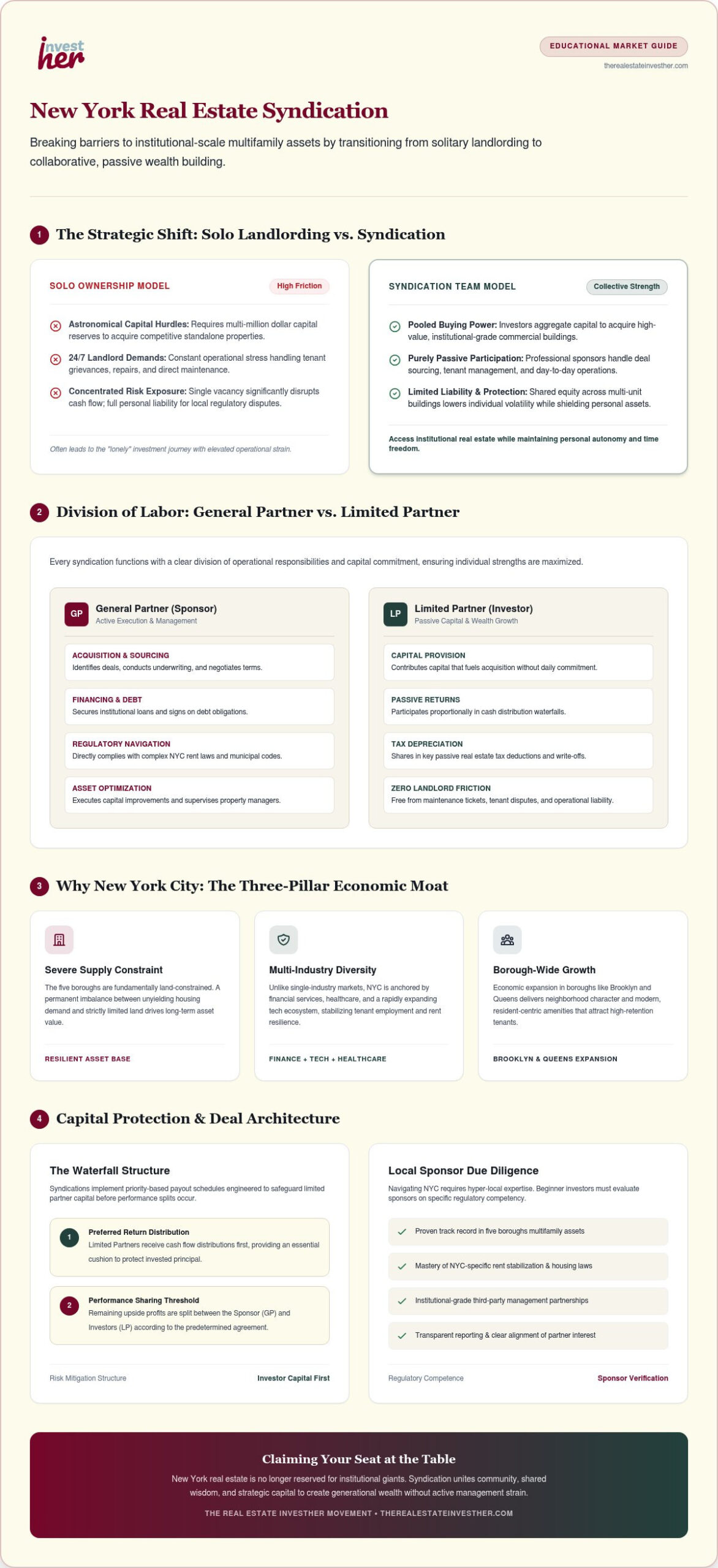
New York City real estate often feels like a gated community, reserved only for those with eight-figure bank accounts or decades of institutional experience. This perception keeps many ambitious women on the sidelines, watching from afar while others build massive portfolios. New York real estate syndication for beginners changes that narrative entirely. Think of syndication as a strategic team sport where individual investors pool their capital and collective wisdom to acquire high-value assets. Instead of trying to buy a $20 million apartment building alone, you join forces with a group to own a meaningful piece of it. This collaborative model turns the unapproachable into the accessible. It allows you to build a legacy in one of the world’s most resilient markets without needing to be a multi-millionaire on day one.
The allure of the New York market lies in its unique economic moat. High demand and limited supply create a foundation of historical resilience that few other cities can match. Even during global shifts, the density of talent and industry in NYC ensures a constant need for quality housing. Syndication provides a bridge for you to participate in this growth while maintaining your professional autonomy. You aren’t just buying into a building; you are investing in a proven economic engine alongside a community that values strategic excellence.
The General Partner vs. Limited Partner Roles
In every syndication, there is a clear division of labor that honors different strengths and time commitments. The General Partner (GP), often called the sponsor, handles the heavy lifting of the investment. They are responsible for finding the deal, securing the financing, and executing the daily business plan. They navigate the complex local regulations and manage the physical property assets. You, as the Limited Partner (LP), provide the essential capital that fuels the acquisition. Your role is primarily passive, meaning you share in the profits and tax benefits without the burden of active management. A Limited Partnership is a tool for passive wealth that allows you to benefit from real estate without the headaches of management.
Why Syndication Beats Direct Ownership in NYC
Attempting a DIY “fix and flip” or managing a small rental in Manhattan is often a logistical nightmare for a beginner. The entry costs are astronomical, and the competition is fierce. Direct ownership requires you to be a 24/7 landlord, managing tenants and maintenance in a city with some of the most complex housing laws in the country. Syndication offers a more sophisticated, sustainable path. You benefit from institutional-grade property management and the expertise of seasoned sponsors who know the local terrain. Instead of putting all your capital into one single-family home that might sit vacant, you can diversify across a multi-unit building. This approach limits your personal liability while maximizing your exposure to the city’s enduring rental demand. New York real estate syndication for beginners is the antidote to the “lonely” investment journey, replacing individual stress with collective strength.
Why NYC is the Ultimate Market for Collaborative Investing
New York City is far more than just a collection of iconic skyscrapers; it is a mosaic of micro-economies that offer unparalleled stability. While Manhattan often captures the global spotlight, the city’s true strength lies in its economic moat. A powerful mix of finance, healthcare, and a rapidly expanding tech sector creates a safety net for investors. This diversity ensures that even if one industry faces a downturn, the demand for quality housing remains constant. For those exploring New York real estate syndication for beginners, this multi-industry foundation provides a layer of security that is difficult to find in smaller, single-industry markets.
The 2026 outlook for the city reveals a landscape that has fully embraced its post-pandemic evolution. We are seeing a permanent shift toward resident-centric environments where people prioritize quality of life and neighborhood character. This transition has made institutional-grade assets, such as large apartment complexes with modern amenities, more valuable than ever. Through syndication, these high-level assets become accessible to individual women investors. You no longer need to be a billionaire to own a piece of the most resilient real estate market on earth. It is about moving from the sidelines into a position of ownership and strategic growth.
The Power of Multifamily Assets in New York
Multifamily housing remains the gold standard for recession-resistant investing in the five boroughs. New York is a supply-constrained environment; there is simply no more land to build on. This permanent imbalance between high demand and limited supply drives long-term value and consistent cash flow. We’ve seen a significant shift toward live-work-play developments in the outer boroughs, where residents seek community and convenience in equal measure. This trend makes multifamily syndications a sophisticated choice for those looking to build a legacy without the daily stress of property management.
Identifying High-Growth Niche Neighborhoods
Success in New York often requires looking beyond the obvious. While Manhattan is prestigious, Brooklyn and Queens frequently offer higher growth potential for collaborative investors. When vetting a deal, look for markers like transit proximity, strong school districts, and local cultural investments. Neighborhoods like Long Island City and Greenpoint have transformed into high-demand hubs because they offer a seamless blend of residential charm and professional access. Experienced sponsors often identify off-market gems in these pockets through deep-rooted local networks. Finding these opportunities is much more achievable when you are part of a supportive community of women who value collective wisdom over individual ego.
The Anatomy of a New York Syndication Deal
Understanding the mechanics of a deal is where fear transforms into fuel. When you explore New York real estate syndication for beginners, you aren’t just looking at a building; you are examining a structured financial vehicle designed for shared growth. Profit is the result of precision. To vet a deal with confidence, you must look beyond the glossy renderings and understand the core metrics that drive long term success. New York deals are marathon plays, typically targeting a hold period of three to seven years to allow the city’s natural appreciation and the sponsor’s value-add strategy to fully mature.
There are three primary metrics you will encounter in any offering memorandum. The Internal Rate of Return (IRR) measures the total profitability of the investment over time, accounting for the time value of money. The Equity Multiple tells you how many times your initial capital will be returned to you over the life of the deal. Finally, the Cash-on-Cash Return represents the annual yield you receive based on your actual investment. By focusing on these metrics, you shift from a place of uncertainty to a position of informed authority.
Understanding the Waterfall and Preferred Return
The waterfall is a tiered structure that dictates how cash flow is distributed between the limited partners and the sponsor. It often begins with a “Preferred Return,” which is a specific percentage of profit paid to investors before the sponsor receives any share of the remaining upside. This hurdle provides a layer of safety for your passive capital, ensuring your interests are prioritized. Waterfalls align the GP’s interest with the LP’s success by ensuring performance precedes profit sharing for the sponsor. This alignment is the foundation of a healthy, transparent partnership.
The Life Cycle of an NYC Syndication
The journey of a syndication deal moves through distinct phases, each requiring specialized expertise. It begins with acquisition and the value-add phase, where the sponsor renovates units, upgrades common areas, or improves building systems to increase the Net Operating Income (NOI). During the operations phase, professional asset management becomes critical, especially when navigating the nuances of the New York rental market. The final stage is the exit, where the sponsor either refinances the property to return capital to investors or sells the asset to capture the accumulated appreciation. This structured cycle is designed to turn a physical asset into a sustainable engine for passive wealth.
Navigating NYC-Specific Risks and Regulations
New York’s regulatory environment is often seen as a hurdle, but for the informed investor, it’s a filter that rewards diligence. When you approach New York real estate syndication for beginners, you must recognize that local laws are part of the landscape. Rent stabilization is a primary factor. These units have rent increases capped by the city, which directly impacts how a sponsor calculates future income. Additionally, the NYC “Class 2” property tax system is famously nuanced. A sponsor without local data might underestimate these costs, eating into your returns. Successful investing here requires more than capital. It requires a deep respect for the city’s unique legal fabric.
Tenant protections in the five boroughs are among the strongest in the nation. This isn’t a reason to shy away, but it’s a reason to ensure your sponsor is an expert in local housing laws. From the Housing Stability and Tenant Protection Act of 2019 to evolving local mandates, the “rules of the game” change often. You don’t need to be a legal expert yourself, but you do need to know that your partnership has the expertise to remain compliant while protecting your asset’s value. Clarity in these areas is the antidote to the fear of the unknown.
Vetting the Sponsor for New York Expertise
A national sponsor might have a glowing track record in the Sun Belt, but New York is a different beast entirely. You should prioritize sponsors with “boots on the ground” experience. Ask if they’ve successfully navigated the NYC Department of Buildings (DOB) or handled complex renovations within the city’s strict code requirements. Vertical integration is often a major advantage in this market. When a sponsor owns the property management arm, they have direct control over the tenant experience and maintenance costs. This alignment reduces the risk of third party mismanagement in a high stakes environment.
Understanding the Legal Paperwork
Before you commit your capital, you’ll encounter three critical documents that define your rights and risks. The Private Placement Memorandum (PPM) is your essential guide to the deal’s potential pitfalls. It’s a transparent disclosure of everything that could go wrong. The Operating Agreement is the “power map” of the deal. It outlines who has decision making authority and how profits are distributed. Finally, the Subscription Agreement is the document you sign to officially join the partnership. Understanding these documents provides the autonomy you need to invest with peace of mind. To master these complexities alongside a supportive network, join the InvestHER Community Membership and move from the lonely investment journey toward collective strength.
Joining the InvestHER Movement in New York
You don’t have to navigate the concrete jungle alone. In a market as fierce as NYC, community isn’t just a luxury; it’s your most potent secret weapon. For many, the primary hurdle isn’t a lack of capital or interest. It’s the isolation of being the “only woman in the room” in traditional investment circles. Collaborative investing allows you to overcome this syndrome by surrounding yourself with peers who share your professional ambition and personal values. When you explore New York real estate syndication for beginners, you aren’t just buying into a physical asset. You are joining a movement of women who are redefining wealth in the world’s most competitive arena.
This shift from individual effort to collective strength is transformative. It turns a high-barrier market into a shared opportunity for growth and legacy. By pooling resources and wisdom, we move away from cold, transactional interactions toward a more holistic, community-driven approach to wealth. This is about more than just buildings. It is about the intersection of financial independence and personal well-being.
Scaling with the STRIVE Mentorship
Building a sustainable portfolio requires more than just one successful deal. It requires a repeatable strategy and high-level networking that isn’t available on public forums. The STRIVE Mentorship is designed to take you from “interested” to “invested” by providing the strategic framework needed to scale. You’ll gain access to deep-rooted industry wisdom and a network of seasoned professionals who understand the nuances of the five boroughs. This program bridges the gap between theoretical knowledge and practical execution. If you want to move beyond the basics and start building a legacy, you can find a real estate mentor in New York to guide your next strategic move.
The Power of The Real Estate InvestHER Community
Collective wisdom accelerates growth. By sharing real-world lessons through The Real Estate InvestHER network, you avoid common pitfalls and identify off-market opportunities that others might miss. This journey isn’t just about annual yields or equity multiples. It is about creating generational wealth and the personal autonomy that comes with true financial independence. Mastering New York real estate syndication for beginners is far more achievable when you have a supportive community behind you. To meet your future partners and network directly with NYC sponsors, you should get your InvestHER CON 2026 ticket today. This event is where the strategic scaling of your portfolio begins, grounded in the power of a tight-knit network that values partnership over individual ego.
Claim Your Seat at the New York Table
The New York skyline doesn’t have to be a distant dream. By mastering the fundamentals of New York real estate syndication for beginners, you’ve already taken the first step toward reclaiming your time and building a lasting legacy. You now understand that passive investing in multifamily assets offers a path to wealth that doesn’t require you to sacrifice your personal well-being or become a full-time landlord. This is about moving from a place of uncertainty to a position of informed authority.
Success in this market is never a solo journey. Founded by industry leaders Liz Faircloth and Andresa Guidelli, our global community of 30,000+ women investors provides the shared understanding and collective strength you need to thrive. It’s time to move from being a spectator to a strategic participant in one of the world’s most resilient economies. You are ready to align your financial goals with a life of purpose and intentionality. Join the STRIVE Mentorship to scale your NYC portfolio today and start building your future alongside peers who value your growth as much as you do. Your journey toward financial independence is just beginning.
Frequently Asked Questions
Is real estate syndication legal in New York?
Yes, it is legal and regulated by the SEC and the New York Attorney General’s office. Most offerings fall under federal Regulation D. Sponsors must file specific paperwork to remain compliant with both state and federal laws. It’s a standard practice for pooling capital to acquire large multifamily assets. Beginners should ensure their sponsor has legal counsel experienced in New York’s specific filing requirements to protect the partnership’s status.
How much money do I need to start investing in an NYC syndication?
Minimum investments vary by deal, but they typically range from $25,000 to $50,000. Some exclusive opportunities might require $100,000 or more. This lower entry point is a key part of New York real estate syndication for beginners, as it allows you to own a portion of a multi-million dollar building without needing the full purchase price. Always check the Private Placement Memorandum for specific requirements of each offering.
What is an “accredited investor” and do I need to be one?
An accredited investor is someone who meets specific income or net worth thresholds defined by the SEC. Currently, this includes an annual income of $200,000 or a net worth of $1 million excluding your primary residence. While many NYC deals are restricted to accredited investors, some offerings allow a limited number of sophisticated, non-accredited investors to participate. This ensures the partnership remains inclusive while adhering to federal securities regulations.
How do New York rent control laws affect my investment returns?
Rent regulation laws, specifically rent stabilization, cap the annual percentage a landlord can increase rent. This creates a more predictable but sometimes slower growth curve for income. Sponsors factor these regulations into their initial underwriting to ensure the deal remains profitable. Expert sponsors often focus on value-add strategies that improve building efficiency or renovate non-stabilized units to drive growth while remaining fully compliant with local housing mandates.
Can I use my 401(k) or IRA to invest in a New York syndication?
You can use retirement funds if you have a Self-Directed IRA or a Solo 401(k). This allows you to invest in alternative assets like real estate while maintaining tax-advantaged status. You’ll need to work with a specialized custodian to handle the paperwork and ensure the investment complies with IRS rules. It’s a powerful way to diversify your retirement portfolio beyond traditional stocks and bonds while building a legacy.
What happens if the NYC real estate market goes down?
Real estate is a long-term play, and syndications are structured to weather market cycles. New York’s diverse economy and high demand often provide a buffer during national downturns. If property values dip, the sponsor might extend the hold period until the market recovers. Because these are cash-flowing multifamily assets, the primary goal is maintaining occupancy and income even if the underlying asset’s paper value fluctuates temporarily during the hold.
How often do I receive cash flow payments from a syndication?
Distributions are typically paid out on a quarterly or monthly basis, depending on the specific deal’s operating agreement. These payments represent your share of the property’s rental profits after expenses and debt service are covered. Some value-add projects might pause distributions during the initial renovation phase to reinvest capital into the building. Your sponsor will outline the expected payment schedule in the offering memorandum before you commit capital.
Is syndication better than buying a condo in Brooklyn?
It depends on your goals, but syndication offers a truly passive experience. When you buy a condo, you’re responsible for maintenance, tenant issues, and individual property taxes. In New York real estate syndication for beginners, professional teams handle the daily operations. You benefit from economies of scale and professional management. This allows you to build wealth without the stress of being a landlord in a complex and competitive regulatory environment.

Article by
Andresa Guidelli
Real estate investor, operator, and founder of The Real Estate InvestHER, a national platform supporting women real estate investors. With 15+ years of experience in real estate investing and business operations, she focuses on helping investors build stronger businesses behind their portfolios through better systems, clearer decision-making, leadership, and responsible use of AI.
Be the first to comment