


HELOC Down Payment Risks: Guide for Women Investors
Imagine standing in your kitchen, looking at the walls that protect your family, while wondering if that same equity could fund your next three rental properties. It is a heavy realization that your greatest asset is also your most significant source of untapped capital. You likely feel a deep sense of hesitation when weighing the risks of using a HELOC for a down payment, especially with national average rates hovering around 7.11% as of September 2026. Single women currently own over 20 million homes in the U.S., which means we hold an incredible amount of collective power, but that power comes with the responsibility of protecting our peace of mind.
We understand that “over-leveraged” anxiety. It is natural to worry about variable interest rates or the fear of a deal going south and affecting your primary home. This guide will help you master the complexities of home equity leverage so you can scale your real estate portfolio without compromising your financial foundation. We will break down the math behind smart leverage, provide a framework to decide if the reward justifies the risk, and give you the confidence to take that next strategic step toward your legacy.
Key Takeaways
- Learn how to transform “lazy equity” in your primary residence into a strategic down payment for new, income-producing assets.
- Identify the four major risks of using a HELOC for a down payment, including variable rate volatility and the potential impact on your primary home.
- Compare the flexibility of a credit line against the security of a cash-out refinance to preserve your historical low interest rates.
- Apply the “Sleep Well at Night” (SWAN) ratio to maintain a safe loan-to-value threshold that protects your household foundation.
- Discover how professional mentorship and collective wisdom help you vet the math of leverage to avoid the pitfalls of solo investing.
Leveraging Equity: How Using a HELOC for a Down Payment Works
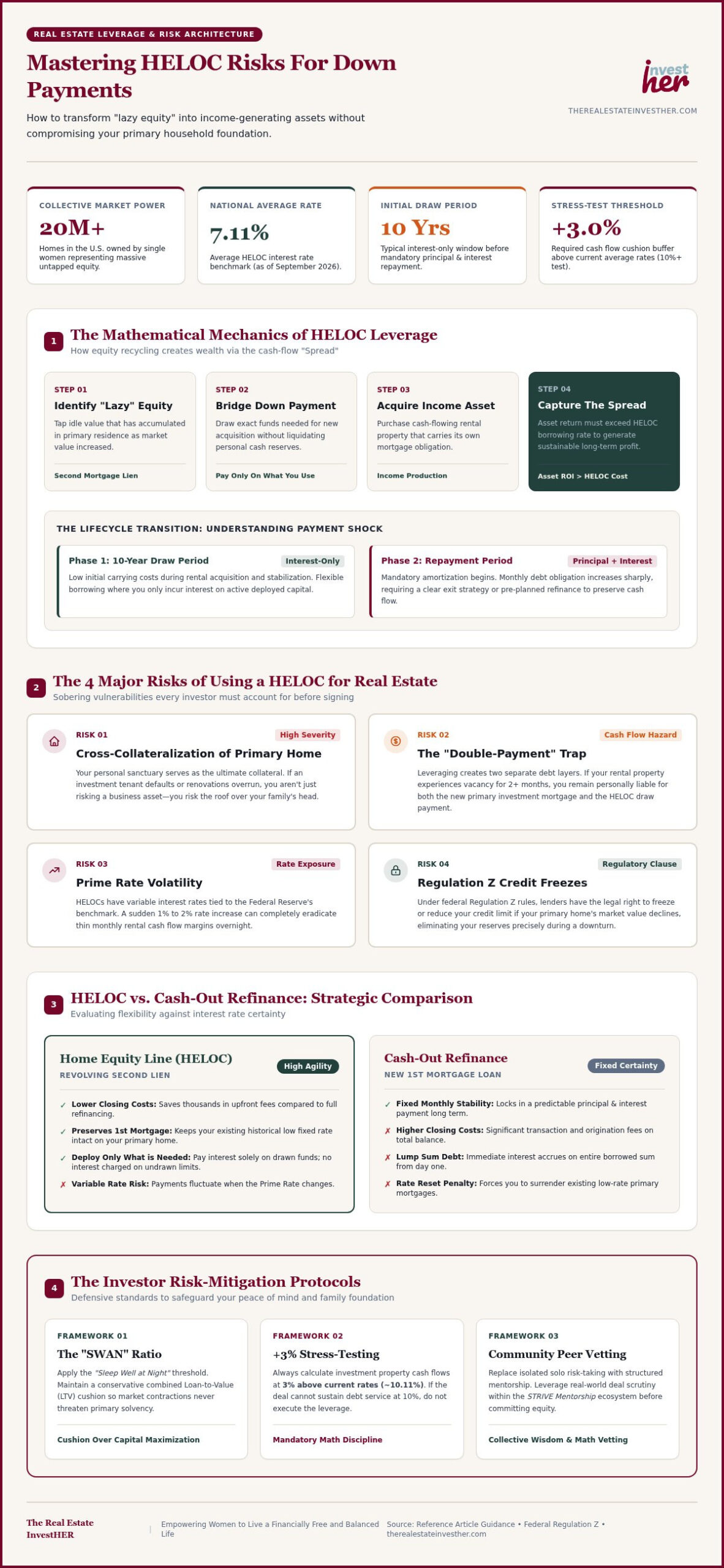
A home is often a place of sanctuary, but for the strategic investor, it’s also a powerful engine for growth. A Home equity line of credit (HELOC) acts as a second mortgage, giving you access to the “lazy equity” that has built up as your property value increased. Instead of letting that wealth sit idle, you can use it to bridge the capital gap for your next acquisition. Women investors are increasingly turning to this method because it provides a path to ownership without needing years of aggressive personal savings. However, you must weigh the potential rewards against the very real risks of using a HELOC for a down payment before signing any documents.
Understanding the timeline is vital for your long-term stability. Most HELOCs feature a ten-year draw period where you only pay interest on what you use. Once that window closes, you enter the repayment period, where you must pay back both principal and interest. This shift can be a shock to your monthly cash flow if you haven’t prepared for the transition. Navigating these complexities is easier when you have the support of The Real Estate InvestHER Community Membership, where peers share their real-world experiences with leverage.
The Mathematical Appeal of HELOC Leverage
The goal is simple. The return on your new investment property should exceed the interest rate on your HELOC. This “spread” is where wealth is created. A HELOC serves as a temporary financial bridge that allows you to secure a new asset while keeping your existing cash reserves intact. By “recycling” equity from one property to buy another, you can scale your portfolio at a pace that traditional savings simply cannot match. It’s a sophisticated maneuver that requires a growth mindset and a clear exit strategy while also accounting for the specific risks of using a HELOC for a down payment, such as interest rate fluctuations.
Why Investors Choose HELOCs Over Traditional Loans
Efficiency matters when you’re building a legacy. HELOCs typically carry much lower closing costs than a full cash-out refinance, which can save you thousands of dollars in upfront fees. You also benefit from interest-only payment options during the initial draw period, keeping your initial carrying costs low while the rental property stabilizes. Perhaps the greatest advantage is flexibility. You only pay for the capital you actually deploy. If a deal falls through, you aren’t stuck paying interest on a lump sum sitting in a bank account. This level of control is exactly why many women in our STRIVE Mentorship Program prefer this tool for scaling.
The 4 Major Risks of Using a HELOC for Real Estate Investing
Tapping into your home equity feels like a superpower until you remember what is actually at stake. Your primary residence is the ultimate collateral. If a tenant stops paying or a renovation goes over budget, you aren’t just risking a business asset; you’re risking the roof over your head. This cross-collateralization is the most sobering of the risks of using a HELOC for a down payment. With national average HELOC rates currently at 7.11% as of September 2026, the cost of this capital is significant, and the stakes are personal.
You must also prepare for the “double-payment” trap. When you use equity to fund a new purchase, you create two separate debt obligations. If your rental property sits vacant for two months, you are still responsible for the new mortgage and the HELOC payment. Furthermore, under Regulation Z, lenders can freeze your credit line if your home’s market value drops significantly. This means your “emergency fund” could disappear exactly when you need it most. Reviewing Federal Trade Commission guidance on home equity credit can help you understand the legal protections and pitfalls of these revolving lines.
Interest Rate Risk in a Shifting Economy
Most HELOCs are tied to the Prime Rate, meaning your monthly payment can change overnight. A mere 1% or 2% rate hike can quickly evaporate the thin cash flow margins of a new rental property. This volatility creates a heavy psychological toll, as you’re constantly checking the Federal Reserve’s next move. We recommend “stress-testing” your numbers by calculating your cash flow at a rate 3% higher than today’s average. If the deal doesn’t work at 10%, it’s likely too risky for your foundation. Learning to run these numbers with precision is a core focus within the STRIVE Mentorship Program.
The Impact on Your Debt-to-Income (DTI) Ratio
Lenders view HELOCs as “invisible debt” that can complicate your future scaling. Even if you haven’t drawn the full amount, some banks calculate your DTI based on the entire available credit limit. This can lower your borrowing power when you try to secure a conventional loan for your third or fourth property. To maintain your momentum, you must keep a borrowing buffer. Don’t max out your equity just because the bank says you can. Instead, leave a portion of that credit line untouched to signal financial stability to future lenders and protect your long-term autonomy.
HELOC vs. Cash-Out Refinance: Which is Riskier for Your Portfolio?
Choosing between a HELOC and a cash-out refinance is a defining moment for your portfolio’s resilience. In 2026, many women investors face the “Rate Lock” dilemma. If you have a primary mortgage at 3.5% from 2021, a cash-out refinance would reset your entire debt to the current average of 7.12%. That’s a significant price for liquidity. A HELOC allows you to keep your low rate on the first mortgage while only paying today’s rates on the equity you actually draw. You must carefully weigh the risks of using a HELOC for a down payment against the permanent cost of a refinance. This CFPB analysis of home equity financing options clarifies how these two instruments impact your debt structure differently.
Closing costs also play a major role in your math. Refinancing typically costs between 2% and 5% of the total loan amount. On a $500,000 mortgage, you could pay $25,000 in fees. HELOCs usually have minimal upfront costs, making them attractive for smaller capital needs. However, the risks of using a HELOC for a down payment include the potential for interest expenses to spiral if the Prime Rate moves upward. You must have a clear exit strategy for either choice to ensure your household stability isn’t compromised by shifting market conditions.
When the HELOC is the Clear Winner
A HELOC is often the superior choice for short-term “buy, rehab, refinance” (BRRRR) cycles. If you only need a portion of your equity to bridge a gap in high-appreciation markets like Scottsdale or San Diego, the flexibility is invaluable. You only pay interest on the funds deployed, and you can pay the balance down as soon as your investment property is stabilized. It provides the agility needed to move quickly on a deal without the heavy burden of permanent debt restructuring.
When a Cash-Out Refinance is the Safer Path
Predictability is the cornerstone of a “buy and hold” strategy. If your goal is long-term stability, a cash-out refinance offers fixed-rate security that a HELOC cannot match. This path protects you from payment shock during high-inflation cycles. It’s also a powerful tool if you need to consolidate high-interest debts alongside your investment. By rolling everything into one fixed payment, you simplify your finances and ensure your monthly obligations remain constant for the next thirty years. This approach provides a sense of peace that variable rates often lack.
Mitigating Risk When Using Home Equity to Scale
Scaling a portfolio requires courage, but it shouldn’t cost you your sleep. The “Sleep Well at Night” (SWAN) ratio is your most important metric. While many traditional lenders allow a combined loan-to-value (CLTV) of up to 90% for high-credit borrowers, we recommend capping your total leverage at 70% to 75%. This buffer protects you if property values dip, preventing you from being “underwater” on your own home. By limiting your exposure, you mitigate the most severe risks of using a HELOC for a down payment, ensuring that a market correction doesn’t become a personal crisis.
Strategic investors also utilize a “Cash Reserve Ladder” to handle the double-debt obligation. Instead of a generic savings account, you need six to twelve months of principal, interest, taxes, and insurance (PITI) for both your primary residence and your new investment property. This liquidity acts as a shield against vacancy or sudden repairs. You should also avoid cross-collateralization whenever possible; keeping your assets legally and financially distinct prevents a domino effect if one property underperforms.
The Investor Safety Checklist
- Reserves: Do you have 6 to 12 months of PITI reserves for BOTH properties?
- DSCR: Is the rental property’s Debt Service Coverage Ratio (DSCR) above 1.25 when including the new HELOC interest payment?
- Appraisal: Obtaining an independent professional appraisal before committing to a credit line ensures your equity calculations are based on reality rather than optimistic market projections.
Local Market Nuances: Scottsdale to Philadelphia
Market volatility varies by region, making local data indispensable. In high-growth hubs like Phoenix or Austin, equity can build fast, but it can also compress quickly during a correction. You must also understand state-specific legalities. For example, Texas uses non-judicial foreclosure, which moves significantly faster than the judicial process in states like Pennsylvania. Tapping into local InvestHER meetups in cities like Scottsdale or San Diego is the best way to find investor-friendly lenders who understand these nuances. You don’t have to navigate these risks of using a HELOC for a down payment alone. Join the InvestHER Community Membership to vet your leverage strategies with women who have already walked this path.
Scaling with Confidence: Why Community and Mentorship Outperform Solo Risk-Taking
Real estate investing is often portrayed as a solo race, but the “Lone Wolf” approach is a primary driver of financial failure. When you operate in isolation, your blind spots become your biggest liabilities. This is particularly true when navigating the risks of using a HELOC for a down payment, where one miscalculation can threaten your family’s primary residence. Scaling with confidence requires moving beyond individual ego and tapping into a collective wisdom that has already stress-tested these strategies. You don’t have to carry the weight of these decisions alone.
The STRIVE Mentorship Program is designed specifically to help you vet your leverage math before you sign a single loan document. Mentors who have managed through multiple market cycles can help you identify if your projected cash flow is realistic or if you’re overlooking hidden costs like variable rate resets. Similarly, the InvestHER Community Membership provides a platform to share “Red Flag” deals, allowing you to learn from others’ near-misses rather than your own expensive mistakes. Investing in your knowledge first, perhaps by securing an InvestHER CON Ticket, is the most effective hedge against the inherent risks of using a HELOC for a down payment.
Strategic Networking as a Risk Management Tool
True risk management happens in the conversations you have with peers who have already successfully navigated home equity leverage. Through our community, you gain access to “off-market” wisdom that traditional banks simply won’t disclose, such as which lenders are currently freezing lines or which local markets are showing signs of equity compression. It’s about building a core team of trusted advisors, including CPAs, attorneys, and specialized mortgage teams like loansbyjb.com, who understand complex loan scenarios and the specific needs of women investors. This network transforms a high-risk financial maneuver into a calculated, supported business decision.
Taking the Next Step Toward Wealth
Empowerment comes from moving away from fear-based hesitation and toward fact-based execution. You don’t have to wait until you have all the answers to start your scaling journey; you just need to be in the right room. By joining the InvestHER Community, you align yourself with a movement of women dedicated to financial independence and sustainable growth. We invite you to Join the STRIVE Mentorship Program to scale your portfolio with expert guidance and turn your home’s equity into a legacy of lasting wealth.
Building Your Legacy with Strategic Leverage
Navigating the risks of using a HELOC for a down payment is not just a financial exercise; it’s a step toward personal autonomy and long-term security. By mastering the “Sleep Well at Night” ratio and choosing the right financing structure for your specific market, you transform a potential liability into a powerful tool for growth. You have the vision to scale. Now, you need the collective wisdom to ensure your foundation remains unshakable. Real estate is a marathon, and the most successful runners are those who refuse to go it alone.
You don’t have to navigate these complexities in isolation. Join over 10,000 women investors in our global community and learn from industry leaders who have successfully scaled 100+ unit portfolios. With direct mentorship from Liz Faircloth and Andresa Guidelli, you can move from hesitation to high-level execution. It’s time to align your professional ambition with your personal well-being. Secure your spot at InvestHER CON 2026 to master advanced investment strategies and take the next step in your journey. Your future self will thank you for the intentionality and courage you show today.
Frequently Asked Questions
Is it a good idea to use a HELOC for a down payment in 2026?
Whether it is a good idea depends entirely on your specific deal math and cash flow margins. In 2026, with average HELOC rates around 7.11%, the cost of capital is higher than in previous years. You must ensure the rental income comfortably covers both the primary mortgage and the new credit line. For investors in Scottsdale or Phoenix, where appreciation is often high, this can be a powerful tool if you have a clear exit strategy.
What is the maximum HELOC I should take for an investment?
We recommend maintaining a combined loan-to-value (CLTV) ratio of no more than 70% to 75% on your primary residence. While some lenders in cities like San Diego or Austin might allow up to 90%, leaving an equity cushion protects you against market volatility. This conservative approach ensures you don’t end up underwater if property values dip. Always prioritize your household’s financial stability over aggressive portfolio growth to maintain your long-term peace of mind and financial autonomy.
Can I lose my primary home if I default on an investment property bought with a HELOC?
Yes, your primary residence serves as the direct collateral for the line of credit. If the investment property fails to generate income and you cannot cover the HELOC payments, the lender has the legal right to foreclose on your home. This cross-collateralization is one of the most significant risks of using a HELOC for a down payment. It is vital to have robust cash reserves for both properties to prevent a business setback from becoming a personal crisis.
How does a HELOC affect my credit score for future rental loans?
A HELOC impacts your credit in two main ways: your credit utilization ratio and your debt-to-income (DTI) ratio. Even if you don’t draw the full amount, some lenders in markets like Dallas or Philadelphia view the entire limit as potential debt. High utilization can temporarily lower your score, while a higher DTI might limit your ability to secure conventional financing for future properties. Managing your draws carefully helps maintain your borrowing power for long-term scaling and strategic growth.
Are HELOC interest rates tax-deductible when used for investment properties?
Interest is generally deductible if the funds are used strictly for an income-producing rental property. Under IRS interest tracing rules, the deductibility depends on how you use the money rather than what asset secures the loan. You should document the transfer directly from your HELOC to the investment escrow account. We always suggest consulting a tax professional to ensure you are correctly reporting these expenses on Schedule E to maximize your rental business deductions and protect your bottom line.
What happens to my HELOC if the housing market crashes?
If home values drop significantly, your lender may freeze your credit line or reduce your limit under Regulation Z. This often happens during market corrections in volatile hubs like Phoenix or Orlando. You might lose access to undrawn funds exactly when you need them most for repairs or capital expenditures. Relying on a HELOC as your only emergency fund is dangerous; you must maintain separate liquid cash reserves to weather a market downturn safely and with confidence.
Should I use a HELOC or a 401k loan for a down payment?
Choosing between these tools depends on your employment stability and tax strategy. A HELOC offers higher borrowing limits but carries the risks of using a HELOC for a down payment, such as variable interest rates and primary home collateral. A 401k loan doesn’t involve your home, but you lose out on market gains, and the balance often becomes due immediately if you leave your job. Discussing these nuances with your mentorship group can help you decide which path aligns.
How long does it take to get approved for a HELOC for investing?
Approval timelines typically range from two to six weeks, depending on the lender’s appraisal requirements and your financial complexity. In fast-moving markets like Austin or New York, you should start the application process well before you find a deal. Having your line of credit ready to go allows you to act as a “cash-like” buyer, giving you a competitive edge. Ensure your documentation, including tax returns and property records, is organized to expedite the bank’s review process.

Article by
Andresa Guidelli
Real estate investor, operator, and founder of The Real Estate InvestHER, a national platform supporting women real estate investors. With 15+ years of experience in real estate investing and business operations, she focuses on helping investors build stronger businesses behind their portfolios through better systems, clearer decision-making, leadership, and responsible use of AI.
Be the first to comment