


Mistakes to Avoid When Scaling Your Portfolio: A Strategic Investor Checklist
Adding more doors to your business won’t fix a fractured foundation; it only magnifies the cracks. If you’re exhausted from juggling daily operations while trying to analyze new deals, you already know the toll of unaligned growth. With investment property mortgage rates hovering between 7.4% and 8.15%, the margin for underwriting error has evaporated. Understanding the critical mistakes to avoid when scaling your portfolio is no longer just about boosting your returns. It’s about protecting your hard-earned equity, your time, and your family’s baseline.
You started investing to build true freedom, not to trap yourself inside an overwhelming, round-the-clock job. Sustainable portfolio growth requires disciplined systems, intelligent debt structures, and community leverage before you take down the next asset, not after. In this guide, you’ll uncover the blind spots that derail promising investors and learn how to stress-test your existing assets. Ahead, our strategic investor checklist gives you the roadmap to expand with clarity, protect your peace of mind, and scale on your own terms.
Key Takeaways
- Recognize why unit count is a dangerous vanity metric, and learn to prioritize net monthly cash flow and balance sheet liquidity over rapid door acquisition.
- Uncover the critical operational mistakes to avoid when scaling your portfolio, moving away from solo-landlord exhaustion toward repeatable, institutional-grade systems.
- Protect your hard-earned equity by identifying common underwriting blind spots, from unverified utility expenses to underbudgeted capital reserves.
- Execute a structured, five-part pre-acquisition audit to stress-test your existing debt, operations, and cash buffers before signing your next purchase contract.
- Discover how strategic mentorship and community alignment ensure your real estate growth elevates your personal freedom rather than chaining you to another job.
The Scaling Trap: Mistaking Unit Count for True Wealth and Liquidity
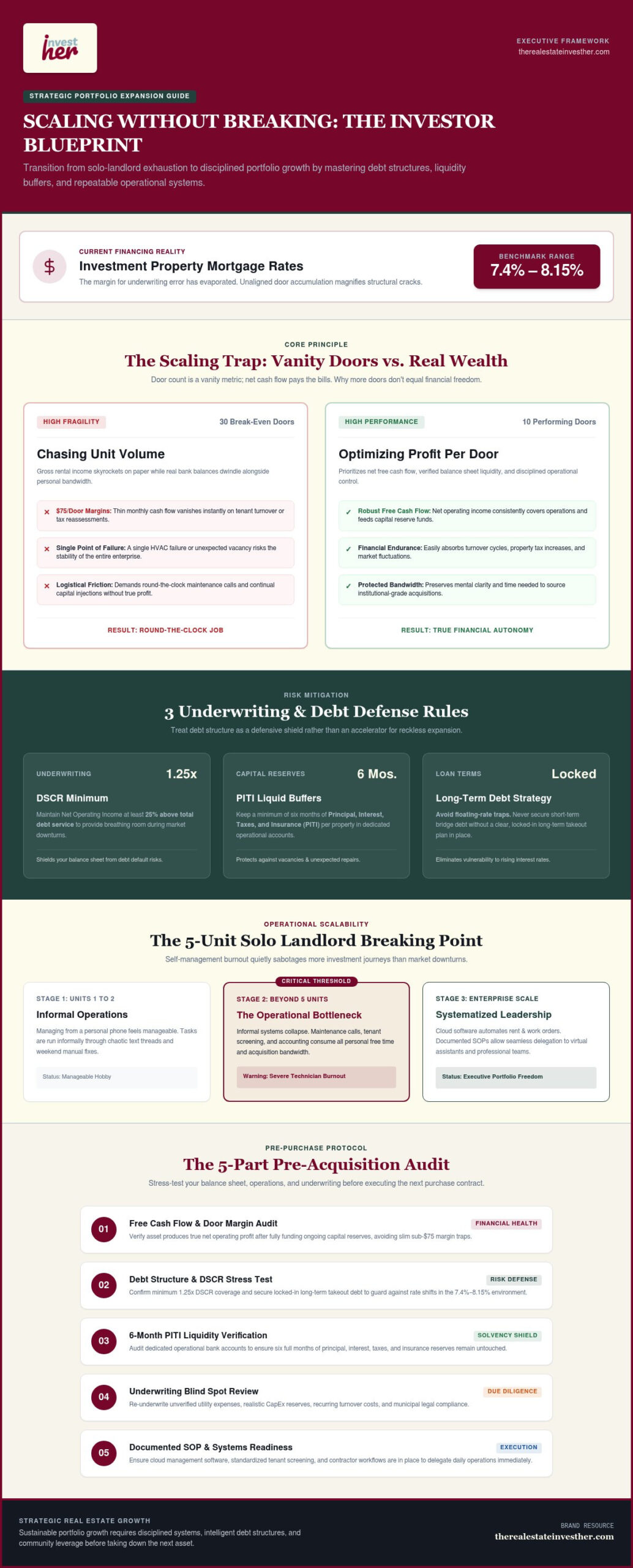
Door count is a vanity metric; net cash flow pays your bills. One of the most insidious mistakes to avoid when scaling your portfolio is prioritizing unit accumulation over free cash flow and balance sheet liquidity. When you fall into this trap, your gross rental income might skyrocket on paper, but your actual bank balance dwindles alongside your personal bandwidth. You end up owning a massive, fragile operation where a single HVAC failure or unexpected vacancy puts your entire portfolio at risk.
Sustainable growth in real estate investing requires financial endurance. If a property produces only $75 in monthly cash flow, that slim margin can vanish the moment tenant turnover occurs or local property taxes jump. Rather than racing to announce 50 doors on social media, true wealth builders optimize profit per door first. A lean, highly optimized portfolio of ten performing doors consistently outperforms thirty break-even assets that demand round-the-clock maintenance and constant capital injections.
Chasing Door Count Instead of Net Free Cash Flow
Gross revenue looks impressive until real-world operating expenses hit. Many investors fail to account for realistic capital expenditure reserves, recurring turnover costs, and legal compliance. Break-even properties amplify logistical friction without delivering disposable wealth. Worse, managing these low-margin properties drains the emotional and mental bandwidth you need to source truly profitable acquisitions. Focus on net operating income after funding dedicated reserves, not top-line receipts.
Overleveraging Capital and Ignoring Debt Service Coverage Ratios
Cheap leverage often conceals poor underwriting, but shifting debt markets expose those cracks instantly. Understanding your Debt Service Coverage Ratio (DSCR) protects your enterprise from capital insolvency:
- Target a 1.25x DSCR minimum: Maintaining net operating income at least 25% above your total debt service gives you breathing room during unexpected market downturns.
- Avoid floating-rate traps: Securing short-term bridge debt without a clear, locked-in long-term takeout plan leaves you vulnerable when interest rates rise.
- Maintain liquid cash buffers: Keep at least six months of principal, interest, taxes, and insurance (PITI) per property in dedicated operational accounts.
By treating debt structure as a defensive shield rather than an accelerator for risky expansion, you sidestep key mistakes to avoid when scaling your portfolio. True wealth gives you choices, peace of mind, and financial autonomy. Expanding too quickly without adequate debt coverage or cash reserves only chains you to the very stress you set out to escape.
Operational Breakdown: Scaling Your Portfolio as a Solo Landlord
Self-management burnout quietly sabotages more investment journeys than market downturns ever will. Managing your first two rental properties from your personal phone feels manageable, but expanding past five units with that informal approach creates an operational bottleneck. When you treat your growing portfolio like an informal hobby rather than an enterprise, your free time evaporates. Stepping into the role of a strategic portfolio leader means shifting from an exhausted technician who fixes minor leaks to an executive who designs dependable systems.
Every seasoned investor must confront operational roadblocks before taking on new acquisitions. Among the most costly mistakes to avoid when scaling your portfolio is attempting to run every showing, maintenance call, and accounting task without documented infrastructure.
Failing to Build Documented Operating Systems Early
Documented Standard Operating Procedures (SOPs) protect your sanity and standardize property performance. Cloud-based property management software transforms chaotic text threads into trackable work orders, automated rent collection, and clear maintenance records. For investors looking to streamline marketing and messaging systems, learn more about REI Reply to explore automated contact management. Without clear workflows for tenant screening, move-in checklists, and turnover protocols, delegating tasks to a virtual assistant or boots-on-the-ground support becomes impossible. Systems create freedom; informal habits breed chaos.
Delaying Professional Property Management and Contractor Networks
Spending your weekend handling emergency plumbing repairs costs you thousands in lost acquisition opportunities. High-performing investors in competitive markets like Dallas, Phoenix, or Orlando build reliable trade networks before closing, not during an emergency. When vetting property management firms, demand transparency on their fee structures, average turnover timelines, and tenant screening criteria. Auditing their communication response times ensures your assets remain protected and tenants stay satisfied.
Operating in Isolation Without Strategic Peer Review
Isolation breeds blind spots. Making significant capital choices without seasoned feedback leaves you vulnerable to emotional deal purchases during competitive bidding cycles. You need a trusted circle to review your numbers, question your assumptions, and share reliable vendor contacts. Connecting with like-minded peers through the InvestHER Community gives you an essential sounding board to stress-test your growth plans, celebrate milestones, and avoid costly operational missteps.
Building your business alongside an experienced network transforms an overwhelming solo endeavor into a collaborative journey. When you eliminate these operational mistakes to avoid when scaling your portfolio, you protect both your financial balance sheet and the personal freedom you set out to achieve.
Underwriting and Due Diligence Blind Spots in Multi-Property Growth
Spreadsheets accept any numbers you type, but the real estate market only honors actual cash flows. When you acquire your second or third property, minor underwriting oversights hurt. By the time you reach ten or fifteen properties, those same errors compound exponentially, threatening to wipe out years of accumulated equity. Among the most dangerous mistakes to avoid when scaling your portfolio is assuming that past operational performance will automatically replicate across new acquisitions without rigorous verification.
Sellers present pro-forma statements designed to showcase peak income potential while concealing deferred obligations. Protecting your balance sheet requires digging past surface-level marketing packages to verify real figures:
- Actual trailing collections: Reconcile the seller’s stated rent roll against at least twelve months of bank deposit records, uncovering non-paying tenants and phantom lease terms.
- Historical utility records: Request trailing twelve-month utility statements directly from local utility providers to verify true heating, water, and sewer costs.
- Post-sale property tax resets: Calculate your tax liability based on the anticipated purchase price, rather than trusting the seller’s grandfathered historical tax assessment.
- Physical system inspections: Scope main sewer lines, test electrical panels, and inspect roofing substructures to unearth deferred maintenance before your earnest money goes hard.
Copy-Pasting Assumptions Across Divergent Real Estate Markets
What succeeds in Scottsdale won’t work identically in Philadelphia, Austin, or San Diego. Local regulatory frameworks, climate risks, and property tax assessments vary drastically across metro boundaries. High landlord-friendly margins in one state can easily turn into severe compliance drag in another. Never rely solely on desktop data aggregators. Walking specific submarkets gives you ground-level context on neighborhood vacancy patterns, street-level dynamics, and tenant employment centers.
Underestimating Capital Expenditure and Reserve Funds
Routine repairs differ fundamentally from major capital expenditures (CapEx). Fixing a leaky faucet is an operational expense; replacing an aging boiler or replacing 30-square roofing shingles requires substantial liquidity. Underfunded reserves force unprepared owners to liquidate performing assets at a discount during temporary localized vacancies. Establishing dedicated, segregated cash accounts for every asset protects your portfolio against unexpected economic shocks.
Disciplined underwriting serves as your primary defense during uncertain lending environments. When you confront these due diligence blind spots directly, you sidestep the fundamental mistakes to avoid when scaling your portfolio, ensuring every deal strengthens your enterprise rather than destabilizing it.
The Portfolio Scaling Checklist: 5 Crucial Audits Before Your Next Purchase
Before signing your next purchase contract, pause and audit your foundation. Many investors charge forward into new escrows while their operational baseline is quietly splintering. A structured pre-acquisition audit prevents overextension and ensures each new asset strengthens your financial position. Running through this five-part checklist helps you catch the critical mistakes to avoid when scaling your portfolio before you commit non-refundable earnest money.
Audit 1 & 2: Capital Reserves and Lending Architecture
Liquidity protects longevity. Begin by auditing your post-closing cash buffers across all current assets:
- Liquid reserve verification: Maintain a minimum of six months of principal, interest, taxes, and insurance (PITI) reserves for every existing unit, keeping this capital untouched post-closing.
- Segregated accounts: Establish distinct, dedicated bank accounts for operational cash, tenant security deposits, and capital reserves to prevent commingling funds.
- Debt maturity review: Audit loan covenants, balloon payments, and maturity dates across your financing stack to eliminate sudden refinancing bottlenecks.
- Portfolio stress-testing: Model your overall debt obligations against prolonged vacancies and market shifts to ensure your cash flow remains positive.
Audit 3 & 4: Team Bandwidth and Operational Systems
Your portfolio can only grow as fast as your operational team can manage. Confirm your “core four” partners; an investor-focused agent, property manager, contractor, and real estate lender; have verified capacity in your market. Audit whether your current property management team can onboard additional doors without tenant communication slipping. At the same time, verify that your accounting software produces clear, property-by-property profit and loss statements without requiring manual spreadsheet reconciliation.
Audit 5: Strategic Alignment and Exit Strategy Review
Never purchase an asset simply because the numbers look favorable on a spreadsheet. Every acquisition must directly support your five-year lifestyle vision and long-term financial baseline. Define at least two viable exit plans, whether that involves long-term agency refinancing or executing a 1031 exchange, before submitting an offer. If you want high-level accountability to stress-test your underwriting and portfolio strategy, refine your acquisition criteria alongside experienced coaches in the STRIVE Mentorship Program.
Executing these audits transforms reckless expansion into deliberate, sustainable wealth building. By treating this checklist as an indispensable gatekeeper, you eliminate common mistakes to avoid when scaling your portfolio and protect your personal freedom every step of the way. Take control of your next stage of growth by connecting with The Real Estate InvestHER to build a resilient, well-leveraged enterprise.
Scaling with Intention: How Strategic Guidance Protects Your Freedom
Real wealth is measured in personal autonomy, vibrant health, and sovereignty over your calendar. When expansion happens without clear intention, investors inadvertently trade a corporate job for an exhausting, round-the-clock entrepreneurial grind. Addressing the strategic mistakes to avoid when scaling your portfolio means deliberately connecting your business architecture with your lifestyle aspirations and personal well-being.
Transitioning from Hustle Culture to Sustainable Wealth Building
The belief that portfolio growth demands sacrificing your family life and peace of mind is fundamentally flawed. True scale should buy back your time, not steal your presence from the dinner table. Set firm boundaries around operational tasks by delegating repetitive property duties to trusted partners. Protect your schedule so you can focus on high-leverage activities like capital allocation, market relationship building, and strategic underwriting. Your real estate business must fund your ideal lifestyle, never consume it.
Harnessing the Power of Mentorship and Collaborative Capital
Navigating expansion alone is an expensive, stressful way to learn. Seasoned mentors help you identify balance sheet vulnerabilities, debt traps, and operational blind spots long before they trigger financial strain. In dynamic markets like Austin, Philadelphia, and Scottsdale, women investors are pooling local knowledge, structuring collaborative joint ventures, and sourcing off-market opportunities through collective strength. Collaborative capital transforms isolated vulnerability into shared resilience, allowing you to scale into multifamily and commercial assets safely. Just as commercial companies leverage specialized consulting from The GovCon Architect to navigate federal procurement, aligning with domain experts ensures sustainable expansion without costly missteps.
Deliberate progress starts with an honest evaluation of your baseline. Move forward with intention by taking three practical steps this month:
- Conduct an honest portfolio audit: Review your debt structures, liquidity buffers, and property cash flows using the pre-acquisition framework before looking at new deals.
- Eliminate your main operational bottleneck: Identify the single property task causing you the most daily friction and implement a documented Standard Operating Procedure to streamline or delegate it.
- Step out of isolation: Surround yourself with an empowering network of peers and mentors who hold you accountable to your higher vision.
Take the next step in your wealth journey by joining The Real Estate InvestHER community today. Sidestepping the major mistakes to avoid when scaling your portfolio begins with choosing the right partners, building resilient systems, and growing with clear purpose.
Scale Your Real Estate Vision with Conviction and Clarity
Scaling your investments isn’t a race to accumulate doors; it’s a deliberate practice of securing net cash flow, maintaining deep liquidity reserves, and standardizing operations. When you step back from daily emergencies to lead strategically, your properties serve your lifestyle rather than consuming it. Recognizing these critical mistakes to avoid when scaling your portfolio ensures that every new acquisition strengthens your financial baseline without compromising your peace of mind.
You don’t have to build your business in isolation. Founded by experienced investors Liz Faircloth and Andresa Guidelli, The Real Estate InvestHER provides a proven framework blending high-level strategy, execution support, and holistic well-being. Ready to stress-test your balance sheet and expand with confidence? Accelerate your growth with the STRIVE Mentorship Program and join a thriving community of women investors building financial freedom on their own terms. Your ambition deserves an enduring foundation; let’s build it together.
Frequently Asked Questions
What is the biggest mistake investors make when scaling a real estate portfolio?
The single most destructive pitfall is prioritizing gross door count over net free cash flow and balance sheet liquidity. Chasing arbitrary unit targets blinds investors to razor-thin margins and rising capital expense requirements. When you treat scale as an ego metric rather than an operational discipline, a single prolonged vacancy or mechanical failure can jeopardize your entire enterprise. Sustainable growth always requires optimizing profit per unit before adding inventory.
How many rental properties can an investor realistically self-manage before hiring help?
Most solo landlords begin experiencing severe operational friction around four to six units. Beyond that threshold, routine maintenance calls, tenant screening, and accounting tasks start consuming time needed for deal analysis and family commitments. Recognizing your bandwidth limits early is one of the key mistakes to avoid when scaling your portfolio. Transitioning to professional property management or bringing on administrative support allows you to lead as an executive rather than a tired technician.
How much cash reserves should I keep per rental unit while expanding my portfolio?
You should hold between three and six months of principal, interest, taxes, and insurance (PITI) in liquid reserves for every residential door you own. For older properties with aging mechanical systems, aim for the higher end of that target. Maintain these funds in segregated accounts separate from your day-to-day checking balance. This dedicated buffer shields your enterprise against unexpected repair bills, tenant turnover periods, and regional market softening.
What is a safe Debt Service Coverage Ratio (DSCR) when financing new properties?
A conservative target is a minimum Debt Service Coverage Ratio of 1.25x. This benchmark ensures the property’s annual net operating income covers all debt payments by at least 125%, giving you an essential buffer against shifting vacancies or unexpected operating costs. While some lenders may qualify assets at 1.15x or 1.20x, underwriting to a stricter 1.25x standard protects your personal balance sheet against cash calls during market disruptions.
Is it better to scale in one local market or diversify across multiple geographic cities?
Mastering a single market is generally safer before expanding across state lines. Dominating one metro area, whether that is Phoenix, Dallas, or Philadelphia, allows you to build trusted relationships with reliable lenders, contractors, and agents. Diversifying into multiple cities too early multiplies your operational overhead and splits your focus across divergent municipal tenancy laws. Expand into a secondary market only after your initial core market operates under robust, documented systems.
How do I know if my real estate portfolio is overleveraged?
Your portfolio is overleveraged if a modest 10% dip in gross collections forces you to inject personal savings to cover monthly debt payments. Heavy reliance on floating-rate bridge debt, tight DSCR numbers below 1.15x, and a total loan-to-value ratio topping 80% across the board are classic warning signs. Avoiding these leverage traps is among the primary mistakes to avoid when scaling your portfolio, ensuring rising interest rates don’t erode your equity.
What should I look for when hiring a property manager for an expanding portfolio?
Look for transparent fee structures, low portfolio vacancy rates, and established vendor networks with volume pricing. Ask prospective management companies about their average unit turnover duration, their tenant screening standards, and how they handle after-hours maintenance emergencies. A high-performing manager in competitive hubs like Austin, San Diego, or Scottsdale should provide detailed monthly accounting reports and have verifiable experience managing the specific property class you own.

Article by
Andresa Guidelli
Real estate investor, operator, and founder of The Real Estate InvestHER, a national platform supporting women real estate investors. With 15+ years of experience in real estate investing and business operations, she focuses on helping investors build stronger businesses behind their portfolios through better systems, clearer decision-making, leadership, and responsible use of AI.
Be the first to comment