


6 Alternatives to Traditional Real Estate Investing
Alternatives to traditional real estate investing include publicly traded REITs, real estate ETFs, crowdfunding, private syndications, Delaware Statutory Trusts, and real estate debt investments. Each offers a different balance of ownership, control, liquidity, and operating responsibility, so the right comparison starts with how you want your capital and attention to be used.
Direct ownership can give you meaningful decision-making authority, but it also takes time and operational capacity. A more passive structure may reduce day-to-day work while asking you to rely on a sponsor, fund manager, or platform instead. Neither trade-off is automatically right for every investor or business.
This guide compares six options using practical criteria: how you participate, how readily you may be able to access your capital, what decisions you control, and what fees, risks, or eligibility requirements to examine in the offering documents.
You’ll also see how the options differ in their demands on your attention and where investor access may vary. The goal is not to rank them, but to help you identify a next step that aligns with your investment goals, risk tolerance, and the capacity you want your business to require.
Key Takeaways
- Alternatives to traditional real estate investing can change how much property ownership and day-to-day operating work you take on.
- Compare REITs, ETFs, syndications, crowdfunding, Delaware Statutory Trusts, and real estate debt by control, time commitment, liquidity, information access, and responsibility.
- Less hands-on involvement doesn’t remove investment risk or the need to understand who makes decisions and how the structure works.
- Before assessing an opportunity, clarify its role in your portfolio, your capacity, time horizon, liquidity needs, and ability to absorb a loss.
- Use your priorities to narrow the field to one or two structures for closer review of their offering documents.
What counts as an alternative to traditional real estate investing?
Alternatives to traditional real estate investing are ways to gain investment exposure while changing or reducing direct property ownership and the day-to-day work of operating a rental. You might invest through shares, an exchange-traded fund, a lending arrangement, or a pooled deal rather than holding title to a property yourself. Some options still center on real estate; others involve adjacent assets, such as operating businesses.
Keep two questions separate: What asset am I exposed to? and How is my investment structured? A property can be held directly by an individual, owned through a pooled investment, or represented in a publicly traded vehicle. The asset may be similar, but your rights, access to information, and responsibilities can differ. A broad overview of alternative investments includes real estate alongside other investment categories.
That distinction matters if you’re comparing options based on how much work they remove from your week. Delegating property operations doesn’t automatically make an investment passive, easy to sell, or low-risk. The details depend on the structure and its governing documents. If you’re grounding your strategy first, the 2026 guide to starting real estate investing offers foundational context for thinking through your goals and approach.
How is alternative investing different from owning a rental property?
With direct ownership, you hold title to the rental and are responsible for landlord decisions, either personally or through people you hire. With an intermediary or pooled structure, another party may own or manage the property, while you hold shares, an interest in a pooled investment, or a loan. For example, one investor might oversee a rental’s leasing process; another might invest in a pooled property deal and rely on its sponsor for operations. Their authority and information access depend on the arrangement.
“Less hands-on” describes a potential shift in operating duties, not a transfer of every decision or risk. Review what you can decide, what reports you receive, and which responsibilities remain yours.
Does an alternative investment have to be outside real estate?
No. REITs, real estate syndications, private lending tied to property, and real estate funds can all provide real estate exposure through different structures. They aren’t interchangeable: a lender’s position differs from an ownership interest, and a fund’s holdings and terms depend on its design. Don’t assume that two investments connected to real estate carry the same risks, rights, or relationship to property values.
Adjacent assets broaden the comparison. An operating business, including an online business, may offer exposure to business operations rather than property itself. That can diversify what drives an investment, but it isn’t a substitute for real estate exposure. Decide which asset you want in your portfolio, then examine how the structure affects your role as an investor.
Which alternatives to traditional real estate investing can you compare?
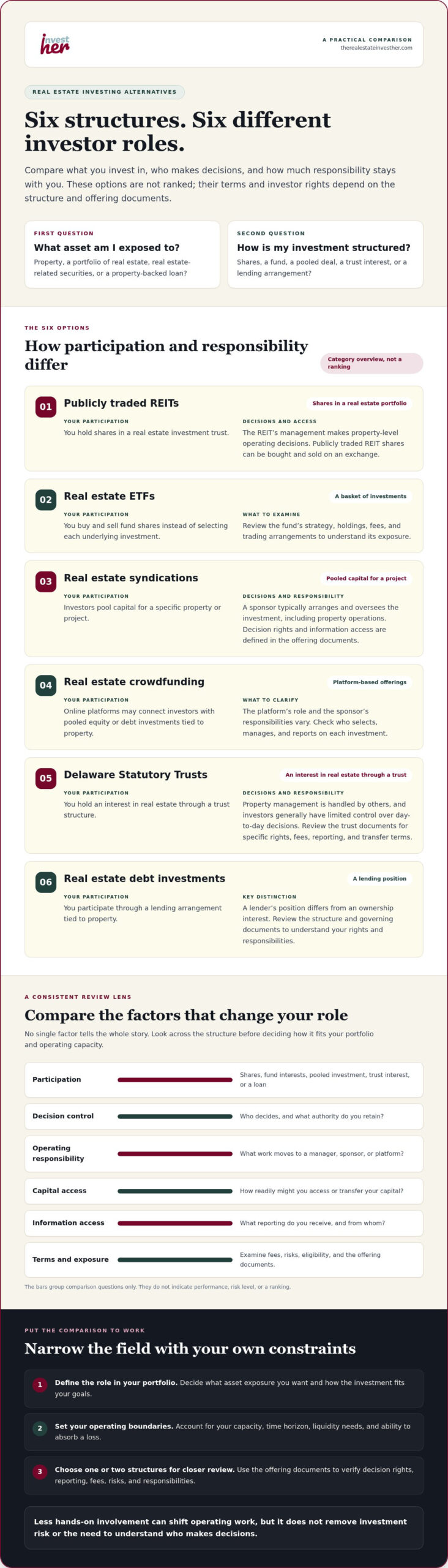
Six alternatives change how you participate in real estate or property-related investments: REITs, real estate ETFs, crowdfunding, syndications, Delaware Statutory Trusts, and real estate debt. The options below are a category overview, not a ranking or recommendation. Compare them by the asset involved, how you participate, and who makes operating decisions. The specific rights and responsibilities depend on the investment’s structure and documents.
What are the main indirect ways to invest in real estate?
These structures can provide real estate exposure without requiring you to personally manage each property, but they place you in different roles:
- REITs: A real estate investment trust provides exposure to a portfolio of real estate through shares. Publicly traded REIT shares can be bought and sold on an exchange, while the REIT’s management makes property-level operating decisions. REITs vary in what they own and how they’re structured.
- Real estate ETFs: An exchange-traded fund holds a basket of investments and may focus on REITs or other real estate-related securities. You buy and sell shares of the fund rather than selecting each underlying investment. Review its stated strategy, holdings, fees, and trading arrangements to understand what exposure it provides.
- Real estate syndications: Investors pool capital for a specific property or project. A sponsor typically arranges and oversees the investment, including property operations, while investors’ decision rights and access to information are defined by the offering documents.
- Real estate crowdfunding: Online platforms may connect investors with property-related offerings, which can include pooled equity or debt investments. The platform’s role and the sponsor’s responsibilities vary. Read the offering materials to understand who selects, manages, and reports on each investment.
- Delaware Statutory Trusts: A DST can allow investors to hold an interest in real estate through a trust structure, with property management handled by others. Investors generally have limited control over day-to-day decisions. Review the trust documents for the specific ownership rights, fees, reporting, transfer restrictions, and risks.
- Real estate debt: A private lender provides capital to a real estate borrower or project, rather than taking the same role as a property owner. The borrower manages the project; the lender’s rights and exposure depend on the loan terms and whether the loan is secured by property or other collateral.
The labels alone don’t tell you how involved you’ll be. For example, a publicly traded REIT and a DST may both provide exposure to real estate, but their ownership structures, decision-making authority, and ways of accessing capital can differ substantially. The documents, not the category name, define the arrangement.
Can you invest in assets beyond property itself?
Yes, but an adjacent asset shouldn’t be mistaken for real estate exposure. An operating business, including an online business, is a business investment. Its value and operations may depend on factors such as customers, revenue sources, staffing, systems, and the owner’s ability to run or transition the business. That diligence differs from evaluating a property or real estate fund.
Each category brings its own operating model and risks. A useful first screen is to name what you’re investing in, who controls its day-to-day decisions, and what evidence you’ll use to monitor it. Peer insight through the InvestHER Community can add perspective to that process, alongside your own review of the offering documents.
Do alternatives reduce work or trade control?
Compare how each structure would fit into your operating rhythm, not just how many property tasks it removes. The table highlights where an investor may need to spend attention: reviewing information, handling decisions, and planning around access to capital. These are prompts for evaluating a specific arrangement, not guarantees about every investment in a category.
| Structure | Control | Time | Liquidity | Access to information | Operating responsibility |
|---|---|---|---|---|---|
| Direct ownership | You can set approval boundaries with your team or property manager. | Track recurring reviews, escalations, and decisions that still route to you. | Plan around the steps and timing involved in selling a property. | Set a consistent process for receiving property and team updates. | Assign tasks clearly, while specifying which exceptions need your judgment. |
| Sponsor-led investment | Identify which investor decisions are specified in the governing documents. | Schedule time to review updates and address any investor decisions. | Map the stated restrictions and exit process against your own plans. | Check what information is provided, how often, and in what format. | Clarify the sponsor’s scope and the questions investors are expected to handle. |
| Publicly traded vehicle | Investors generally don’t direct individual property operations. | Set an oversight routine for reviewing disclosures and portfolio fit. | Check how the specific vehicle is bought, sold, or redeemed. | Use the vehicle’s disclosures and reporting to inform your review. | Property operations are handled by management, not individual shareholders. |
| Lending arrangement | Separate project decisions from the lender’s rights under the loan documents. | Plan for reviewing borrower updates and monitoring repayment. | Align your capital plan with the repayment terms and possible delays. | Confirm what borrower information and updates the agreement provides. | The borrower operates the project; the lender focuses on the loan relationship. |
Which investment structures give you more or less control?
Control is most useful when translated into decision boundaries. For a rental, you might authorize a manager to handle routine tasks while reserving specific exceptions for your approval. In an investment vehicle, the equivalent boundary is whatever investor rights the documents actually grant. A process can clarify how information reaches you, but it doesn’t transfer judgment or decision authority. Note who can approve changes, what requires investor consent, and what remains outside your control.
How should you think about time, liquidity, and risk together?
Put the investment’s expected touchpoints beside your existing operating calendar. For example, if quarterly reporting arrives during a busy portfolio review period, decide who will organize it, what you will personally assess, and how unresolved questions will be tracked. Separately, compare the stated liquidity terms with the dates when you may need capital. An exchange-traded investment may have a different route to sale than a private offering with transfer restrictions or a stated holding period. A lower-touch workflow won’t make a timing mismatch disappear. The aim is to see whether the required oversight and capital commitment fit the way you actually run your business.
How can you assess whether an alternative investment fits your business?
Assess fit by connecting an opportunity to a specific portfolio purpose, your business capacity, the investment’s structure, and the terms in its primary documents. This is less about finding a universally suitable option and more about deciding what role, if any, it should play in your plan.
Start with your portfolio priorities. Is the goal to diversify beyond assets you already hold, add a different form of real estate exposure, or put capital to work without acquiring another property? Then look at the portfolio as a whole. Consider whether the investment would deepen an existing concentration, how it fits your time horizon, and whether your financial plan could absorb a loss without disrupting business operations.
Capacity matters, too. A structure that appears to require little day-to-day involvement may still need a clear owner for document review, follow-up, and decisions. The strategic guide to scaling real estate investments can help you consider how investment choices relate to the team, systems, and priorities supporting your portfolio.
What questions should you answer before committing capital?
Write a short investment rationale before reviewing an offering: “This investment would serve ___ in my portfolio. I would reconsider it if ___.” The second sentence helps make your downside assumptions explicit. Next, name who in your business would own the ongoing investment review and how that work fits into existing responsibilities. If the answer is only “I’ll handle it,” consider whether that creates another owner-dependent task.
Finally, read the current documents against your rationale. Confirm that the structure and terms match what you believe you are investing in. Note any points you cannot explain in plain language, and pause the decision until you can resolve them through the primary materials or qualified advice.
How do you evaluate the operator or platform without relying on promises?
Look for evidence that helps you understand how the operator executes its stated strategy. Review relevant experience, the clarity of its explanation, available disclosures, and whether its account of the opportunity is consistent across materials. Treat projected outcomes and testimonials as claims to assess, not as proof that the same experience will apply to your investment.
Peer conversations can help uncover questions you hadn’t considered, but they don’t replace independent review. This section is general education, not legal, tax, or personalized financial advice. Consult qualified professionals for guidance specific to your circumstances. The final test is practical: can you explain why the investment belongs in your portfolio, what could change that view, and how your business will support the responsibilities it brings?
What is a practical next step after comparing real estate investing alternatives?
Turn your comparison into a short decision worksheet. Instead of choosing an investment immediately, identify which structures deserve a closer look and what evidence would help you make a decision. This creates a clear next step without treating a promotional claim or a category label as a recommendation.
How do you turn the comparison into a focused shortlist?
Rank your priorities, then use them to narrow the field. Be specific about what matters most to your portfolio and business right now.
- Portfolio purpose: Write down what you want the investment to contribute.
- Operating fit: Identify who will own the review and follow-up work.
- Non-negotiables: Note the terms or responsibilities that would rule an option out.
- Shortlist: Select one or two structures for a closer document review.
- Open questions: Record what you need to resolve before making a decision.
Use primary documents to answer those questions. If a term remains unclear or could affect your legal, tax, or financial position, get advice specific to your circumstances before proceeding.
Where can peer perspective support a better decision?
Experienced peers can help you test your assumptions. Ask what operational issue they would investigate, what information they would want before committing, or what part of your plan depends too heavily on your own attention. Their experience can surface useful questions, but it can’t establish whether an investment is right for your portfolio.
Keep the final decision tied to your own priorities and evidence. Before taking another step, write one sentence explaining why the shortlisted structure merits further review and one sentence describing what could make you walk away. That gives you a practical basis for continuing diligence, discussing the opportunity with qualified advisers, or deciding it isn’t a fit.
Choose an investment path your business can support
The next move doesn’t need to be a commitment. Set aside time to compare one or two structures against your portfolio priorities, operating capacity, and the responsibilities you’re willing to retain. Then identify what you still need to verify before deciding. A thoughtful pause is part of good investment practice.
The right alternatives to traditional real estate investing are not simply the ones that promise less work. They’re the ones whose terms, oversight requirements, and role in your portfolio make sense for you. Keep your judgment at the center, even when you delegate operations or learn from other investors.
The Real Estate InvestHER supports women investors through its community membership, the STRIVE Mentorship Program, and the annual InvestHER CON. Explore the InvestHER Community to connect with peers and access educational resources as you make deliberate decisions for your portfolio.
Frequently Asked Questions
Is a REIT an alternative to buying a rental property?
Yes. A REIT can provide real estate exposure without requiring you to personally buy or manage each property. REIT structures and liquidity arrangements differ, and public trading doesn’t remove investment risk or guarantee that you can sell at a preferred price. Before investing, review the vehicle’s current disclosures, including its holdings, stated strategy, and risks. Then consider whether its structure and role fit your goals and existing portfolio.
Can you invest in real estate without owning property directly?
Yes. Depending on the offering and eligibility requirements, investors may access real estate through REITs, ETFs, funds, syndications, crowdfunding, Delaware Statutory Trusts, or private lending. These routes can give you different rights, decision authority, liquidity, and reporting. For example, an investor in a loan has a different role from an investor with an ownership interest. Alternatives to traditional real estate investing still require due diligence: indirect exposure doesn’t eliminate risk or the need to understand the terms.
Are real estate syndications truly passive investments?
Not necessarily. A sponsor may take responsibility for property operations, but investors still need to evaluate the strategy, offering documents, fees, risks, reporting, and their own decision rights. “Passive” doesn’t promise zero oversight, a hands-off experience, or a particular result. Before committing, understand what updates you’ll receive, what decisions you can influence, and what the documents say about your rights and responsibilities. Those details depend on the specific offering.
What is the difference between a REIT and a real estate syndication?
A REIT and a syndication use different structures, access routes, governance, and liquidity arrangements. For example, a publicly traded REIT may be bought and sold through an exchange, while a syndication is typically organized around a specific sponsor-led offering. Don’t assume the same access or exit options apply across either category. Compare each opportunity’s current disclosures and identify who controls property-level decisions before deciding which structure warrants further review.
Can real estate crowdfunding replace owning a rental property?
Crowdfunding can provide access to particular real estate projects or portfolios without making you the direct landlord, but it doesn’t necessarily replicate property ownership, control, or liquidity. Platform processes, offering terms, and investor rights vary. For instance, contributing to a project doesn’t necessarily give you authority over leasing or property management. Review the offering documents to understand your role, then consider whether that exposure complements your wider portfolio and financial plans.
What should I compare before choosing an alternative real estate investment?
Compare the investment’s purpose, who operates the asset, your decision rights, time demands, liquidity terms, fees, reporting, conflicts, and risks. A practical test is to imagine a reporting period when the investment needs attention: what information will arrive, and what action, if any, will be yours to take? Review primary documents and seek qualified professional advice where appropriate. Fit depends on your goals, capital needs, and capacity to oversee the investment.

Article by
Andresa Guidelli
Real estate investor, operator, and founder of The Real Estate InvestHER, a national platform supporting women real estate investors. With 15+ years of experience in real estate investing and business operations, she focuses on helping investors build stronger businesses behind their portfolios through better systems, clearer decision-making, leadership, and responsible use of AI.
Be the first to comment