


Building a Personal Brand as a Female Investor: A Practical Guide
A credible investor brand depends less on how often you post and more on the evidence behind what you share. Building a personal brand as a female investor starts with a clear point of view, practical examples from your work, and consistent communication about how you make decisions. You don’t need to turn visibility into another full-time job or present every investment as a win.
If you’re unsure which expertise to highlight, how much experience to share, or where your reputation ends and your real estate business begins, that hesitation makes sense. Your brand should reflect both your judgment as an investor and the strength of the business operating behind your portfolio.
This guide will help you define what you want to be known for, support your perspective with accurate examples, and create a sustainable rhythm for sharing it. You’ll also learn how to connect your personal reputation to your business without making every decision or relationship depend on you. The goal is recognizable expertise, built through repeatable evidence rather than constant self-promotion.
Key Takeaways
- Define your investor brand by the consistent, evidence-backed impression you want others to form, not by how often you post.
- Choose a focused point of view grounded in your actual investment experience and current business priorities.
- Building a personal brand as a female investor can involve selective, useful visibility, from private conversations to written resources.
- Turn decisions and operating lessons into a repeatable content workflow while keeping confidential business information private.
- Use peer learning and mentorship to refine how you communicate your expertise, while letting your own work provide the proof.
What does building a personal brand as a female investor actually mean?
An investor brand is the consistent, evidence-backed impression others form of your expertise. Building a personal brand as a female investor means making your investment judgment, priorities, and approach understandable to the people you want to work with. It communicates what you know and how you operate, not a promise of financial or deal outcomes.
Intentional reputation-building is different from self-promotion, popularity, or posting frequency. A useful brand gives people a grounded sense of your perspective through what you say and do over time. That clarity can help you identify conversations, partnerships, and opportunities that fit your business priorities, and recognize those that don’t. The broader idea of personal branding applies here, but an investor’s proof comes from relevant experience and decisions, not visibility alone.
This video offers another perspective on developing a personal brand:
For a real estate investor, reputation can influence who seeks your perspective and what they assume about your business. A clear point of view sets expectations before a meeting, partnership discussion, or introduction. It doesn’t guarantee access or results. It gives others a more accurate basis for deciding whether your approach aligns with theirs.
How is an investor’s personal brand different from a real estate business brand?
Your personal brand communicates your judgment, experience, and point of view. Your company brand communicates its services, operating identity, and how work gets done. The two can reinforce each other without becoming interchangeable.
For example, an investor may be known for careful rental-property analysis, while her company uses documented review steps and delegated responsibilities to assess opportunities. Her reputation may prompt a relevant conversation, but the business’s systems, not her visibility, need to carry the work forward. Neither brand requires sharing private portfolio details. You can explain your principles and processes without disclosing addresses, investor information, or confidential deal terms.
What should a female investor want her brand to communicate?
Choose the decisions, asset focus, or operating strengths you want others to understand. You might explain how you assess rental demand, structure property operations, or decide when a portfolio is ready to grow. Choose a focus you can support with experience, not just a label that sounds marketable.
Then consider who needs to understand that perspective. Peers may value lessons about team decision rights. Potential partners may want to understand your investment criteria. Capital sources may need a clear account of your approach and communication practices. Being a woman can shape your experience, but it need not be your only differentiator. A useful positioning statement names your focus, your approach, and the people you want to serve or collaborate with, while leaving room for your expertise to evolve.
Which expertise and proof points make a female investor brand credible?
Credibility comes from clear expertise, consistent decisions, and specific examples, not inflated claims. When building a personal brand as a female investor, start with work you can explain and evidence you can stand behind. Demonstrate your expertise through your decision process, operating practices, and lessons learned, without implying that others can expect the same results.
Your point of view should connect to both your actual experience and the business you’re building now. If your current priority is improving portfolio operations, for example, focus on how you evaluate recurring issues, set responsibilities, or decide when a process needs to change. A focused perspective is easier to recognize and can evolve as your experience and priorities change.
How can you define an investment point of view?
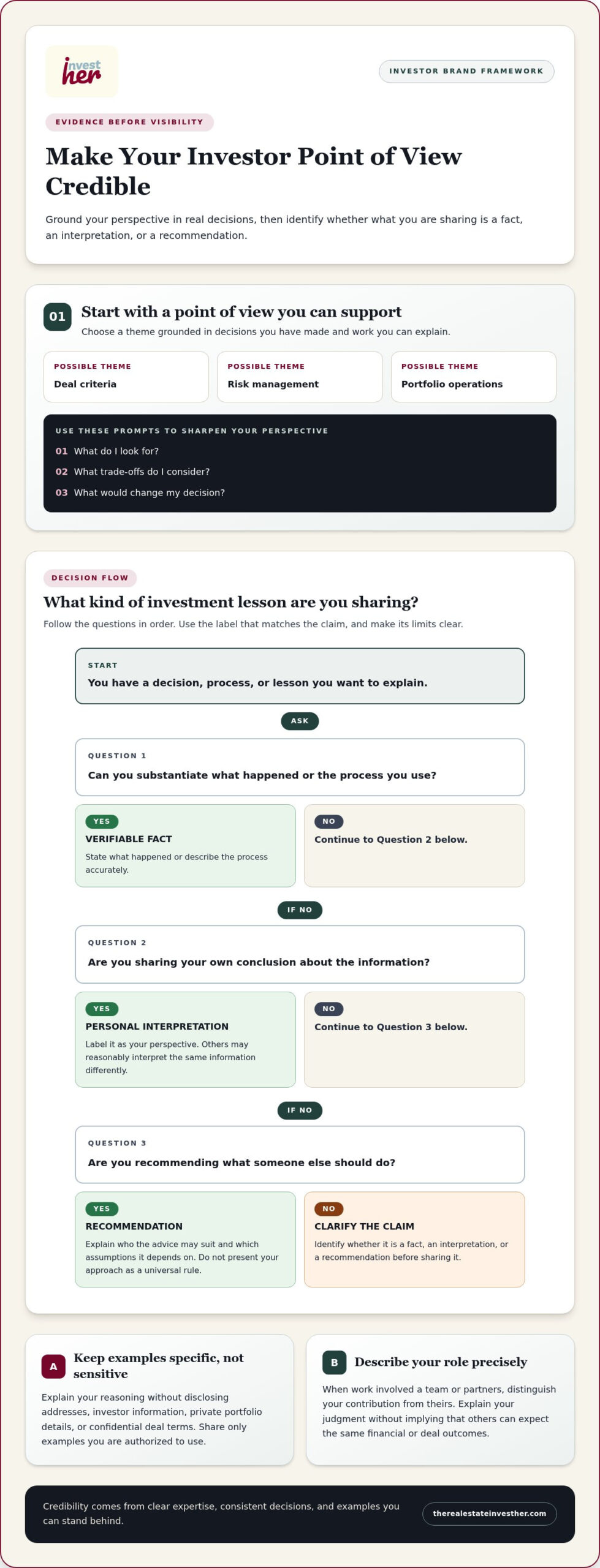
Choose a theme you can support with decisions you’ve made, such as deal criteria, risk management, or portfolio operations. Then ask: What do I look for? What trade-offs do I consider? What would change my decision? Your answers make your point of view specific without locking you into a permanent identity. Keep it narrow enough to be clear, but flexible enough to reflect new experience.
Use this simple distinction when sharing an investment lesson:
- Verifiable fact: State what happened or what process you use, and make sure you can substantiate it.
- Personal interpretation: Label your conclusion as your perspective, especially when others could reasonably interpret the same information differently.
- Recommendation: Explain who the advice may suit and which assumptions it depends on. Don’t present a personal approach as a universal rule.
For instance, describe the criteria your team uses to review a potential acquisition, then explain why a particular factor matters to your strategy. Keep the example general enough to protect private deal terms, partner information, or property details. Specificity comes from explaining your reasoning, not revealing confidential records.
What counts as credible proof when you are building a reputation?
Useful proof includes documented processes, decision rationale, lessons from completed work, and examples you’re authorized to share. Describe your role precisely. If a result involved partners or a team, distinguish your contribution from theirs rather than implying sole responsibility. A clear account of what you did, what the group handled, and what you learned gives readers a fair basis for understanding your expertise.
Before publishing a claim, check whether it’s factual, whether you can support it, and whether the wording accurately reflects your role. Avoid turning one successful decision into a promise of repeatable results. You can share a method, trade-off, or lesson without suggesting that it guarantees a particular return, acquisition, or outcome.
Thoughtful peer discussion can also help you sharpen how you explain your reasoning. The InvestHER Community gives women investors a place to exchange perspectives. Those conversations can inform your point of view, while your own decisions and evidence remain the foundation of your credibility.
How can female investors build visibility without constant self-promotion?
Visibility can be selective, useful, and bounded. Building a personal brand as a female investor doesn’t require posting every day or sharing every deal. Choose a few ways to communicate that fit your audience and work rhythm, then focus on ideas that help others understand how you think and operate.
A practical contribution might explain how you assess a property-management issue, decide whether a workflow needs documentation, or weigh a trade-off in a potential investment. The lesson can be useful without turning your life or portfolio into content. If hesitation comes from doubting whether your experience is worth sharing, this guide to overcoming imposter syndrome in real estate investing may help you examine that concern.
What can you share without exposing confidential information?
Share the decision framework, not sensitive deal or partner details. Describe the factors you considered, the process your team followed, or a lesson you took forward without naming a property, disclosing financial terms, or identifying another party.
Anonymized or composite examples can protect privacy only if they remain accurate and don’t create a misleading impression. Before publishing, consider whether someone involved could recognize the situation and whether permission, a confidentiality agreement, or professional obligations may apply. Those considerations depend on the circumstances, so removing names alone does not automatically make an example appropriate to share. If details are sensitive, use a general principle or a hypothetical scenario clearly labeled as such.
Which visibility channels fit different investor goals?
Choose a channel based on who you want to reach, how much upkeep it requires, and what kind of conversation it supports. These are practical trade-offs, not fixed rules:
- LinkedIn posts: Public and potentially broad, with moderate ongoing effort. Useful for sharing concise operating lessons and inviting professional discussion, but public posts offer less privacy.
- Private industry conversations: Narrower reach and generally low publishing effort, with more room for dialogue. Useful for developing peer, partner, or capital-source relationships, while still requiring discretion about deal details.
- Guest education or speaking: Can reach a relevant audience in a focused setting. Preparation may take more effort than a short post, but questions from attendees can reveal what people want to understand.
- Written resources: A guide or article takes focused effort to create and can be shared repeatedly. You control what it contains, though a public resource may circulate beyond its original audience.
Start with one or two channels that fit your existing schedule. For example, turn a recurring operating question into a short post, then use the responses to guide a deeper conversation or resource. Set boundaries around how often you publish and what information stays internal. A manageable rhythm is more useful than a visibility plan that competes with running the business.
How do you turn investor expertise into a repeatable personal-brand system?
A sustainable personal-brand system connects visibility to business priorities, turns existing work into useful topics, and assigns production tasks without handing away your judgment. The aim isn’t to publish more. It’s to make sharing expertise repeatable, accurate, and manageable alongside operating your portfolio.
Brand-building works best when it fits your operating rhythm. A property review, team discussion, or investment decision may surface a lesson worth sharing. A strategic guide to scaling real estate investments can also help connect visibility decisions to the systems and priorities supporting portfolio growth.
What are the steps for creating a sustainable brand workflow?
Use this workflow to move from business priorities to publishing and review without adding a separate content operation:
- Set the business purpose. Decide what visibility should support, such as building relationships with aligned partners or explaining your operating approach to peers. A clear purpose helps you decide which ideas deserve your time.
- Choose a few themes. Tie them to current priorities and experience you can explain. If your focus is improving property operations, topics might include recurring workflow decisions, team responsibilities, or lessons from reviewing operating performance.
- Capture ideas inside existing work. Add a brief “shareable lesson” prompt to a review or meeting agenda. Record the general question, reasoning, and takeaway, not confidential deal files or private partner information.
- Assign production and approval roles. A team member can organize notes, prepare a draft from an approved template, and schedule content. Documenting those steps makes production easier to delegate. You should retain authority over the meaning, sensitive details, and claims made in your name.
- Review the system. Check whether the content supports the original purpose, prompts useful conversations, and fits the time available. Adjust themes or frequency if publishing becomes a burden or no longer reflects business priorities.
Where can AI help, and what still needs human judgment?
AI can help organize non-sensitive notes, suggest an outline, or adapt investor-approved material into a post and a longer resource. Give it clear instructions about the audience, intended purpose, and information it must not include. Treat its output as a draft, not an independent source of investment expertise.
Before anything is published, a human reviewer should check factual accuracy, investment nuance, confidentiality, and whether the recommendations match the intended context. You remain accountable for the final claims, voice, and decisions. If review still requires you to rewrite every line, refine the template or define a clearer production task to delegate. Don’t delegate judgment without explicitly deciding who has authority to make that call.
To strengthen the operating habits behind your visibility, explore resources for women real estate investors and choose a next step that fits your business priorities.
How can InvestHER support a stronger investor brand and next steps?
A community can help you test whether your point of view is clear, hear how other investors approach similar questions, and build relationships over time. It can’t replace evidence from your own decisions and experience. Use peer input to sharpen how you explain your work, not as proof that a business claim is true.
When building a personal brand as a female investor, distinguish support from substantiation. The Real Estate InvestHER Community offers peer learning and connection with women in real estate investing. The STRIVE Mentorship Program provides strategic guidance as you examine business choices and clarify the reasoning behind them. These resources can support your development, but your expertise is yours to demonstrate.
When can peer community or mentorship sharpen your positioning?
Peer discussion can show whether another investor understands your explanation and finds it useful. Ask what was clear, what seemed too broad, and what context was missing. Mentorship can help you examine the strategic choices behind your position, such as why your current operating model supports one growth priority over another. Treat responses as perspective for refinement, then verify your facts and stand behind your own conclusions.
What should you do in the next 30 days?
Keep the first month focused. You’re testing a manageable approach, not committing to a permanent content schedule. Choose one point of view, one audience, and one channel that fits the way you already work. A short review at the end of the month can tell you whether the effort supports the relationships you intended to build.
- Start with your positioning statement. Write one sentence connecting your current expertise to a business priority. For example: “I share how our team evaluates operating processes so rental-property decisions don’t depend on one person.” Make sure the wording accurately reflects your role and experience.
- Name the audience. Decide who should find the perspective useful, such as peers refining their operations, potential partners who need to understand your approach, or investors interested in your decision process. A specific audience helps you choose the right level of detail.
- Choose one topic from actual work. Pull a lesson from a recent review, team conversation, or decision. Explain the question, the factors you considered, and what you learned. Leave confidential details out, and be clear when you’re sharing a personal view rather than general advice.
- Select a sustainable channel. Use a professional post, a peer conversation, or a short written resource, whichever fits your existing rhythm. Set a boundary for the time you’ll spend preparing and publishing.
- Review the effort and response. Consider whether the message was accurate, prompted relevant conversation, and supported the intended relationship. If it added unnecessary owner workload, simplify the process or try a different channel.
When you’re ready to exchange perspectives with other women investors, explore The Real Estate InvestHER Community. Start with a clear idea and a small, repeatable action. Let your experience provide the substance and your system make sharing it sustainable.
Make your next step small and intentional
Before expanding your visibility, decide what your business must be able to support if more people respond. If your brand draws questions about partnerships, for example, make sure there’s a clear way to assess fit and follow up without routing every step through you. A strong reputation creates expectations, so check that your roles and operating processes can meet them.
Use that as your next decision point: identify one relationship or opportunity you want your reputation to support, then look for any gap between the impression you create and how the business currently operates. That gap may point to a clearer explanation, a documented process, or a responsibility you can delegate with defined decision authority.
If peer perspective would help as you think through that next stage, explore the InvestHER Community. Build a reputation your business can consistently stand behind, and let your operating structure grow alongside it.
Frequently Asked Questions
Is a personal brand the same as a real estate company’s brand?
No. They can work together, but they serve different practical purposes. When a reader asks who makes investment decisions, your professional profile should make your role clear. When someone needs to understand property management, resident communication, or service delivery, the company’s materials should explain the relevant process and responsible team member. Review both periodically to make sure they don’t imply that every business function depends on you personally.
Can you build a personal brand without posting on social media?
Yes. If you prefer not to publish publicly, make it easy for trusted contacts to introduce you accurately. Prepare a short professional biography, a concise description of your investment focus, and a resource you’re comfortable sharing in relevant conversations. Keep those materials current as your priorities change. This can support warm introductions without creating a recurring social media publishing obligation.
How can I share real estate investing experience without revealing private deal details?
Use a prepublication screen before sharing an example: remove names and identifying specifics, check whether the people involved could still recognize it, and confirm that the remaining details support the point you want to make. Avoid altering facts simply to make a story more compelling. If you can’t preserve both privacy and accuracy, share the general lesson without presenting it as a transaction example.
Should I use my name or my company name for my investor brand?
Choose based on how you want people to find and refer to you. If your professional relationships are built around your individual perspective, use your name as the primary identifier and state your company affiliation clearly. If inquiries should go to a team or business account, make the company identity prominent and identify your role within it. Whichever approach you choose, use the same naming consistently across your profile, biography, and presentation materials.
Does building a personal brand help a real estate investor raise capital?
A professional presence can give prospective capital partners context about your focus and communication style, but it can’t guarantee that anyone will invest. Keep public statements aligned with information you can substantiate and with the materials you share in direct discussions. If your stated approach differs from how your business evaluates opportunities or reports progress, that inconsistency can create questions instead of confidence.
How can I show expertise if I am not ready to share a long track record?
Be transparent about your current scope and show work you can accurately describe. For example, explain the analysis you performed on a potential acquisition, the operating process you helped document, or the responsibility you hold within a partnership. Distinguish completed work from plans and personal contributions from group decisions. Clear boundaries around your experience make your perspective easier to assess without overstating your history.

Article by
Andresa Guidelli
Real estate investor, operator, and founder of The Real Estate InvestHER, a national platform supporting women real estate investors. With 15+ years of experience in real estate investing and business operations, she focuses on helping investors build stronger businesses behind their portfolios through better systems, clearer decision-making, leadership, and responsible use of AI.
Be the first to comment