


Scaling a Real Estate Portfolio With Partners: A Practical Operating Guide
What if a partner brings in more capital but leaves every important decision on your desk? Scaling a real estate portfolio with partners works when shared resources come with clear responsibilities, decision rights, and repeatable operating systems. Without those foundations, a partnership can add coordination and conflict instead of capacity.
When you evaluate a potential partner, look beyond what each person can contribute financially. Fit also depends on complementary skills, aligned expectations, and agreement on how the business will run. A capable partner should strengthen the operation, not create another relationship that depends on you to keep things moving.
This guide offers a practical framework for assessing partnership fit, defining contributions and accountability, and deciding which choices partners make together or delegate. You’ll also learn how to build operating rhythms that keep the portfolio moving without routing every task through the owner. The goal is growth with clearer ownership, better decisions, and more room to lead.
Key Takeaways
- Scaling a real estate portfolio with partners means combining complementary resources to reach portfolio goals, not simply buying more properties.
- Set shared goals and clarify each partner’s financial and nonfinancial contributions, decision authority, and accountability.
- Compare property-level joint ventures with ongoing operating partnerships based on control, capital needs, and execution demands.
- Make day-to-day collaboration clearer by documenting workflows, assigning owners, and setting approval limits.
- Before pursuing a partner or deal, identify your business constraint and assess whether your operations can support growth.
What does scaling a real estate portfolio with partners actually involve?
Scaling a real estate portfolio with partners means combining complementary resources to pursue shared portfolio goals. It is not simply about acquiring more properties. Growth can also mean improving deal analysis, asset oversight, or execution so the portfolio can expand without every task or decision depending on you.
A partner might contribute capital, acquisition expertise, asset oversight, execution capacity, relationships, or operating infrastructure. Contributions do not have to be identical, but both partners should understand and address them in the partnership’s arrangements. Shared ownership also brings shared exposure, responsibilities, and decisions. More resources can create capacity, but they do not guarantee investment performance.
Real estate syndication is one model in which investors participate in a real estate venture. The structure is only part of the picture. Partners also need a workable plan for who contributes, who acts, and how decisions get made.
For an example of using outside capital to pursue portfolio growth, watch this video:
The practical test is whether a partner fills a specific gap in your operating model. If you have capital but limited time for asset oversight, a partner’s availability and experience may matter more than additional funds. If you can execute but need deeper acquisition analysis, expertise may be the missing resource. Name the constraint before choosing a partnership approach.
When can a real estate partnership support portfolio growth?
A partnership can support growth when a resource or capability gap is limiting your next stage. One investor may bring capital while another contributes acquisition analysis, property oversight, or execution capacity. Before pursuing a deal, compare your goals, investment horizon, risk tolerance, and preferred level of involvement. Misaligned expectations can turn a promising opportunity into an ongoing source of friction.
What changes when portfolio decisions become shared?
As a solo investor, you can often make decisions within your own process. With partners, agree in advance which choices require discussion, who can approve routine spending, and how to handle disagreements. Responsibilities continue after closing: someone must track performance, manage property issues, maintain financial records, and share updates. Added capacity helps only when each responsibility has a clear owner and accountability.
Takeaway: A partnership can expand the resources and operating capacity available to your portfolio, but it cannot promise a particular return. Assess the fit by asking whether each partner’s contribution addresses a real constraint and whether the group can make and carry out decisions together.
How should partners align goals, contributions, and decision rights?
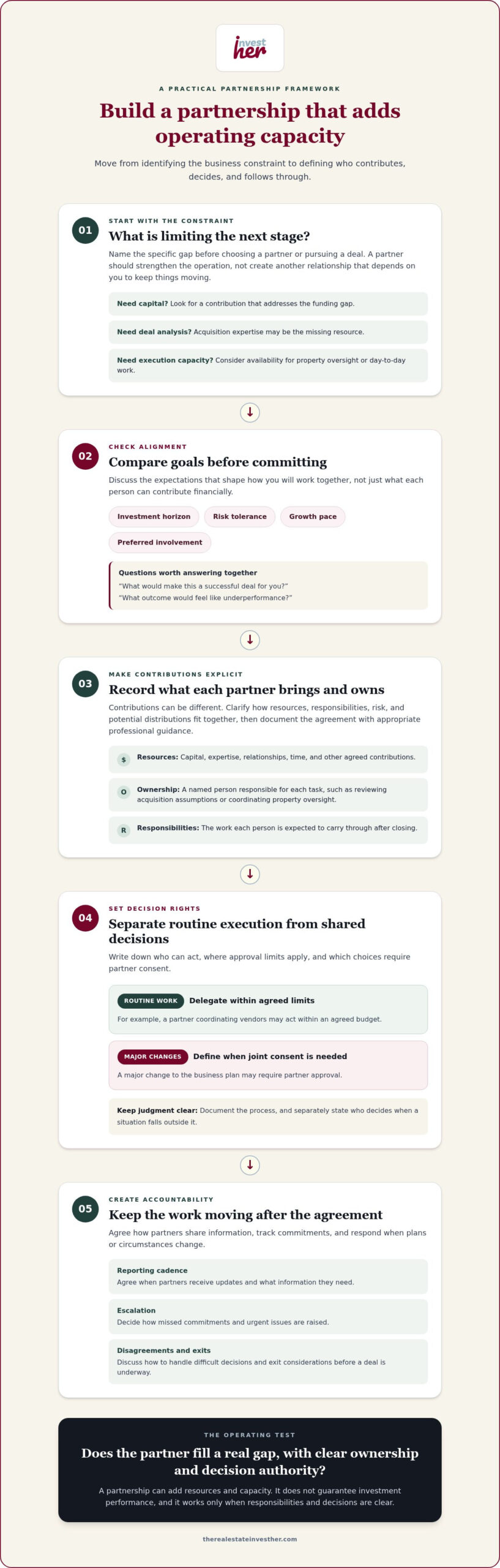
Partners align by making four things explicit before committing: shared goals, each person’s contributions, who has authority to act, and how accountability works. These agreements help you assess whether the arrangement can support scaling a real estate portfolio with partners, rather than relying on goodwill or assumptions.
Contributions can be financial or nonfinancial. One partner might provide capital while another contributes acquisition expertise, property oversight, relationships, or time managing execution. Equal contributions do not automatically require identical terms, and unequal contributions do not determine the right arrangement on their own. Discuss how contributions, risk, responsibilities, and potential distributions fit together, then document the agreement with appropriate professional guidance.
Which questions reveal whether a prospective partner is aligned?
Discuss investment horizon, risk tolerance, desired growth pace, and the role each person wants to play. Ask, “What would make this a successful deal for you?” and “What outcome would feel like underperformance?” Compare answers about reinvesting proceeds, handling unexpected costs, or holding an asset longer than planned. Agree on communication expectations and how you’ll resolve a difficult decision if you disagree.
How do partners clarify contributions and decision rights?
Write down what each person is bringing and what they own operationally. Then distinguish routine execution from decisions that require shared approval. For example, a partner coordinating vendors might act within an agreed budget, while a major change to the business plan could require partner consent.
- Contributions: Record capital, expertise, relationships, time, and other agreed resources.
- Responsibilities: Assign an owner to each task, such as reviewing acquisition assumptions or coordinating property oversight.
- Authority: Set limits for routine approvals and name decisions that require joint consent.
- Accountability: Agree on reporting cadence, what information partners receive, and how missed commitments or urgent issues are escalated.
Clear delegation does not mean every judgment can be reduced to a checklist. Document the process, but separately state who may make decisions when a situation falls outside it. This helps prevent two common problems: one partner waiting for approval on routine work, or one acting beyond the authority others understood them to have.
Discuss disagreements, reporting expectations, and exit considerations before a deal is underway. For example, decide how partners will revisit a plan if expenses rise or one person’s capacity changes. Record the agreed approach in deal documents. Legal structure, tax treatment, and agreement language depend on the specific transaction, so have qualified legal and tax professionals review them before you commit.
Peer discussion can help you pressure-test assumptions and prepare focused questions. The Real Estate InvestHER community connects women investors who want to learn from one another. Due diligence and professional advice remain part of your decision process.
Which partnership approach fits your portfolio and operating capacity?
The right approach depends on what is limiting growth and how much control, capital, and execution capacity you need to add. Compare partnership options by their practical demands, rather than assuming one structure suits every investor. A project may call for shared ownership, while an ongoing workload may be better addressed through delegation.
Use these criteria as a decision aid, not an objective ranking of structures:
- Control: Consider which choices you want to retain and which another party can make within defined boundaries.
- Capital needs: If available capital is the constraint, shared investment may address it. Delegating tasks alone does not add investment capital.
- Execution burden: A partner may bring strategic capability or hands-on capacity. A hire or service provider may take on repeatable work without becoming an owner.
- Alignment: Shared ownership requires compatible expectations about the investment. Delegation depends more on clear outputs, authority, and oversight.
- Operational complexity: Each additional owner can add coordination and reporting. Delegation also needs management, but can follow existing workflows and accountability structures.
For example, if an acquisition needs pooled capital and each investor wants exposure to that project, a property-level collaboration may fit. If you already have capital and strategy but are losing time to recurring coordination, hiring or delegating that work may address the bottleneck with less change to ownership.
How does a joint venture differ from an ongoing operating partnership?
A joint venture generally describes a collaboration organized around a defined investment or project, with roles tied to that undertaking. An ongoing operating partnership involves continuing responsibilities across a portfolio or business, such as acquisition support or asset oversight. The distinction helps clarify scope and workload, but labels alone do not determine partners’ rights or obligations. Written terms and applicable law matter, and details can vary by jurisdiction.
When might delegation fit better than adding an equity partner?
Delegation may fit when the bottleneck is repeatable execution, such as coordinating routine property tasks or preparing recurring reports, rather than capital or strategic capability. Documented processes help someone complete that work consistently, but they do not automatically transfer judgment or authority. Before deciding, compare the cost of the arrangement, the control you retain, accountability for results, and the owner oversight required.
To choose, name the constraint first. If you need investment capital, shared ownership may be relevant. If you need a strategic capability, assess whether a partner can contribute it and whether shared decisions make sense. If the gap is recurring work, define the process and consider delegating execution. Partnership, ongoing operations, and delegation can coexist, but each role should have a distinct purpose. Legal and tax treatment is deal-specific, so have qualified professionals review the proposed arrangement for the relevant jurisdiction before you commit.
How can you make a real estate partnership workable day to day?
A workable partnership turns agreed responsibilities into a repeatable operating rhythm. Document each workflow, assign an owner, set approval limits, and review results. This makes it clear what should happen next, who is accountable, and when a decision needs to come back to the group.
Start with recurring work, not a new tool. For an acquisition workflow, document how an opportunity moves from initial review to a decision. Name the person responsible for gathering information, who checks the analysis, and which issues require partner approval. Then use a responsibility map to clarify ownership across core functions:
- Acquisitions: Deal sourcing, analysis, due diligence coordination, and investment decisions.
- Property operations: Routine oversight, issue escalation, and follow-through on agreed plans.
- Finances: Transaction records, expense review, cash planning, and financial updates.
- Reporting: Collecting information, preparing partner updates, and flagging exceptions.
A named owner keeps work moving, but does not have unlimited authority. Separate documented steps from judgment calls. A process can explain how to collect an operating update; an authorized person still needs to assess an unexpected issue and decide whether it requires partner input.
What should a partner operating agreement make clear?
Operating terms should reflect the actual arrangement, not a generic template. Address contributions, responsibilities, approval authority, reporting expectations, conflict processes, and planned exits. If one partner manages routine operations while another focuses on capital or strategy, capture those differences clearly. Legal and tax treatment depends on the deal and applicable rules, so have qualified professionals review the terms before relying on them.
How do systems reduce owner dependency in a partnership?
Map recurring work from the initial decision through completion, including handoffs and exception handling. Assign a process owner, then identify where human review is needed for consequential choices. A focused operating review can surface unresolved decisions, exceptions, and uneven workloads. Track measures relevant to the work, such as outstanding maintenance issues or overdue financial updates, without treating any outside benchmark as a universal target.
How can partners use AI responsibly in portfolio operations?
AI can assist with organizing property information, drafting routine updates, or flagging workflow exceptions. Define what information it can access, who reviews its output, and which person remains accountable for decisions. Treat AI-generated summaries as aids, not verified financial, legal, or investment judgment. Keep sensitive information within approved systems and route consequential choices to an authorized human decision-maker.
Set a recurring operating review that gives partners a clear place to discuss open issues, missed handoffs, and capacity concerns. Use the same agenda each time: review exceptions, confirm owners and next steps, and note decisions that need follow-up. This rhythm can reveal when a workflow needs improvement before every unresolved task lands back with you.
The Real Estate InvestHER resources support women investors building clearer operating rhythms for their portfolios.
What should your next step be before scaling with a partner?
Before pursuing a specific partner or deal, complete a readiness review. Identify the constraint you want to solve, define the role a partner would play, and test whether your current operations can support shared ownership. This helps distinguish a genuine need for partnership from a workflow problem you could address another way.
How to scale real estate investments can help you consider growth in the context of your wider business, not just your next acquisition. Use the questions below to make that assessment specific to your portfolio.
What partnership-readiness questions should you answer first?
Name the exact constraint: Is it capital, a strategic capability, or time for a defined body of work? Then assess whether your workflows and reporting are clear enough for someone else to participate without relying on you to explain every step. Finally, decide which choices you’ll retain, delegate within agreed limits, or make jointly with a partner.
- Constraint: What can’t the current business do consistently or at the pace you want?
- Role: What responsibility or resource would a partner contribute, and what remains yours?
- Readiness: Can you show how key information, tasks, and decisions move through the business?
- Authority: Which decisions require your judgment, shared approval, or an authorized delegate?
If the intended partner role is hard to describe, pause before discussing a deal. A clear role makes it easier to assess fit, responsibilities, and the operating changes a partnership would require.
How can mentorship and community strengthen your growth decisions?
Experienced perspectives can help you pressure-test assumptions and sharpen the questions you bring to a potential partnership. The STRIVE Mentorship Program provides strategic knowledge and guidance to women looking to scale their real estate investments. Peer discussion can broaden your perspective, but it does not replace deal-specific due diligence or legal, tax, and financial review.
The InvestHER Community gives women investors a place to connect around the business of real estate, with educational resources and strategic networking. Use those conversations to examine your thinking, not to outsource your decision. You remain responsible for evaluating the specific opportunity, partner, and terms in front of you.
Your next step does not need to be a commitment. Write a short readiness brief: the constraint, the role you need, the decisions you’ll share, and the operating gaps to address. This gives you a grounded starting point for a partnership conversation and helps keep portfolio growth aligned with how you want to run the business.
If peer connection would support your thinking, explore the InvestHER Community as you shape your next growth decision.
Make your next growth decision with intention
Before your next partnership conversation, define what should be different in the business if the arrangement is working. Perhaps you’ll spend less time coordinating routine work, make investment decisions with more perspective, or have capacity to pursue opportunities that currently stall. Choose observable signs of progress so you can evaluate how the partnership functions, not only what you hoped it would add.
This keeps scaling a real estate portfolio with partners connected to the kind of business and life you want to build. A partner is one possible path to growth, not a requirement. The right next move may be to improve an operating rhythm, delegate a defined responsibility, or explore shared ownership. Make that choice with care rather than urgency.
To keep building your portfolio alongside women investors, explore the InvestHER Community.
Frequently Asked Questions
How do you find a partner to scale a real estate portfolio?
Start with people who understand the type of investing and operating work your portfolio requires, then assess their experience in that context. Ask about a past decision that did not go as planned and what they learned from it. A shared network can offer perspective on someone’s working style, but it is not a vetting process or investor-matching service. Treat introductions as a starting point, then do your own due diligence.
What should be included in a real estate partnership agreement?
Beyond ownership and role terms, clarify how partners will keep records, share material updates, and handle requests that affect the investment plan. For example, specify what information each person can expect to review before approving a major change. The details should fit the actual arrangement and applicable law. Use a checklist to prepare questions, not as a substitute for tailored legal advice or a professionally reviewed agreement.
How should real estate partners split ownership and profits?
Discuss ownership and distributions as separate questions. Ownership describes the agreed interests in the venture, while distribution terms explain how available proceeds are allocated and when. Model different scenarios, such as a sale, refinancing, or cash retained for property needs, to see how proposed terms work in practice. Record the assumptions behind the arrangement, and get deal-specific legal and tax review before finalizing it.
Can you scale a real estate portfolio with a partner who contributes no capital?
Potentially, if the partner’s noncapital contribution has a clear scope and both parties agree how its value will be recognized. For example, a partner responsible for a defined acquisition or operating function should understand the expected work, decision authority, and how the arrangement may change if the work stops. Compare shared ownership with a paid service or delegated role, and have the chosen terms reviewed for the specific deal.
What happens if real estate partners disagree about a decision?
First, identify whether the disagreement concerns a routine action, an interpretation of the agreed plan, or a decision that could materially change the investment. Record the question, relevant information, and any time-sensitive constraints before escalating it through the agreed process. Avoid letting an unresolved discussion become an informal veto or assuming silence means consent. If the written terms do not address the situation, seek advice suited to the agreement and circumstances.
Is a real estate partnership better than investing alone?
Compare the actual trade-off: what resources or capabilities a partner adds, and what additional coordination shared ownership requires. Investing alone may suit a strategy that depends on one person’s judgment and available capacity. A partnership may make more sense if the plan depends on complementary contributions that are difficult to obtain otherwise. Assess the work each option creates, the control you’re willing to share, and whether the expected benefit justifies the added complexity.
How can real estate partners avoid one owner becoming the bottleneck?
Audit a recent month of work and note which tasks waited for one person, why they waited, and what information or authority was missing. Separate delays caused by incomplete documentation from those that genuinely require owner judgment. Then address the cause: improve access to needed information, clarify an approval boundary, or keep the decision with the accountable person. AI may help sort or summarize workflow data, but a human should verify it and own consequential choices.

Article by
Andresa Guidelli
Real estate investor, operator, and founder of The Real Estate InvestHER, a national platform supporting women real estate investors. With 15+ years of experience in real estate investing and business operations, she focuses on helping investors build stronger businesses behind their portfolios through better systems, clearer decision-making, leadership, and responsible use of AI.
Be the first to comment