


Orlando Short-Term Rental Guide for Women Investors 2026
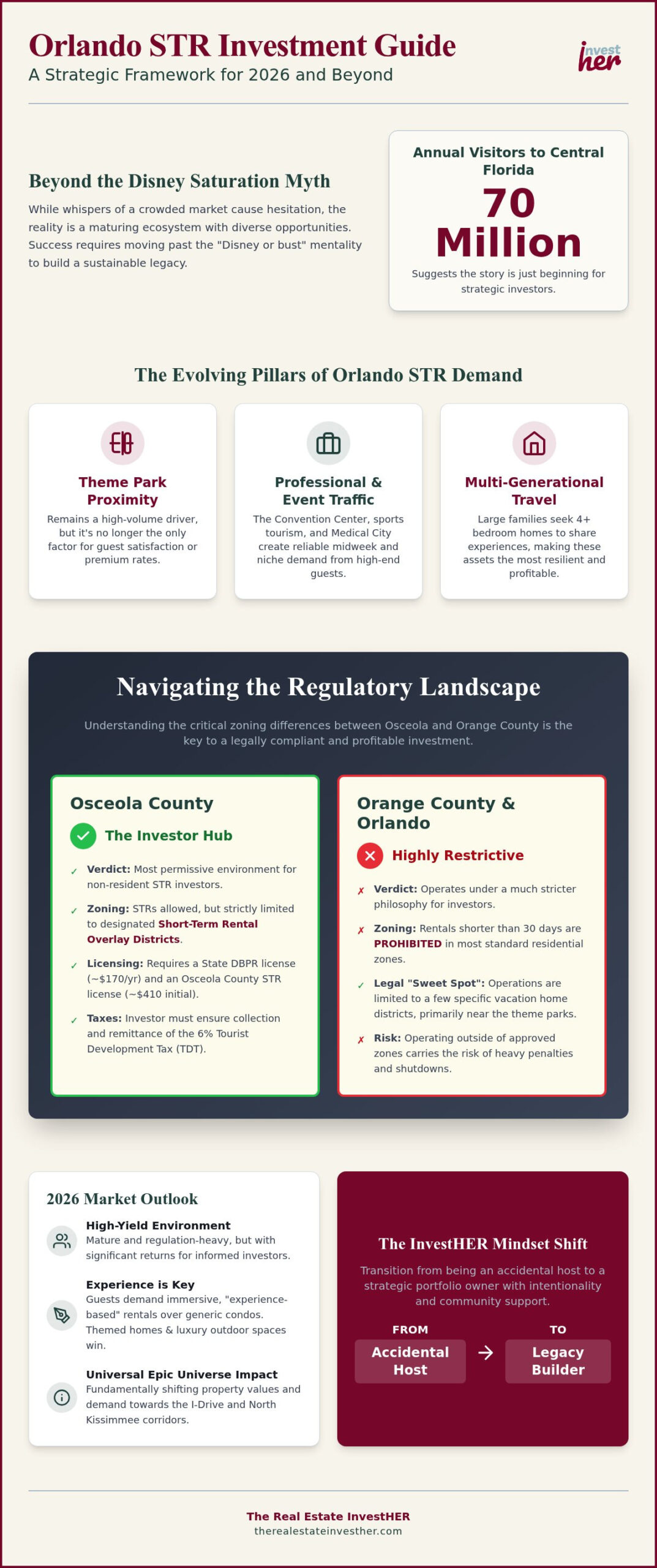
You have likely heard the whispers that the Central Florida market is too crowded, yet 70 million annual visitors suggest the story is just beginning for those who look beyond the surface. It’s natural to feel a sense of hesitation when facing the “Disney saturation” narrative or the complex maze of conflicting regulations between Orange and Osceola counties. You want to build a legacy, not a second job that drains your energy from states away. We understand that the leap from curiosity to closing requires more than just a map; it requires a strategy rooted in both data and collective wisdom.
This Orlando short-term rental investment guide is designed to replace that anxiety with a clear, actionable framework. We’re blending the 2026 regulatory realities of Central Florida with the strategic, wealth-building mindset of the InvestHER community to help you move forward with total confidence. You’ll gain a deep understanding of exactly where STRs are legally permitted, how to calculate a realistic ROI in today’s market, and how to connect with a local power team that supports your growth. We are moving past the confusion to focus on intentional scaling and the financial independence you deserve.
Key Takeaways
- Discover why the 2026 market extends far beyond theme parks to include sports tourism and medical city growth, creating diverse occupancy opportunities for your portfolio.
- Learn to navigate the critical zoning differences between Osceola and Orange County with this Orlando short-term rental investment guide to ensure your property remains legally compliant.
- Master a modern ROI framework that accounts for 2026 Central Florida cap rates and the specific nuances of calculating true net operating income.
- Identify the essential roles of a local power team and see how community support transforms a high-turnover property into a hands-off legacy asset.
- Transition from an accidental host to a strategic portfolio owner by leveraging mentorship and collective wisdom to scale your investments with intentionality.
Understanding the Orlando STR Market: Why Proximity to Disney Isn’t Everything
Orlando’s identity is shifting. While the mouse still draws the crowds, the 2026 market is becoming a sophisticated ecosystem where savvy women investors are looking beyond the theme park gates. A deep understanding short-term rentals in this region means recognizing that Central Florida is now a multi-faceted destination. We aren’t just looking for quick cash flow; we are building sustainable legacies that weather economic shifts. This Orlando short-term rental investment guide highlights that success today requires moving past the “Disney or bust” mentality.
New drivers are reshaping demand across the metro area. Sports tourism is surging with world-class facilities hosting year-round tournaments, and the expansion of Lake Nona’s Medical City has introduced a high-end, professional guest profile. Families are also staying longer, blending work and play in a “work-from-anywhere” culture. They seek high-speed internet and dedicated office spaces alongside their private pools. You might hear that the market is saturated, but this is a myth born of generic offerings. The reality is that the market is maturing. While generic condos face pressure, high-quality, experience-based homes are thriving. When you have a community-backed strategy and a “power team” behind you, you aren’t just competing; you’re leading.
The Three Pillars of Orlando STR Demand
- Theme Park Proximity: This remains the high-volume driver, but it’s no longer the only factor in guest satisfaction.
- Convention Center Traffic: The Orange County Convention Center creates a reliable midweek niche for business travelers who prefer the autonomy of a home over a cramped hotel room.
- Multi-generational Travel: Large families are the sweet spot. Properties with 4+ bedrooms allow families to share memories under one roof, making these assets the most resilient in any Orlando short-term rental investment guide strategy.
Market Outlook for 2026
The 2026 Orlando STR market is a mature, regulation-heavy but high-yield environment. The opening of Universal Epic Universe has fundamentally shifted property values toward the I-Drive and North Kissimmee corridors. Guests no longer want a simple place to sleep; they want an immersive extension of their vacation experience. We are seeing a massive shift toward “experience-based” rentals. Properties that offer curated themes or luxury outdoor living spaces are seeing the highest returns. Success in this landscape is about intentionality and staying aligned with a community that understands these nuances.
Navigating the Regulatory Landscape: Osceola vs. Orange County STR Rules
Understanding the regulatory pulse of Central Florida is the difference between a thriving asset and a costly legal headache. Rules change. In 2026, the divide between Osceola and Orange County has never been more pronounced, making it vital to know exactly where your property stands before you sign a contract. This Orlando short-term rental investment guide breaks down the two distinct paths available to you. While Orlando STR performance data can show you the revenue potential, only a deep dive into local ordinances ensures you keep those earnings.
Osceola County: The Investor Hub
Osceola County remains the most permissive environment for investors, particularly in the Kissimmee and Davenport corridors. To operate here, you must secure a state DBPR vacation rental license for $170 per year and a specific Osceola County STR license, which costs $410 initially. Short-term rentals are strictly limited to designated Short-Term Rental Overlay Districts. If you step outside these zones, you risk heavy penalties. For the 2026 season, ensure you are registered to collect and remit the 6% Tourist Development Tax (TDT), as platforms like Airbnb don’t always handle this automatically in this county.
Orange County & Orlando City Limits
Orange County operates under a much stricter philosophy. In most unincorporated areas, rentals shorter than 30 days are prohibited in residential zones. The legal “sweet spot” is limited to specific vacation home districts near the parks, primarily in zip codes like 32836 and 32830. Within the City of Orlando, the rules are even more personal. Their “Home Sharing Registration” requires you to live on-site for at least 51% of the year. Enforcement is active. Fines for illegal operations in 2026 start at $500 per day and can escalate to $2,500 per day for repeated violations. It is a high-stakes environment that demands absolute compliance.
Beyond the county level, you must account for the 13.5% total tax on every booking. This includes the 6% state sales tax, a 1.5% discretionary surtax, and the 6% TDT. Managing these numbers is part of the professional journey. If you find yourself paralyzed by the technicalities of zoning or tax remittance, joining the InvestHER community can connect you with women who have already mastered these specific hurdles.
The final, and often most restrictive, layer of regulation is the Homeowners Association (HOA). Even if the county says “yes,” the community’s CC&Rs might say “no.” Never assume a property is STR-eligible just because it is near Disney. You must review the specific community bylaws to ensure they don’t prohibit short-term stays or impose restrictive guest rules that could stifle your occupancy rates. Your legacy depends on this due diligence.
Evaluating Performance: ROI, Cap Rates, and Choosing the Right Community
Investing in Central Florida requires a shift from emotional excitement to clinical precision. While gross revenue numbers often dazzle, your legacy is built on Net Operating Income (NOI). In this Orlando short-term rental investment guide, we prioritize the “real” math. Success in 2026 isn’t found in a generic spreadsheet; it’s found in the nuances of Florida-specific expenses. You must account for property taxes, which typically range from 1.4% to 1.6% of the purchase price, and full-service management fees that often sit between 15% and 35% of rental income. When you strip away the noise, you’re looking for a property that performs even when the parks aren’t at peak capacity.
The Short-Term Rental Math
Your “real” ROI must account for the high-utility costs associated with Florida’s climate and the mandatory weekly pool maintenance that guests expect. Many investors overlook the “Disney Premium,” where a higher purchase price doesn’t always correlate to a higher nightly rate. It’s vital to establish a robust reserve fund. High-turnover properties near the attractions experience more wear and tear than traditional rentals. We recommend budgeting for a complete furniture refresh every three to five years to stay competitive in a market that rewards “Instagrammable” experiences. This isn’t just an expense; it’s an investment in your asset’s future occupancy.
The 2026 cap rate framework has stabilized. For economy properties, expect net cap rates in the 5% to 6% range. Mid-tier properties proximate to Disney are the current sweet spot, often hitting 6% to 7.5%. Luxury assets, while commanding higher nightly rates, often settle in the 5% to 7% range due to higher carrying costs. These figures represent a mature market where quality management is the primary lever for growth. Understanding these benchmarks helps you avoid the “investor fatigue” that hits those who overpay based on outdated 2021 data.
Top STR Communities in Orlando
- Reunion Resort: This is the destination for high-end luxury. With three signature golf courses and massive estate homes, it draws a guest profile looking for exclusivity and high-tier amenities.
- ChampionsGate: Known as a resort-style powerhouse, this community offers a massive clubhouse and water park. It’s a reliable choice for investors seeking high occupancy through family-focused amenities.
- Storey Lake: This community wins on proximity. It’s one of the closest modern developments to Disney, making it a favorite for “work-from-anywhere” families who value a short commute to the parks.
Don’t ignore value-add opportunities in older, established communities like Windsor Hills. While the architecture may feel dated, these locations often boast the best proximity to park gates. A strategic renovation can unlock significant equity and nightly rate increases. However, always verify that your chosen community doesn’t fall under the restrictive City of Orlando Home Sharing Ordinance, which limits rentals to owner-occupied properties. Your power team can help you navigate these micro-market distinctions to ensure your capital is placed where it can truly scale.
Building Your Power Team: Managing Orlando STRs Without Losing Your Sanity
Managing an out-of-state property doesn’t have to be a source of constant anxiety. In this Orlando short-term rental investment guide, we define the “Power Team” as the essential bridge between your investment and your peace of mind. Without a vetted team, your asset becomes a high-stress job rather than a wealth-building vehicle. You need specialized cleaning crews who understand the “Disney standard” of sparkle and 24/7 maintenance partners who can handle a broken AC in the Florida heat without you ever picking up the phone. These partners ensure your property remains a five-star destination while you focus on your next acquisition.
The Property Management Decision
Choosing between full-service and hybrid management is a pivotal step in your journey. Full-service managers handle everything from guest communication to tax remittance, allowing for a truly passive experience. The InvestHER standard for property management is built on radical transparency and total alignment with your long-term goals. You should always audit performance remotely by reviewing guest feedback trends and verifying that maintenance costs align with local market rates. Building a Powerful Real Estate Team starts with asking the right questions: How do they handle emergency repairs at 2 AM? What is their specific strategy for maintaining occupancy during the off-peak months of September and January?
Leveraging Technology for Remote Ownership
Technology acts as your eyes and ears on the ground. Smart locks and noise monitoring systems are non-negotiable for 2026; they provide security while ensuring your property remains a good neighbor in the community. Relying on a “set it and forget it” pricing strategy is a recipe for lost revenue in the competitive Central Florida market. Dynamic pricing tools that adjust for local events, park openings, and school breaks are essential for maximizing your nightly rate. These tools allow you to pivot in real-time, capturing higher margins when demand spikes unexpectedly.
Finding these trusted partners is easier when you aren’t doing it alone. The InvestHER community offers a network of women who share vetted referrals for the Orlando market, helping you scale with confidence. Don’t let the fear of management stop your progress. Instead, join a community that empowers you to lead your team effectively and build a legacy that lasts. Success here isn’t just about the property; it’s about the people you trust to care for it.
Scaling Your Portfolio: Moving from One Unit to a Legacy with InvestHER
Transitioning from a single property to a flourishing portfolio requires a fundamental shift in your identity. You’re no longer just an “accidental host” managing a side hustle; you’re becoming a strategic portfolio owner. This Orlando short-term rental investment guide serves as your roadmap for building a lasting legacy that balances financial independence with personal well-being. As your first unit stabilizes, the next step involves leveraging your equity to fuel expansion. Whether you’re utilizing a 1031 exchange to move into a larger asset or performing a strategic refinance, the Orlando market offers a unique landscape for compounding your growth. It’s about more than just adding doors. It’s about the intentionality you bring to every acquisition and the alignment of those assets with your life’s vision.
Scaling often triggers the “only woman in the room” syndrome. You might find yourself in high-stakes negotiations or complex zoning meetings where your voice feels isolated or overlooked. We believe your mindset is your greatest asset. The STRIVE Mentorship Program is specifically designed to support you through these growth pains. It provides the professional framework to navigate Orlando’s intricate HOA rules and regulatory shifts while keeping you grounded in a community that understands your challenges. When you move from a solo journey to a collective one, the path to wealth becomes much clearer and more sustainable.
Strategic Networking in Orlando
Community is the ultimate catalyst for scale. By attending local InvestHER meetups, you gain access to real-time data and off-market deals that never hit the public listing sites. There is immense power in collective wisdom and strategic partnerships that allow you to take on larger projects than you could ever manage alone. If you’re ready to expand your reach, Orlando Real Estate: Raising Capital for Your Next Deal offers the specific tools and strategies needed to fuel this next phase of your professional journey. Sharing data isn’t just about the numbers; it’s about the partnership that makes those numbers possible.
Your Next Steps to Wealth
Your journey doesn’t end with a single successful booking. To truly master the Orlando market, you must immerse yourself in a culture of excellence and continuous growth. Attend InvestHER CON 2026 to connect directly with STR experts and fellow pioneers who have successfully scaled their Florida portfolios. For ongoing support and a seat at the table with like-minded women, join our InvestHER Community Membership. It’s time to move past the hesitation and step into your full potential. Join the InvestHER Community and scale your portfolio today! We are here to ensure you never have to navigate the world of real estate alone.
Your Legacy in Central Florida Starts Now
You’ve navigated the zoning maps of Kissimmee and the cap rates of luxury resorts. You now understand that proximity to Disney is just one piece of a much larger puzzle. Real success in 2026 comes from aligning local data with a strategic growth mindset. This Orlando short-term rental investment guide is your foundation, but the execution requires a support system that understands your ambition. Moving from a single property to a scalable portfolio is a journey of both technical mastery and personal evolution.
We don’t want you to navigate this complex landscape alone. Whether you’re connecting with peers at one of our over 50 local InvestHER meetups nationwide or joining 500+ attendees at our annual InvestHER CON, the resources are here. It’s time to move beyond the fear of market saturation and step into your role as a strategic owner. You can scale your Orlando portfolio with the STRIVE Mentorship Program, led by experienced female investors who have walked this path before. Your vision for financial independence and personal fulfillment is within reach. We’re ready to help you build it.
Frequently Asked Questions
Is Orlando a good place for short-term rental investment in 2026?
Orlando remains a premier destination for investors because it attracts over 70 million annual visitors. In 2026, the market has matured, favoring owners who prioritize high-quality guest experiences over generic accommodations. Net cap rates typically range between 5% and 8% depending on the property tier and location. Success requires a data-driven approach, making this Orlando short-term rental investment guide essential for navigating the competitive landscape while building sustainable long-term wealth.
Where are short-term rentals allowed in Orlando?
Short-term rentals are primarily permitted in designated vacation rental zones within Osceola County and specific districts in Orange County. Within the City of Orlando, regulations are much stricter, limiting rentals to owner-occupied “home sharing” where the host lives on-site for at least 51% of the year. Investors should focus on zip codes like 34747 in Kissimmee or 33896 in Davenport. Always verify the specific zoning and HOA bylaws before purchasing any property.
What is the difference between Osceola and Orange County STR rules?
Osceola County is generally more investor-friendly, offering specific Short-Term Rental Overlay Districts in areas like Kissimmee and Reunion. Orange County maintains stricter zoning, with most unincorporated residential areas prohibiting rentals under 30 days. While Osceola requires a local license and TDT registration, Orange County enforcement is active and aggressive. Fines for illegal operations in 2026 can reach $2,500 per day, making it critical to understand these boundaries before deploying your capital.
How much can I realistically make with an Airbnb in Orlando?
A well-managed 4-bedroom home near Disney World can generate between $55,000 and $80,000 in gross annual revenue. Net yields typically range from 6% to 10% after accounting for operating expenses, taxes, and management fees. Peak season occupancy in high-demand communities like ChampionsGate can reach 85%. Your actual earnings depend heavily on property themes, professional photography, and your team’s ability to maintain high guest satisfaction scores throughout the year.
Do I need a special license for a short-term rental in Florida?
Yes, all Florida short-term rentals require a state license from the Department of Business and Professional Regulation (DBPR), which costs $170 annually. Additionally, local jurisdictions like Osceola County require their own specific STR licenses and inspections. You must also register for a Tourist Development Tax (TDT) account to remit the required local taxes. Navigating these requirements is a standard part of this Orlando short-term rental investment guide for professional, compliant owners.
What are the best communities for STR investment near Disney?
Reunion Resort, ChampionsGate, and Windsor Hills are consistently top performers due to their proximity to theme parks and resort-style amenities. Reunion offers high-end luxury and golf demand, while ChampionsGate attracts families with its massive water park and clubhouse. Windsor Hills remains a favorite for its unbeatable location near the park gates. Each community has unique HOA rules and fee structures, so performing deep due diligence on community-specific bylaws is vital for your ROI.
How do I manage an Orlando rental property from out of state?
Successful remote management relies on a trusted local power team and integrated technology. You’ll need a specialized cleaning crew, a 24/7 maintenance partner, and a property manager who aligns with your standards. Implementing smart locks, noise monitors, and dynamic pricing tools allows you to oversee operations from anywhere. Connecting with the InvestHER community provides access to vetted referrals, ensuring you have the support needed to manage your portfolio without the stress of daily operations.
What are the property management fees for STRs in Orlando?
Full-service vacation rental management fees in the Orlando area typically range from 15% to 35% of your gross rental income. Some local managers offer hybrid models or lower rates between 15% and 25% depending on the level of service provided. These fees usually cover guest communication, marketing, and emergency coordination. While management is a significant expense, a professional team often pays for itself by maximizing occupancy and maintaining the property’s long-term value.

Article by
Andresa Guidelli
Real estate investor, operator, and founder of The Real Estate InvestHER, a national platform supporting women real estate investors. With 15+ years of experience in real estate investing and business operations, she focuses on helping investors build stronger businesses behind their portfolios through better systems, clearer decision-making, leadership, and responsible use of AI.
Be the first to comment