


Philadelphia BRRRR Method Case Study: Scaling Your Portfolio in the Rowhome Market
The Philadelphia rowhome market isn’t just a collection of brick and mortar; it’s a high-stakes puzzle where the wrong move with a contractor or a missed L&I filing can stall your legacy. Many women enter this space feeling like they’re the only ones in the room who truly understand the balance between a beautiful renovation and a bottom-line ROI. This Philadelphia BRRRR method case study peels back the layers of a real-world deal. It proves that you don’t need to over-rehabilitate to win big in the city of brotherly love. Success here requires more than just capital. It demands a mastery of local nuances, from 2026 lead paint regulations to the rhythmic flow of a neighborhood’s appreciation.
You probably already know that the BRRRR strategy is the most powerful way to recycle equity and scale quickly. Yet, the anxiety of managing male-dominated job sites or meeting the “Safe Healthy Homes Act” compliance deadlines can feel paralyzing. We understand that pressure because we’ve been in those same unfinished basements. We’re going to give you a clear blueprint for a successful Philly rowhome deal. You will discover which neighborhoods offer the best ROI and gain the technical confidence to lead your project with authority. Let’s look at how to turn a single property into a sustainable engine for wealth.
Key Takeaways
- Learn how the BRRRR strategy serves as a powerful engine for recycling capital and building long-term wealth specifically within Philadelphia’s historic rowhome market.
- Walk through a detailed Philadelphia BRRRR method case study to understand the renovation decisions that maximize ROI without over-improving the property.
- Navigate complex local hurdles with confidence by mastering city-specific requirements like the Lead Paint Law and L&I permit applications.
- Identify high-potential neighborhoods by evaluating the “Path of Progress” and distinguishing between established and emerging rental markets.
- Discover how to move past analysis paralysis and scale your portfolio through the support of the STRIVE Mentorship Program and a dedicated network of women investors.
Understanding the BRRRR Method in the Philadelphia Context
The BRRRR strategy represents more than a financial acronym; it’s a vehicle for autonomy. By mastering the cycle of Buy, Rehab, Rent, Refinance, and Repeat, you transition from a passive saver to an active architect of your financial future. Philadelphia stands out as a premier destination for this method due to its vast inventory of distressed rowhomes. These properties offer a unique opportunity to apply a capital recycling strategy, where your initial investment is returned to you during the refinance phase. This allows you to scale without needing an endless supply of personal cash. This Philadelphia BRRRR method case study explores how intentionality in the rehab phase creates sustainable growth.
Success in real estate investing often hinges on your ability to move from “parked cash” to “recycled equity.” Instead of leaving your down payment locked in a single property, you leverage forced appreciation to pull that capital back out. This rhythmic approach to growth is what separates those who own a single rental from those who build a legacy. It’s about making your money work as hard as you do.
Why Philadelphia Rowhomes are Unique for BRRRR
The architectural consistency of Philly rowhomes provides a distinct advantage when analyzing comparable sales. Since many blocks feature identical footprints, your appraisal values are often more predictable than in fragmented suburban markets. However, you must account for the “party wall” dynamic. Sharing structural walls with neighbors means your rehab budget must include contingencies for soundproofing or structural repairs that affect both properties. In the context of a Philly rowhome gut-reno, forced appreciation is the intentional increase in a property’s value through strategic physical improvements that far exceed the cost of the labor and materials invested.
The 2026 Economic Outlook for Philly Investors
As of August 2026, the local market is transitioning toward a more balanced state. With 30-year fixed mortgage rates hovering between 6.5% and 6.92%, the math on your refinance must be precise. Precision is your protection. Debt Service Coverage Ratio (DSCR) loans remain a vital tool for investors, as they focus on the property’s income rather than personal debt-to-income ratios. While the city’s property tax rate sits at 1.3998%, savvy investors are looking toward community-backed underwriting. Sharing data and experiences within a network like the InvestHER Community ensures your projections are rooted in reality. This collective wisdom is essential for navigating a Philadelphia BRRRR method case study in a shifting interest rate environment.
Case Study: A North Philadelphia Rowhome Transformation
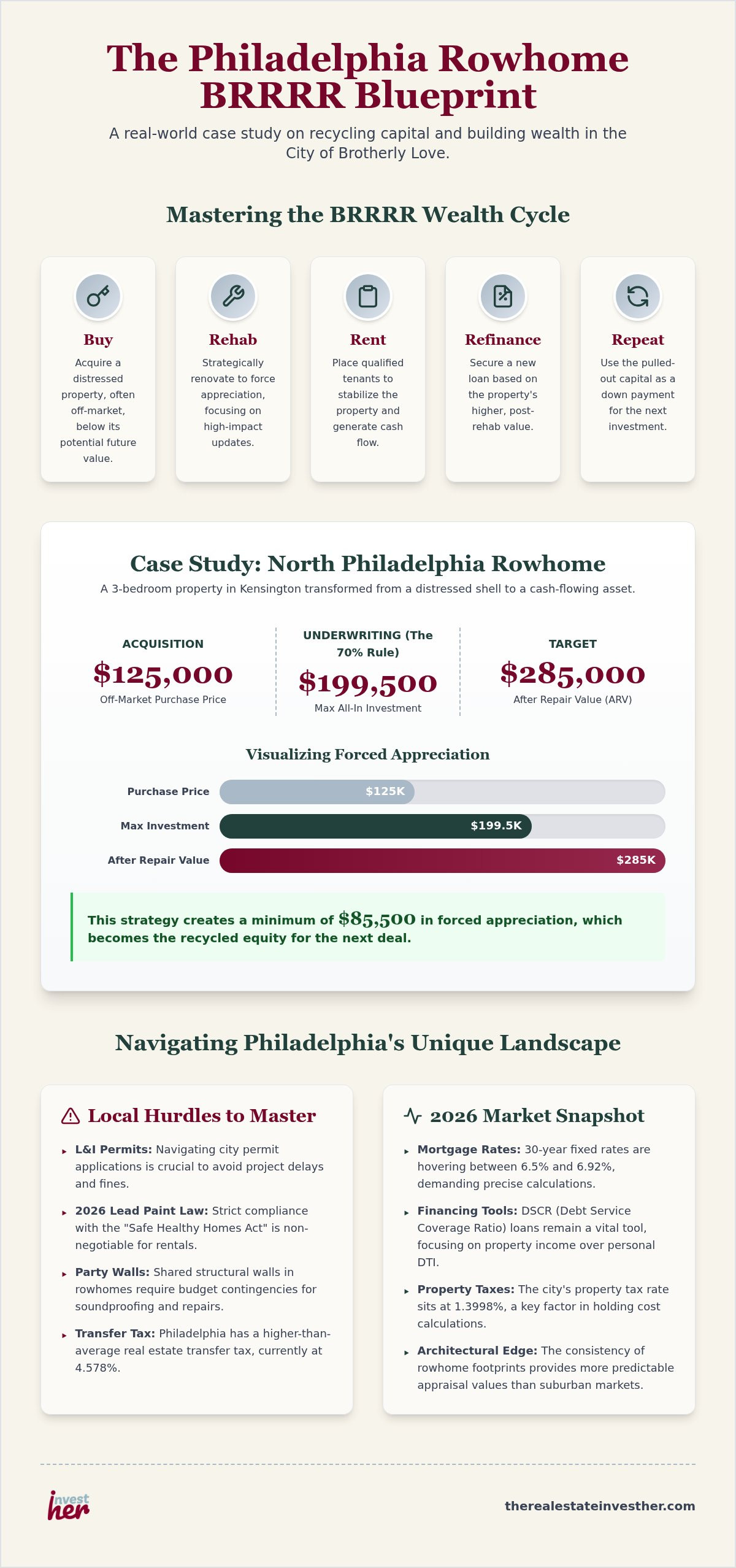
To see how theory meets reality, let’s look at a representative 3-bedroom rowhome in Kensington. This property was acquired for $125,000 through off-market networking, a price point that reflected its distressed state and the 4.578% real estate transfer tax common in the city. This Philadelphia BRRRR method case study follows the journey from a boarded-up shell to a cash-flowing asset, providing a narrative blueprint for scaling in a competitive urban landscape.
The Acquisition and Underwriting Phase
Success begins with a conservative After Repair Value (ARV) target. In this deal, the target ARV was set at $285,000. Applying the 70% rule, the total investment including purchase and rehab should not exceed $199,500. During the walkthrough, we looked for structural red flags typical of 100-year-old Philly homes, such as bowing front walls or compromised “party walls.” Identifying these issues early prevents your budget from ballooning during the demolition phase.
Rehab Strategy: Where to Spend and Where to Save
We prioritized high-impact zones by installing modern kitchens and designer-inspired bathrooms, as these drive the highest appraisal bumps in the rowhome market. Managing the contractor relationship is about more than just oversight; it is about setting clear boundaries and professional expectations from day one. By leading with expertise, you ensure the project stays on schedule. If you want to refine your leadership skills on the job site, connecting with a community of women real estate investors can provide the peer-to-peer support needed to manage complex builds.
Stabilization required navigating the latest 2026 compliance standards. With the “Safe Healthy Homes Act” taking effect on November 1, 2026, we ensured the property had a valid Certificate of Rental Suitability issued within 30 days of tenant placement. This meticulous attention to compliance was essential for the final phase: the refinance. We executed a cash-out refinance at 75% Loan-to-Value (LTV), which returned the majority of the initial capital. The final result was a fully renovated property with a DSCR loan in place, running on recycled equity and providing a blueprint for the next acquisition.
Philadelphia Neighborhood Analysis: Where BRRRR Works Best
Philadelphia is a city of neighborhoods, but for the strategic investor, it’s a city of blocks. Understanding the “Path of Progress” means looking beyond general zip codes to identify where infrastructure and anchor institutions, like the University of Pennsylvania or Temple University, are driving demand. In this Philadelphia BRRRR method case study, we see that location isn’t just about a name; it’s about proximity to transit hubs and stable employment centers. You aren’t just buying a house. You’re investing in a micro-market where one side of the street might offer significantly higher appraisal potential than the other because of a new commercial development or a localized “clean and green” initiative.
When evaluating these zones, we distinguish between Tier 1 and Tier 2 markets. Tier 1 areas have established high rents and predictable appreciation, while Tier 2 areas offer lower entry points with higher potential for forced appreciation. With citywide home prices up 5.2% in mid-2026, finding the right tier for your specific capital goals is the difference between a deal that stalls and one that scales. It’s about alignment between your financial capacity and the neighborhood’s current velocity.
Emerging Markets: Port Richmond and Strawberry Mansion
These neighborhoods are attracting the 2026 wave of investors because they offer the “sweet spot” of entry prices and strong rental demand. Port Richmond benefits from its proximity to the riverfront and the spillover from Fishtown, while Strawberry Mansion sits on the edge of Fairmount Park’s vast amenities. In North Philly, the price-to-rent ratio remains highly attractive for the BRRRR method. While the citywide average rent reached $1,814 in June 2026, North Philly allows for lower acquisition costs on distressed shells, often creating a ratio where monthly rent exceeds 1% of the total project cost. This attracts an “ideal tenant” profile—often young professionals or long-term residents seeking high-quality, renovated spaces.
Established Markets: West Philly and Brewerytown
In more mature markets like West Philly or Brewerytown, the strategy often shifts from rapid capital recycling to long-term wealth preservation. As equity builds through natural appreciation, your focus moves toward finding “the last distressed house on a good block.” These deals are rarely found on the MLS; they’re discovered through consistent off-market networking and community ties. Success here relies on your ability to spot potential where others see a burden. If you’re looking to sharpen your market analysis and find these hidden gems, building a supportive investor community in Philadelphia is the best way to gain “boots-on-the-ground” insights that raw data alone cannot provide. Connecting with peers who know the nuances of each block ensures you’re never navigating the rowhome market in isolation.
Navigating Philadelphia-Specific Hurdles and Regulations
Mastering the Philadelphia rowhome market requires more than just a sharp eye for aesthetics; it demands a deep respect for the city’s complex regulatory environment. While the financial structure of our Philadelphia BRRRR method case study provides the foundation, local compliance is what secures your long-term returns. From the Department of Licenses and Inspections (L&I) to the specific nuances of municipal fees, every detail matters. You aren’t just a landlord. You’re a business owner navigating a landscape that favors those who prioritize meticulous documentation and safety. Ignoring these hurdles doesn’t just invite fines; it can completely stall your ability to refinance and scale.
Effective property management in high-density urban environments also means understanding the “Trash Tax” and other municipal fees. Philadelphia requires commercial trash fees for certain multi-unit properties, and failing to pay these can lead to liens that complicate your exit strategy. Success here is about building a business that is as resilient as the rowhomes themselves. It requires a proactive stance on every city requirement, ensuring your portfolio remains a source of pride rather than a liability.
The Lead Paint Certification Process
The Philadelphia Lead Paint Law is a non-negotiable hurdle for every rental property. As of 2026, all landlords must provide a lead-safe or lead-free certification to the city to receive or renew a rental license. This isn’t just about a one-time test. For lead-safe certifications, renewals are required every four years or when a new tenant moves in, whichever comes first. The cost of professional testing is a minor investment compared to the risk of non-compliance. Under the “Safe Healthy Homes Act” taking effect on November 1, 2026, you cannot file for an eviction without a Certificate of Rental Suitability issued within the previous 30 days, which is directly tied to your lead compliance status.
Permitting and L&I: Avoiding Costly Delays
L&I oversight is often viewed with anxiety, but it’s actually your best defense against a failed refinance. Unpermitted work is the most common reason a bank will reject your cash-out request during a Philadelphia BRRRR method case study. For a typical $25,000 renovation project, the building permit fee is $500 according to the current fee schedule. If your project requires a Zoning Board of Adjustment (ZBA) hearing, the application fee increased to $811 on August 1, 2026. Paying these fees and following the inspection schedule ensures your property is fully compliant and ready for the “Refinance” phase. To navigate these complexities with a group of peers who have already walked this path, join the InvestHER Community Membership to share local resources and contractor recommendations.
Scaling Your Portfolio with the InvestHER Community
Scaling a real estate portfolio requires a profound shift from individual effort to collective leverage. While your first deal provides the proof of concept, moving toward a 10+ unit portfolio demands a different set of tools and a more resilient mindset. Many women experience “analysis paralysis” after their initial success, fearing that the complexity of the Philadelphia market will eventually outpace their capacity. The STRIVE Mentorship Program is designed specifically to bridge this gap. It offers the strategic framework needed to move from a single renovation to a sustainable, wealth-building engine by focusing on high-level portfolio management and refined underwriting.
Embracing the “The Only Woman in the Room” mindset is no longer about surviving a male-dominated industry. It is about wearing your expertise as a badge of honor. When you walk onto a job site in Kensington or Brewerytown, your preparation and community backing become your greatest assets. You aren’t just managing a rehab; you’re leading a vision. This Philadelphia BRRRR method case study has shown that technical knowledge is vital, but the confidence to lead is what actually closes the deal and ensures your projects stay on track.
The Power of Collective Wisdom
Women investors often scale faster when they stop trying to solve every problem in isolation. Within our network, members share more than just encouragement; they share the high-level data and contractor referrals that make or break an urban rehab. If you found a reliable electrician for your first rowhome, that knowledge becomes a currency within the group. This exchange of “boots-on-the-ground” wisdom ensures that no member has to reinvent the wheel. Sharing these resources allows you to focus on the high-level strategy of your business rather than the minutiae of daily hurdles. You can Join the InvestHER Community Membership today to start building the partnerships that will carry you through your next five acquisitions.
Your Next Steps: From Education to Execution
Your journey doesn’t end with a single successful refinance. It begins there. Setting strategic goals for your next Philadelphia acquisition means looking at the 2026 market with fresh eyes and a stronger network. High-level professional development is the key to maintaining your momentum in a shifting economy. The annual InvestHER CON serves as the ultimate gathering for finding the partners and capital necessary to reach that 10-unit milestone. It’s where the lessons from this Philadelphia BRRRR method case study transform into a multi-generational legacy. You can Secure your InvestHER CON 2026 Ticket now to ensure you are part of the room where the next generation of real estate leaders is being forged and supported.
Mastering the Rowhome Market and Your Financial Future
Scaling a portfolio in Philadelphia is about more than just finding a deal; it’s about the precision of your execution and the strength of your support network. This Philadelphia BRRRR method case study highlights how intentionality in the rehab phase and a deep understanding of local regulations like the “Safe Healthy Homes Act” create a foundation for long-term wealth. You now have the blueprint to turn distressed rowhomes into high-performing assets that run on recycled equity. Success doesn’t have to be a solo journey. You can join thousands of women in the InvestHER Community to learn directly from founders Liz Faircloth and Andresa Guidelli. Whether you are preparing to attend InvestHER CON 2026 or looking for a structured path to 10+ units, the right guidance changes everything. Elevate your investing strategy with the STRIVE Mentorship Program and move from one deal to a scaled legacy with confidence. You’ve got the vision; now it’s time to build the life you’ve always wanted.
Philadelphia Real Estate Investing FAQs
Is the BRRRR method still profitable in Philadelphia in 2026?
Yes, the BRRRR method remains highly profitable because demand for high-quality, renovated rowhomes still outpaces supply. While inventory rose nearly 10% year-over-year by May 2026, the market is transitioning to a more balanced state. Investors who focus on forced appreciation in emerging neighborhoods can still achieve strong margins. Success requires precise underwriting to account for the 1.3998% property tax rate and new tenant protection laws that increase landlord compliance burdens.
How do I find off-market deals for BRRRR in Philadelphia?
Direct-to-seller marketing and local networking are the most effective ways to find distressed rowhomes before they hit the MLS. You can leverage driving for dollars, direct mail campaigns, or building relationships with local wholesalers. In a tight market with only 1.85 months of supply, these off-market channels are essential for finding properties at a deep enough discount to make the BRRRR math work. Networking within a dedicated community provides the most reliable leads.
What are the biggest mistakes women investors make in the Philly market?
Over-rehabilitating for the neighborhood and failing to set firm boundaries with contractors are common hurdles. In a rowhome market, you must balance high-quality finishes with the realistic After Repair Value of the block. Many women also struggle with analysis paralysis when navigating L&I regulations or lead paint certifications. This Philadelphia BRRRR method case study demonstrates that having a clear blueprint and a supportive network prevents these costly missteps and builds project leadership confidence.
Do I need a local partner if I am investing in Philadelphia from out of state?
Having a trusted local partner or a high-level project manager is critical for out-of-state investors in Philadelphia. The city’s regulatory environment, including the Safe Healthy Homes Act and L&I inspections, requires boots on the ground to ensure compliance. You need someone who understands the nuances of specific blocks and can manage contractors daily. A local partner ensures your project doesn’t stall due to missed filings or unpermitted work while you are away.
What is the “70% rule” and does it apply to Philadelphia rowhomes?
The 70% rule suggests your total investment shouldn’t exceed 70% of the After Repair Value. In the competitive Philadelphia market, some investors stretch this to 75% or 80% if the rental demand is exceptionally high. However, staying closer to 70% provides a safety net against shifting interest rates. Since rowhomes often share party walls, maintaining a conservative buffer in your underwriting is vital to account for structural surprises that suburban properties might not have.
How does the Philadelphia Lead Paint Law affect my BRRRR timeline?
The Lead Paint Law adds approximately two to four weeks to your stabilization timeline for testing and certification. You cannot legally collect rent or secure a rental license without a lead-safe or lead-free certificate. With the new 2026 regulations, you must also provide a Certificate of Rental Suitability issued within 30 days of a lease start. Planning for these inspections during the final stages of your rehab prevents holding cost delays during the refinance phase.
What kind of financing is best for the “Refinance” step in BRRRR?
Debt Service Coverage Ratio (DSCR) loans are often the best fit for the refinance step because they focus on the property’s cash flow rather than your personal income. As of August 2026, 30-year fixed rates are between 6.5% and 6.92%. DSCR loans allow you to scale quickly by keeping your personal debt-to-income ratio clear for future acquisitions. This approach is a cornerstone of any successful Philadelphia BRRRR method case study focused on building a portfolio.
How can I connect with other women real estate investors in Philadelphia?
Joining a community specifically designed for women, like the InvestHER Community, is the most effective way to build local connections. You can find peer-to-peer support through local meetups, online forums, and mentorship programs. These spaces allow you to share contractor referrals, discuss neighborhood trends, and find potential partners. Attending events like InvestHER CON 2026 provides the networking opportunities needed to move from your first deal to a scaled, professional real estate business.

Article by
Andresa Guidelli
Real estate investor, operator, and founder of The Real Estate InvestHER, a national platform supporting women real estate investors. With 15+ years of experience in real estate investing and business operations, she focuses on helping investors build stronger businesses behind their portfolios through better systems, clearer decision-making, leadership, and responsible use of AI.
Be the first to comment