


Philadelphia Women’s Commercial Real Estate: 2026 Guide
What if the biggest barrier to your success in commercial real estate investing for women in Philadelphia isn’t the market itself, but the silence of walking into every room as the only woman there?
If that question landed somewhere deep, you’re not alone. The Philadelphia commercial real estate landscape is genuinely full of opportunity, from its neighborhood-driven corridors in Fishtown and Kensington to the mixed-use developments reshaping West Philly. But the isolation that comes with being a woman pursuing this path is real, and it’s one of the most underestimated obstacles in the industry. Analysis paralysis sets in. Access to the right lenders, attorneys, and brokers feels like a closed network. And without a local power team that understands your goals, even the most promising deal can stall.
This guide was built to change that. Inside, you’ll find a clear breakdown of Philadelphia’s 2026 commercial market shifts, an honest look at local financing programs like CREAL, and a practical roadmap for building a scalable portfolio with the right community behind you. Consider this your starting point for doing things differently, and doing them alongside women who are already in the game.
Key Takeaways
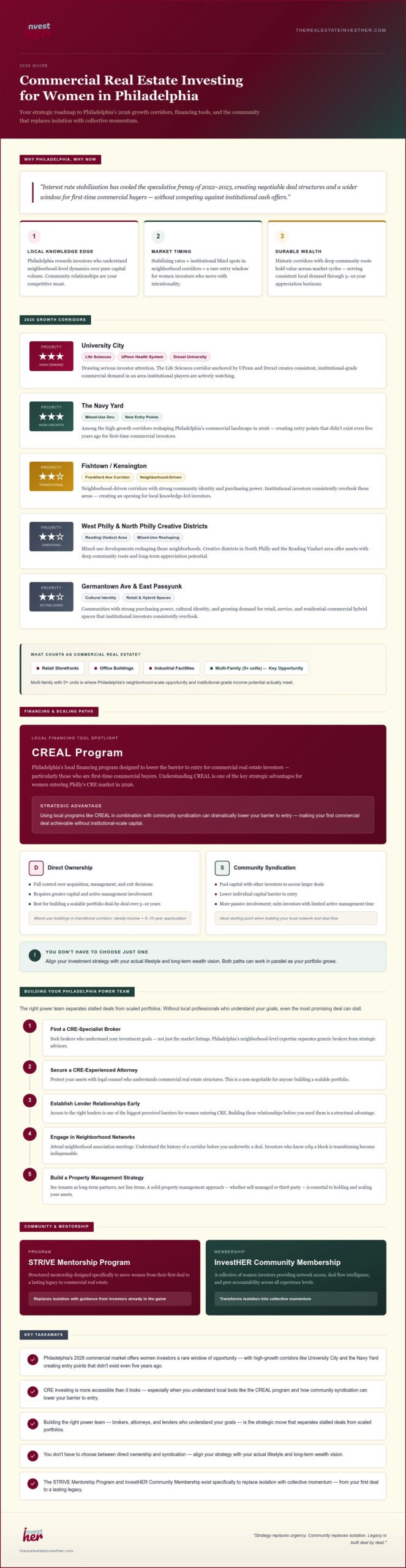
- Philadelphia’s 2026 commercial market offers women investors a rare window of opportunity, with high-growth corridors like University City and the Navy Yard creating entry points that didn’t exist even five years ago.
- Commercial real estate investing for women in Philadelphia is more accessible than it looks, especially when you understand local financing tools like the CREAL program and how community syndication can lower your barrier to entry.
- Building the right power team, from brokers who understand your goals to attorneys who protect your assets, is the strategic move that separates stalled deals from scaled portfolios.
- You don’t have to choose between direct ownership and syndication; this guide breaks down both paths so you can align your investment strategy with your actual lifestyle and long-term wealth vision.
- The STRIVE Mentorship Program and InvestHER Community Membership exist specifically to replace isolation with collective momentum, giving you the network and guidance to move from your first deal to a lasting legacy.
Why Philadelphia is the 2026 Frontier for Women in Commercial Real Estate
Philadelphia isn’t just recovering. It’s reshaping. The city’s multi-family and mixed-use sectors are drawing serious capital as developers and investors recognize what longtime Philadelphians already know: this is a city built on neighborhoods, and neighborhoods are where commercial value lives. Corridors like Germantown Avenue, East Passyunk, and the stretch of Frankford Avenue running through Fishtown aren’t abstract market opportunities. They’re communities with purchasing power, cultural identity, and growing demand for the kind of retail, service, and residential-commercial hybrid spaces that institutional investors consistently overlook.
That oversight is your opening.
The 2026 market dynamics in Philadelphia specifically reward investors who lead with local knowledge and relationship intelligence rather than pure capital volume. Interest rate stabilization has cooled the speculative frenzy that priced out smaller investors in 2022 and 2023, creating more negotiable deal structures and a wider window for first-time commercial buyers to enter without competing against institutional cash offers. For women pursuing commercial real estate investing for women Philadelphia, this moment is less about luck and more about intentionality arriving at exactly the right time.
The Emotional Landscape of Philly CRE
Walking into a room full of established brokers, developers, and lenders in Center City can feel like entering a conversation that started without you. That feeling is real, and dismissing it doesn’t serve anyone. What does serve you is understanding that Philadelphia’s “City of Neighborhoods” identity creates a different kind of competitive advantage: deep local expertise and genuine community relationships carry more weight here than in markets driven purely by institutional scale. The investor who knows why a block in Brewerytown is transitioning faster than the one two streets over isn’t just informed. She’s indispensable.
Moving from transactional interactions to shared community strength isn’t soft strategy. It’s a structural edge. The investors building lasting portfolios in Philadelphia are the ones who show up to neighborhood association meetings, who understand the history of a corridor before they underwrite a deal, and who see tenants as long-term partners rather than line items on a rent roll.
Financial Independence Through Local Assets
Defining wealth on your own terms starts with rejecting the high-pressure, quick-flip model that dominates so much of the mainstream real estate conversation. Philadelphia’s historic commercial corridors, from the Reading Viaduct area to the emerging creative districts in North Philly, offer something more durable: assets with deep community roots that tend to hold value through market cycles precisely because they serve real, consistent local demand.
Sustainable progress here looks like a mixed-use building in a transitional corridor that generates steady income while appreciating over a five-to-ten year horizon. It looks like a portfolio built deal by deal, with each acquisition reinforcing the last. That kind of legacy-building is exactly what commercial real estate investing for women Philadelphia can look like when strategy replaces urgency and community replaces isolation.
Decoding the Philadelphia Commercial Market: 2026 Growth Corridors
Philadelphia Commercial Real Estate, or CRE, covers any property used primarily for business purposes: retail storefronts, office buildings, industrial facilities, and multi-family residential properties with five or more units. That last category matters more than most new investors realize, because it’s where Philadelphia’s neighborhood-scale opportunity and institutional-grade income potential actually meet.
Knowing the definition is the easy part. Knowing where to deploy capital in 2026 is the strategic edge that separates intentional investors from those who simply follow the loudest headlines.
University City is drawing serious attention for a reason. The Life Sciences corridor anchored by the University of Pennsylvania Health System and Drexel’s expanding research campus is generating sustained demand for specialized commercial space, wet labs, medical office suites, and mixed-use buildings that serve a dense, high-income population of researchers, clinicians, and graduate students. Vacancy rates in this submarket have remained tighter than the broader Philadelphia office sector, and the pipeline of institutional anchor tenants creates a stabilizing effect that benefits smaller commercial landlords nearby.
The Navy Yard tells a different story, one built around industrial conversion and adaptive reuse. As the master plan continues evolving, women-led syndicates have a genuine entry point into flex-industrial and creative office product at price points that still reflect the asset’s transitional status rather than its eventual value. This is exactly the kind of asymmetric opportunity that rewards investors who move before the market fully prices in the transformation.
Then there’s the Fishtown-Kensington corridor, where mixed-use and retail redevelopment is being driven not by institutional capital but by community demand. Small-format retail, service-based tenants, and residential-over-commercial configurations are thriving here because the neighborhood’s identity is generating foot traffic that larger, homogenized corridors can’t replicate. For women pursuing commercial real estate investing for women Philadelphia, this is the frontier where local knowledge creates measurable competitive advantage.
Emerging Neighborhoods to Watch
North Philadelphia’s revitalization is attracting what some investors are calling “intentional capital,” funding that prioritizes long-term community alignment alongside financial returns. Two catalysts are accelerating this momentum in 2026 specifically: the FIFA World Cup matches hosted at Lincoln Financial Field and the city’s Semiquincentennial celebrations are expected to drive sustained retail and hospitality demand across multiple neighborhoods, not just Center City. Investors who position retail CRE assets along transit corridors connecting visitors to event venues stand to benefit from a compressed window of elevated foot traffic with longer-term tenant stability built on top of it.
Identifying alignment between a property type and your personal investment goals isn’t a soft consideration. It’s underwriting discipline. A mixed-use building in a transitional corridor requires a different operational tolerance than a stabilized multi-family asset in a mature submarket. Knowing which one fits your current capacity is the difference between a portfolio that scales and one that stalls.
Philly Market Data for 2026
Multi-family cap rates in Philadelphia have shown resilience compared to many peer cities, though specific figures shift with each quarter’s transaction data. Investors should consult current CBRE, Marcus and Millichap, or CoStar reports for the most accurate submarket-level cap rate benchmarks before underwriting any deal. What’s consistently observable across sources is that suburban Philadelphia office product has outperformed urban Class B office in absorption, reflecting the hybrid work reality that has permanently reshaped demand patterns.
Translating market data into a personal investment vision requires more than reading reports. It requires a framework for filtering which signals are relevant to your specific strategy. That’s precisely the kind of analytical clarity that a community built around commercial real estate investing for women Philadelphia can accelerate. If you’re ready to move from data consumption to deal execution, exploring the InvestHER Community Membership puts you inside a network of women who are actively working these same corridors.
Financing and Scaling: From CREAL Loans to Community Syndication
Access to capital is where most promising deals die quietly. Not because the opportunity wasn’t real, but because the investor didn’t know which financing tools existed or how to position herself to use them. For women pursuing commercial real estate investing for women Philadelphia, understanding the full landscape of available financing isn’t optional. It’s the foundation everything else is built on.
Navigating the CREAL Program
Philadelphia’s Commercial Real Estate Acquisition Loan program, known as CREAL, was designed specifically to help small business owners acquire the commercial properties they occupy or intend to occupy. That distinction matters. This isn’t a general investment loan; it’s a tool for owner-operators who want to stop paying rent to someone else and start building equity in their own space.
Eligibility generally centers on being a for-profit business operating within Philadelphia, demonstrating creditworthiness, and presenting a viable business plan that shows how property ownership supports your business’s long-term stability. The application process is where most people stumble, not because they lack qualifications, but because they underestimate what city officials and participating lenders actually want to see. A strong CREAL application doesn’t just describe your business. It tells a story about community impact, job retention, and neighborhood-level economic contribution. That framing is what separates approved applications from rejected ones.
Common pitfalls include submitting incomplete financial documentation, underestimating the property’s operating costs in your projections, and failing to demonstrate that your business has the cash flow to service the debt. Work with a commercial attorney and a CPA familiar with Philadelphia’s lending programs before you submit anything. Verify current CREAL requirements directly with the Philadelphia Department of Commerce, as program specifics can shift with each fiscal year.
The Power of Syndication for Women
Direct ownership isn’t the only path to building a commercial portfolio. Syndication, where a group of investors pools capital to acquire a property that none could purchase alone, opens doors to larger, more complex assets without requiring you to carry the full financial weight yourself.
This model aligns naturally with the collective wisdom approach that defines communities like the STRIVE Mentorship Program. When women bring deal-finding, due diligence, and capital-raising skills together inside a structured partnership, the risk gets distributed and the learning curve compresses dramatically. A mixed-use building in Fishtown that’s out of reach individually becomes entirely viable when five investors with aligned goals and complementary expertise approach it together.
Structuring deals for long-term sustainability means resisting the pressure to engineer a quick exit. The strongest syndication partnerships prioritize cash flow stability, tenant quality, and asset appreciation over a compressed timeline. That’s not a conservative mindset. It’s a legacy mindset, and it’s exactly the kind of strategic clarity the InvestHER Community Membership is built to cultivate alongside you.
Building Your Philadelphia Power Team: 5 Essential Steps
No deal closes on strategy alone. The investors who consistently execute in Philadelphia’s commercial market aren’t just the most informed people in the room. They’re the ones with the right people around them before the room ever fills up. Building a power team isn’t a one-time task you complete before your first acquisition. It’s an ongoing practice of intentional relationship-building that compounds in value with every deal you close.
For women pursuing commercial real estate investing for women Philadelphia, this team is the structural difference between a stalled opportunity and a scaled portfolio. Here’s how to build it with purpose.
- Identify local commercial brokers who lead with alignment. You want a broker who understands that your investment goals are tied to a longer vision, not just the fastest commission. Ask directly how they approach mixed-use and neighborhood-corridor deals, and listen for whether they talk about community context or just square footage and cap rates.
- Vet Philadelphia-based real estate attorneys and asset protection specialists. Your attorney isn’t just a closing formality. She or he is the person who structures your LLC, reviews your operating agreements, and protects your assets when a deal gets complicated. Prioritize attorneys with demonstrated experience in Philadelphia commercial transactions, not just residential closings.
- Connect with property managers who hold ESG standards. A property manager who understands environmental, social, and governance priorities isn’t just a values match. She or he is a tenant retention asset. Managers who treat tenants as community partners reduce turnover, which directly protects your cash flow.
- Establish relationships with local lenders and credit unions. Philadelphia has a strong community development financial institution ecosystem. Building relationships with local lenders before you need them means faster underwriting, more flexible deal structures, and a lending partner who actually understands the submarket you’re investing in.
- Find a mentor who has navigated this specific market. This one deserves its own conversation.
The Role of a Real Estate Mentor
A mentor isn’t someone who hands you a deal. She’s someone who helps you see the deal clearly before you commit to it. The costly mistakes in commercial real estate, overpaying because you didn’t understand a submarket’s absorption trends, signing a lease with a weak tenant covenant, underestimating a building’s capital expenditure needs, are almost always mistakes that experienced eyes would have caught. A mentor who has successfully navigated Philadelphia’s CRE landscape doesn’t just accelerate your learning curve. She compresses the timeline between your first deal and your third. The STRIVE Mentorship Program was built specifically to fill this gap, pairing women with experienced investors who understand both the market mechanics and the unique challenges of building a portfolio without an established network behind you. The transition from mentee to peer happens naturally when you stop asking “what do I do?” and start asking “here’s what I’m seeing, what am I missing?” That shift is what sustainable growth actually looks like.
Networking with Purpose in Philly
Transactional networking produces business cards. Purposeful networking produces deals, referrals, and the kind of professional solidarity that makes the isolated moments in this industry genuinely rare. Philadelphia’s commercial real estate community has pockets of genuine opportunity for women investors: Urban Land Institute Philadelphia events, NAIOP Pennsylvania chapter programming, and neighborhood-specific investor meetups in corridors like Fishtown and West Philly all offer entry points. The difference between showing up and showing up strategically is knowing what you’re there to give, not just what you’re there to gain. The InvestHER Community Membership takes this further by creating a structured environment where mentor-to-peer connections aren’t accidental. They’re the entire design. When your network is built inside a community that understands the specific terrain of commercial real estate investing for women Philadelphia, every introduction carries more weight and every deal conversation starts from a foundation of shared context.
Scaling Your Legacy with the InvestHER Community
Every strategy covered in this guide, from reading University City’s Life Sciences corridor to structuring a syndication deal in Fishtown, becomes exponentially more executable when you’re not navigating it alone. The final piece of the puzzle isn’t another market report. It’s the community that turns information into action and ambition into a portfolio.
Mentorship as a Catalyst for Growth
The STRIVE Mentorship Program exists precisely for the moment when you know enough to be dangerous but not enough to be decisive. It’s built around the “problem-to-vision” cadence that defines the InvestHER coaching model: you bring the challenge you’re staring down, and the mentorship framework helps you reframe it into a clear next move. Complex strategies, from underwriting a mixed-use asset to structuring your first commercial LLC, get broken into steps you can actually execute this quarter, not someday.
Women who’ve moved through STRIVE describe a consistent turning point: the shift from waiting to feel ready to trusting the process enough to act. For women pursuing commercial real estate investing for women Philadelphia, that shift is the difference between a deal that closes and one that stays in a spreadsheet indefinitely. The mentorship relationship doesn’t end when you close your first commercial deal. It evolves into a peer dynamic where your growing experience becomes part of the collective intelligence that the next woman in the program benefits from.
Your Invitation to the Philadelphia Network
You don’t have to be the only woman in the room anymore. That’s not a motivational slogan. It’s a structural reality when you’re inside the InvestHER Community Membership.
The membership gives you access to a network of women who are actively working Philadelphia’s commercial corridors and markets across the country, alongside educational resources designed specifically for the professional woman who’s building wealth on her own terms. This isn’t a passive content library. It’s a living community where deal questions get real answers, where accountability replaces isolation, and where your growth is genuinely celebrated.
And then there’s InvestHER CON 2026. The annual event is where the community’s collective momentum becomes visible and tangible. It’s the room where commercial real estate investing for women Philadelphia stops being a solo pursuit and becomes a shared mission, with speakers, deal conversations, and connections that carry forward long after the event ends.
Your first step doesn’t have to be dramatic. It just has to be deliberate. Join the InvestHER Community and start building your Philadelphia legacy alongside women who are already in motion.
Your Next Move in Philadelphia’s Commercial Market Starts Now
Philadelphia’s 2026 commercial landscape isn’t waiting, and neither should you. The growth corridors are real, the financing tools exist, and the power team you need is buildable. What transforms all of that from potential into an actual portfolio is the decision to stop navigating commercial real estate investing for women Philadelphia in isolation and start moving with a community that understands exactly where you’re headed.
The market knowledge, the CREAL program insights, the syndication framework, none of it compounds until you have the right people around you accelerating your execution. That’s precisely what the STRIVE Mentorship Program and InvestHER Community are built to provide: strategic guidance, high-level networking, and a room full of women who are already in motion.
Your first deal doesn’t have to be perfect. It just has to happen. Scale your portfolio with the STRIVE Mentorship Program and step into the Philadelphia legacy you’ve already been building toward. The community is here, and there’s a seat at this table with your name on it.
Frequently Asked Questions About Commercial Real Estate Investing for Women in Philadelphia
What is the CREAL program in Philadelphia and how can women investors use it?
The Commercial Real Estate Acquisition Loan (CREAL) program is a Philadelphia city-backed financing tool designed to help small business owners purchase the commercial properties they occupy or plan to occupy. It’s not a general investment vehicle; it’s specifically structured for owner-operators who want to convert rent payments into equity-building ownership. Eligibility typically requires operating a for-profit business within Philadelphia, demonstrating creditworthiness, and presenting a business plan that shows community and economic impact.
Women investors can use CREAL most effectively by framing their application around neighborhood contribution and job retention, not just business financials. Before submitting anything, verify current program requirements directly with the Philadelphia Department of Commerce, as terms shift with each fiscal year. Working with a Philadelphia-based commercial attorney and a CPA familiar with city lending programs before applying significantly improves your approval odds.
Is commercial real estate investing more difficult for women in Philadelphia?
The structural challenges are real: access to established broker networks, lender relationships, and deal flow has historically been built around networks that women were excluded from. That’s not pessimism; it’s context. The good news is that Philadelphia’s neighborhood-driven market actually rewards the relationship intelligence and community fluency that many women investors bring naturally, creating a competitive edge that pure capital volume can’t replicate.
Commercial real estate investing for women in Philadelphia becomes measurably more accessible when you’re inside a community built specifically for this path. Isolation is the biggest compounding obstacle, and replacing it with structured mentorship and peer accountability changes the entire trajectory of how quickly you move from research to execution.
How much capital do I need to start commercial real estate investing in Philadelphia?
The honest answer is: it depends on your entry point. Direct ownership of a small mixed-use property in a transitional corridor like Fishtown or North Philly requires a different capital base than participating in a syndication, where pooled investor capital lowers the individual threshold significantly. Syndication structures can allow entry at amounts that make larger commercial assets accessible without carrying the full financial weight yourself.
Rather than anchoring to a single number, focus on two things: understanding your current liquidity and creditworthiness clearly, and identifying which deal structure aligns with your actual capacity right now. A mentor who has navigated Philadelphia’s commercial market can help you map that honestly before you commit to any specific capital target.
What are the best neighborhoods in Philadelphia for commercial investment in 2026?
University City remains one of the strongest submarkets, driven by sustained demand from the Life Sciences corridor anchored by Penn Medicine and Drexel’s research expansion. The Navy Yard offers asymmetric opportunity in flex-industrial and adaptive reuse product, with pricing that still reflects transitional status rather than long-term value. The Fishtown-Kensington corridor continues to reward investors with deep local knowledge, particularly in mixed-use and small-format retail configurations.
North Philadelphia is drawing intentional capital from investors prioritizing both financial returns and community alignment. The 2026 FIFA World Cup matches at Lincoln Financial Field and the city’s Semiquincentennial celebrations are expected to elevate retail and hospitality demand across transit-connected corridors, creating a compressed window of elevated foot traffic with longer-term tenant stability built on top of it.
How do I find a female real estate mentor in Philadelphia?
Start by looking for structured programs rather than hoping organic networking produces the right connection. The STRIVE Mentorship Program was built specifically to pair women with experienced investors who understand both Philadelphia’s commercial market mechanics and the unique challenges of building a portfolio without an established network. That specificity matters; a mentor who understands your exact terrain compresses your learning curve in ways that general real estate coaching simply can’t.
Beyond structured programs, ULI Philadelphia events, NAIOP Pennsylvania chapter programming, and neighborhood investor meetups in corridors like West Philly and Fishtown create genuine entry points. The InvestHER Community Membership takes this further by making mentor-to-peer connections a structural feature rather than an accidental outcome of showing up to the right event.
What is the difference between residential and commercial real estate investing for beginners?
Residential real estate covers one-to-four unit properties; commercial covers everything from retail storefronts and office buildings to multi-family properties with five or more units. The underwriting process differs significantly: commercial deals are evaluated primarily on the income the property generates (its net operating income and cap rate), while residential valuations lean heavily on comparable sales in the area. Commercial leases also tend to be longer and more complex, with different tenant covenant considerations than a standard residential lease.
For beginners, the practical difference is that commercial investing requires a more specialized power team from the start, including a commercial broker, a CPA familiar with investment property taxation, and an attorney experienced in commercial transaction structures. The learning curve is steeper, but the income potential and portfolio scalability are substantially higher once you understand the fundamentals.
Can I invest in Philadelphia commercial real estate through a syndicate?
Yes, and syndication is one of the most strategic entry points available for women who want access to larger, more complex commercial assets without carrying the full capital requirement alone. In a syndication, a group of investors pools resources to acquire a property that none could realistically purchase individually. One investor typically serves as the general partner managing the deal, while others participate as limited partners contributing capital and sharing in the returns.
The key to a successful syndication is alignment: shared investment goals, clearly defined roles, and a deal structure built for long-term cash flow stability rather than a rushed exit. Women-led syndicates have found genuine entry points in Philadelphia’s Navy Yard and mixed-use corridors specifically because the collaborative model distributes both risk and expertise across the partnership.
What should I look for in a Philadelphia commercial real estate power team?
Your power team needs five core players: a commercial broker who understands neighborhood-level context and not just square footage metrics; a Philadelphia-based real estate attorney with demonstrated commercial transaction experience; a CPA familiar with investment property structures and local tax considerations; a property manager who treats tenant relationships as a retention asset; and a local lender or community development financial institution with genuine submarket knowledge. Each role compounds the others, and a weak link in any one of them can stall a deal that was otherwise solid.
Build these relationships before you need them. The investors who execute consistently in Philadelphia’s commercial market aren’t scrambling to find an attorney at closing; they’ve already had three conversations with that attorney about deal structure. The InvestHER Community Membership gives you a network where referrals to vetted team members come from women who’ve already worked these same corridors.

Article by
Andresa Guidelli
Real estate investor, operator, and founder of The Real Estate InvestHER, a national platform supporting women real estate investors. With 15+ years of experience in real estate investing and business operations, she focuses on helping investors build stronger businesses behind their portfolios through better systems, clearer decision-making, leadership, and responsible use of AI.
Be the first to comment