


Dallas Multifamily Real Estate Market 2026: A Woman Investor’s Guide to Strategic Scaling
While the headlines might shout about a 12.2% vacancy rate, the most strategic investors know that the real story of the Dallas multifamily real estate market 2026 isn’t found in a single spreadsheet. It’s found in the quiet divergence between Class A rent growth and the rebalancing of suburban submarkets like Frisco and McKinney. You’ve likely felt that familiar hesitation when looking at conflicting data or felt like the only woman in the room during a high-stakes commercial negotiation. It’s exhausting to weigh the fear of overpaying against the deep-seated drive to build a lasting legacy for your family.
This guide will give you the clarity you need to move past analysis paralysis and into strategic action. We’ll show you how to navigate the current high-supply environment with data-driven confidence and a community-first approach to building sustainable wealth. We are breaking down the DFW due diligence framework, the mindset shift required to scale from single-family to multifamily, and how to leverage a supportive network to vet deals in a market that rewards precision over volume. You don’t have to navigate this transition alone. The path to professional excellence is paved with collective wisdom and intentional growth.
Key Takeaways
- Gain clarity on how the Dallas multifamily real estate market 2026 is rebalancing as it absorbs over 30,000 new units, allowing you to move past analysis paralysis.
- Learn to identify the divergence in rent growth where Class A properties see 3.2 percent increases while Class B and C assets require more strategic management.
- Discover why leveraging collective wisdom during due diligence is essential for identifying hidden zoning hurdles that solo investors often overlook.
- Master the 2026 value-add framework to find “diamond in the rough” deals by analyzing loss-to-lease opportunities in established North Texas submarkets.
- Transition from transactional single-family investing to a legacy-focused approach that prioritizes long-term cash flow and personal well-being.
The Dallas Multifamily Landscape in 2026: Supply, Demand, and the ‘Sideways’ Shift
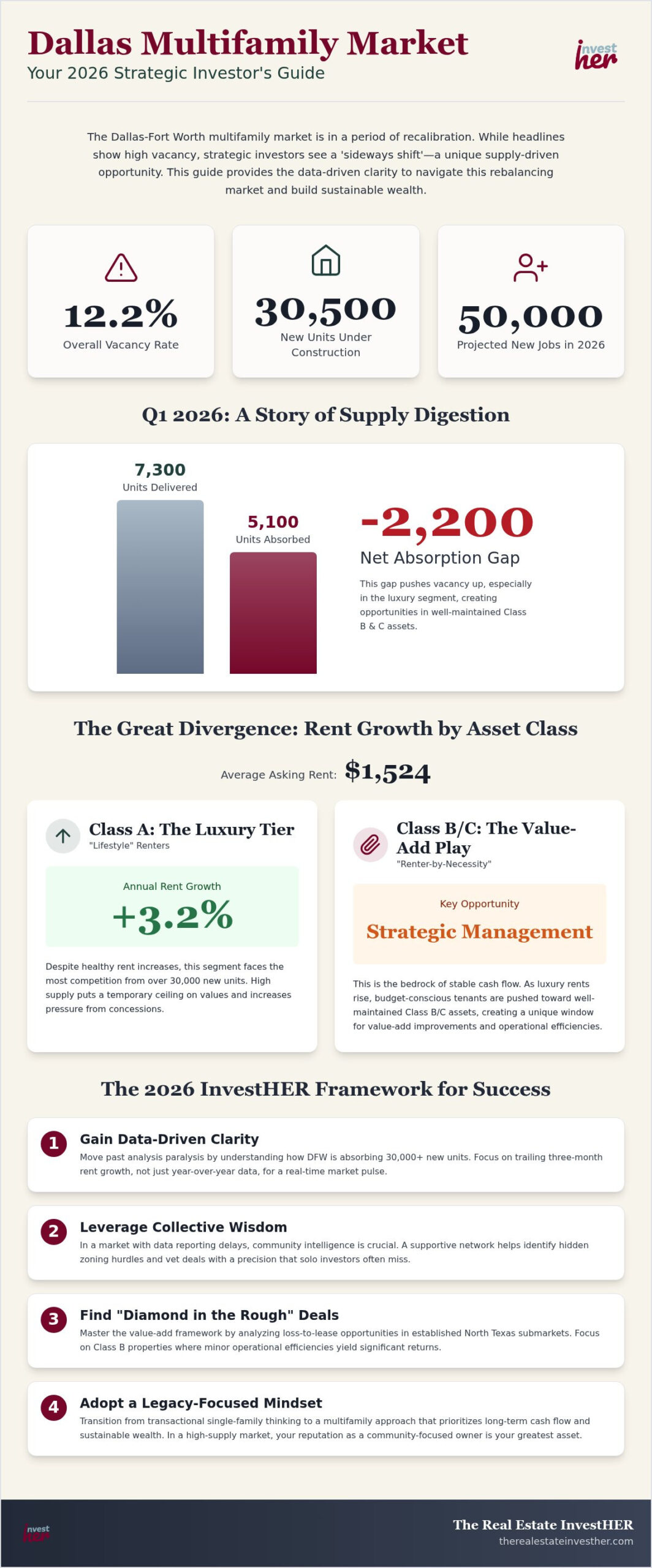
The Dallas multifamily real estate market 2026 is currently defined by a rhythmic, sideways motion. It’s a period of recalibration where the frantic pace of the previous decade has met the reality of massive supply. Many investors feel a sense of unease as stability remains elusive, yet this is exactly where the most disciplined women in our community find their edge. While the broader market works to absorb the 30,500 units currently under construction, existing property values are facing a temporary ceiling. It’s a classic rebalancing act. High mortgage rates and steep home prices have solidified a permanent renter class in North Texas, ensuring that demand for quality housing isn’t going anywhere. For the patient investor, 2026 isn’t a year to fear. It’s the year of supply-driven opportunity.
Macroeconomic Drivers in North Texas
The strength of the Dallas economy and demographics remains a primary tailwind for our sector. Despite national fluctuations, the Metroplex is projected to add approximately 50,000 jobs this year, representing a healthy 1.2% increase. We’re seeing the Victory Park Effect in full swing as corporate relocations continue to funnel high-earning professionals into the urban core. Simultaneously, the Fed’s transition from fighting inflation to supporting employment has created a more predictable, albeit cautious, lending environment. This shift favors those who prioritize long-term debt strategies over quick flips. It’s about building a legacy, not just chasing a transaction.
Supply vs. Absorption Realities
The numbers tell a story of digestion. In Q1 2026 alone, the market saw 7,300 units delivered, but net absorption trailed at 5,100 units. This gap has pushed vacancy rates to 12.2%, particularly in the luxury segment. While Class A properties are seeing a 3.2% annual rent rise, the oversupply in that tier is actually pushing budget-conscious tenants toward well-maintained Class B assets. This creates a unique value-add window. If you can identify properties where you can recover value through minor operational efficiencies, you’re positioned to win. Data tracking has been slightly complicated by recent federal reporting delays, making hyper-local community intelligence more valuable than ever. We don’t just look at the spreadsheets; we look at the neighborhood pulse.
- Job Growth: 50,000 new positions projected for 2026.
- Supply Pipeline: 30,500 units currently underway across DFW.
- Absorption Gap: 2,200 unit delta between Q1 deliveries and net absorption.
- Class A Divergence: 3.2% rent growth despite elevated vacancy in luxury builds.
Success in this sideways market requires a move away from cold, transactional thinking. It’s about understanding the human element behind the data. When supply is high, your reputation as an owner-operator who cares about the community becomes your greatest asset. It’s how you maintain occupancy when the building down the street is offering three months of free rent.
Rent Growth and Occupancy: Navigating Dallas Pricing Realities
Understanding the pulse of the Dallas multifamily real estate market 2026 requires looking beyond the static numbers of the past. Currently, the average asking rent sits at $1,524. Many investors are asking if we’ve finally found the bottom. While year-over-year data still reflects the heavy supply absorption mentioned previously, your focus should shift to trailing three-month rent growth. This KPI offers a real-time window into market sentiment and tenant demand. It’s the difference between reacting to old news and anticipating a recovery. We’re seeing a clear divergence between Renter-by-Necessity (RBN) and Lifestyle renters. While luxury “Lifestyle” units face stiff competition from new deliveries, RBN properties remain the bedrock of stable cash flow for those looking to build a sustainable legacy.
The 92.3% stabilization threshold has become the new benchmark for DFW properties. Falling below this mark often triggers aggressive concessions, while staying above it allows for modest organic growth. To navigate these pricing realities, you must align your strategy with current Dallas multifamily market data which suggests that while the pace has slowed, the foundation remains firm. It’s about finding that sweet spot where professional execution meets empathetic management. If you’re feeling the weight of these shifting metrics, connecting with a supportive network of women investors can provide the perspective needed to vet these deals with confidence.
Sub-Market Spotlight: Las Colinas to Victory Park
Las Colinas continues to thrive as corporate campus growth brings a steady stream of professional tenants who value proximity to work. The demand here is less about flash and more about long-term stability. Conversely, Victory Park is experiencing a surge in high-end rental demand, partially influenced by the presence of major firms like Scotiabank. These neighborhoods offer a form of recession-resistance because they cater to diverse employment sectors. When you focus on these hyper-local drivers, the broader market noise begins to fade.
The Pricing Gap: Dallas vs. The National Average
Dallas unit prices currently average around $155,000, offering a significantly more competitive entry point compared to the national average of $185,000. This $30,000 per-unit gap is a primary reason why North Texas remains a magnet for capital. We’ve also seen cap rate expansion, which requires a more nuanced approach to your 2026 exit strategy. You can’t rely on market appreciation alone; success now demands operational excellence and intentional value-add strategies. Stabilized occupancy in the Dallas market refers to a property maintaining a consistent 92.3% or higher physical occupancy rate after the initial lease-up phase.
- Average Rent: $1,524 asking price across the Metroplex.
- Entry Point: $155,000 average price per unit in DFW.
- Stabilization Goal: Maintaining a 92.3% occupancy floor.
- Key Metric: Prioritize T3 rent growth over lagging annual stats.
Scaling in this environment isn’t about being the loudest person in the room. It’s about being the most informed. By understanding these pricing gaps and renter behaviors, you move from a place of fear to a place of strategic autonomy.
Why Community-Driven Due Diligence is Non-Negotiable in North Texas
In the Dallas multifamily real estate market 2026, the data is only half the battle. You can study cap rates and vacancy percentages until you’re exhausted, but the real risks often hide in the shadows of a deal. Solo due diligence is a relic of the past. Today, the most successful women scaling their portfolios understand that collective wisdom is their greatest competitive advantage. It’s about moving away from the isolation of the “lone wolf” investor and toward a model of shared intelligence. When you’re looking at a 50-unit property in Oak Cliff or a value-add opportunity in Arlington, a spreadsheet won’t tell you about an unrecorded city lien or a pending zoning shift that could stall your renovations. Leveraging a network of peers allows you to uncover these hurdles before you sign the contract.
We’ve all felt the weight of being the “only woman in the room” in commercial brokerages. It’s a psychological hurdle that can lead to second-guessing your instincts or feeling pressured to overpay in a competitive environment. By leaning into a community of high-level investors, you replace that isolation with a sense of collective strength. The InvestHER Community Membership provides that vital second set of eyes on DFW deals. It transforms a high-stakes, lonely process into a collaborative victory where you can vet opportunities with people who have already walked the path you’re on.
Networking as a Strategic Asset
Building your “Dallas Power Team” is about more than just finding a name in a directory. You need lenders who understand the nuances of the 2026 DFW job growth trends and property managers who know how to maintain a 92.3% occupancy floor in a high-supply environment. Local meetups are the heartbeat of off-market opportunities. In our experience, women-led investor groups often see higher referral-to-deal ratios because the foundation is built on mutual support rather than just a transaction. It’s about finding alignment with partners who value your long-term legacy as much as you do.
The Power of Shared Professional Development
Theory is fine, but execution in Dallas is what builds sustainable wealth. Events like InvestHER CON 2026 bridge this gap by connecting you with mentors who have weathered previous Texas market cycles. These pioneers offer a roadmap for scaling from single-family to multifamily with confidence. They understand that the emotional intelligence advantage in tenant retention is what keeps your cash flow steady when the broader market moves sideways. When you invest in your professional development alongside a supportive network, you aren’t just buying a property; you’re building a foundation for financial independence.
- Collective Wisdom: Use peer reviews to identify hidden property liens or zoning hurdles.
- Power Team: Curate a local network of lenders and inspectors who know the North Texas terrain.
- EQ Advantage: Leverage emotional intelligence to improve tenant management and retention.
- Mentorship: Connect with leaders who have successfully navigated high-supply environments.
Success in this market isn’t just about the numbers on the page. It’s about the quality of the people you have in your corner. When you prioritize community-driven due diligence, you move from a place of uncertainty to a place of strategic autonomy.
Strategic Scaling: How to Identify ‘Diamond in the Rough’ Deals in DFW
Identifying opportunity in the Dallas multifamily real estate market 2026 requires a pivot from macro-trends to hyper-local micro-execution. While the luxury “Lifestyle” segment works through its current oversupply, the most resilient “diamonds” are hiding in established Class B and C submarkets. These properties often feature a significant “Loss to Lease” gap, where current rents sit 15% to 20% below market rates due to passive management or deferred aesthetic updates. By applying a disciplined 2026 value-add framework, you can unlock organic growth that isn’t dependent on market-wide appreciation. We also prioritize the “Proximity to Infrastructure” test, targeting assets near DART rail extensions and major highway expansions that ensure long-term tenant stability and ease of access for the North Texas workforce.
The Deal Vetting Checklist
Scaling from a handful of doors to a mid-sized portfolio demands a rigorous vetting process that looks beyond the surface. You need a second set of eyes to ensure your projections align with reality. Consider these three pillars during your DFW due diligence:
- Rent-to-Income Analysis: Target specific Dallas zip codes where the average rent remains below 30% of the median household income to ensure a deep pool of qualified applicants.
- Utility Cost Auditing: Older DFW assets often harbor inefficient HVAC systems or outdated plumbing; these are hidden profit-killers that require a detailed line-item audit before closing.
- Maintenance Assessment: It is vital to distinguish between cosmetic deferred maintenance and the structural foundation issues common in North Texas soil, as the latter can derail your renovation budget.
Financing the Scale-Up
In a higher interest rate environment, creative financing is no longer an alternative; it’s a necessity for strategic growth. Seller carry-backs and wraps allow you to maintain your debt-to-equity balance while bypassing some of the friction of traditional commercial lending. Bridge loans also remain a vital tool for the 2026 Dallas market, providing the capital needed for rapid renovations before you transition into permanent agency debt. To secure financing in the North Texas region, lenders typically require a 1.25x Debt Service Coverage Ratio (DSCR), meaning the property’s net operating income must exceed the annual debt service by at least twenty-five percent.
Scaling from 4 to 40 units is a significant leap that requires more than just capital. It requires a proven system and a shift in mindset from “landlord” to “portfolio strategist.” This specific transition is the core focus of our mentorship, where we break down the complexities of commercial deals into actionable steps. You don’t have to navigate these high-stakes negotiations alone. If you are ready to move from transactional investing to building a true legacy, apply for the STRIVE Mentorship Program to receive the strategic guidance and collective wisdom you need to scale with confidence.
Building Your Dallas Legacy: The InvestHER Path to Financial Independence
Building wealth is about more than just the next closing statement. It’s about intentionality. As you navigate the Dallas multifamily real estate market 2026, the shift from transactional investing to legacy-focused wealth building becomes your most significant milestone. Multifamily real estate remains the ultimate vehicle for sustainable cash flow because it provides a foundation of scale that single-family rentals simply cannot match. It allows you to move away from the daily grind of micro-management and toward a life of autonomy and alignment. You aren’t just buying buildings. You are securing a future where your financial independence and personal well-being coexist in a state of shared strength and collective resilience.
True success isn’t measured solely by your portfolio’s unit count or your net operating income. It’s found in the delicate balance between high-level professional ambition and the freedom to be present for the moments that matter most. We understand the unique pressure of being the only woman in the room during a multi-million dollar negotiation. It can be isolating to weigh complex market data without a sounding board that shares your values. That’s why taking the next step involves joining a community that understands your “Why” and supports your pursuit of excellence without requiring you to sacrifice your personal fulfillment.
The Role of Mentorship in Scaling
Scaling from a handful of doors to a commercial portfolio requires a roadmap that is as unique as your specific goals. The STRIVE Mentorship Program provides this personalized strategy, specifically tailored for the nuances of North Texas. It’s the proven antidote to the analysis paralysis that often stalls even the most ambitious investors. By working with expert coaches who have successfully navigated high-supply environments, you gain the clarity to move from “thinking about it” to “submitting the offer.” We celebrate the wins together because we know the psychological impact of community support is what keeps you moving forward when the broader market feels uncertain.
Your 2026 Action Plan
Your journey toward a Dallas legacy starts with a single, decisive action. Begin by refining your market research to focus on the sub-markets we’ve discussed, then move toward preparing your first Dallas multifamily offer with a vetted power team in your corner. Attending InvestHER CON 2026 is a strategic investment in your professional development, offering a rare chance to connect with industry leaders in an environment designed for collective growth. It’s time to stop navigating the commercial landscape in isolation. Whether you are analyzing your first deal or refining your exit strategy within the Dallas multifamily real estate market 2026, we invite you to Join the InvestHER Community and scale your Dallas portfolio today!
Your Future in North Texas Starts Today
The Dallas multifamily real estate market 2026 is a landscape of profound opportunity for those who prioritize strategy over speed. We’ve explored how the current “sideways” shift is actually a period of stabilization, allowing you to identify value-add assets while others hesitate. By moving from solo due diligence to a model of collective wisdom, you protect your capital and your peace of mind. You don’t have to navigate these complexities alone; your growth is a shared journey.
Whether you’re looking to scale via the STRIVE Mentorship Program or seeking the support of our vibrant community of 10,000+ women investors, your path to financial independence is already paved. It’s time to step into your power as a portfolio strategist. Join us for expert-led sessions and high-level networking that will transform your approach to commercial deals. Secure Your InvestHER CON 2026 Ticket and Connect with Dallas Leaders. You have the vision and the tools. Now, let’s build your legacy together.
Frequently Asked Questions
Is Dallas still a good market for multifamily real estate in 2026?
Yes, Dallas remains a robust market due to the projected addition of 50,000 jobs this year and a consistent 1.2% increase in employment. While the area is currently working through a period of high supply, the fundamental demand for housing in North Texas is driven by major corporate relocations and a growing permanent renter class. This creates a stable foundation for investors who prioritize long-term cash flow over short-term speculation.
What is the average price per unit for Dallas multifamily properties right now?
The average price per unit for the Dallas multifamily real estate market 2026 reached $175,300 as of the first quarter. This entry point remains significantly more competitive than the national average, which often hovers around $185,000. These valuations offer a strategic window for women investors who are looking to scale their portfolios while maintaining a disciplined approach to their debt-to-equity balance and overall financial well-being.
How does the high supply of new apartments in DFW affect rent growth?
Current high supply has led to a temporary stabilization of rents, with some submarkets experiencing a year-over-year decrease of approximately 2.1%. However, there is a clear divergence in asset performance; Class A properties continue to see an annual rise of 3.2% while Class B and C assets face more pressure. This environment requires you to focus on operational excellence and hyper-local data to maintain your margins effectively.
Do I need a local mentor to invest in the Dallas real estate market?
While not a legal requirement, having a mentor who understands the specific nuances of the Dallas multifamily real estate market 2026 is a strategic necessity for scaling safely. A mentor helps you move past the “only woman in the room” syndrome and provides a second set of eyes on complex commercial deals. This guidance is vital for identifying hidden risks like North Texas soil issues or unrecorded city liens.
What are the best neighborhoods in Dallas for value-add multifamily deals?
Established submarkets like Las Colinas and suburban nodes such as Frisco and McKinney offer excellent value-add potential this year. These areas benefit from proximity to major corporate campuses and infrastructure expansions like the DART rail extensions. Look for older properties with “loss to lease” opportunities where professional management can bridge the gap between current rents and market rates through aesthetic updates and improved tenant services.
How can women investors overcome industry bias in the Dallas commercial market?
Overcoming industry bias starts with building collective strength through a supportive network of peers who value shared intelligence over individual ego. By aligning with a community that provides data-driven insights, you gain the confidence to negotiate as an equal in male-dominated spaces. Professional development events and mentorship provide the strategic vocabulary and high-level expertise needed to command respect and achieve excellence in any commercial boardroom.
What is the STRIVE Mentorship Program, and how does it help with scaling?
The STRIVE Mentorship Program is a strategic coaching initiative designed to help women scale from single-family rentals to mid-sized multifamily portfolios. It provides a personalized roadmap and expert guidance to help you move from 4 to 40 units with confidence. The program focuses on breaking through analysis paralysis by offering actionable frameworks for due diligence, financing, and building a power team that understands the North Texas terrain.
What should I look for in a Dallas property management team?
Look for a team that has a deep understanding of the DFW market’s specific 92.3% stabilization threshold and a proven track record in tenant retention. They should prioritize emotional intelligence in their management style while maintaining high standards for utility cost auditing and deferred maintenance. A great team acts as your local partner, ensuring your property remains competitive even when nearby new builds are offering aggressive concessions.

Article by
Andresa Guidelli
Real estate investor, operator, and founder of The Real Estate InvestHER, a national platform supporting women real estate investors. With 15+ years of experience in real estate investing and business operations, she focuses on helping investors build stronger businesses behind their portfolios through better systems, clearer decision-making, leadership, and responsible use of AI.
Be the first to comment