


Real Estate Mastermind vs Mentorship for Women: Which Path Scales Your Wealth in 2026?
Single women now represent 20% of all homebuyers in 2026, yet the path to scaling from a few rentals to a massive portfolio often feels like a solo trek through a desert of traditional networking. You’ve built a solid foundation and proved your resilience. Now, you’ve reached that frustrating plateau where the next level requires more than just hard work; it requires a strategic shift in your support system. Choosing between a real estate mastermind vs mentorship for women is the most consequential decision you’ll make for your wealth this year. It’s the difference between having a guide who shows you the way and a tribe that helps you build the road.
We understand the weight of making high-stakes decisions without a sounding board, especially when you’re balancing professional excellence with personal fulfillment. You deserve a roadmap that doesn’t force you to choose between your portfolio and your peace of mind. In this article, you’ll discover the critical differences between mentorship and masterminds to determine which high-level support system will actually move the needle for your real estate portfolio. We will explore how these distinct paths offer access to capital partners, off-market deals, and the collective wisdom needed to navigate the 2026 market with absolute confidence.
Key Takeaways
- Recognize the signs of a growth plateau where your individual efforts can no longer support the complexity of scaling your portfolio.
- Understand how mentorship provides a vital transfer of expert wisdom to help you master foundational systems and technical deal analysis.
- Learn why masterminds leverage collective intelligence to facilitate high-level strategic vision and help you secure essential capital partners.
- Determine the best path for your wealth by evaluating a real estate mastermind vs mentorship for women based on your current need for technical skills or peer networking.
- Discover how a holistic ecosystem bridges the gap between local community support and elite professional scaling for long-term sustainability.
The Growth Plateau: Why Women Investors Need More Than Just Information
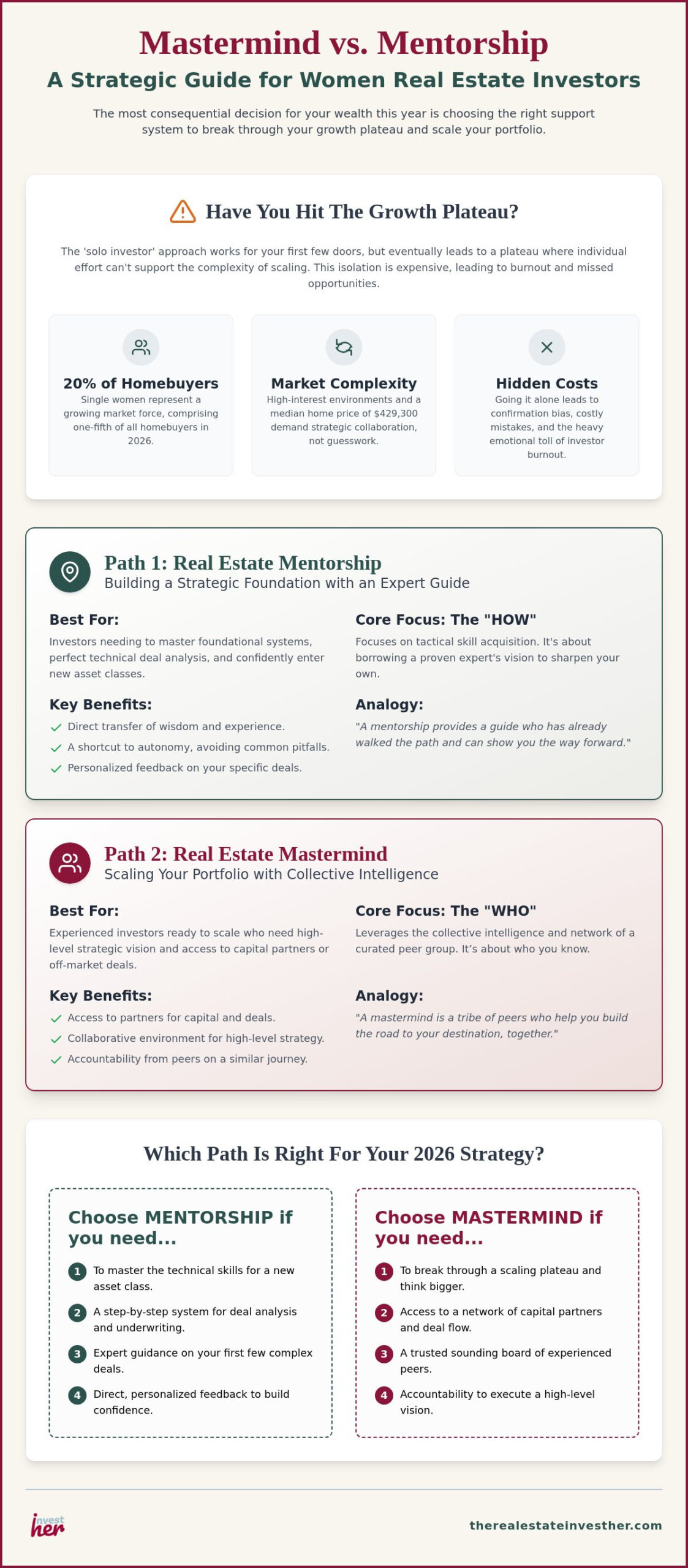
Scaling a real estate portfolio in 2026 isn’t about working harder; it’s about thinking differently. Most investors start as solopreneurs, wearing every hat from property manager to bookkeeper. This approach works for your first few doors. However, you eventually hit the Growth Plateau. This is the point where your existing knowledge cannot support the complexity of your next ten deals. In this high-interest environment, where the 2026 median home price hovers around $429,300, individual guesswork is a liability. You need a team. You need a strategy. Most importantly, you need to decide between a real estate mastermind vs mentorship for women to break through.
Traditional investor circles often leave women feeling like an outsider. Walking into a room where you’re the only woman makes it harder to ask vulnerable questions or find partners who share your values. The 2026 market dynamics, including the 21st Century ROAD to Housing Act, have changed the landscape. Individual investors must now navigate more transparency and shifting institutional boundaries. Succeeding in this climate requires collective wisdom rather than isolated effort. You can’t scale a legacy on a foundation of “doing it all yourself.”
The ‘Solo Investor’ Myth and Its Hidden Costs
Isolation is expensive. When you underwrite a deal in a vacuum, you’re prone to confirmation bias. You might miss a subtle zoning change or miscalculate the impact of the new SALT deduction cap of $40,000. These aren’t just numbers; they’re the foundation of your financial future. Beyond the financial risk, the emotional toll of carrying a portfolio alone is heavy. Investor burnout is the inevitable exhaustion of trying to manage high-stakes assets without a resilient community to lean on.
Why Gender-Specific Networks Accelerate Success
The definition of mentorship often focuses on the transfer of technical skills, but for women, it’s also about psychological safety. In a gender-specific network, the conversation shifts from competition to collaboration. You aren’t just comparing ROIs; you’re discussing how to scale while maintaining a life of purpose. Whether you’re choosing a real estate mastermind vs mentorship for women, the goal is the same: to find an environment where your ambition is understood. These groups foster a mindset where one woman’s exit is another woman’s entry, creating a seamless flow of capital and opportunity that traditional, male-dominated groups simply can’t replicate.
Real Estate Mentorship: Building a Strategic Foundation with Expert Guidance
Mentorship isn’t just about learning the ropes. It’s about borrowing someone else’s vision until your own is sharp enough to lead. In a market where 30-year fixed mortgage rates are averaging in the mid-6% range, the margin for error has narrowed significantly. This is where the debate of real estate mastermind vs mentorship for women becomes practical for your portfolio. Mentorship provides a direct transfer of wisdom from a pioneer who has already weathered market cycles to an investor ready to scale. It focuses on the “how”—mastering skill acquisition, perfecting deal analysis, and installing the foundational systems that prevent your business from collapsing under its own weight. You aren’t just buying information; you’re investing in a shortcut to autonomy.
Entering a new asset class, like moving from single-family homes to mid-sized multifamily, requires more than just a spreadsheet. It requires a sounding board. A mentor acts as that board, helping you navigate the nuances of commercial lending or the complexities of the 2026 Qualified Business Income (QBI) deduction, which is now permanent at 23%. Small group or 1-on-1 guidance ensures that your specific questions don’t get lost in the noise of a larger crowd. The STRIVE Mentorship Program is designed for this exact transition. It moves you away from the frantic pace of solo investing and toward a more rhythmic, intentional growth strategy.
Direct Feedback vs. General Education
General education tells you what a good deal looks like in theory. A mentor tells you why the deal on your desk is a trap. In 2026, with the FinCEN Residential Real Estate Reporting Rule increasing transparency requirements for legal entities, having an expert eye on your underwriting is vital. Risk mitigation is the cornerstone of legacy building. When a mentor reviews your underwriting, they see the red flags you’ve been trained to ignore. This personalized scrutiny shortens your learning curve by years. It moves you from “hoping it works” to “knowing it scales.”
What to Look for in a Real Estate Mentor in 2026
Choosing a guide requires more than just looking at their bank account. You need alignment in values. Does this person respect your “why” and your legacy goals? In a post-ROAD Act environment, you need a mentor who has navigated shifting institutional boundaries and market downturns. Avoid the trap of informal “coffee chats” that lack accountability. Seek a structured program that provides consistent feedback and high-level professional descriptors. This ensures your growth is sustainable and deeply rooted in both financial success and personal well-being.
Real Estate Masterminds: Scaling Your Portfolio Through Collective Intelligence
If mentorship is about learning the rules of the game, a mastermind is where you rewrite them. While we’ve explored the technical foundation of a real estate mastermind vs mentorship for women, the mastermind serves a distinct purpose: scaling through collective intelligence. In this environment, the group is the expert. You aren’t looking for a single guide to show you the way; you’re looking for a peer-powered engine that accelerates your high-level vision. This is where strategic partnerships are forged and where capital raising moves from a stressful hurdle to a rhythmic part of your business growth.
Think of a mastermind as the “board of directors” for your real estate business. As a solo investor, you’re the CEO, the CFO, and the intern. In a mastermind, you surround yourself with other CEOs who offer radical accountability. This isn’t about incremental 10% improvements; it’s about the 10x growth that happens when you stop doing and start leading. When you’re held accountable by peers who are operating at or above your level, the excuses that once slowed you down simply evaporate. You’re no longer just managing properties; you’re orchestrating a legacy.
The Power of Peer-to-Peer Problem Solving
The “hive mind” of a mastermind is particularly effective when navigating complex 2026 market trends, such as shifting asset management strategies in a high-interest environment. Instead of one perspective, you get ten. When you face a creative financing challenge or a difficult tenant situation, the collective wisdom of the group provides a spectrum of solutions you couldn’t have envisioned alone. In the ecosystem of high-level growth, the “Mastermind Effect” creates a synergy where one plus one equals eleven, turning individual efforts into exponential business expansion.
Networking Beyond the Deal: Legacy and Alignment
True success isn’t just about the numbers on a closing statement; it’s about building a life of autonomy. Masterminds for women prioritize this holistic view, fostering partnerships that extend into joint ventures and syndications. You’ll find peers who share your commitment to financial independence on your own terms, without sacrificing your well-being. This high-level networking fundamentally shifts your investor identity. You stop seeing yourself as someone who “buys houses” and start seeing yourself as a sophisticated capital allocator. This confidence is the invisible fuel that allows you to walk into any room and command the respect your portfolio deserves.
Mastermind vs. Mentorship: A Framework for Your 2026 Strategy
Choosing between a real estate mastermind vs mentorship for women isn’t about finding a “superior” model. It’s about identifying your current bottleneck. Mentorship answers the question, “How do I do this?” It’s about technical precision, underwriting, and systems. Masterminds answer the question, “Who can I do this with?” They’re designed for strategic partnerships and capital expansion. If you’re struggling with deal analysis, you need a mentor. If you have the deals but lack the capital or partners to close them, you need a mastermind.
Combining these models creates a 360-degree support system that protects your downside while accelerating your upside. You don’t have to choose one and abandon the other forever. Many high-level investors utilize a mentor for new asset classes while remaining active in a mastermind for deal flow and peer accountability. This dual approach ensures your growth is both technically sound and strategically expansive.
Assessing Your Current Portfolio Stage
- The Foundation Stage (0-5 units): Your priority is skill acquisition. Mentorship is vital here to prevent expensive rookie mistakes in a market where 2026 median home prices hover around $429,300.
- The Scaling Stage (10+ units): You’ve mastered the basics. A mastermind becomes your primary growth driver by connecting you with capital partners and syndication opportunities.
- The Legacy Stage: You’re transitioning from active management to wealth preservation and giving back. This often involves taking on mentorship roles or joining elite, invite-only masterminds.
Cost vs. ROI: Evaluating the Financial Commitment
Stop viewing tuition as an expense. It’s an investment in your most valuable asset: your own expertise. When evaluating a program, calculate the “Cost of Inaction.” What’s the price of missing three deals this year because you lacked the confidence to pull the trigger? Statistics show women often under-invest in their professional development compared to men, yet the ROI on specialized real estate training often manifests in a single well-negotiated deal. Before committing, ask the program director how they handle market-specific shifts, such as the 2026 ROAD Act restrictions. If you’re ready to move from analysis paralysis to intentional action, explore the STRIVE Mentorship Program to see how a structured roadmap can redefine your trajectory.
Navigating Your Journey with The Real Estate InvestHER Ecosystem
Building wealth isn’t a destination; it’s a series of intentional pivots supported by the right people. While you’ve analyzed the technicalities of a real estate mastermind vs mentorship for women, the real magic happens when these paths converge. The Real Estate InvestHER ecosystem was built to bridge this exact gap. We provide a space where community networking, strategic mentorship, and high-level events work in harmony to elevate your portfolio. It’s about moving from isolation to a state of collective strength where your ambition is the norm, not the exception. This holistic approach ensures that as your assets grow, your personal well-being remains a priority.
Local chapters in hubs like Scottsdale, Austin, and San Diego offer the “boots on the ground” support that purely digital groups often lack. These chapters are where the strategies discussed in mentorship sessions meet the reality of local market nuances. Whether you’re navigating the new FinCEN reporting rules effective March 2026 or seeking local capital partners, having a tribe in your specific city changes the game. It turns a national strategy into a local legacy. Authenticity is our currency here. We value the “growth mindset” that allows women to be vulnerable about their challenges while remaining relentless in their pursuit of excellence.
Finding Local Support in Major Investor Hubs
In high-growth markets like Scottsdale and Phoenix, networking is the key to uncovering off-market opportunities before they hit the MLS. Conversely, navigating high-barrier markets like New York or Philadelphia requires a tribe that understands local rent controls and tax complexities. In Dallas or Austin, our local meetups serve as a talent pool for building your core team. By connecting with women who have already mastered these specific terrains, you bypass the expensive trial-and-error phase and move straight into execution.
Taking the Next Step: InvestHER CON and STRIVE
InvestHER CON 2026, held from June 14-16 in Scottsdale, AZ, serves as the ultimate catalyst for your next phase of growth. Use this annual gathering as a “litmus test” to determine if you’re ready for the peer-to-peer intensity of a mastermind or the structured guidance of a mentor. It’s a premier environment for finding your next partner or the guide who will help you 10x your vision. If you’ve identified that your current bottleneck is a lack of systems and strategic scaling, it’s time for a deeper commitment. Learn more about the STRIVE Mentorship Program to see how a dedicated roadmap for women can move the needle for your portfolio this year.
Claim Your Seat at the Strategic Table
Breaking through the growth plateau in 2026 demands a shift from working in your business to leading it. You’ve already proven you have the grit to start. Now, you need the technical systems of a mentor and the collective leverage of a peer group to sustain your success without sacrificing your well-being. Whether you prioritize one-on-one guidance or group intelligence, your choice between a real estate mastermind vs mentorship for women will define your portfolio’s trajectory. This decision is about more than just deals; it’s about the legacy you intend to build.
Led by industry pioneers Liz Faircloth and Andresa Guidelli, The Real Estate InvestHER is trusted by thousands of women investors globally. With community hubs in 8+ major US cities, we provide the local support and national expertise required to navigate high-stakes market shifts with absolute confidence. You don’t have to navigate these complexities alone. It’s time to invest in the high-level support that mirrors your ambition and respects your purpose. Scale your portfolio with the STRIVE Mentorship Program today. Your future self is waiting for you to take this step with clarity and courage.
Frequently Asked Questions
What is the main difference between a real estate mastermind and mentorship?
The primary distinction lies in the source of expertise and the stage of your journey. Mentorship is a direct transfer of wisdom from an expert to an individual, focusing on the technical “how” of deal analysis and systems. Conversely, a mastermind is a peer-powered engine where the collective intelligence of the group solves strategic problems. Choosing between a real estate mastermind vs mentorship for women depends on whether you need a roadmap to follow or a board of directors to help you lead.
Is a real estate mentor worth the cost for a beginner woman investor?
Investing in a mentor is often the most effective way to avoid expensive underwriting errors in a market where the median home price is $429,300. A mentor provides the technical foundation and psychological safety needed to navigate 2026 mortgage rates, which remain in the mid-6% range. By borrowing an expert’s vision, you shorten your learning curve and gain the confidence to execute deals that align with your long-term legacy goals.
How do I know if I’m ready for a high-level real estate mastermind?
You’re likely ready for a mastermind when you’ve mastered the foundational skills and your primary bottleneck is no longer knowledge, but network. If you’ve scaled to 10 or more units and find yourself needing capital partners or strategic joint ventures, the peer-to-peer environment is ideal. Masterminds are designed for investors who are ready to transition from active management to high-level portfolio orchestration through collective wisdom.
Can I find a real estate mentor for free in cities like Scottsdale or Austin?
While formal, structured programs require an investment, you can find organic peer guidance through local InvestHER chapters in Scottsdale or Austin. Many investors also find initial support through local Real Estate Investment Associations (REIAs), where annual membership fees typically range from $50 to $150. These community-driven spaces allow you to build relationships that can evolve into informal mentorships based on shared values and mutual support.
How much does a typical real estate mentorship program cost in 2026?
High-level industry programs often range from $15,000 to over $25,000 depending on the asset class and the mentor’s track record. These costs reflect the significant ROI that comes from avoiding a single bad deal or gaining access to elite capital partners. When evaluating a real estate mastermind vs mentorship for women, it’s vital to view these fees as an investment in your autonomy rather than a transactional business expense.
What should I ask before joining a women-only real estate investing group?
Ask about the group’s core values and how they handle market-specific shifts like the 2026 ROAD Act restrictions. You should also inquire about the balance between professional ambition and personal well-being within the community. Ensure the group’s communication rhythm feels like a conversation between equals and that they prioritize a “growth mindset” over individual ego, fostering a culture of true collaboration.
Does the STRIVE Mentorship Program help with capital raising?
The STRIVE Mentorship Program focuses on strategic portfolio scaling, which naturally includes the professionalization of your capital-raising systems. By helping you master deal analysis and foundational business structures, the program makes your portfolio more attractive to lenders and partners. It provides the technical clarity and confidence required to walk into a room and secure the funding needed for larger, more complex deals.
How do I balance the time commitment of a mastermind with my full-time job?
Most high-level programs utilize a rhythmic, methodical flow that respects the busy schedules of professional women. By focusing on high-leverage activities and breaking complex strategies into clear, actionable steps, these groups actually create more time in your life. You’ll stop wasting hours on individual guesswork and start following a steady cadence that prioritizes long-term sustainability over frantic, short-term wins.

Article by
Andresa Guidelli
Real estate investor, operator, and founder of The Real Estate InvestHER, a national platform supporting women real estate investors. With 15+ years of experience in real estate investing and business operations, she focuses on helping investors build stronger businesses behind their portfolios through better systems, clearer decision-making, leadership, and responsible use of AI.
Be the first to comment