


Analyzing Rental Properties in San Diego: A Woman Investor’s Guide to Strategic Wealth in 2026
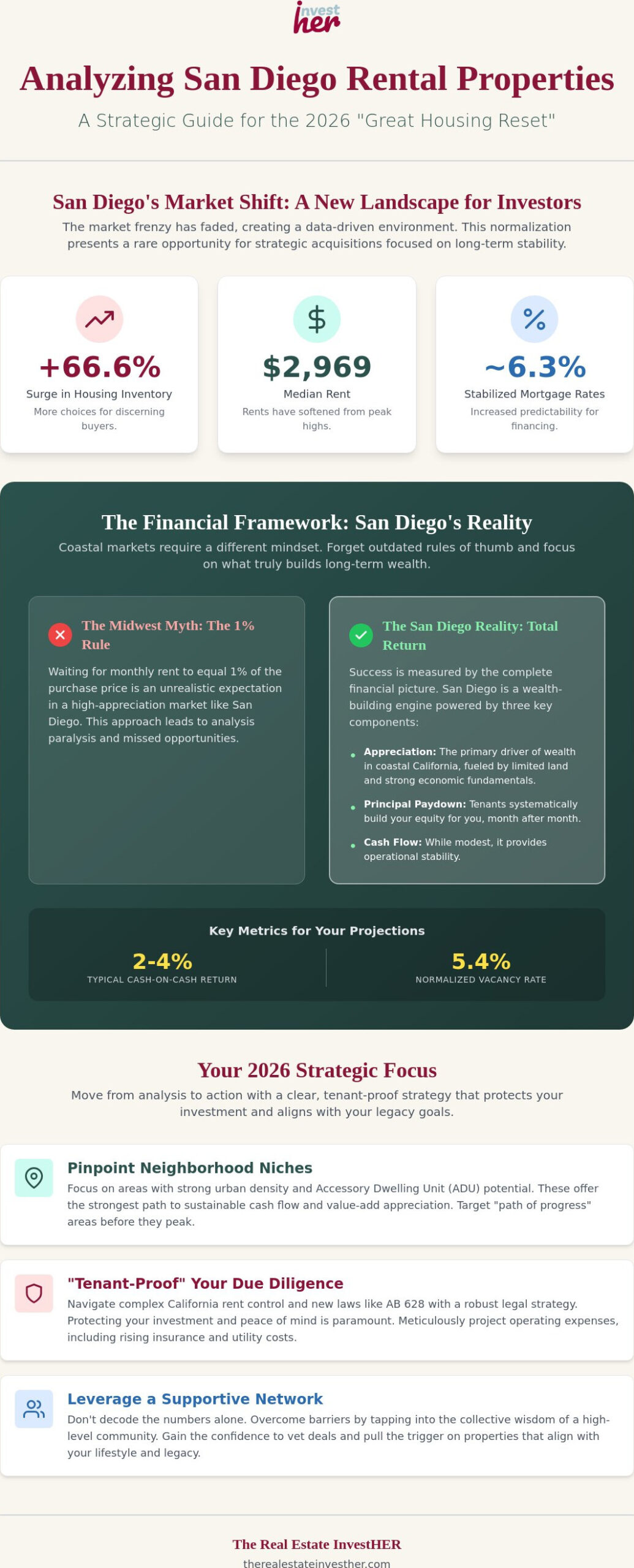
San Diego’s real estate market is currently navigating what experts call “The Great Housing Reset.” While a 66.6% surge in housing inventory might feel like a shift toward uncertainty, it actually presents a rare opportunity for analyzing rental properties in San Diego with a focus on long-term stability rather than temporary hype. It is natural to feel a sense of hesitation when facing median rents that have softened to around $2,969 and a legal landscape shaped by new requirements like AB 628. You are likely balancing the fear of overpaying with the desire to stop feeling like the only woman in the room. We understand that building a portfolio in a high-stakes environment requires more than just a spreadsheet; it requires a community that shares your ambition.
This guide provides the strategic framework you need to move from analysis paralysis to confident execution. We will break down the 2026 financial roadmap, simplify complex tenant protection ordinances, and show you how to leverage collective wisdom to secure your financial future. By the end of this article, you’ll have the clarity to pull the trigger on a deal that aligns with both your lifestyle and your legacy. Let’s transform these market shifts into your most powerful competitive advantage.
Key Takeaways
- Gain a clear perspective on the 2026 “Great Housing Reset” to identify how shifting supply-demand dynamics create unique opportunities for intentional growth.
- Master the essential financial framework for analyzing rental properties in San Diego, focusing on total return and appreciation metrics that align with coastal market realities.
- Pinpoint specific neighborhood niches from North County to Central SD where urban density and ADU potential offer the strongest path to sustainable cash flow.
- Navigate complex California rent control laws and 2026 legal updates with a “tenant-proof” due diligence strategy that protects your investment and your peace of mind.
- Discover how to scale your portfolio by leveraging the STRIVE Mentorship Program and a supportive network of high-level female investors.
Why Analyzing Rental Properties in San Diego Requires a 2026 Perspective
The investment climate of 2026 demands a departure from the “buy and hope” strategies of the past decade. With mortgage rates stabilizing near 6.3% and a 66.6% surge in housing inventory, the market frenzy has finally faded. It is replaced by a methodical, data-driven environment characterized by “The Great Housing Reset.” For women investors, analyzing rental properties in San Diego now means looking far beyond the sticker price. We aren’t just buying houses. We are acquiring strategic assets that anchor a financial legacy. This normalization requires a sharper eye for value and a deeper understanding of how supply-demand shifts affect your bottom line. You need to know if a property’s value is supported by local wage growth or merely by temporary scarcity.
San Diego is famously an appreciation-first market. This means the math looks different here than it does in the cash-flow-heavy Midwest. You are playing a long game. Success requires high-level analysis that accounts for the city’s unique geography and limited buildable land. When you shift your mindset from “landlord” to “portfolio strategist,” you begin to see how these market corrections actually protect your equity over time. It’s about finding the intersection of professional ambition and personal well-being. We focus on assets that provide sustainable wealth, ensuring your portfolio grows alongside your personal life. This approach helps you avoid overpaying in a competitive market while giving you the confidence to act when the right deal appears.
San Diego’s Economic Moat in 2026
Understanding the Economy of San Diego is crucial for predicting long-term stability. The life sciences corridor in UTC attracts high-income professionals, while military bases provide a recession-proof demand floor. Despite tighter short-term rental regulations, the 2026 landscape rewards those focusing on high-quality, long-term housing. This diversity ensures San Diego remains a premier appreciation-first market.
The ‘InvestHER’ Approach to Market Research
Generic scrapers lack the “soul” of a neighborhood. Our approach prioritizes community-led insights over cold algorithms. When analyzing rental properties in San Diego, you must balance financial metrics with your legacy goals. Identifying “path of progress” areas before they peak requires a growth mindset and the type of high-level analysis we champion in our community.
The Financial Framework: Essential Metrics for San Diego Property Analysis
Numbers tell a story, but in a high-cost market, you must know how to read between the lines. Analyzing rental properties in San Diego requires a departure from traditional “rules of thumb” that apply to cheaper, midwestern markets. The 1% rule, which suggests monthly rent should equal 1% of the purchase price, is essentially a myth in coastal California. If you wait for a property in North Park or La Jolla to hit that mark, you’ll likely never close a deal. Instead, we focus on the Total Return. San Diego is a wealth-building engine powered by appreciation and principal paydown. While your initial Cash on Cash (CoC) return might hover between 2% and 4% in 2026, the long-term equity growth often outpaces high-cash-flow markets by a significant margin.
We often see women face unique Barriers For Women Investing In Real Estate, particularly when it comes to accessing high-level financial mentorship and sophisticated deal analysis. Overcoming these hurdles starts with mastering the math. You aren’t just looking for a monthly paycheck; you’re building a foundation for your family’s future. This means accounting for San Diego’s specific operating expenses. You must factor in a 5.4% vacancy rate, which has normalized after the lows of 2021. Additionally, rising insurance premiums and tiered utility costs can eat into your margins if they aren’t meticulously projected. If these numbers feel overwhelming, remember that you don’t have to decode them alone; our InvestHER community is here to help you vet every deal with confidence.
In the San Diego market, the Cap Rate serves as a baseline indicator of a property’s unleveraged yield, reflecting the premium investors pay for the city’s historically high appreciation potential and geographic supply constraints.
Advanced Metrics for Scaling
As you grow, look toward the Internal Rate of Return (IRR) to understand your wealth horizon over ten years. If you’re using specialized lending, the Debt Service Coverage Ratio (DSCR) becomes your most important hurdle. Finally, use the Equity Multiple to measure the total wealth generated for every dollar you invest. These metrics move you from “buying a house” to “executing a strategy.”
Accounting for the ‘California Factor’
Proposition 13 is a critical piece of the puzzle. You must accurately project property tax resets to 1.1% or 1.25% of the new purchase price, rather than relying on the seller’s current tax bill. Don’t forget maintenance reserves. Coastal properties face unique wear and tear from salt air, and many older San Diego builds require proactive “tenant-proofing” to maintain their value in a competitive market.
San Diego Neighborhood Niches: Where the Numbers Make Sense
San Diego isn’t a monolith. It’s a collection of distinct micro-markets, each offering a different path to financial autonomy and personal fulfillment. When you’re analyzing rental properties in San Diego, the zip code often dictates whether you’re chasing immediate yield or long-term equity. We believe in choosing locations that align with your specific wealth goals and your capacity for management. Every neighborhood tells a different story about your future portfolio.
In North County, Oceanside and Vista have emerged as the premier sweet spot for cash flow. This is largely due to the steady, reliable presence of military families from Camp Pendleton. These tenants offer incredible stability. Research shows that San Diego’s average tenant retention is 39 months. That’s over three years of consistent, predictable income that allows you to focus on scaling rather than constant turnover. It’s a strategy rooted in the reality of local demand.
Moving toward Central San Diego, neighborhoods like North Park and City Heights offer a different set of advantages. These areas are defined by high urban density and a “flight to quality” among modern renters who value walkability and smart home features. Here, the strategy isn’t just about the existing structure. It’s about the land. For those just beginning their journey, East County neighborhoods like La Mesa and El Cajon often provide a more accessible entry point with lower purchase prices. Meanwhile, South Bay, specifically Chula Vista, is seeing growth fueled by the massive Bayfront development project. This area is a prime example of a “path of progress” play where early analysis leads to significant future gains.
The ADU Strategy (Accessory Dwelling Units)
The real “hidden” value in San Diego often lies in the backyard or the garage. By 2026, density bonuses and streamlined permitting have made ADUs a cornerstone of strategic growth. Converting an underutilized space into a second rental unit allows you to double your income stream without the cost of buying a second lot. This is how you turn a cash-flow-neutral deal into a winner. It’s an intentional way to build a legacy while maximizing every square foot of your investment. Our community often discusses these conversions as a way to “house hack” your way to a larger portfolio.
Military and Student Rental Analysis
Analyzing proximity to major hubs is essential for long-term success. Properties near the 32nd St Naval Base serve a different demographic than those near Camp Pendleton. Similarly, student housing near SDSU or UCSD offers guaranteed demand but requires a mindset prepared for higher turnover. While the average leasing speed in San Diego is just 13 days, these niches demand specialized management. You need a team that understands the nuances of military clauses or student lease cycles to ensure your investment remains a source of peace, not stress.
Due Diligence and Risk Mitigation in a Complex Market
Once you have identified a promising neighborhood, the transition from interest to investment requires a rigorous due diligence process. Analyzing rental properties in San Diego in 2026 is no longer just about the physical structure; it is about navigating a dense web of local and state regulations. The “Great Housing Reset” has brought market normalization, but it has also introduced stricter compliance standards. You must account for the San Diego Tenant Protection Ordinance, which became effective June 24, 2023. This law requires “just cause” for eviction from the first day of tenancy and mandates relocation assistance of two months’ rent for no-fault evictions, or three months for seniors and disabled tenants. These aren’t just details. They are fundamental components of your risk mitigation strategy.
A successful “InvestHER” inspection goes beyond looking for leaky faucets. It focuses on “tenant-proofing” your asset to meet modern standards and legal requirements. For example, California Assembly Bill 628 now requires landlords to provide and maintain working stoves and refrigerators for all new or extended leases. Additionally, Assembly Bill 414 requires the electronic return of security deposits if the tenant paid electronically. We view these regulations not as barriers, but as a framework for professional excellence. By ensuring your property is fully compliant and structurally sound, you protect your equity and build a reputation as a high-quality housing provider. This intentionality is what separates a hobbyist from a wealth-builder.
Insurance and title verification are equally critical in our coastal environment. You must analyze whether a property sits in a high-risk fire zone or requires specific coastal flood coverage, as these premiums can significantly impact your net operating income. Simultaneously, you must verify the legal unit count. San Diego has a high frequency of “fixer-uppers” with unpermitted work or garage conversions that don’t meet current safety codes. Confirming the zoning and short-term rental permit status ensures your exit strategy remains viable. If the complexity of these checks feels daunting, joining the STRIVE Mentorship Program can provide the professional guidance needed to vet these details with ease.
A 5-Step San Diego Due Diligence Checklist
- Verify actual vs. pro-forma rents: Don’t trust a listing at face value; use local networking to confirm what tenants are truly paying.
- Audit the utility history: SDG&E costs are historically high; review at least 12 months of bills to ensure your expense projections are accurate.
- Inspect for unpermitted work: Cross-reference the property’s physical layout with city records to avoid future legal or insurance headaches.
- Review relocation assistance liabilities: Calculate potential “no-fault” eviction costs based on current San Diego rental averages.
- Confirm electronic payment readiness: Ensure your management systems comply with AB 414 for security deposit returns.
Mitigating the ‘Analysis Paralysis’
Setting a strict “Buy Box” is the most effective way to filter out market noise and focus on deals that align with your legacy. When you define your parameters for neighborhood, property type, and minimum return, you remove the emotional weight of every decision. Analysis paralysis is the #1 hurdle for women in high-stakes markets because the fear of making a costly mistake often feels more immediate than the long-term cost of inaction. Sharing your analysis with a trusted group of peers provides the “second set of eyes” necessary to move forward with absolute confidence.
Scaling Your San Diego Portfolio with the InvestHER Community
In a market as dynamic as Southern California, isolation is your biggest risk. While analyzing rental properties in San Diego provides the data, a strong network provides the actual opportunity. You need access to the lenders who understand ADU density bonuses and the property managers who can maintain that 98.9% occupancy rate. Our community is built on the belief that we go further when we go together. It’s about moving away from cold, transactional interactions and toward collective strength. When you have a group of peers to vet your numbers, the “Great Housing Reset” feels less like a hurdle and more like a strategic opening.
The STRIVE Mentorship Program offers a dedicated space for high-level deal analysis. It turns your spreadsheets into actionable wealth strategies by pairing you with those who have navigated similar market cycles. As you look toward 2026, InvestHER CON serves as a vital milestone for your professional growth. It’s the ultimate event where you find the partners, lenders, and specialized managers who see the same vision for your portfolio that you do. This is where professional ambition meets deep emotional resonance, ensuring your growth is both sustainable and aligned with your personal well-being.
From One Rental to a Portfolio
Many women start their journey as “accidental landlords,” but scaling into a multi-unit portfolio requires an intentional pivot. Mentorship helps you bridge this gap by refining your mindset and your metrics. By leveraging community wisdom, you can often find off-market deals in neighborhoods like North Park or Oceanside that never hit the public inventory. This support system is especially critical when you are “The Only Woman in the Room” at traditional real estate events. Here, your ambition isn’t just accepted; it is celebrated and supported by a network that understands your specific challenges.
Next Steps for Your San Diego Journey
Your path to strategic wealth in 2026 starts with a single, confident step toward connection. Begin by joining a local San Diego InvestHER meetup to ground your goals in the reality of our local micro-markets. This allows you to share insights on everything from SDG&E cost management to the latest tenant protection ordinances. Set your 2026 investment targets with a mentor who can help you filter the noise and focus on high-quality assets. Success in analyzing rental properties in San Diego is just the foundation. The next level is taking action within a network that refuses to let you fail. Join the InvestHER Community and start scaling today!
Your Path to San Diego Real Estate Mastery
The 2026 market normalization represents a powerful invitation to claim your seat at the table. By mastering the financial metrics of an appreciation-first market and navigating the intricacies of local tenant ordinances, you move beyond the “accidental landlord” mindset. You are now a strategic wealth-builder. Analyzing rental properties in San Diego is no longer a solitary task; it’s a skill honed through collective wisdom and precise execution. You’ve learned how to spot the hidden value in ADUs and why neighborhood micro-markets like Oceanside offer unique stability for your growing portfolio.
Founded by Liz Faircloth and Andresa Guidelli, our global community of thousands of women is here to ensure you never feel like the only woman in the room. From our annual InvestHER CON event to our local meetups, we provide the connection and confidence you need to thrive. It’s time to stop waiting for the perfect moment and start creating your own legacy. Scale your portfolio with the STRIVE Mentorship Program and join a network dedicated to your excellence. Your future self will thank you for the bold steps you take today.
Frequently Asked Questions
Is San Diego a good place for rental property investment in 2026?
Yes, San Diego remains a premier location for building long-term legacy wealth. While the 2026 “Great Housing Reset” has introduced more inventory, the city’s fundamental economic drivers, like the biotech and defense sectors, remain unshakable. You are investing in a market with a 13-day average leasing speed and high-income tenant demand. It is a strategic play for those who prioritize appreciation and stability over temporary market hype.
What is the average cash on cash return for San Diego rentals?
Traditional cash on cash (CoC) returns in this coastal market typically range between 2% and 4%. Analyzing rental properties in San Diego requires a shift in perspective; you are looking at the total return rather than just monthly cash flow. While the initial yield may seem modest, the historic appreciation and principal paydown often outperform high-cash-flow markets in the long run. We focus on assets that provide sustainable growth and autonomy.
How do California’s rent control laws affect my property analysis?
You must factor in the specific costs of AB 1482 and the local San Diego Tenant Protection Ordinance. These laws mandate “just cause” for eviction and require relocation assistance of two to three months’ rent for no-fault evictions. Your financial roadmap should include higher reserves to account for these potential liabilities. Successful investors view these regulations as a professional standard that ensures high-quality housing and long-term tenant retention.
Can I still find cash-flowing properties in San Diego with little money?
It is challenging but possible through creative strategies like house hacking or adding an Accessory Dwelling Unit (ADU). These methods allow you to maximize the “hidden” value of a property and increase your income stream without a massive upfront investment. You can also leverage community partnerships to pool resources. This approach turns a neutral deal into a winner by utilizing collective strength and intentional planning.
What are the best neighborhoods in San Diego for first-time investors?
East County neighborhoods like La Mesa and El Cajon offer more accessible entry points for those starting their portfolio. If you prefer a “recession-proof” floor, Oceanside in North County provides steady demand from military families at Camp Pendleton. These areas allow you to build confidence and scale without the extreme price tags found in coastal enclaves. Choosing the right niche is about aligning your investment with your personal lifestyle goals.
Should I invest in long-term rentals or Airbnb in San Diego in 2026?
Long-term rentals are currently the more sustainable choice for most investors. With an average tenant retention of 39 months and tightening short-term rental regulations, traditional leases offer a level of predictability that STRs lack in 2026. While Airbnb can generate higher gross revenue, the operational complexity and legal shifts favor a long-term strategy. We value the peace of mind that comes from a stable, professionally managed asset.
How does the STRIVE Mentorship Program help with analyzing deals?
The STRIVE Mentorship Program provides the “second set of eyes” necessary to move past analysis paralysis and execute with absolute confidence. It offers a sophisticated framework for analyzing rental properties in San Diego, ensuring your math accounts for the “California Factor” and local ordinances. You gain access to a successful pioneer who has navigated these obstacles and is dedicated to elevating your portfolio. This mentorship bridges the gap between professional ambition and actual results.
What is the median price for a rental property in San Diego right now?
Recent benchmarks placed the median property price around $828,000, though 2026 has brought a 66.6% surge in housing inventory. This increase in supply is creating a more balanced landscape for investors who have been waiting on the sidelines. It is vital to analyze neighborhood-specific comps rather than relying on city-wide averages. Your analysis should reflect the current “Great Housing Reset” to ensure you are acquiring a strategic asset at a fair price.

Article by
Andresa Guidelli
Real estate investor, operator, and founder of The Real Estate InvestHER, a national platform supporting women real estate investors. With 15+ years of experience in real estate investing and business operations, she focuses on helping investors build stronger businesses behind their portfolios through better systems, clearer decision-making, leadership, and responsible use of AI.
Be the first to comment