


Investor-Friendly Loan Terms: A Practical Guide
What if the loan with the lowest rate puts the most pressure on your business? Understanding investor-friendly loan terms means looking beyond the headline rate to assess the full cost, repayment schedule, flexibility, and maturity against your investment strategy, property, and operating capacity. A loan can look attractive on paper but still leave you facing a difficult refinance deadline or relying on memory to track payments.
Interest rates matter, but fees, prepayment restrictions, and balloon payments can change how a loan works for a renovation, a long-term rental, or a growing portfolio. The right terms are the ones your deal and operating systems can reliably support.
This guide explains common loan terms and shows you how to compare financing against your timeline and downside exposure. You’ll learn what to review, what to clarify before committing, and how to make repayment responsibilities part of a repeatable process, so financing decisions support the business behind your portfolio.
Key Takeaways
- Understanding investor-friendly loan terms means assessing how well the financing fits your property, strategy, timeline, and operating capacity.
- Look beyond the interest rate. Amortization, maturity, payment timing, fees, and total repayment obligations all shape the loan.
- Compare loan types by intended use, underwriting focus, repayment structure, flexibility, and trade-offs, not by headline rate alone.
- Stress-test your assumptions against delays, vacancy, renovation overruns, slower leasing, and changes to your exit timeline.
- Before committing, clarify how the agreement handles extensions, payoff, prepayment, draw timing, project changes, and default provisions.
What Does Investor-Friendly Loan Terms Mean for a Real Estate Deal?
Investor-friendly loan terms fit the property, investment strategy, timeline, and borrower’s capacity to meet the obligations. The label alone doesn’t establish that fit. To understand investor-friendly loan terms, read the written agreement and assess how its payment requirements, maturity date, fees, and restrictions interact with your plan. A product marketed to investors may still be costly, difficult to qualify for, or restrictive for your intended use.
Here, “investor-friendly” is an evaluation, not a standardized promise. The contract states what the borrower and lender have agreed to; your assessment is whether those terms are workable for this deal. A mortgage can have different interest-rate structures and repayment features, as outlined in Understanding Mortgage Loans, but a favorable feature in isolation doesn’t make the full agreement suitable.
How Is an Investor-Friendly Loan Different from a Friendly Loan?
The phrase can mean either financing intended for an investment property or a “friendly loan,” an informal personal loan between people who know one another. The first is structured around a property or project, with terms documented in financing agreements. The second describes a personal relationship between borrower and lender, not a particular investment-loan product. Don’t assume the meanings are interchangeable.
Why Does Investor-Friendly Depend on the Deal?
A loan’s fit depends on how the project is expected to generate repayment. A rental hold may call for payment demands that work alongside ongoing property operations. A renovation project may need financing that accounts for the work and planned exit. A new build may have funding needs tied to construction stages. These are factors to assess, not guarantees about what a lender will offer.
Repayment timing matters as much as intended use. Compare the contractual payment schedule and maturity date with your operating plan and expected exit. If a project takes longer than planned, a loan structured around a quick sale may pressure you to refinance or repay before your business is ready. Assess that risk before signing, not after a delay occurs.
- Read the agreement: Identify payment obligations, maturity, fees, and restrictions in the actual documents.
- Test the plan: Consider whether the loan remains manageable if leasing, construction, or sale takes longer than expected.
- Clarify ownership: Assign responsibility for tracking payments, key dates, and lender requirements so these tasks don’t depend on memory or one person’s availability.
Keep the decision grounded in three things: the lender’s marketing describes an offering, the written terms define the obligations, and your deal analysis determines whether those obligations fit your strategy and capacity. That is the practical standard for deciding whether financing is investor-friendly for your business.
Which Loan Terms Should Real Estate Investors Understand First?
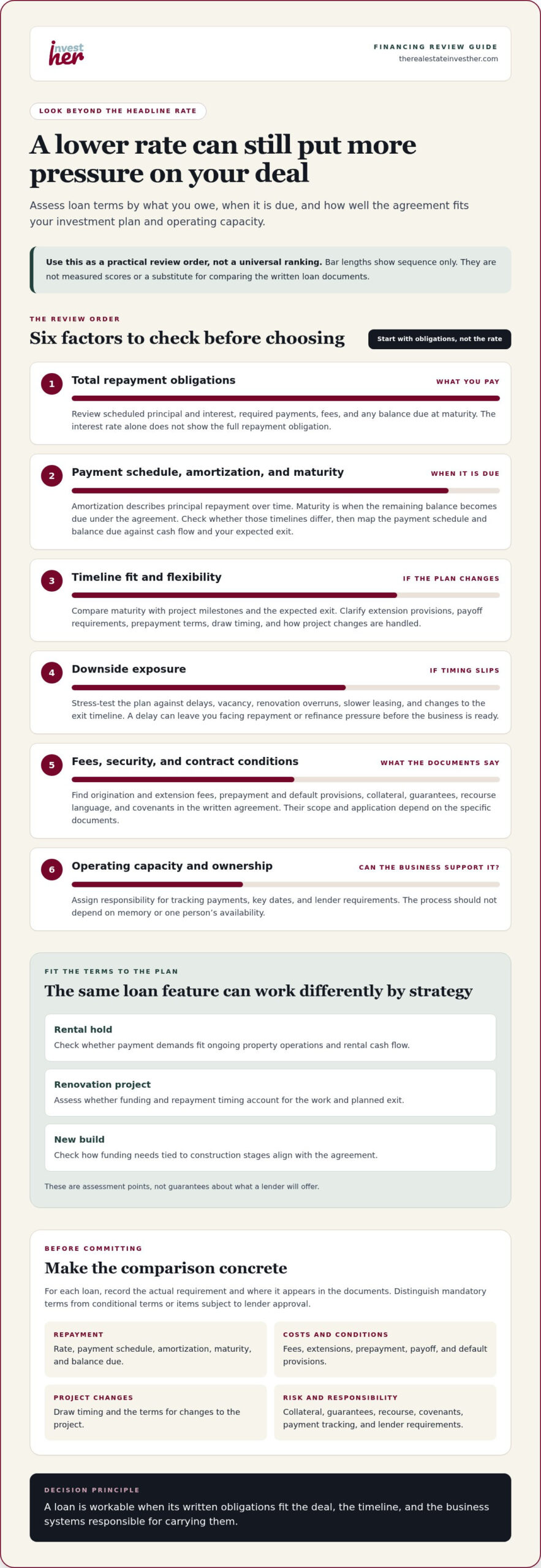
Start with the terms that determine what you pay, when you pay it, and what happens if the business plan changes. Interest rate, amortization, maturity, payment schedule, fees, collateral, guarantees, recourse, and covenants each describe a different part of the lender-borrower agreement. Review them together rather than treating the rate as a stand-alone measure of cost.
How Do Rate, Amortization, and Maturity Affect Repayment?
The interest rate is the price charged for borrowing. The payment schedule sets when payments are due and how they’re calculated. Amortization describes how principal is repaid over time, while maturity is when the loan’s remaining balance becomes due under the agreement. These can be different timelines, as described in this overview of mortgage structures.
That difference can shape your exit plan. A loan may have scheduled payments based on a longer amortization period but a shorter maturity date, leaving a balance to address when the loan comes due. Don’t assume regular payments will fully repay the debt by maturity. Check the payment schedule and balance due in the contract, then map both against rental cash flow, project milestones, and a realistic exit timeline.
Total repayment obligations include more than the interest rate. Review scheduled principal and interest, fees, required payments, and any amount due at maturity. The agreement may also describe charges connected to extensions, prepayment, late payment, or default. Whether and how these apply depends on the specific documents.
What Fees, Guarantees, and Restrictions Belong on Your Review List?
Record every charge and obligation shown in the loan documents, including origination fees, extension provisions, prepayment terms, and default provisions. Don’t assume a fee applies, or that it is absent, based on a verbal summary or product label. Find the relevant language and note whether the charge or condition is mandatory, conditional, or subject to lender approval.
Collateral is property or another asset pledged to secure repayment. A personal guarantee may make an individual responsible for specified obligations, while recourse language describes whether the lender may seek repayment beyond the pledged collateral. Covenants are conditions the borrower agrees to meet. Their scope varies by agreement, so read the actual language rather than assuming every loan has the same protections or restrictions.
A written comparison makes the details easier to manage. For each loan under consideration, record the term, its value or requirement, the document where it appears, and any unresolved question. For example, list the rate from the term sheet, then record the payment frequency and maturity from the agreement if they appear elsewhere. This gives your team a shared reference instead of leaving key dates and obligations in one person’s inbox.
- Payment: What is due, how often, and under what conditions can the amount change?
- Timing: When does the loan mature, and what balance is due then?
- Flexibility: What do the documents say about extensions and early payoff?
- Exposure: What collateral, guarantees, covenants, and default provisions apply?
A consistent review process also makes financing decisions easier to track and delegate. The Real Estate InvestHER community offers women investors a place to learn alongside peers. Keep the final assessment grounded in the loan documents and your deal’s capacity.
How Do Investor Loan Types Compare for Different Strategies?
Loan types differ in intended use, underwriting focus, repayment structure, flexibility, and trade-offs. The comparison below describes general patterns, not promises about a specific lender or program. Exact qualification criteria and terms depend on the financing program and transaction, so use the table to guide document review rather than assuming what a particular loan will offer.
| Loan type | Common use and underwriting focus | Repayment shape, flexibility, and trade-offs |
|---|---|---|
| Conventional | Often used to buy or refinance residential rental property. Underwriting commonly considers borrower finances and property details. | May use scheduled payments over a stated term. Requirements and options vary by program, and the structure may be less tailored to a project’s changing needs. |
| Portfolio | May serve investors with multiple properties or a transaction a lender evaluates within its own portfolio. Underwriting focus varies. | Terms may be structured around the lender’s program. Review maturity, payment schedule, and flexibility in the agreement. |
| DSCR | Commonly considered for rental property, with underwriting focused on property income relative to debt obligations. | Payment terms and qualification criteria are program-specific. Test the property’s income assumptions against realistic operating costs and vacancy. |
| Bridge or hard-money | Often considered for time-sensitive acquisitions or renovation projects, with attention to collateral, project scope, and exit plan. | Typically structured as shorter-term financing. A compressed timeline can make payoff, extension provisions, and delays central to the decision. |
| Construction | Designed for building projects, with underwriting that may assess project plans, budget, and execution capacity. | Funding may be tied to construction milestones or draws. Understand the process, required documentation, timing, and what happens if work falls behind. |
Which Structures May Fit Rental, Renovation, or Construction Plans?
For a rental, compare payment obligations with property income assumptions and your intended hold period. For a renovation, assess whether the project scope, timing, and planned exit align with the loan’s maturity and payoff terms. For new construction, consider whether your team can manage milestones, draw requests, and records without making every decision depend on you. These are fit considerations, not rankings.
Why Is the Lowest Headline Rate Not Always the Best Fit?
A lower rate may come with terms that don’t match your project. Compare fees, maturity, payment schedule, extension options, and prepayment terms alongside the rate. For a short project, an extension provision may matter if completion or sale takes longer than planned. For a long hold, the ongoing payment structure may deserve more attention. These are recommendations for evaluating fit, not objective rankings of loan types.
Compare each option using the same deal assumptions and record which contract provisions drive your decision. Peer learning can help you consider financing choices from different operational perspectives. The Real Estate InvestHER community connects women investors through education and peer support.
How Can You Stress-Test Loan Terms Before Committing?
Stress-test a loan by documenting your assumptions, modeling downside scenarios, checking the agreement’s obligations, assigning oversight, and recording the decision. The goal isn’t to predict exactly what will happen. It’s to see how repayment interacts with operating cash flow and reserves if the project takes longer or brings in less income than planned.
Use deal-specific inputs rather than generic forecasts. Map expected income, operating expenses, debt service, and project timing. Then test how the plan responds to vacancy, slower leasing, renovation overruns, delays, or a changed exit timeline. A useful scenario reveals which assumption creates pressure and what action or decision would follow.
What Should You Model Before Accepting the Terms?
Start with the current deal model and record the source and owner for each key assumption, such as rent estimates, project milestones, and expense inputs. Change one or more assumptions to test a downside case. Note when cash flow may fall short of debt service, whether reserves can cover the gap, and what decision would need to happen next. Keep the scenarios grounded in the property and plan.
- Document assumptions: Record expected income, expenses, debt service, timing, and where each input came from.
- Model downside: Test delays, vacancy, slower leasing, cost overruns, and a later sale or refinance.
- Inspect obligations: Compare the scenarios with payment dates, maturity, and other requirements in the loan documents.
- Assign owners: Name who monitors the inputs, payments, and upcoming deadlines.
- Record the decision: Note why the terms fit, which risks remain, and what would trigger a review.
Connect the results to liquidity and responsibility. If a delay reduces available operating cash, identify whether reserves can support scheduled payments and who has authority to recommend a change in plan. This makes the stress test an operating tool, not just a spreadsheet exercise. For a broader portfolio perspective, consider how this financing decision fits the principles in How to Scale Real Estate Investments: The Strategic Guide for Women Investors.
How Can Loan Oversight Become a Repeatable Business Process?
Assign responsibility for payment dates, covenant tracking, renewals, and document storage, then review those items on a consistent schedule. Documenting the steps makes the work repeatable, but it doesn’t automatically transfer judgment or authority to change the financing plan. Define who flags a concern, who evaluates options, and who approves a material decision.
A shared calendar and a simple loan register may be enough. Track the property, key dates, required actions, responsible person, and location of the governing document. Make the record accessible to the people responsible for execution, with clear approval boundaries for decisions that affect repayment or the exit plan. Understanding investor-friendly loan terms includes knowing whether your business can reliably manage the obligations, not just whether the initial model works.
For peer learning on building a more resilient investment business, explore the InvestHER Community.
What Should You Clarify Before Choosing Investor-Friendly Loan Terms?
Before choosing financing, get clear answers about every payment, fee, deadline, condition, and borrower responsibility. Compare those answers with the written loan documents and your deal assumptions. This final review shows not only whether the terms work today, but what your team must track if the project or exit plan changes.
What Questions Help Reveal the Full Loan Commitment?
Use the term sheet and agreement to build a concise question list. If an answer is unclear or differs across documents, note the discrepancy and resolve it before relying on that assumption in your decision.
- Payments: What payments are due, when are they due, and how is any amount that may change described?
- Maturity: When does the loan come due, and what balance or other obligation remains at that point?
- Fees: Which charges apply at closing, during the loan, at payoff, or after a missed deadline?
- Prepayment and payoff: How does the agreement address early repayment and the process for obtaining a payoff amount?
- Extensions: Are extensions addressed, and what conditions, deadlines, or approvals apply?
- Draw timing: For financing with project draws, what milestones and documentation govern when funds are released?
- Project changes: What does the agreement say if scope, schedule, or exit strategy changes?
- Default provisions: What events trigger default, and what steps or consequences does the agreement specify?
Compare each response against the controlling written language, not shorthand from a conversation or summary. Record the document and section supporting the answer. If a planned sale shifts or construction runs late, use that record to identify what the agreement allows rather than assuming a deadline can be moved.
How Do You Make the Decision Clear Across Your Business?
Keep the decision in one shared record: the selected loan, alternatives considered, assumptions behind the choice, open questions, and decision deadline. Assign someone to monitor required dates and escalate material changes in deal conditions. That person can flag a concern, while approval authority for changing the financing or exit plan remains explicit. A documented workflow supports delegation without transferring judgment by default.
If you’re still defining your investment approach, the foundational questions in How to Start Investing in Real Estate: The 2026 Strategic Guide for Women can provide broader strategy context. Peer learning can also help you examine decisions from more than one operational perspective. Explore the InvestHER Community to learn alongside women real estate investors.
Your next step is practical: gather the term sheet and loan documents, complete the question list, and record the answers, assumptions, responsible owners, and deadlines together. That gives you a clear basis for deciding whether the obligations fit the deal and whether your business can manage them consistently.
Make Your Financing Decision Easier to Run
A strong financing decision should remain understandable after the deal closes. Turn your review into an operating record: capture the assumptions behind the choice, assign ownership for key dates, and define what should trigger a fresh review. That way, understanding investor-friendly loan terms becomes part of how you manage the business, not a one-time exercise that lives only in your notes.
You don’t have to make every decision in isolation. The InvestHER Community offers women real estate investors membership and educational resources, while the STRIVE Mentorship Program provides strategic guidance and access to experienced investors. Peer perspective can help you sharpen your questions and strengthen the decision process you bring back to your business.
Explore The Real Estate InvestHER Community to learn alongside women investors and keep building a financing process that supports your portfolio and the way you want to operate. Put the loan documents, decision assumptions, and ownership plan in one place so your team can act on a clear record.
Frequently Asked Questions
What does investor-friendly mean in real estate financing?
Investor-friendly financing supports the way you plan to acquire, operate, and eventually exit a property without creating avoidable strain on the business. Consider the work required to manage the loan as well as the property numbers. For example, if reporting obligations require recurring documentation, identify who will prepare it and how the team will keep records current. A workable loan should fit both the deal and your operating capacity.
Is a DSCR loan always more investor-friendly than a conventional loan?
No. Compare how each program evaluates your specific transaction and what information your team must maintain. For a rental with multiple income sources or changing occupancy, check how the program treats the property’s income inputs. Then consider how the alternative structures its borrower review. Make sure the underwriting approach and documentation process fit your records, ownership structure, and capacity to manage the application.
Can investment property loan terms change before closing?
They can, so track the version and date of each written offer rather than relying on an earlier summary. Keep a record of remaining conditions and updated documents, then compare the final terms with the assumptions in your deal model. If a change affects cash needed at closing, projected payments, or your intended exit, pause and update the analysis before proceeding.
What is a balloon payment on an investment property loan?
A balloon payment is a remaining loan balance that becomes due as a lump sum at a specified point. If your loan has one, include its due date in the property’s long-range cash planning, not only in a calendar reminder. Decide in advance which conditions would prompt you to prepare for payoff, sale, or another financing plan. These are planning paths, not guaranteed options.
What is a prepayment penalty, and why should investors check for one?
A prepayment penalty is a charge that may apply when a borrower repays a loan early under circumstances defined in the agreement. Review its timing and triggers against likely business decisions, such as selling after a renovation or refinancing to reorganize portfolio debt. Look for any stated exceptions or calculation method. If the language is unclear, document the question before including a payoff assumption in your model.
What does loan recourse mean for a real estate investor?
Loan recourse concerns the lender’s ability to seek repayment beyond the collateral, as defined by the loan documents. Identify exactly which borrower or guarantor is named, what obligations the language covers, and whether exceptions are described. Don’t infer the exposure from the property-owning entity’s name or a brief deal summary. Keep the relevant clauses with the transaction record so decision-makers can review the same language.
How can I compare two investment property loan offers fairly?
Use one comparison sheet and apply the same property assumptions, operating plan, and expected holding period to both offers. Include cash required at closing, scheduled payments, remaining balance at key dates, and costs tied to the intended exit. Cite the document supporting each entry, and mark unresolved terms separately rather than filling gaps with assumptions. This makes differences visible and gives your team a clear basis for follow-up.
Does a lower monthly payment mean a loan is more investor-friendly?
Not by itself. A lower scheduled payment can leave less principal repaid by a future date or shift more of the obligation to payoff. Compare the payment with the balance expected at sale, refinance, or maturity, then check whether your operating plan can support both. Also consider whether the payment pattern works during a period of reduced income, rather than assessing affordability only under the expected case.

Article by
Andresa Guidelli
Real estate investor, operator, and founder of The Real Estate InvestHER, a national platform supporting women real estate investors. With 15+ years of experience in real estate investing and business operations, she focuses on helping investors build stronger businesses behind their portfolios through better systems, clearer decision-making, leadership, and responsible use of AI.
Be the first to comment