


Overcoming the Fear of Losing Money in Real Estate: A Practical Decision Framework
Fear of losing money can be useful when it leads to better questions instead of endless hesitation. Overcoming fear of losing money in real estate starts with separating evidence-based caution from open-ended worry. You can’t eliminate risk, but you can decide what exposure you’re prepared to carry, test the assumptions behind a deal, and set conditions for when to proceed, pause, or walk away.
That discipline matters because financing costs can reshape a deal’s margins. Freddie Mac reported an average 30-year fixed mortgage rate of 7.28% on October 1, 2026. An incorrect assumption about debt, insurance, repairs, or vacancy can affect more than one property, especially when decisions and operations depend on you alone.
This article gives you a practical framework for evaluating downside before you commit. You’ll learn how to stress-test a deal, set repeatable decision criteria, and turn key choices into processes your team can use without routing every judgment call back to you. The goal isn’t to invest without fear. It’s to make risk visible and manageable enough to support thoughtful growth.
Key Takeaways
- Separate a defined financial exposure from uncertainty or worst-case thinking so you can respond to the actual concern.
- Use consistent criteria to check assumptions, stress-test a deal, set downside limits, and document your decision.
- Make overcoming fear of losing money in real estate a practical process by naming the concern, identifying missing evidence, and setting a decision rule.
- Clarify who owns operating decisions and establish regular reviews to surface issues earlier without routing every choice through you.
- Choose deliberately whether to proceed, pause, gather more information, or decline based on your investment criteria.
Why Fear of Losing Money in Real Estate Deserves a Clear Answer
You’re reviewing a property, the numbers appear workable, and one question keeps returning: what if repairs cost more than expected, or the property can’t support its debt? Start by defining your investment criteria and investigating the assumptions behind the deal. No framework can remove risk, but it can help you decide what level of exposure fits your goals and what would make you walk away.
Fear can be useful information. It may point to a missing estimate, an unclear responsibility, or a decision that relies on your judgment without a clear process. To start overcoming fear of losing money in real estate, name the concern and identify the evidence or next step that could address it.
For an overview of how financing, investment approaches, and market conditions shape real estate investing, see Real Estate Investing Overview.
For another perspective on the emotional side of investing, watch “Overcoming Fear of Real Estate Investing” by Ken McElroy:
What does fear of losing money signal to an investor?
Fear is an emotional response that may signal uncertainty, exposure, or insufficient information. It doesn’t prove that a deal is bad or safe. Make the concern specific: “I’m worried cash flow won’t cover expenses if vacancy lasts longer than planned.” Then examine the likelihood and impact using your assumptions, records, and due diligence. If you can’t identify what evidence would change your view, define the concern more clearly before using it to guide a decision.
When does caution become analysis paralysis?
Caution becomes analysis paralysis when more research no longer clarifies a material assumption or changes your decision. A real information gap has a defined next step, such as verifying a repair estimate or reviewing lease-up assumptions. Waiting for certainty is different: real estate decisions always involve outcomes you can’t know in advance. Set a deadline for resolving open questions, then decide what you’ll do if the information remains unavailable.
Self-doubt can make this distinction harder, especially when you begin questioning your ability instead of evaluating the deal. If that’s part of the hesitation, explore imposter syndrome in real estate investing. A peer discussion or mentorship can help pressure-test your assumptions, but it can’t guarantee an outcome. The decision still needs to fit your criteria and your capacity to manage the downside.
How to Separate Investment Risk from Uncertainty and Worst-Case Thinking
Risk is a defined exposure; uncertainty means important outcomes or assumptions remain unclear. Naming the difference helps you investigate what can be assessed without treating every unknown as evidence that a deal will fail. A stress-tested assumption is a planning input examined under a plausible adverse scenario, not a known outcome or a guarantee.
For example, you might worry that a property won’t lease on the expected schedule. The risk is how delayed occupancy could affect cash flow and reserves. The uncertainty may be how long leasing will take or whether your assumptions reflect current conditions. “This could ruin the portfolio” is a broader fear that doesn’t yet point to a specific test or decision.
How can an investor make a fear specific enough to evaluate?
Ask three questions: What could happen? Which assumption would have to fail? How might the result affect the property and the wider business? A property-level exposure might reduce available cash; a business-level exposure might add management work when your team is already stretched. For each open question, identify whether you need data, professional input, or a person with authority to decide.
That last distinction matters. A concern may remain unresolved because nobody owns the next step, not because the information is impossible to find. Assign an owner, but don’t assume that gathering evidence transfers judgment or decision authority. Clarify who gathers information, who recommends an action, and who makes the final call.
How do downside scenarios improve a real estate decision?
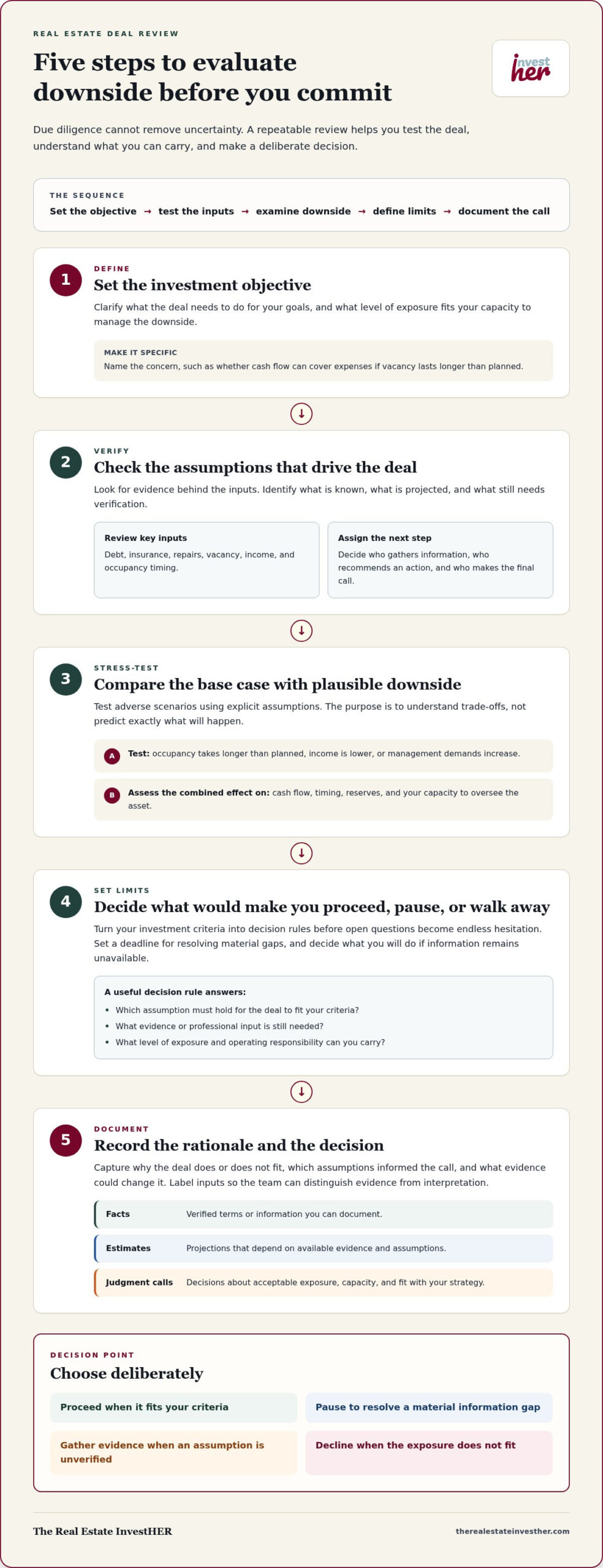
Compare a base case with plausible downside scenarios using explicit assumptions. For a rental property, test what could happen if occupancy takes longer than planned, income is lower, or management demands increase. Consider the combined effect on cash flow, timing, reserves, and your capacity to oversee the asset. The point is to understand trade-offs, not predict exactly what will happen.
Label inputs so you can see how much confidence to place in them:
- Facts: verified terms or information you can document.
- Estimates: projections that depend on available evidence and assumptions.
- Judgment calls: decisions about acceptable exposure, capacity, and fit with your strategy.
Update the analysis when new evidence changes an important input. If you’re working through decisions with peers, the InvestHER community for women real estate investors offers a space to pressure-test assumptions. Outside perspectives can sharpen your thinking, but they can’t remove uncertainty or make the decision for you.
How to Evaluate a Real Estate Deal Before Committing
Evaluate a deal in five steps: define your objectives, verify key assumptions, stress-test the downside, set decision limits, and record your rationale. Due diligence doesn’t remove uncertainty. It tests whether the investment thesis still holds when you examine the evidence and consider what could change.
Start with the role the property should play in your portfolio, your time horizon, and the operating capacity you can commit. As you refine your approach, make sure the investment fits both your portfolio objectives and the business you have available to support it.
Which assumptions should you examine before investing?
Focus on assumptions that materially affect projected income, expenses, timing, or ongoing operations. For each one, note the supporting evidence and what remains an estimate. Review expected rent and occupancy, financing terms, insurance, repairs, taxes, management needs, and the time required to stabilize the property. The relevant details depend on the deal and your investment strategy.
Sensitivity analysis shows how changing an input affects your projection. Adjust the expected lease-up timing or a repair estimate, for example, and observe what happens to cash flow and reserve needs. This doesn’t predict the future. It shows which assumptions have the greatest influence on the decision and deserve closer scrutiny.
How do you set decision rules without pretending risk is zero?
Before committing, write down your acceptable exposure, non-negotiable conditions, and reasons to pause or decline. You might pause if a key cost remains unverified, or decline if a downside scenario exceeds the exposure you’re prepared to carry. Set limits that reflect your finances, portfolio, and operating capacity rather than relying on universal thresholds.
Illustrative example: An investor assessing a rental property finds that the projected return depends on a quick lease-up and limited repairs. She verifies what she can, models a slower lease-up and higher repair needs, then decides what evidence she still needs and what conditions would make the deal unsuitable. This is a decision process, not a promised result.
Document the decision so you can review the reasoning later. Record who owns the final call, which evidence informed it, what assumptions remain uncertain, and when those assumptions should be revisited. A documented process helps others gather information and make recommendations, but it doesn’t automatically transfer decision authority. Clear ownership is part of overcoming fear of losing money in real estate because it makes the reasoning visible, accountable, and repeatable across the portfolio.
How Systems and Decision Ownership Reduce Fear After a Deal Closes
Dependable operating rhythms help you spot problems earlier, but they can’t prevent every loss. After a deal closes, clear responsibilities and regular reviews make it easier to notice when performance is drifting from expectations and decide who should respond. Without them, issues can sit unresolved because everyone assumes someone else is handling them, or because every decision waits for the owner.
Knowing how your business will monitor and manage an investment after acquisition can make the risk feel more concrete. Create a consistent way to review the property, surface exceptions, and route decisions to the person with the right context and authority.
Which operating systems help an investor spot issues sooner?
Keep the review rhythm simple and useful. Regularly compare cash flow with expectations, review changes in key assumptions, and track open decisions and operating responsibilities. If repair work is delayed or expenses are trending above plan, the review should show who is gathering facts, who can approve the next step, and when the issue requires your judgment.
Document recurring workflows so the team can see what happens, who owns each step, and what counts as an exception. A written process for reviewing invoices or tracking maintenance requests can reduce reliance on memory. The goal isn’t to add software or paperwork for its own sake. It’s to make important work visible and repeatable.
How should investors use delegation and AI responsibly?
Delegate repeatable work with clear instructions, such as collecting operating updates or organizing documents for review. But documenting a process isn’t the same as transferring judgment. Define which decisions a team member can make independently, which require escalation, and who remains accountable for the final call.
AI can support this operating rhythm by organizing information, summarizing updates, or flagging items that may need review. Treat its output as support, not authority. Set guardrails for what information it can use, require a human to check material conclusions, and keep decision rights with the person accountable for the investment. Neither automation nor delegation guarantees accuracy or prevents losses.
Peer learning can help you compare how other investors structure reviews and clarify decision ownership. Explore the InvestHER Community to connect with women investors and learn alongside peers. Use those conversations to pressure-test your operating approach, then adapt it to your portfolio and team.
What to Do When Fear Affects Investment Decisions
Name the concern, identify the evidence you’re missing, set a decision rule, and choose a review date. This sequence turns fear into a decision process. Overcoming fear of losing money in real estate doesn’t mean forcing yourself to say yes. It means making a deliberate choice that fits your criteria, portfolio capacity, and ability to operate the investment.
After reviewing the facts and your limits, choose the action that fits:
- Proceed if the deal meets your criteria and the remaining uncertainty is within the exposure you’ve decided you can carry.
- Pause if a material assumption or condition needs to change before you can make a sound commitment.
- Gather information if a specific, answerable question could affect the decision.
- Decline if the deal falls outside your non-negotiables or would stretch your financial or operating capacity.
An attractive acquisition still has to fit the business behind your portfolio. Consider whether your team can absorb the added workload, whether existing properties are receiving adequate attention, and whether the decision would create new bottlenecks that depend on you.
What should you do if you cannot resolve the concern today?
Don’t force a yes-or-no decision while a material question remains open. Write down the unanswered question, assign someone to follow through, identify the evidence needed, and set a date or condition for reviewing the decision again. For example, revisit the choice once a key operating assumption is verified. If the evidence or circumstances change, reassess. If they don’t, use your established criteria instead of extending the pause indefinitely.
How can experienced investors build confidence through better decisions?
Review past decisions for the quality of the process, not just whether the outcome was favorable. Ask whether assumptions were documented, material questions were investigated, and decision rights were clear. A good process can still lead to an unfavorable result; a favorable outcome doesn’t prove the analysis was sound. Both outcomes can help you improve how you evaluate future opportunities.
As growth increases operating demands, revisit whether your roles, workflows, and decision-making capacity can support the next stage. This guide to strategic real estate investment scaling explores the connection between expansion and the business that supports it.
For education, mentorship, and peer perspective, explore the InvestHER Community and STRIVE Mentorship Program. For now, document the investment decision in front of you and name who owns the next step. That gives the concern a clear path forward, whether you proceed, pause, gather evidence, or decline.
Make Your Next Investment Decision With Clearer Criteria
Overcoming fear of losing money in real estate doesn’t mean ignoring risk or waiting until every uncertainty disappears. It means naming the downside, testing the assumptions that matter, and setting clear conditions for proceeding, pausing, or declining.
Before your next commitment, write down what the deal needs to deliver, what could challenge that plan, and who owns the next step. Then assess whether your portfolio and operating business can support the investment. A sound process won’t guarantee a particular outcome, but it can make your decisions more deliberate and easier to learn from.
You don’t have to pressure-test every decision alone. The InvestHER Community offers peer support and educational resources for women real estate investors, while STRIVE combines expert coaching with access to experienced investors. Explore the InvestHER Community and connect with women investors.
Take the next step with one decision, one clear criterion, and one owner for follow-through. That gives you a practical way to move forward.
Frequently Asked Questions
How can I stop being afraid of losing money in real estate?
Turn the fear into a specific question you can investigate. Identify the potential loss, the assumption behind it, and how it could affect your finances or portfolio. Review the available evidence, set a limit for acceptable exposure, and decide what would make you proceed, pause, or walk away. Overcoming fear of losing money in real estate doesn’t mean eliminating uncertainty. It means making decisions with clear criteria.
Is it normal to fear losing money when investing in real estate?
Yes. Real estate investing involves financial commitments and outcomes that can’t be known with certainty, so concern about loss is understandable. Ask whether the concern points to a specific exposure, such as uncertain repair needs or cash flow assumptions, or remains a general worry without a next step. Treat fear as a prompt to review the evidence and your capacity, not as proof that a deal is right or wrong.
How do I know if a real estate deal is too risky?
A deal may be too risky for you if its plausible downside exceeds the exposure you’re prepared to carry, depends on assumptions you can’t verify, or requires more operating capacity than your business can support. Compare the deal with your objectives and limits, then test how changed assumptions could affect cash flow, timing, and workload. There’s no universal risk threshold. Your decision should reflect your financial position, portfolio, strategy, and ability to manage the investment.
Can due diligence prevent losing money in real estate?
No. Due diligence can’t guarantee that an investment will avoid losses or that every assumption will prove accurate. It helps test your investment thesis by checking important information, identifying unanswered questions, and examining how plausible changes could affect the deal. Use the findings to refine projections and decide whether the remaining uncertainty fits your criteria. Due diligence supports informed decision-making, not a particular outcome.
What should I do when fear is causing analysis paralysis?
Write down the decision you’re avoiding and the specific information that could change your view. Assign a next step to each material question, such as verifying an expense assumption or clarifying who owns an operating decision. Set a review date and decide in advance what you’ll do if the information remains unavailable. If additional research no longer changes the analysis, choose to proceed, pause, or decline based on your established criteria.
How can I reduce the risk of a real estate investment without avoiding every opportunity?
Reduce avoidable exposure by setting deal criteria, checking assumptions, stress-testing plausible downside, and defining limits before committing. Also assess whether your existing portfolio and operating team can absorb the investment’s workload. These steps won’t remove risk, but they can help you distinguish manageable exposure from a mismatch with your finances or capacity. The aim is not to say yes to every opportunity or avoid them all, but to make a considered choice.
Can a real estate investing mentor help with fear of losing money?
A mentor can help you examine assumptions, ask sharper questions, and learn from experienced investors’ perspectives, but mentorship can’t guarantee a deal’s outcome or make the decision for you. The Real Estate InvestHER’s STRIVE Mentorship Program combines expert coaching with access to experienced investors. Its community membership also offers peer support and educational resources. Use these perspectives to pressure-test your thinking, then make a decision that fits your criteria and portfolio.

Article by
Andresa Guidelli
Real estate investor, operator, and founder of The Real Estate InvestHER, a national platform supporting women real estate investors. With 15+ years of experience in real estate investing and business operations, she focuses on helping investors build stronger businesses behind their portfolios through better systems, clearer decision-making, leadership, and responsible use of AI.
Be the first to comment